

Quick Answer
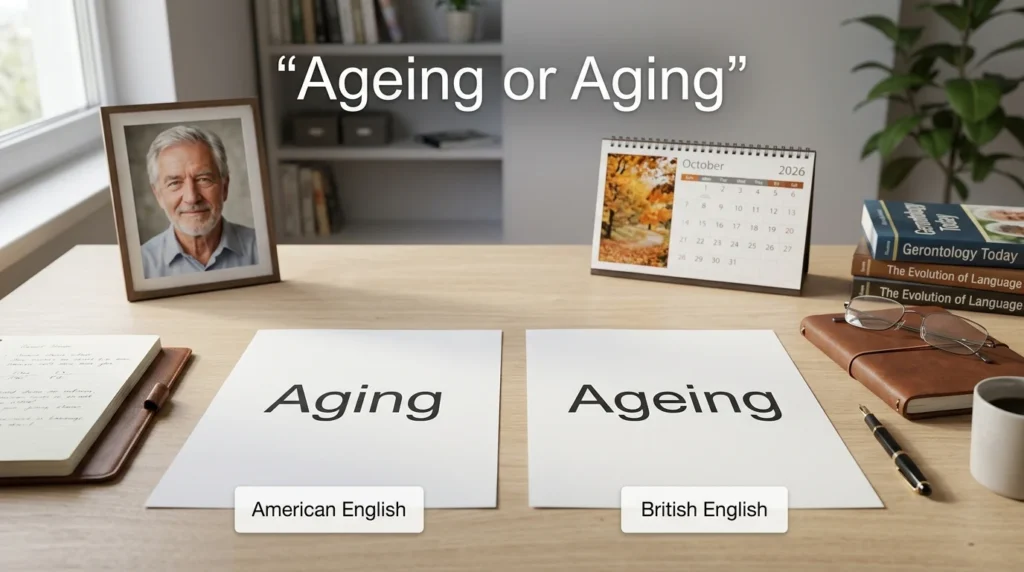
Aging and ageing are both correct spellings of the same word. Aging is the standard spelling in American English, while ageing is the usual British English spelling.
Have you ever typed aging and then wondered if it should be ageing instead? Both forms appear in books, articles, medical writing, business documents, and everyday English, so the confusion is understandable.
The good news is that neither spelling is simply wrong. Aging and ageing have the same basic meaning. They describe the process of becoming older or the changes that happen as something gets older. The main difference is the spelling style being used.
For example, you can write aging population or ageing population. You can also write aging process or ageing process. The meaning stays the same. The spelling changes according to the variety of English.
What Does Aging Mean?
Aging means becoming older or going through the process of getting older.
It can describe people, animals, materials, buildings, machines, systems, and many other things.
For example:
- Aging is a natural part of life.
- The aging process happens gradually.
- The country has an aging population.
- The company needs to replace its aging equipment.
- Researchers study healthy aging.
The spelling aging is especially common in American English. Oxford identifies aging as especially common in North American English and notes that British English usually uses ageing.
What Does Ageing Mean?
Ageing has the same basic meaning as aging.
It refers to becoming older or showing the effects of growing older.
Examples include:
- Ageing is a natural process.
- The ageing population is growing.
- The company has ageing equipment.
- She is interested in healthy ageing.
- The ageing process affects everyone differently.
The spelling with e is the usual British form.
So, if you see ageing in a British article and aging in an American article, they are normally referring to the same concept.
Ageing or Aging: What Is the Difference?
The main difference is spelling, not meaning.
| Spelling | Common Usage | Example |
|---|---|---|
| Aging | American English | The aging process is natural. |
| Ageing | British English | The ageing process is natural. |
Both forms describe the process of becoming older.
Cambridge specifically identifies aging as the US spelling of ageing.
Therefore, you do not need to learn two different definitions. You only need to remember which spelling fits the English variety you are using.
Is Aging or Ageing Correct?
Both are correct.
This is the easiest answer to remember.
If you are following American spelling, use:
aging
If you are following British spelling, use:
ageing
Neither form has a different meaning simply because it has one more letter.
For example:
Aging is a natural process.
and
Ageing is a natural process.
Both sentences communicate the same idea.
When Should You Use Aging?
Use aging when following American English spelling.
You will commonly see it in phrases such as:
- aging population
- aging process
- healthy aging
- aging adults
- aging parents
- aging technology
- aging equipment
- aging infrastructure
Examples:
The city is preparing for an aging population.
Scientists are studying healthy aging.
The company is replacing its aging computers.
The one important thing is consistency. If your writing uses American spelling, aging will usually fit naturally throughout the article.
When Should You Use Ageing?
Use ageing when following British English spelling.
Common phrases include:
- ageing population
- ageing process
- healthy ageing
- ageing adults
- ageing parents
- ageing technology
- ageing equipment
- ageing infrastructure
Examples:
The country is preparing for an ageing population.
Researchers are studying healthy ageing.
The company is replacing its ageing computers.
The meaning is the same as the American spelling aging.
Aging or Ageing Population
One of the most common phrases is aging population or ageing population.
The phrase refers to a population in which older people make up a growing share of the total population.
In American English:
The country has an aging population.
In British English:
The country has an ageing population.
The spelling changes, but the idea does not.
This phrase often appears in discussions about healthcare, retirement, employment, housing, social services, and population trends.
Aging or Ageing Process
Another common phrase is aging process.
It refers to the gradual changes that occur as something becomes older.
American spelling:
The aging process affects every person differently.
British spelling:
The ageing process affects every person differently.
The phrase can refer to people, animals, materials, products, or other systems depending on the context.
Healthy Aging or Healthy Ageing
Both phrases are correct.
American English:
healthy aging
British English:
healthy ageing
The phrase is often used when discussing habits and conditions that support well-being as people grow older.
For example:
Regular exercise can be part of a healthy aging lifestyle.
Or:
Regular exercise can be part of a healthy ageing lifestyle.
Again, the spelling is the only difference between the two forms.
Anti-Aging or Anti-Ageing
You may also see this word in products, advertising, beauty writing, and health discussions.
American spelling:
anti-aging
British spelling:
anti-ageing
Examples:
The product is marketed as an anti-aging cream.
The product is marketed as an anti-ageing cream.
The word aging or ageing does not change meaning when it appears after anti.
The spelling simply follows the variety of English being used.
Aging and Ageing in Medical Writing
Both forms can appear in medical and scientific writing.
For example:
Researchers are studying the effects of aging on the human body.
A British publication may write:
Researchers are studying the effects of ageing on the human body.
In either case, the writer is referring to the process of growing older.
Medical terminology can sometimes have its own style requirements, so writers should follow the spelling rules of the journal, organization, or publication they are writing for.
Aging and Ageing for People
The word can describe people who are becoming older.
Examples:
- aging adults
- aging parents
- aging population
- aging workers
- aging society
British spelling changes the aging part:
- ageing adults
- ageing parents
- ageing population
- ageing workers
- ageing society
For example:
Many families are learning how to care for aging parents.
British spelling:
Many families are learning how to care for ageing parents.
The meaning remains unchanged.
Aging and Ageing for Objects
The word is not limited to people.
Objects can also age.
For example:
The house has an aging roof.
The factory uses aging machinery.
The bridge needs repairs because of its aging structure.
British spelling would use:
The house has an ageing roof.
The factory uses ageing machinery.
The bridge needs repairs because of its ageing structure.
Here, the word can describe something that has become old, worn, outdated, or affected by the passage of time.
Aging and Ageing for Technology
Technology can also be described as aging or ageing.
For example:
The company still relies on aging computers.
The software runs on an aging system.
The business needs to replace its aging equipment.
British spelling:
The company still relies on ageing computers.
The software runs on an ageing system.
The business needs to replace its ageing equipment.
In this context, the word can suggest that something is becoming old or less suitable for current needs.
Aging and Ageing for Materials
Materials can change as they become older.
For example:
The wood changes color as it ages.
The material shows signs of aging.
Proper storage can affect how a product ages.
The British spelling may appear as:
The material shows signs of ageing.
This use shows that aging and ageing are not limited to human life.
Aging as a Noun
Aging can also work as a noun.
For example:
Aging is a natural part of life.
Here, aging names the process of growing older.
Another example:
Researchers are studying aging and its effects on the body.
British English may use:
Ageing is a natural part of life.
Researchers are studying ageing and its effects on the body.
Oxford lists aging as a noun meaning the process of growing old.
Aging as an Adjective
Aging can also describe something that is becoming older.
For example:
The company needs to replace its aging equipment.
Here, aging describes the equipment.
More examples:
- aging building
- aging population
- aging workforce
- aging technology
- aging infrastructure
The British forms are:
- ageing building
- ageing population
- ageing workforce
- ageing technology
- ageing infrastructure
Ageing as an Adjective
The same grammatical use applies to ageing.
For example:
The company needs to replace its ageing equipment.
Here, ageing describes the equipment.
More examples include:
- ageing building
- ageing population
- ageing workforce
- ageing technology
- ageing infrastructure
The difference is spelling rather than grammatical function.
Why Does Aging Drop the E?
The difference comes from regional spelling conventions.
The base word is:
age
When the ing ending is added, British English commonly retains the e:
ageing
American English commonly uses:
aging
This is a spelling pattern that developed through different conventions in different varieties of English.
However, you should not assume that every English word ending in e will follow exactly the same pattern. English has many spelling exceptions and historical forms.
For this particular word, the useful rule is simple:
American English → aging
British English → ageing
Aging or Ageing in Canada
Canadian English has an interesting position.
Canadian government language guidance says aging is the preferred spelling in Canada and the United States, while ageing is the British form and is also accepted in Canada.
So if you are writing specifically for Canadian readers, aging is generally a suitable choice.
Still, an organization or publication may have its own style guide. When one exists, follow that guide.
Common Mistakes With Aging and Ageing
Thinking one spelling is always wrong
This is the most common mistake.
Both aging and ageing are legitimate spellings.
Using ageing in an American-style article
The spelling is understandable, but aging is normally the better choice when following American conventions.
Using aging in a British-style article
Again, readers will understand it, but ageing is the usual British spelling.
Switching between both forms
For example:
The aging population is growing, and healthy ageing is becoming more important.
The sentence is understandable, but the spelling is inconsistent.
A cleaner American-style version would use aging in both places.
A British-style version would use ageing in both places.
Thinking the pronunciation changes
The two forms are normally pronounced the same way.
The extra e does not create a different spoken word.
Aging or Ageing in Formal Writing
Both forms can be used in formal writing.
The choice depends on the English variety and the style guide.
For example, an American report might say:
The study examines the effects of aging on employment patterns.
A British report might say:
The study examines the effects of ageing on employment patterns.
Neither sentence is less formal.
The important thing is to keep the spelling consistent throughout the document.
Aging or Ageing in Everyday Writing
The same rule applies to emails, messages, articles, school assignments, and everyday writing.
If your normal spelling style is American, use aging.
If your normal spelling style is British, use ageing.
For example:
My parents are getting older, and I have been learning more about aging.
A British writer might use:
My parents are getting older, and I have been learning more about ageing.
Both sentences sound natural.
Aging vs Ageing Examples
Here are some simple examples:
American spelling
- Aging is a natural process.
- The aging population is growing.
- She studies healthy aging.
- The company has aging equipment.
- The building shows signs of aging.
- Scientists study the aging process.
- The business is replacing its aging computers.
British spelling
- Ageing is a natural process.
- The ageing population is growing.
- She studies healthy ageing.
- The company has ageing equipment.
- The building shows signs of ageing.
- Scientists study the ageing process.
- The business is replacing its ageing computers.
The meaning stays the same in every pair.
Practice Questions
Choose the form that fits the spelling style.
Question 1
The country has an ______ population.
American English: aging
British English: ageing
Question 2
Researchers are studying the ______ process.
American English: aging
British English: ageing
Question 3
The company has old and ______ equipment.
American English: aging
British English: ageing
Question 4
She is interested in healthy ______.
American English: aging
British English: ageing
Question 5
The building is showing signs of ______.
American English: aging
British English: ageing
The important lesson is that there is no single spelling that must be used in every variety of English.
Aging or Ageing: Quick Comparison
| Feature | Aging | Ageing |
|---|---|---|
| Basic meaning | Becoming older | Becoming older |
| Spelling | One extra e is removed | Keeps the e |
| Common variety | American English | British English |
| Noun use | Yes | Yes |
| Adjective use | Yes | Yes |
| Pronunciation | Normally the same | Normally the same |
| Example | aging population | ageing population |
The simplest rule is:
Aging = American English
Ageing = British English
How to Remember Aging or Ageing
Use this short memory trick:
US → aging
UK → ageing
You can also think about the letter e.
American spelling usually writes:
aging
British spelling usually writes:
ageing
Once you remember this pair, you can recognize related expressions more easily:
American
- aging process
- aging population
- healthy aging
- anti-aging
British
- ageing process
- ageing population
- healthy ageing
- anti-ageing
Final Tips
Keep these points in mind:
- Aging and ageing are both correct.
- They normally have the same meaning.
- Aging is the standard American spelling.
- Ageing is the usual British spelling.
- Canadian English generally prefers aging, although ageing is accepted.
- Both forms can function as nouns and adjectives.
- Both can describe people, animals, objects, systems, and materials.
- The pronunciation is normally the same.
- Do not mix the two spellings without a reason.
- Follow the style guide of the publication or organization when one is provided.
FAQs
Is aging or ageing correct?
Both are correct. Aging is the standard spelling in American English, while ageing is the usual British spelling.
Is aging American or British English?
Aging is the standard American English spelling. It is also generally preferred in Canadian English.
Is ageing British or American English?
Ageing is the usual British English spelling. It is also accepted in Canadian English.
Do aging and ageing have the same meaning?
Yes. Both normally refer to the process of becoming older or to something that is becoming older. The main difference is regional spelling.
Should I write aging population or ageing population?
Use aging population when following American spelling and ageing population when following British spelling. Both phrases have the same meaning.
Conclusion
Aging and ageing are two correct spellings of the same word. The difference is mainly based on regional English rather than meaning.
For American English, aging is the standard choice. For British English, ageing is the usual choice. Canadian English generally prefers aging, although ageing is also accepted.
The easiest way to remember the difference is simple: US uses aging, while UK uses ageing. Once you choose a spelling style, keep it consistent throughout your writing. That will make your articles, assignments, emails, and other content look clear and polished.