

Quick Answer
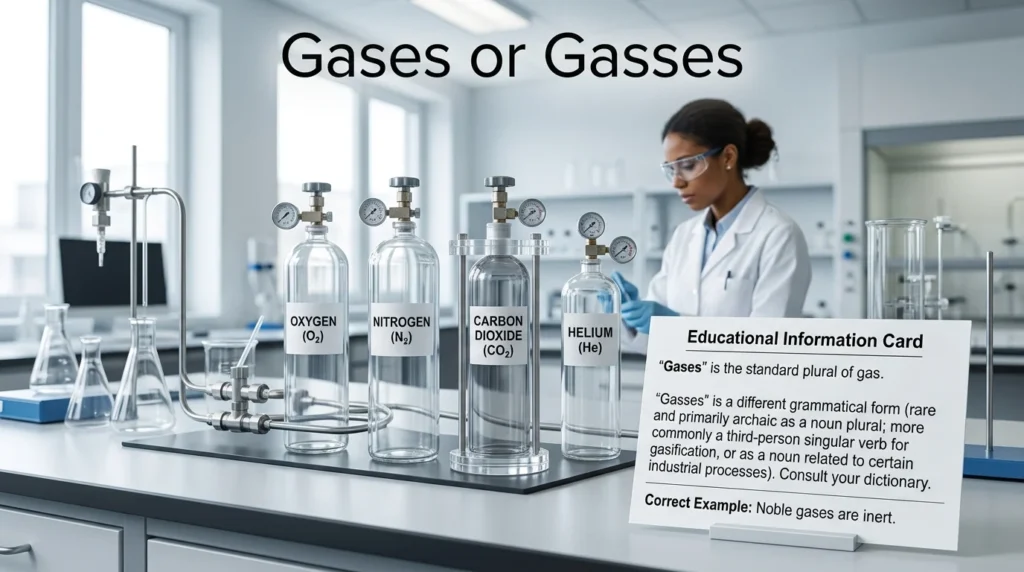
Gases is the standard and much more common plural of gas. Gasses is also a real English word and can appear as a less common plural, but it is especially used as a verb in certain contexts.
Gases or gasses can be confusing because the two words look almost identical and sound the same in normal speech. The extra s makes the difference look small, but the correct choice depends on what you mean.
When you are talking about more than one gas, gases is the normal spelling. For example, oxygen, nitrogen, and carbon dioxide are different gases. The word appears often in science, education, medicine, industry, and everyday writing.
Gasses is not simply a useless spelling. It has legitimate uses, including some dictionary-recognized plural use and verb forms connected with gas or gass. That makes context important.
What Does Gases Mean?
Gases is the plural form of the noun gas.
A gas is a substance that does not have a fixed shape or fixed volume. When you are talking about more than one gas, the usual spelling is gases.
For example:
- Oxygen and nitrogen are gases.
- The experiment produced several gases.
- Some gases are difficult to detect.
- The atmosphere contains different gases.
- Scientists study gases under different conditions.
Here, gases refers to multiple substances.
The basic pattern is:
one gas → several gases
This is the form most readers will expect in normal writing.
What Does Gasses Mean?
Gasses has more than one possible use, which is why it can cause confusion.
First, some dictionaries recognize gasses as a plural form of gas. However, this form is much less common than gases.
Second, gasses can function as a verb in sentences where something performs an action involving gas.
For example:
The equipment gasses the chamber before testing.
Here, gasses does not mean several gases. It describes an action.
Because of this, you should not automatically assume that every appearance of gasses is a spelling mistake.
Gases or Gasses: What Is the Difference?
The easiest way to understand the difference is to look at the role the word plays in the sentence.
| Word | Common use | Example |
|---|---|---|
| gases | Standard plural noun | Several gases were detected. |
| gasses | Less common plural or verb form | The system gasses the chamber. |
For normal plural writing, gases is the safer and more familiar choice.
For example:
The laboratory tested several gases.
Here, the word names several substances.
Compare that with:
The machine gasses the container.
Here, the word describes an action performed by the machine.
The sentence tells you which meaning is intended.
What Is the Plural of Gas?
The standard plural is:
gas → gases
Examples:
- one gas
- two gases
- several gases
- different gases
- harmful gases
- industrial gases
For most everyday and professional writing, this is the form you should choose.
For example:
The factory releases several gases.
This sentence clearly refers to multiple types or amounts of gas.
You would normally use gases in scientific reports, school assignments, articles, instructions, and general writing.
Why Is It Gases Instead of Gasses?
English spelling can make this word look unusual.
Many words ending in s form their plural with es, and gas follows the standard spelling:
gas → gases
The extra e separates the plural ending from the original word.
Compare:
- gas → gases
- bus → buses
- class → classes
- glass → glasses
- lens → lenses
This does not mean every word ending in s follows exactly the same pattern. English has many spelling details that developed over time.
For gas, however, the normal plural form is simply gases.
When Should You Use Gases?
Use gases when you mean more than one gas.
This is the form you will usually want in sentences about science, nature, chemistry, pollution, medicine, industry, or the atmosphere.
Examples:
- The container holds several gases.
- Scientists identified three gases.
- Different gases behave differently.
- The reaction released harmful gases.
- The atmosphere contains many gases.
- The laboratory measures gases carefully.
If you can replace the word with more than one gas, gases is usually the right choice.
When Can Gasses Be Used?
Gasses can be correct, but its use depends on the sentence.
As a plural noun, it is recognized as an alternative form of gas, although gases is far more common.
For example, you may occasionally encounter:
The equipment was designed to handle different gasses.
However, in most modern writing, especially when clarity matters, gases is the more natural choice:
The equipment was designed to handle different gases.
Gasses can also function as a verb.
For example:
The machine gasses the chamber before the experiment.
In this sentence, gasses describes an action.
That is an important distinction.
Gasses as a Verb
The word gasses can be the third-person singular form of a verb.
For example:
- The machine gasses the chamber.
- The system gasses the container.
- The equipment gasses the material.
- The process gasses the sample.
Here, gasses answers the question:
What does the machine do?
It describes an action rather than naming multiple substances.
This is why context matters so much.
If the sentence says:
Several gases were released.
the word is a plural noun.
If it says:
The equipment gasses the chamber.
the word functions as a verb.
Gases in Science
Gases is extremely common in scientific writing.
You may see it when discussing:
- oxygen
- nitrogen
- hydrogen
- carbon dioxide
- helium
- methane
- water vapor
- industrial gases
- greenhouse gases
- noble gases
Examples:
Oxygen and nitrogen are gases.
The experiment produced several gases.
Scientists measured the gases inside the container.
In science writing, gases is normally the clearest choice when referring to multiple gaseous substances.
Gases in Everyday Writing
You do not need to be a scientist to use gases.
The word also appears in ordinary situations.
For example:
The car produces exhaust gases.
Some household products can release harmful gases.
The room smelled strange because of the gases.
Different gases can have different smells.
These examples show that gases is useful in both technical and everyday language.
Gases in Environmental Writing
Environmental topics often use the word gases.
For example:
Some gases in the atmosphere affect the climate.
Industrial activity can release gases into the air.
Scientists monitor gases in the atmosphere.
Certain gases contribute to air pollution.
You will also frequently see the phrase greenhouse gases.
For example:
Carbon dioxide and methane are greenhouse gases.
Here, gases is the normal plural noun.
Gases or Gasses in American English
In American English, gases is the normal spelling when you mean multiple gases.
For example:
The atmosphere contains several gases.
You would generally choose gases in schoolwork, business writing, technical documents, websites, and everyday communication.
The distinction is not mainly a regional issue like some other English spelling differences. The main issue is whether you are using the word as a plural noun or in another grammatical role.
Gases or Gasses in British English
British English also commonly uses gases as the plural of gas.
For example:
Scientists detected several gases in the sample.
So this is not a simple case of one spelling being American and the other being British.
Both varieties of English use gases widely.
That is useful to remember because some spelling differences between English varieties can make people expect a similar difference here. In this case, the normal plural form remains gases.
Common Mistakes With Gases and Gasses
One common mistake is writing gasses whenever the writer means more than one gas.
For example:
The atmosphere contains many different gasses.
A clearer and more standard choice is:
The atmosphere contains many different gases.
Another mistake is assuming that gasses can never be correct.
It can be correct in certain contexts, especially when it functions as a verb. It is also recorded as an alternative plural form in some dictionaries.
A third mistake is treating the two words as completely interchangeable in every sentence.
They are not.
The grammatical role of the word matters.
Gases vs Gas
It can help to compare the singular and plural forms directly.
| Singular | Plural |
|---|---|
| gas | gases |
| one gas | two gases |
| a gas | several gases |
| this gas | these gases |
Examples:
Oxygen is a gas.
Oxygen and nitrogen are gases.
The first sentence talks about one substance.
The second talks about more than one.
This simple comparison makes the standard spelling easy to remember.
Gases or Gasses in Formal Writing
When writing a formal report, essay, article, or scientific paper, gases is usually the best choice when you mean multiple gases.
For example:
The experiment produced three different gases.
This sounds clear and natural.
Using the less common gasses as a plural noun may distract some readers because gases is much more familiar.
That does not automatically make every use of gasses wrong. It simply means that gases is normally the clearer choice for standard plural usage.
Gases or Gasses in School Writing
Students often encounter this word in science classes.
For example:
Plants and animals interact with gases in the atmosphere.
The experiment released several gases.
Different gases have different properties.
If you are writing a science assignment and need the plural of gas, choose gases.
A simple memory rule is:
One gas, two gases.
That rule will handle most school assignments.
Gases or Gasses in Professional Writing
Professional writing benefits from familiar and clear word choices.
If you are writing about fuel, chemicals, manufacturing, air quality, laboratory work, or industrial processes, gases will usually be the form you need when referring to multiple gases.
Examples:
The facility monitors harmful gases.
The system detects several gases.
Workers must avoid exposure to dangerous gases.
The word fits naturally in technical and professional contexts.
Common Phrases With Gases
You will often see gases in phrases such as:
Greenhouse gases
Greenhouse gases are discussed in environmental research.
Toxic gases
The workers were warned about toxic gases.
Harmful gases
The ventilation system removes harmful gases.
Noble gases
Helium and neon belong to the group of noble gases.
Exhaust gases
The vehicle releases exhaust gases.
Industrial gases
The company supplies industrial gases.
These phrases all use gases as a plural noun.
Gases or Gasses in a Sentence
Look at these examples:
The scientists studied different gases.
Gases is correct because the sentence refers to multiple substances.
The machine gasses the chamber.
Gasses is correct because the word describes an action.
The atmosphere contains several gases.
Gases is correct because it is the plural noun.
The equipment gasses the sample before testing.
Gasses is correct because it functions as a verb.
The surrounding words make the meaning clear.
Pronunciation of Gases and Gasses
In ordinary speech, gases and gasses can sound very similar.
That is one reason the spelling can be confusing.
When speaking, listeners usually understand the intended meaning from the sentence.
In writing, however, the spelling tells the reader how the word is being used.
This is another reason to pay attention to grammar rather than relying only on pronunciation.
How to Remember Gases or Gasses
Use this simple rule:
Talking about substances? Use gases.
Describing an action? Check whether gasses is the verb you need.
For example:
Oxygen and nitrogen are gases.
Here, you are naming substances.
The machine gasses the chamber.
Here, you are describing an action.
For most situations where you are simply looking for the plural of gas, remember:
gas → gases
That is the spelling most readers will expect.
Practice Questions
Choose gases or gasses.
1. Oxygen and nitrogen are two common ______.
Answer: gases
2. The machine ______ the chamber before the test.
Answer: gasses
3. Scientists studied several different ______.
Answer: gases
4. The atmosphere contains many ______.
Answer: gases
5. The equipment ______ the container before sealing it.
Answer: gasses
The first, third, and fourth sentences need a plural noun. The second and fifth use the word as a verb.
Quick Grammar Test
Ask yourself one question:
Am I naming more than one gas?
If the answer is yes, use:
gases
For example:
Several gases were detected.
If you are describing something performing an action, examine whether the verb form gasses fits:
The system gasses the chamber.
This quick test can prevent most mistakes.
Gases or Gasses: Quick Comparison
| Word | Main role | Meaning | Example |
|---|---|---|---|
| gases | Plural noun | More than one gas | Different gases were tested. |
| gasses | Verb or less common plural | An action involving gas or an alternative plural | The machine gasses the chamber. |
For normal plural writing, gases should be your first choice.
Final Tips
Remember these points:
- Gases is the standard and much more common plural of gas.
- Gasses is also a real English word.
- Gasses can appear as a less common plural.
- Gasses can also function as a verb in certain sentences.
- Use gases when you are talking about multiple gases.
- Oxygen, nitrogen, carbon dioxide, and helium can all be described as gases.
- Gas → gases is the easiest pattern to remember.
- The choice is mainly about grammar and usage, not a simple American versus British spelling difference.
- In formal and scientific writing, gases is normally the clearest plural form.
- Always look at the meaning and grammatical role before choosing the spelling.
FAQs
Is gases or gasses correct?
Gases is the standard and much more common plural of gas. Gasses is also a legitimate word and can be used in some contexts, including certain verb forms and less common plural usage.
What is the plural of gas?
The standard plural of gas is gases. For example, “Oxygen and nitrogen are gases.”
Is gasses a real word?
Yes. Gasses is a real English word. It can be a verb in certain sentences, and some dictionaries also record it as an alternative plural of gas. However, gases is much more common when referring to multiple gases.
Should I write greenhouse gases or greenhouse gasses?
The standard and much more common expression is greenhouse gases. Use gases when you mean multiple gaseous substances.
Why do people confuse gases and gasses?
The words look almost identical and can sound very similar when spoken. The confusion becomes easier to solve when you look at the grammatical role. Gases normally names multiple gases, while gasses can serve other grammatical purposes.
Conclusion
When choosing between gases or gasses, gases is the spelling you will normally want when talking about more than one gas. The basic form is simple: gas becomes gases.
At the same time, gasses should not automatically be treated as a mistake. It exists as a real English form and can appear in particular grammatical contexts. Some dictionaries also recognize it as an alternative plural, although it is much less common than gases.
For schoolwork, scientific writing, professional documents, and everyday communication, gases is usually the clearest choice when you mean multiple gaseous substances. Remember the simple pattern, one gas, several gases, and this spelling question becomes much easier.