
Quick Answer
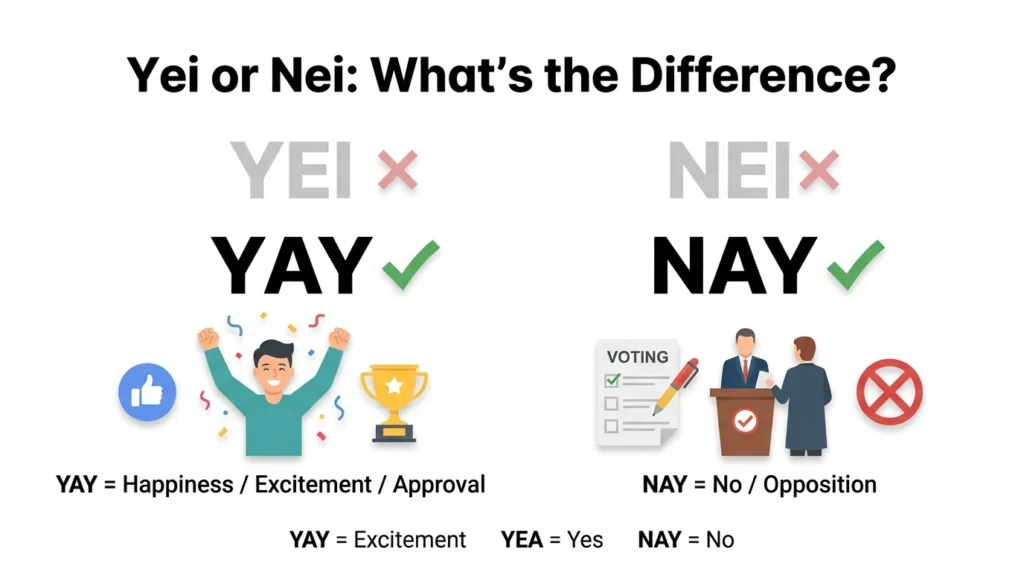
Yei and nei are not standard English spellings for the common words yay and nay. If you mean excitement or happiness, use yay; if you mean no or opposition, use nay.
The words yei and nei can be confusing because they may look or sound similar to familiar English expressions. However, neither yei nor nei is normally used as a standard English spelling for yay or nay. Yay is an informal word used to show happiness, excitement, or approval, while nay means no or opposition and is often seen in voting or formal contexts. People may write yei or nei because of spelling mistakes, pronunciation, typing errors, or informal online language. Knowing the difference can help English learners avoid common spelling mistakes and choose the right word in everyday writing, conversations, and professional content.
What Does Yei Mean?
Yei is not normally a standard English word when it is intended to express excitement or happiness.
If someone writes:
Yei! We won!
they may mean:
Yay! We won!
The standard informal English spelling for this expression is yay.
Example
Incorrect or nonstandard:
Yei! I passed my exam.
Preferred:
Yay! I passed my exam.
What Does Nei Mean?
Nei is not normally the standard English spelling of nay.
If someone writes:
Nei, I don’t agree.
they may be trying to say:
Nay, I don’t agree.
However, in modern everyday English, the most natural choice would usually be:
No, I don’t agree.
The word nay is more common in voting, formal, historical, or literary contexts.
Yei or Nei vs Yay or Nay
The easiest way to understand these words is to compare them directly.
| Word | Standard English Use | Meaning |
|---|---|---|
| Yei | Usually nonstandard | Often intended as yay |
| Nei | Usually nonstandard | Often intended as nay |
| Yay | Standard informal English | Happiness or excitement |
| Nay | Standard English | No or opposition |
So, if you are writing standard English, choose yay instead of yei and nay instead of nei.
Yei vs Yay
Yay is a common informal English interjection.
It is used to show:
- Happiness
- Excitement
- Celebration
- Approval
- Joy
Examples
Yay! We won the game.
Yay! I got the job.
Yay! It’s finally Friday.
Yay, we’re going on vacation.
Yay! My package arrived.
The spelling yei is not the normal standard spelling for this meaning.
Nei vs Nay
Nay means no, not, or against.
It is a real English word, although it is less common in everyday speech than no.
Examples
The committee voted nay.
The proposal received several nays.
The members were asked to vote yea or nay.
The spelling nei is not normally used for this English meaning.
Why Do People Write Yei?
There are several reasons someone might write yei.
Pronunciation Confusion
English spelling can be difficult because words are not always spelled exactly as they sound.
A learner may hear yay and think it should be written yei.
However, the standard spelling is:
Yay
Typing Mistakes
People often type quickly on phones and computers. A person may accidentally write yei instead of yay.
Informal Internet Writing
Online communication often contains unusual spellings.
People may intentionally change words for humor, style, or personal expression. Such spellings do not necessarily become standard English.
Why Do People Write Nei?
The same issue can happen with nei.
A person may hear nay and spell it according to pronunciation.
However, the standard English spelling is:
Nay
not:
Nei
If you mean a normal negative answer, no is usually the better choice.
What Does Yay Mean?
Yay is an informal expression of positive emotion.
It is often used when something good happens.
Examples
Yay! I passed the test.
Yay! We won the competition.
Yay! The weekend is here.
Yay! We are going to the beach.
Yay, you made it!
In all these examples, the speaker feels happy or excited.
What Does Nay Mean?
Nay means no or against.
It is less common in casual modern English.
It is often associated with voting.
Examples
The members voted nay.
The bill received ten nays.
The committee voted yea or nay.
He voted nay on the proposal.
In casual conversation, most people would simply use no.
Yay, Yea, Nay, and Nei
These words can easily cause confusion.
| Word | Meaning |
|---|---|
| Yay | Excitement or happiness |
| Yea | Yes or a vote in favor |
| Nay | No or a vote against |
| Yei | Usually a nonstandard spelling of yay |
| Nei | Usually a nonstandard spelling of nay |
For example:
Yay! We won!
This shows excitement.
The proposal received 50 yea votes.
This means 50 people voted in favor.
The proposal received 10 nay votes.
This means 10 people voted against it.
Yay vs Yea
This is an especially important difference.
Yay and yea are not the same word.
Yay means excitement.
Yea means yes or indicates approval in a vote.
Examples
Yay! We won!
The motion received 80 yea votes.
A simple memory trick is:
Yay = excitement
Yea = yes
Nay vs No
Nay can mean no, but it is not as common as no in everyday English.
Compare:
No, I don’t want coffee.
This sounds natural.
Nay, I don’t want coffee.
This sounds old fashioned or unusual.
However:
The senator voted nay.
This sounds natural in a voting context.
When Should You Use Yay?
Use yay when you want to express excitement, happiness, or approval in informal English.
Examples include:
- Yay! I got the job.
- Yay! We won.
- Yay! It’s my birthday.
- Yay! School is closed tomorrow.
- Yay, you’re coming with us.
The word is common in texts, social media, casual conversations, and informal writing.
When Should You Use Nay?
Use nay when you mean no or opposition, especially in formal or voting contexts.
Examples:
- The committee voted nay.
- The proposal received five nays.
- The senator voted nay.
- The members voted yea or nay.
For ordinary conversation, no is normally more natural.
Common Mistakes
Mistake One
Incorrect:
Yei! We won!
Better:
Yay! We won!
Mistake Two
Incorrect:
Nei, I don’t agree.
Better:
No, I don’t agree.
Or in a formal voting context:
Nay, I oppose the proposal.
Mistake Three
Incorrect:
Yei means excitement in standard English.
Correct:
Yay is the standard informal spelling for excitement.
Mistake Four
Incorrect:
Nei is the English word for no.
Correct:
Nay is the English word associated with no or opposition.
Real World Examples
Example One: Celebration
Your friend says:
You passed the exam!
You respond:
Yay!
This expresses happiness.
Example Two: Vacation
Someone says:
We’re going to the beach tomorrow.
You say:
Yay!
This expresses excitement.
Example Three: Voting
A chairperson says:
Those in favor say yea. Those opposed say nay.
Here, nay means against.
Example Four: Everyday Conversation
Someone asks:
Do you want another cup of tea?
You say:
No, thank you.
You would not normally say:
Nei, thank you.
Regional and Global Usage
Yay is widely understood in modern English-speaking countries, including the United States, United Kingdom, Canada, and Australia.
Nay is also widely understood, but it is less common in everyday conversation.
It is more likely to appear in:
- Voting
- Parliamentary language
- Historical writing
- Literature
- Formal speeches
- Humorous writing
The forms yei and nei should not normally be used as replacements for yay and nay in standard English writing.
Polite and Natural Alternatives
If you are unsure about using nay, you can simply use no.
Instead of:
Nay, I don’t want to go.
Use:
No, I don’t want to go.
For excitement, yay is already a natural informal choice.
In more formal writing, you can replace yay with:
- Great!
- Excellent!
- Wonderful!
- I’m very pleased.
- That’s good news.
Easy Memory Trick
Remember these four simple words:
Yay = Happy
Yea = Yes
Nay = No
Yei and Nei = Usually not standard English spellings
This simple pattern can help you avoid most mistakes.
Practice Exercises
Exercise One
Choose the correct word.
- ______! We won the match.
- The committee voted ______.
- ______! I got the job.
- The proposal received five ______.
- ______! We are going on vacation.
Answers
- Yay
- Nay
- Yay
- Nays
- Yay
Exercise Two
Choose the best option.
- You are excited about a party.
A. Yei!
B. Yay!
- You are voting against a proposal.
A. Nay
B. Nei
- You are refusing coffee politely.
A. No, thank you.
B. Nei, thank you.
- Your team wins a competition.
A. Yay!
B. Nei!
Answers
- B. Yay!
- A. Nay
- A. No, thank you.
- A. Yay!
Exercise Three
- Yei! We passed the test.
- Nei, I don’t agree.
- Yei! It’s my birthday.
- The members voted nei.
Answers
- Yay! We passed the test.
- No, I don’t agree. or Nay, I don’t agree.
- Yay! It’s my birthday.
- The members voted nay.
FAQs
What is the difference between yei and nei?
Yei and nei are not normally standard English alternatives for yay and nay. Use yay for excitement and nay for no or opposition.
Is yei a correct spelling of yay?
No. Yay is the standard informal spelling used to express happiness, excitement, or approval. Yei is usually a typo or nonstandard variation.
Is nei a correct spelling of nay?
Generally, no. Nay is the standard English word meaning no or opposition. Nei is usually a nonstandard spelling in this context.
What is the difference between yay and yea?
Yay expresses excitement or happiness, while yea means yes or indicates a vote in favor.
Should I use nay or no in everyday English?
Use no in most everyday conversations. Nay is more common in voting, formal, historical, literary, or humorous contexts.
Conclusion
The difference between yei or nei is mainly about standard English spelling and meaning. Yei is not normally the standard spelling of yay, while nei is not normally the standard spelling of nay. If you want to express happiness, excitement, or approval, use yay. If you want to express opposition or a negative vote, use nay. In normal everyday conversation, no is usually a more natural choice than nay.
It is also important to avoid confusing yay with yea. Yay shows excitement, while yea means yes or a positive vote. Learning these small differences can make your English writing clearer and more accurate. The easiest rule is simple: yay means excitement, yea means yes, and nay means no. When writing standard English, avoid using yei or nei as replacements for these words.