

Quick Answer
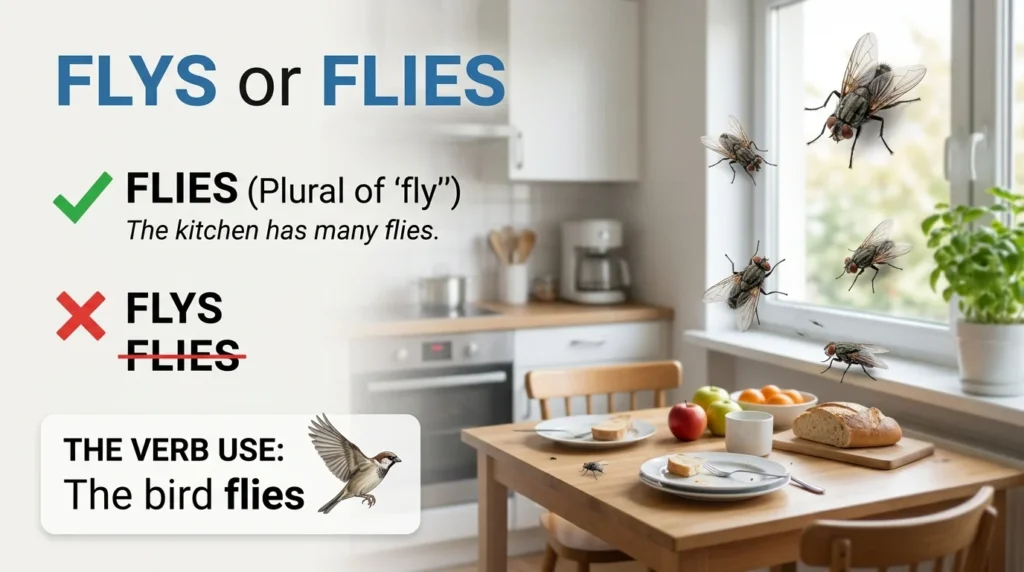
Flies is the correct spelling in standard English when you mean more than one fly or the verb form of fly. Flys is generally incorrect in standard English.
Flys or flies is a common spelling question because the word fly changes its spelling when it becomes plural or when it describes what someone or something does. The correct form is usually flies, not flys.
For example, you can say, “There are two flies in the kitchen.” You can also say, “The bird flies over the trees.” In both cases, flies is spelled with ie rather than y.
The spelling rule is simple once you know it. When fly changes into the third-person singular verb form or its plural noun form, the y changes to i before es. This gives us flies.
Is Flys or Flies Correct?
Flies is the correct standard spelling.
Flys is generally not correct when you are using the word as the plural of fly or as the third-person singular form of the verb fly.
Examples:
- One fly, two flies.
- A bird flies through the sky.
- The plane flies every morning.
- Several flies landed on the food.
So if you are choosing between flys and flies, choose flies in standard English.
What Does Flies Mean?
Flies has two common uses.
First, it can be the plural form of the noun fly.
Example:
There are several flies near the window.
Second, flies can be the third-person singular form of the verb fly.
Example:
The eagle flies above the mountains.
The meaning depends on the sentence.
This is why context matters when you see the word flies.
Flies as the Plural of Fly
A fly is a small flying insect. The plural form is flies.
For example:
- One fly
- Two flies
- Several flies
- A group of flies
Examples in sentences:
A fly landed on the table.
Three flies were near the window.
The kitchen had several flies.
The farmer noticed flies around the animals.
The plural spelling changes from fly to flies.
You do not normally add s directly to make flys.
Flies as a Verb
Flies can also come from the verb fly.
The verb fly means to move through the air.
Examples:
- The bird flies south in winter.
- The plane flies over the city.
- The eagle flies above the valley.
- She flies to New York every month.
- The helicopter flies over the stadium.
Here, flies is used with a singular subject such as he, she, it, or a singular noun.
For example:
The bird flies quickly.
But:
The birds fly quickly.
This difference is important.
Why Is Flies Spelled With IES?
The spelling comes from a common English rule.
When a noun or verb ends in a consonant followed by y, the y often changes to i before the ending es.
So:
fly → flies
The same pattern appears in other words.
For example:
- baby → babies
- city → cities
- story → stories
- family → families
- party → parties
This is why flys does not normally work as the plural form.
Flys Is Usually Incorrect
If you are trying to write the plural of fly, flys is not the standard spelling.
Incorrect:
There are many flys in the room.
Correct:
There are many flies in the room.
The same applies when using the third-person singular verb form.
Incorrect:
The bird flys over the house.
Correct:
The bird flies over the house.
The spelling flies is the form you want in both cases.
Fly or Flies?
Sometimes the confusion is not between flys and flies, but between fly and flies.
The choice depends on the subject and meaning.
Use fly with:
- I
- you
- we
- they
- plural nouns
Examples:
I fly to Chicago tomorrow.
They fly every summer.
Birds fly across the lake.
Use flies with:
- he
- she
- it
- singular nouns
Examples:
He flies to Chicago tomorrow.
She flies every summer.
The bird flies across the lake.
This subject difference is one of the most useful rules to remember.
Flys vs Flies in a Sentence
Compare these examples:
The bird flies over the trees.
The birds fly over the trees.
The first sentence uses flies because bird is singular.
The second sentence uses fly because birds is plural.
Now compare the noun:
I saw one fly.
I saw five flies.
Here, flies is the plural noun.
So the word can have two different grammatical roles.
Examples of Flies as a Noun
Here are some natural examples:
- A fly landed on my plate.
- Two flies were near the door.
- The flies disappeared after we cleaned the room.
- Several flies were outside the window.
- The food attracted flies.
- She used a screen to keep flies out.
- The farmer noticed many flies around the barn.
- We closed the window because of the flies.
In every example, flies means more than one fly.
Examples of Flies as a Verb
Here are examples where flies is a verb:
- The bird flies over the lake.
- The eagle flies very high.
- The plane flies across the country.
- She flies home every Friday.
- He flies to Boston for work.
- The helicopter flies over the city.
- The butterfly flies from flower to flower.
- The kite flies above the field.
Here, flies describes an action.
Flys or Flies for Birds?
When talking about what a bird does, use flies with a singular subject.
Correct:
The bird flies across the sky.
Incorrect:
The bird flys across the sky.
However, use fly when the subject is plural.
Correct:
The birds fly across the sky.
This is a simple subject-verb agreement rule.
Flys or Flies for Airplanes?
The same rule applies to airplanes.
For example:
The plane flies from Dallas to Denver.
Because plane is singular, use flies.
But:
The planes fly from Dallas to Denver.
Because planes is plural, use fly.
Notice that flys is not needed in either sentence.
Flys or Flies for Insects?
When you are talking about more than one insect called a fly, use flies.
Examples:
There are flies in the kitchen.
The flies are near the trash can.
We need to keep the flies away from the food.
The singular is:
There is a fly in the kitchen.
The plural is:
There are several flies in the kitchen.
This is one of the easiest ways to remember the spelling.
The Basic Y to I Rule
A useful spelling pattern is:
consonant + y → ies
For example:
- fly → flies
- cry → cries
- try → tries
- carry → carries
- study → studies
- worry → worries
This rule helps explain why we write flies instead of flys.
However, not every word ending in y changes this way.
When a word ends in a vowel followed by y, the y often stays.
For example:
- play → plays
- enjoy → enjoys
- boy → boys
- toy → toys
So the letter before the y matters.
Flys vs Flies: A Simple Grammar Rule
You can remember the difference with two questions.
First, are you talking about more than one insect?
If yes:
fly → flies
Second, are you using fly as a verb with he, she, it, or another singular subject?
If yes:
fly → flies
Examples:
The bird flies.
She flies.
The plane flies.
But:
Birds fly.
They fly.
We fly.
This pattern makes the correct form much easier to choose.
Common Mistakes With Flys and Flies
One of the most common mistakes is adding s directly to fly.
That produces:
flys
For standard English, this is not the normal spelling.
The correct form is:
flies
Another mistake happens when writers confuse singular and plural subjects.
For example:
The birds flies over the lake.
This is incorrect because birds is plural.
The correct sentence is:
The birds fly over the lake.
You should also avoid:
The bird fly over the lake.
The correct form is:
The bird flies over the lake.
Fly vs Flies vs Flew vs Flown
These forms can be confusing because they all come from the same verb.
Fly
Used as the basic form.
I fly to Seattle tomorrow.
Flies
Used with a singular third-person subject.
She flies to Seattle tomorrow.
Flew
Past tense.
She flew to Seattle yesterday.
Flown
Past participle, usually used with have, has, or had.
She has flown to Seattle many times.
A simple chart helps:
| Form | Example |
|---|---|
| fly | They fly every week. |
| flies | He flies every week. |
| flew | He flew yesterday. |
| flown | He has flown before. |
Learning these forms together can prevent many mistakes.
Flies in Everyday English
You will see flies often in normal conversation and writing.
For example:
The flies are bothering me.
She flies home every month.
The bird flies away when I get close.
I saw several flies near the trash.
The meaning changes according to the context, but the spelling remains flies.
Flies in Professional Writing
The word flies can also appear in professional or formal writing.
For example:
The aircraft flies between several major cities.
Or:
The study examined how insects respond when flies enter a controlled environment.
The spelling does not change simply because the writing is formal.
The same grammatical rules apply.
Flies in Academic Writing
Academic writing may use flies when discussing animals, biology, experiments, travel, or other topics.
For example:
The researcher observed several species of flies.
Or:
The bird flies between the nesting area and the feeding site.
The important point is to identify whether flies is functioning as a noun or a verb.
Flies and Other Words That End in Y
The spelling pattern appears in many everyday words.
Compare:
- fly → flies
- city → cities
- baby → babies
- country → countries
- family → families
- company → companies
- story → stories
- library → libraries
These words all show a similar spelling change.
This is useful because learning the pattern helps with more than just fly.
When the Y Stays
There is an important exception to remember.
If a word ends in a vowel plus y, the y usually stays when you add s.
Examples:
- play → plays
- stay → stays
- enjoy → enjoys
- employ → employs
- boy → boys
- toy → toys
Compare:
fly → flies
with:
play → plays
The reason is that fly ends with a consonant plus y, while play ends with a vowel plus y.
Practice Questions
Choose the correct word.
1. The bird ______ over the house.
Answer: flies
The subject bird is singular.
2. The birds ______ over the house.
Answer: fly
The subject birds is plural.
3. I saw three ______ near the window.
Answer: flies
You are talking about more than one insect.
4. She ______ to California every summer.
Answer: flies
The subject she is singular.
5. They ______ to California every summer.
Answer: fly
The subject they takes the base form.
6. The plane ______ over the mountains.
Answer: flies
The subject plane is singular.
7. Several ______ were inside the room.
Answer: flies
The word refers to multiple insects.
Quick Test: Flys or Flies?
Try filling in the blanks without looking at the answers.
- The eagle ______ above the valley.
- Two ______ landed on the table.
- They ______ to Miami every winter.
- The airplane ______ across the country.
- We watched several ______ near the window.
Answers
- flies
- flies
- fly
- flies
- flies
Notice how flies appears both as a verb and as a plural noun.
How to Remember the Correct Spelling
A simple memory trick is:
Fly + es = flies
But remember that the spelling changes:
fly → flies
The y becomes i, and then es is added.
You can connect it with familiar words:
baby → babies
city → cities
fly → flies
Seeing these words together makes the pattern easier to remember.
Is Flys Ever Correct?
In ordinary standard English, flys is not the spelling you should use for the plural of fly or the third-person singular form of the verb fly.
For normal writing, use:
flies
There may be unusual uses of letter combinations in specialized names, brands, titles, or other proper forms, but those are different situations. They do not change the standard spelling rule for the English word fly.
Flys or Flies: Quick Comparison
| Word | Correct? | Common Use |
|---|---|---|
| fly | Yes | Singular noun or base verb |
| flies | Yes | Plural noun or third-person singular verb |
| flys | No | Not the standard form |
| flew | Yes | Past tense of fly |
| flown | Yes | Past participle of fly |
This comparison makes the difference easy to see.
Final Tips
Remember these simple rules:
- Flies is the standard spelling.
- Flys is generally incorrect.
- Fly becomes flies when it is a plural noun.
- Fly becomes flies with a singular third-person subject.
- Use fly with I, you, we, they, and plural subjects.
- Use flies with he, she, it, and singular nouns.
- The spelling changes from y to i before es.
- Flew is the past tense.
- Flown is the past participle.
- Do not write flys when you mean the normal plural noun or verb form.
FAQs
Is flys or flies correct?
Flies is the correct standard spelling. Flys is generally incorrect when you mean the plural of fly or the third-person singular form of the verb fly.
Why does fly become flies instead of flys?
Because fly ends in a consonant followed by y. When the appropriate ending is added, the y changes to i, giving us flies.
Is flies a plural noun or a verb?
It can be either. Flies is the plural of the noun fly, as in “There are flies outside.” It is also the third-person singular form of the verb fly, as in “The bird flies away.”
What is the difference between fly and flies?
Fly is the basic verb form and can also be a singular noun. Flies is the plural noun form or the verb form used with a singular third-person subject.
Is flys ever the correct spelling?
For standard English, flys is not the normal spelling for either the plural noun or the third-person singular verb. In those situations, use flies.
Conclusion
The correct spelling is flies, not flys, when you are talking about more than one fly or using fly as a verb with a singular third-person subject.
For example, “There are many flies in the room” uses flies as a plural noun. “The bird flies across the sky” uses flies as a verb. In both cases, the spelling changes from y to i before es.
Once you remember the simple pattern fly → flies, the choice becomes easy. Just pay attention to the subject and whether you are using the word as a noun or a verb.