

Quick Answer
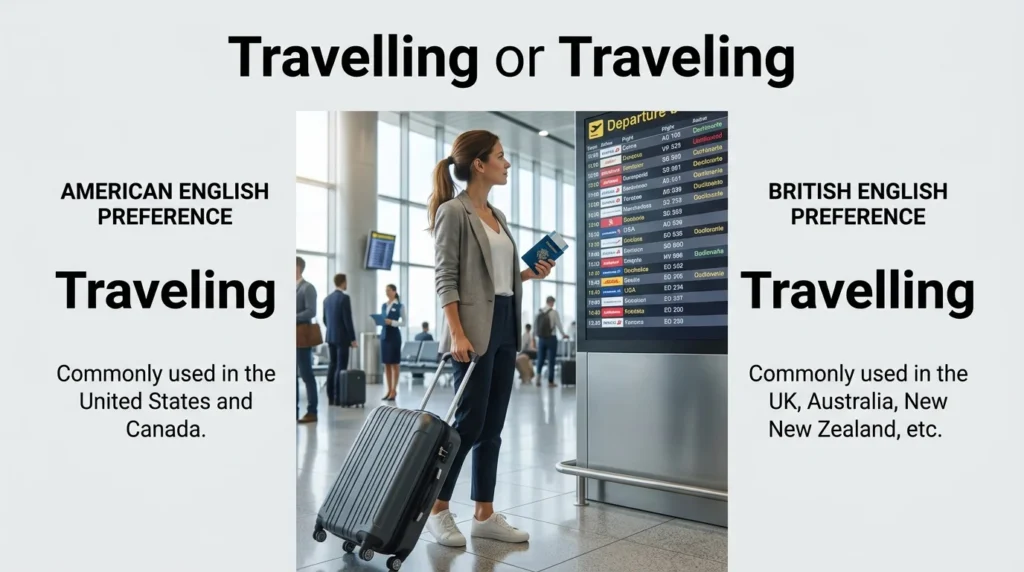
Travelling and traveling are both correct spellings of the word formed from travel. Traveling is the usual American spelling, while travelling is the usual British spelling.
If you have ever written the word traveling and wondered whether it needs another l, you are not alone. The spelling can look different depending on the type of English you are reading.
The good news is that both traveling and travelling are correct. They have the same meaning and come from the same verb, travel. The main difference is the spelling convention used in different varieties of English.
You might write, “I am traveling to New York next week,” or “I am travelling to London next week.” Both sentences are grammatically correct. The choice simply depends on the spelling style you are following.
Understanding this small difference will help you write more consistently and avoid unnecessary spelling mistakes.
What Does Traveling Mean?
Traveling means going from one place to another.
It is the ing form of the verb travel.
For example:
- I am traveling tomorrow.
- She enjoys traveling alone.
- We are traveling across the country.
- He is traveling for work.
- They are traveling by train.
The word can describe short or long-distance movement, vacations, work trips, or regular journeys.
Traveling is the spelling commonly used in American English.
What Does Travelling Mean?
Travelling has the same meaning as traveling.
The only major difference is the spelling.
The double l form is commonly used in British English.
For example:
- I am travelling tomorrow.
- She enjoys travelling alone.
- We are travelling across the country.
- He is travelling for work.
- They are travelling by train.
So, travelling is not a misspelling. It is a standard spelling of the word.
Cambridge lists travelling as the British form of traveling.
Travelling or Traveling: What Is the Difference?
The difference is mainly regional spelling.
| Spelling | Common Usage | Example |
|---|---|---|
| Traveling | American English | I am traveling to Chicago. |
| Travelling | British English | I am travelling to London. |
The meaning does not change.
Both words describe the act of going from one place to another.
This means you do not need to learn two different definitions. You only need to remember which spelling style you are using.
Is Traveling or Travelling Correct?
Both are correct.
There is no universal rule saying that one spelling is right and the other is wrong.
If you are following American spelling, traveling is the usual choice.
If you are following British spelling, travelling is the usual choice.
For example:
I am traveling to California next month.
and
I am travelling to Scotland next month.
Both sentences are correct.
The difference is simply the number of l’s.
When Should You Use Traveling?
Use traveling when following American spelling conventions.
Examples include:
- I love traveling.
- She is traveling for work.
- We are traveling this summer.
- He enjoys traveling by train.
- They are traveling around the country.
- I am traveling to Boston tomorrow.
The one-L spelling is especially common in American books, websites, emails, schoolwork, and business writing.
When Should You Use Travelling?
Use travelling when following British spelling conventions.
Examples include:
- I love travelling.
- She is travelling for work.
- We are travelling this summer.
- He enjoys travelling by train.
- They are travelling around the country.
- I am travelling to Manchester tomorrow.
The meaning remains exactly the same.
The extra l does not change how the word is used in a sentence.
Why Does Traveling Have One L?
The spelling difference comes from different conventions for words ending in l.
In American English, words such as travel commonly keep one l when adding ing:
travel → traveling
British English commonly doubles the l:
travel → travelling
This pattern also appears in the past tense:
American: traveled
British: travelled
So you can think of the forms as a family:
American
- travel
- traveling
- traveled
- traveler
British
- travel
- travelling
- travelled
- traveller
The spelling system stays consistent within each variety.
Traveling in Everyday English
The word traveling is very common in everyday conversation.
You might use it when talking about vacations:
We are traveling to Florida this summer.
You can also use it when talking about work:
My job requires a lot of traveling.
Or when discussing personal interests:
Traveling is one of my favorite hobbies.
The word can describe movement by car, plane, train, bus, boat, or other forms of transportation.
Travelling in Everyday English
The British spelling works in exactly the same situations.
For example:
We are travelling to France this summer.
My job involves a lot of travelling.
Travelling by train can be relaxing.
The extra l does not create a different meaning.
It simply follows a different spelling convention.
Traveling as a Verb
Traveling can function as part of a verb phrase.
For example:
I am traveling tomorrow.
Here, am traveling describes an action that is happening or planned.
More examples:
- She is traveling with her family.
- We are traveling by car.
- They are traveling across the country.
- He was traveling when I called.
- I have been traveling for several weeks.
The British form works in the same way:
- She is travelling with her family.
- We are travelling by car.
- They are travelling across the country.
- He was travelling when I called.
- I have been travelling for several weeks.
Traveling as a Noun
Traveling can also refer to the activity of making journeys.
For example:
Traveling can be expensive.
I enjoy traveling during the summer.
Her job involves a lot of traveling.
In these sentences, traveling refers to the general activity rather than one specific trip.
The British spelling works the same way:
Travelling can be expensive.
I enjoy travelling during the summer.
Her job involves a lot of travelling.
Cambridge also identifies traveling as a noun referring to the activity of making trips.
Traveling as an Adjective
The word can also describe someone or something that moves from place to place.
For example:
- a traveling musician
- a traveling nurse
- a traveling salesman
- a traveling show
- a traveling exhibition
In British spelling, these become:
- a travelling musician
- a travelling nurse
- a travelling salesman
- a travelling show
- a travelling exhibition
Again, the meaning remains unchanged.
Traveling or Travelling for Work
People often use the word when describing jobs that require regular trips.
For example:
I am traveling for work next week.
Her job involves a lot of traveling.
He spends several days each month traveling for business.
The British forms would use travelling instead.
This is especially useful because travel and trip do not always mean exactly the same thing.
Travel can describe the general activity of moving from place to place, while a trip usually refers to a particular journey or visit.
Traveling for Vacation
The word is also common when talking about vacations.
Examples:
- We are traveling during the summer.
- I love traveling with my family.
- She is traveling to Hawaii next month.
- They spent the year traveling around the country.
You can use travelling in the same sentences if you follow British spelling.
The spelling changes, but the idea does not.
Traveling or Travelling by Car
Both forms work when describing transportation.
American spelling:
We are traveling by car.
I enjoy traveling by train.
She is traveling by plane.
British spelling:
We are travelling by car.
I enjoy travelling by train.
She is travelling by plane.
The preposition by tells us how the person is moving from one place to another.
Traveling or Travelling Around the World
You may also see the word with around.
Examples:
He dreams of traveling around the world.
They spent a year traveling around Europe.
She is traveling around the country.
British spelling:
He dreams of travelling around the world.
They spent a year travelling around Europe.
She is travelling around the country.
These sentences all use the word naturally.
Traveling vs Trip
Although traveling and trip are related, they are not interchangeable in every sentence.
Traveling usually describes the activity of going from place to place.
I enjoy traveling.
Trip normally refers to one particular journey.
I enjoyed my trip to Miami.
You would not normally say:
I enjoyed my travel to Miami.
when you mean one specific vacation.
A more natural sentence would be:
I enjoyed my trip to Miami.
The difference is useful when choosing between travel-related words.
Traveling vs Journey
Journey usually focuses on the movement from one place to another, especially the experience or route involved.
For example:
The journey from the airport took two hours.
Traveling is broader:
I enjoy traveling.
You can think of it this way:
Traveling = the general activity
Trip = a particular visit or outing
Journey = the movement from one place to another
These words are related, but each has its own natural uses.
Common Mistakes With Traveling
One common mistake is assuming that travelling is always incorrect.
It is not.
Another mistake is assuming that traveling must be wrong because the word appears with two l’s in some books.
It is not wrong.
A third mistake is mixing spelling styles.
For example:
I am traveling to London and have travelled through France.
This sentence is not necessarily grammatically wrong, but it mixes the one-L and two-L conventions.
If you are following one spelling style, consistency usually makes your writing look cleaner.
Traveling and Traveled
The spelling difference continues in the past tense.
American English commonly uses:
traveled
British English commonly uses:
travelled
Examples:
I traveled to New York last year.
I travelled to London last year.
Both are correct.
This is useful because if you choose traveling, you will usually also choose traveled.
If you choose travelling, you will usually choose travelled.
Traveling and Traveler
The same pattern appears in the noun for a person who travels.
American spelling:
traveler
British spelling:
traveller
Examples:
He is an experienced traveler.
She is an experienced traveller.
Again, both forms are correct.
The spelling style usually stays consistent across the word family.
How to Remember Traveling or Travelling
A simple trick is to remember the number of l’s.
American English:
traveling
traveled
traveler
British English:
travelling
travelled
traveller
If you are writing in American English, think one l.
If you are writing in British English, think two l’s.
This makes the pattern easier to remember.
Practice Questions
Choose the spelling that fits the style.
1. I am ______ to New York next week.
American: traveling
British: travelling
2. She enjoys ______ alone.
American: traveling
British: travelling
3. He is ______ for work.
American: traveling
British: travelling
4. We spent the summer ______ around Europe.
American: traveling
British: travelling
5. They love ______ by train.
American: traveling
British: travelling
There is no single spelling that makes all five answers correct in every variety of English. The right choice depends on the style you are using.
Practice With the Full Word Family
Now choose the consistent spelling set.
Set One
- traveling
- traveled
- traveler
This set follows the common American pattern.
Set Two
- travelling
- travelled
- traveller
This set follows the common British pattern.
The important thing is not to memorize isolated words. Learning the whole pattern makes spelling much easier.
Which Spelling Should You Use?
If your writing follows American English, choose:
traveling
If your writing follows British English, choose:
travelling
For example, a sentence written with the American spelling would be:
I am traveling to Chicago next month.
A sentence using the British spelling would be:
I am travelling to Edinburgh next month.
Neither sentence is more correct simply because of the spelling.
The best choice is the one that matches the rest of your writing.
Quick Comparison
| Word | American Spelling | British Spelling |
|---|---|---|
| Present form | traveling | travelling |
| Past form | traveled | travelled |
| Person | traveler | traveller |
| Base verb | travel | travel |
The base word travel stays the same. The difference appears when certain endings are added.
Final Tips
Keep these rules in mind:
- Traveling is correct.
- Travelling is also correct.
- Traveling is the usual American spelling.
- Travelling is the usual British spelling.
- Both words have the same meaning.
- The difference is spelling, not pronunciation or meaning.
- Traveled matches the common American pattern.
- Travelled matches the common British pattern.
- Traveler matches the common American pattern.
- Traveller matches the common British pattern.
- Use one spelling style consistently.
FAQs
Is traveling or travelling correct?
Both are correct. Traveling is the usual American spelling, while travelling is the usual British spelling.
Is traveling with one L an American spelling?
Yes. Traveling with one l is the standard spelling commonly used in American English.
Why does British English spell travelling with two Ls?
British spelling commonly doubles the final l when forming words such as travelling and travelled. American spelling generally keeps one l in these forms.
Is traveling and travelling pronounced differently?
No. The spelling difference does not normally change the pronunciation. Both forms refer to the same activity of going from one place to another.
Is traveled or travelled correct?
Both are correct. Traveled is the usual American spelling, while travelled is the usual British spelling. The same spelling pattern explains traveling and travelling.
Conclusion
Traveling and travelling are two correct spellings of the same word. They both describe the activity of going from one place to another, and they can be used as part of verb phrases, nouns, and adjectives.
The main difference is regional spelling. Traveling is the usual American form, while travelling is the usual British form. The same pattern appears in related words such as traveled and travelled and traveler and traveller.
So, if you write traveling, you are not making a spelling mistake. If you write travelling, you are not making one either. Choose the spelling style that fits your writing and keep it consistent.