
Quick Answer
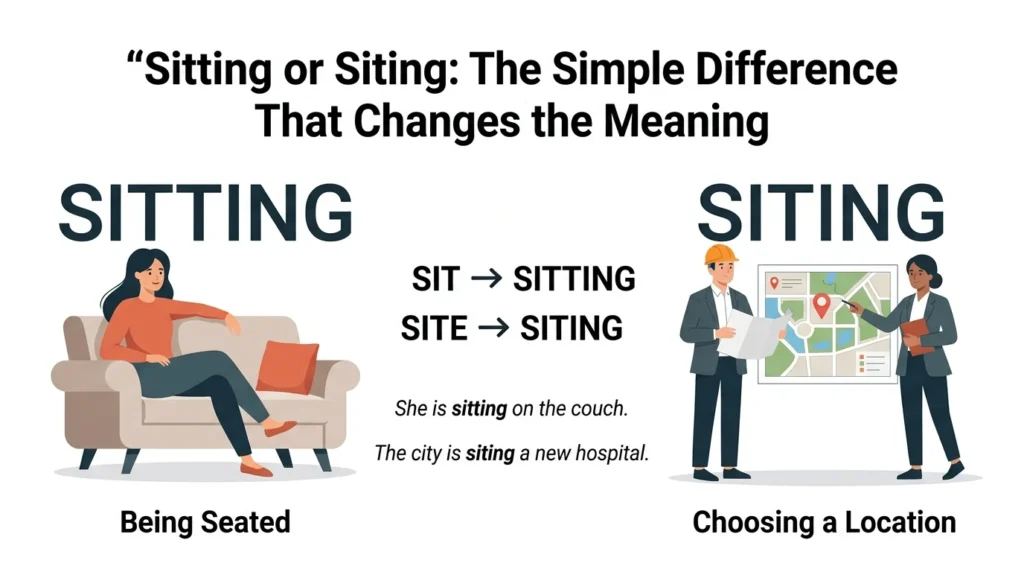
Sitting means being in a seated position, while siting means choosing or placing something in a particular location. For example, “She is sitting on the couch” is correct, but “The city is siting a new hospital” means the city is choosing a location for the hospital.
Sitting or siting is a common spelling confusion because the two words look and sound very similar. The difference seems small, but the meanings are not the same. Sitting comes from the verb sit and describes a person or animal being in a seated position. Siting, however, comes from site and relates to choosing a place for something.
This distinction matters in everyday American English as well as in professional writing. You might write about someone sitting at a desk, or you might read about a company siting a new factory. The surrounding words usually make the intended meaning clear. Still, knowing the spelling rule can help you avoid embarrassing mistakes in emails, school assignments, reports, and online content. Fortunately, the difference is easy to remember once you connect each word to its root. This guide explains the meanings, grammar, examples, spelling rules, common mistakes, and practical uses of sitting and siting in clear American English.
What Does Sitting Mean?
Sitting is the ing form of the verb sit.
It usually means being in a seated position.
For example:
She is sitting on the couch.
The person is in a seated position.
Here are more examples:
I am sitting at my desk.
The children are sitting on the floor.
He is sitting next to his brother.
The dog is sitting by the door.
In every example, sitting describes a physical position.
The word is extremely common in American English because people use it in everyday conversations about homes, offices, schools, restaurants, cars, and many other places.
What Does Siting Mean?
Siting comes from the verb site.
As a verb, site means to choose or place something in a particular location.
Therefore, siting refers to the process of deciding where something should be located.
For example:
The company is siting its new warehouse near the highway.
The company is choosing a location for the warehouse.
Another example:
Officials are siting a new fire station in the northern part of the city.
The officials are deciding where the fire station should go.
Unlike sitting, this word is mainly used when talking about locations, buildings, facilities, projects, and planning.
Sitting or Siting: The Core Difference
The easiest way to understand the difference is to look at the original words.
Sitting comes from sit.
Siting comes from site.
That gives you a useful rule:
| Word | Comes from | Main meaning |
|---|---|---|
| Sitting | Sit | Being seated |
| Siting | Site | Choosing a location |
Consider these two sentences:
The engineer is sitting in the office.
The engineer is seated.
The engineer is siting the new facility.
The engineer is choosing where the facility should be located.
The spelling changes because the meaning changes.
Why Is Sitting Spelled With Two Ts?
The spelling sitting often causes confusion.
The base verb is:
sit
When the ing ending is added, the final consonant is doubled:
sit → sitting
This follows a common English spelling pattern.
You can see a similar pattern in words such as:
run → running
stop → stopping
swim → swimming
Therefore, when you mean being seated, remember the double t:
sitting
Not:
siting
Why Is Siting Spelled With One T?
The word siting comes from site.
When site takes the ing ending, the final silent e is removed:
site → siting
The result has one t.
For example:
The company is siting the new office downtown.
The sentence concerns the location of an office.
This is why siting and sitting cannot simply be treated as two spellings of the same word. They come from different base words and have different meanings.
How to Remember the Difference
A simple memory trick can make the spelling much easier.
Think:
Sit → Sitting
Site → Siting
If you can replace the word with being seated, choose sitting.
If you can replace it with choosing a location, choose siting.
For example:
She is sitting in the chair.
You can say:
She is being seated in the chair.
Now consider:
The company is siting a new factory.
You can say:
The company is choosing a location for a new factory.
That quick test works in most situations.
Examples of Sitting in American English
Sitting appears in many everyday situations.
I’m sitting in the living room.
She is sitting at the kitchen table.
He was sitting in the back of the car.
The students are sitting quietly.
My dog is sitting beside me.
We were sitting outside when it started raining.
Why are you sitting on the floor?
These examples all describe a person or animal in a seated position.
Examples of Siting in American English
The word siting is less common in casual conversation. Still, it has an important role in professional and technical writing.
The city is siting a new public library downtown.
The company is siting its headquarters near the airport.
Developers are siting the apartment complex outside the city center.
Officials are reviewing several options for siting the new hospital.
Engineers are studying the area before siting the facility.
Here, the word always relates to location or placement.
Sitting in Everyday Conversations
For most Americans, sitting is the word they are likely to use in daily speech.
You may hear:
Where are you sitting?
I’m sitting near the window.
Come sit here.
She has been sitting there all morning.
The kids are sitting in the living room.
These sentences have nothing to do with selecting a location.
They describe people or animals being seated.
Siting in Professional Communication
Professional writing uses siting when a project requires a location decision.
For example, a business report might say:
The company is evaluating several sites before siting its new distribution center.
An urban planning report could say:
The city is considering environmental factors before siting the new facility.
A government document might discuss:
The proposed siting of the new courthouse.
This specialized meaning makes siting useful in formal writing.
Sitting in the Workplace
American workers often use sitting when talking about office activities.
For example:
I have been sitting at my desk all morning.
She is sitting in the conference room.
He was sitting beside the manager during the meeting.
Everyone is sitting around the conference table.
The word describes where people are physically positioned.
Siting in Business and Development
Businesses may need to decide where to build stores, offices, factories, or warehouses.
That process can involve siting.
For example:
The company is siting its new distribution center near a major highway.
Location can affect transportation costs, customer access, employee travel, and business operations.
As a result, siting is common in business planning.
Sitting in School
Students and teachers use sitting frequently.
For example:
The students are sitting at their desks.
She is sitting next to her best friend.
The teacher asked everyone to stop talking and start sitting quietly.
The word is connected to physical position.
If a school district is choosing where to build a new school, however, siting may be appropriate:
The district is considering several locations for siting the new school.
Siting in Construction
Construction provides a good example of why these words can be confusing.
A worker can be sitting inside a construction office.
Meanwhile, an architect can be siting a new building.
For example:
The architect is siting the building near the main road.
The architect is not sitting in a chair. Instead, the architect is deciding where the building should be located.
Siting in Real Estate
Real estate professionals may use siting when discussing the placement of a property.
For example:
The architect considered the land carefully before siting the home.
The word may also appear in planning documents:
The siting of the development will affect traffic patterns.
Here, siting refers to the location or placement of the development.
Siting in Environmental Planning
Environmental discussions often involve decisions about where large projects should be built.
For example:
The environmental review focused on the siting of the proposed facility.
Another example:
Several factors must be considered before siting the project.
These factors can include land use, wildlife, transportation, water resources, and nearby communities.
Therefore, siting is useful in environmental and planning vocabulary.
Sitting vs Siting in a Simple Comparison
| Situation | Correct Word | Example |
|---|---|---|
| A person is in a chair | Sitting | She is sitting in the chair. |
| A child is on the floor | Sitting | The child is sitting on the floor. |
| A worker is at a desk | Sitting | He is sitting at his desk. |
| A city chooses a hospital location | Siting | The city is siting the hospital. |
| A company chooses a factory location | Siting | The company is siting the factory. |
| A developer chooses a building location | Siting | The developer is siting the building. |
Sitting or Siting in Different Tenses
Understanding the base verbs makes the grammar easier.
Sit
I sit here every morning.
Sat
I sat here yesterday.
Sitting
I am sitting here now.
The same pattern applies to site.
Site
The company will site the facility here.
Sited
The company sited the facility here.
Siting
The company is siting the facility here.
The words look similar, but their meanings remain different.
The Verb Forms of Sit
Here is a quick reference:
| Grammar form | Word | Example |
|---|---|---|
| Base | sit | Please sit here. |
| Third person | sits | She sits near me. |
| Past | sat | He sat there yesterday. |
| Present participle | sitting | He is sitting there. |
| Past participle | sat | She has sat there before. |
This explains why sitting has two Ts.
The Verb Forms of Site
The verb site follows a different pattern.
| Grammar form | Word | Example |
|---|---|---|
| Base | site | They will site the building here. |
| Third person | sites | The company sites facilities near highways. |
| Past | sited | The company sited the plant nearby. |
| Present participle | siting | They are siting the plant nearby. |
The relationship with site explains the spelling of siting.
Common Mistake: “I Am Siting on the Couch”
This is one of the most common errors.
Incorrect:
I am siting on the couch.
Correct:
I am sitting on the couch.
Why?
The sentence describes a person who is seated.
Therefore, it needs sitting.
Common Mistake: “The Company Is Sitting a Factory”
This mistake reverses the meanings.
Incorrect:
The company is sitting a new factory outside town.
Correct:
The company is siting a new factory outside town.
The company is choosing a location for the factory.
Therefore, siting is correct.
Common Mistake: “She Is Siting Beside Me”
Incorrect:
She is siting beside me.
Correct:
She is sitting beside me.
The person is physically seated beside you.
The word siting would suggest choosing a location, which does not fit the sentence.
Common Mistake: “They Are Sitting the New Facility”
Incorrect:
They are sitting the new facility near the highway.
Correct:
They are siting the new facility near the highway.
The subject is choosing the facility’s location.
That calls for siting.
Common Mistake: Confusing Site and Sit
The base words can help prevent mistakes.
Sit relates to being seated.
Site relates to a location.
For example:
Please sit down.
The construction site is nearby.
From these words, the ing forms follow naturally:
sitting
siting
Sitting or Siting in Formal Writing
Both words are correct in formal writing when used properly.
For everyday situations, sitting is common:
The committee members were sitting in the conference room.
For planning situations, siting is appropriate:
The committee discussed the siting of the proposed facility.
The key is not formality. The key is meaning.
Sitting or Siting in Informal Writing
Casual writing almost always uses sitting when describing people.
For example:
I’m sitting here waiting for you.
She is sitting in the car.
He’s sitting next to me.
You are less likely to see siting in casual messages because choosing a project location is usually a professional or technical topic.
Is Siting a Correct Word?
Yes.
Siting is a real and correct English word.
It is not a misspelling of sitting.
Its meaning comes from site and relates to choosing or establishing a location.
For example:
The siting of the new airport was controversial.
This means the choice of location for the airport was controversial.
Is Sitting a Correct Word?
Yes.
Sitting is the standard present participle of sit.
For example:
She is sitting on the bench.
The word describes a seated position.
It is one of the most common forms of the verb sit.
Sitting and Siting Are Not Pronounced the Same Way
In many varieties of American English, the two words can sound very similar. That similarity is one reason people confuse them.
However, their spelling and meaning are different.
When writing, focus on the root word.
Sit → sitting
Site → siting
This approach is more reliable than trying to hear the difference.
How Context Helps
The words around the blank can often tell you which spelling you need.
Consider:
She is ______ on the sofa.
The phrase on the sofa describes a seated person.
Answer:
sitting
Now consider:
The company is ______ its new warehouse near the airport.
A warehouse needs a location.
Answer:
siting
Context provides a useful clue.
Sitting With Common Prepositions
You will often see sitting with words such as:
sitting on
sitting in
sitting at
sitting beside
sitting near
Examples:
She is sitting on the chair.
He is sitting in the car.
I’m sitting at my desk.
They are sitting beside the window.
These common combinations usually describe physical position.
Siting With Location Language
You will often see siting with words connected to buildings and projects.
Examples include:
siting a factory
siting a hospital
siting a school
siting a warehouse
siting a facility
siting a power plant
This vocabulary provides another useful clue.
Sitting or Siting in News Articles
News reports may use both words.
For example:
Residents were sitting outside the courthouse.
This describes people’s physical position.
A separate report might say:
Officials are debating the siting of a new courthouse.
That sentence concerns the courthouse’s location.
Professional news writing therefore depends heavily on context.
Sitting or Siting in Academic Writing
Academic papers can also contain both words.
For example:
The participants were sitting in separate rooms.
That sentence describes the participants.
Meanwhile:
The study examined factors affecting the siting of renewable energy projects.
That sentence discusses location decisions.
The distinction remains the same.
A Quick Decision Rule
When you see sitting or siting, ask:
Is someone being seated?
If yes, use:
sitting
If the sentence concerns choosing a place for something, use:
siting
For example:
The boy is sitting in the chair.
But:
The city is siting a new clinic.
This simple question can solve most spelling problems.
Practice Exercise
Choose sitting or siting.
The children are ______ at the table.
The city is ______ a new police station.
I am ______ on the sofa.
The company is ______ its new warehouse near the highway.
She was ______ beside her friend.
Officials are reviewing options for ______ the new facility.
Why are you ______ outside?
The developers are ______ the new building near public transportation.
Exercise Answers
The children are sitting at the table.
They are physically seated.
The city is siting a new police station.
The city is choosing the station’s location.
I am sitting on the sofa.
The sentence describes a seated person.
The company is siting its new warehouse near the highway.
The company is deciding where the warehouse should be located.
She was sitting beside her friend.
She was physically seated.
Officials are reviewing options for siting the new facility.
The officials are considering the facility’s location.
Why are you sitting outside?
The question concerns a person’s physical position.
The developers are siting the new building near public transportation.
The developers are selecting the building’s location.
Choose the Correct Sentence
Option A
She is siting on the couch.
Option B
She is sitting on the couch.
Correct answer:
Option B
The sentence describes a person who is seated.
Option A
The company is sitting the factory near the highway.
Option B
The company is siting the factory near the highway.
Correct answer:
Option B
The company is choosing where to locate the factory.
Sitting or Siting: Final Comparison
| Feature | Sitting | Siting |
|---|---|---|
| Root word | Sit | Site |
| Meaning | Being seated | Choosing a location |
| Common in daily speech | Yes | Less common |
| Common in professional writing | Yes | Yes |
| Used for people | Usually | No |
| Used for buildings and projects | No | Yes |
| Example | She is sitting here. | They are siting the facility here. |
FAQs
Is it sitting or siting when talking about a person in a chair?
Use sitting. For example, “He is sitting in a chair.” The word describes a person who is in a seated position.
What is the difference between sitting and siting?
Sitting comes from sit and means being seated. Siting comes from site and means choosing or placing something at a particular location.
Is siting a real word in American English?
Yes. Siting is a correct word in American English. It is mainly used in planning, construction, business, engineering, and other situations involving location decisions.
Why does sitting have two Ts?
The spelling comes from the verb sit. When the ing ending is added, the final consonant is doubled, producing sitting.
How can I easily remember sitting vs siting?
Connect sitting with sit and siting with site. If someone is seated, use sitting. If something needs a location, use siting.
Conclusion
The difference between sitting and siting is simple once you connect each word to its root. Sitting comes from sit and describes a person or animal in a seated position. You would write, “She is sitting on the couch” or “The students are sitting at their desks.” The word appears constantly in everyday American English.
Siting, on the other hand, comes from site. It describes the process of choosing or establishing a location for something. For example, a city might be siting a new hospital, or a company might be siting a warehouse near a major highway. Although the words look almost identical, their meanings are completely different.
The best way to remember the spelling is simple: sit becomes sitting, while site becomes siting. When you are unsure, look at the meaning of the sentence. If someone is seated, choose sitting. If a building, facility, or project needs a location, choose siting. This quick rule will help you use both words correctly in American English.