
Quick Answer
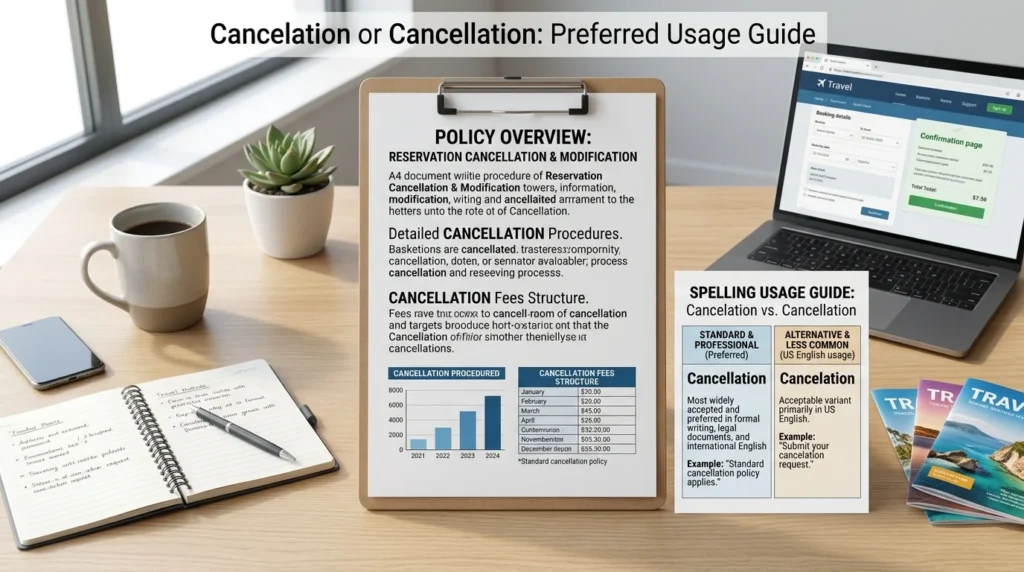
Cancellation is the standard and much more common spelling of the noun related to cancel. Cancelation does exist as a variant, but it is uncommon and usually not the best choice for everyday or professional writing.
Is it cancelation or cancellation? The two words look almost identical, so it is easy to wonder whether the extra l is necessary. This confusion becomes even more common because the verb has different forms, such as canceled and cancelled.
When you need the noun, however, the safest spelling is cancellation. It refers to the act of stopping something that was planned, scheduled, ordered, or agreed upon.
You may see the shorter form cancelation from time to time. It can be recognized as a variant, but it is far less common than cancellation. For most writing, especially when you want your spelling to look natural and polished, cancellation is the better choice.
What Does Cancellation Mean?
Cancellation is a noun.
It describes the act of stopping something that was supposed to happen or continue.
For example:
- The cancellation of the flight caused problems for travelers.
- We received a cancellation notice.
- The event was postponed after the cancellation of the original venue.
- There is no fee for cancellation.
- The company confirmed my subscription cancellation.
The word can describe the end of many different things.
You can have:
- a flight cancellation
- an event cancellation
- a meeting cancellation
- an appointment cancellation
- an order cancellation
- a subscription cancellation
- a reservation cancellation
- a service cancellation
In each case, something that had been planned or arranged is stopped.
What Does Cancelation Mean?
Cancelation has the same basic meaning as cancellation.
It refers to the act of canceling something.
For example:
The cancelation of the event surprised everyone.
The problem is not the meaning. The issue is how often the spelling is used.
Cancelation is much less common than cancellation, so many readers may think it is simply a spelling mistake.
That is why cancellation is normally the better choice.
Cancelation or Cancellation: What Is the Difference?
The main difference is the spelling and frequency of use.
| Word | Meaning | Usage |
|---|---|---|
| Cancellation | The act of canceling something | Standard and very common |
| Cancelation | The act of canceling something | Rare variant |
Both forms point to the same idea.
However, they are not equally useful in normal writing. Cancellation is the form most readers expect to see.
For that reason, choosing cancellation can help your writing look cleaner and more familiar.
Is Cancellation the Correct Spelling?
Yes.
Cancellation is the standard spelling you should normally use.
For example:
The cancellation of the flight was announced early in the morning.
I received a cancellation email from the hotel.
The company confirmed the cancellation of my order.
The cancellation fee was clearly explained.
These sentences all use the most familiar form of the word.
If you are unsure which spelling to choose, cancellation is the simple answer.
Is Cancelation Wrong?
Not completely.
Cancelation can be found as a variant spelling, but it is much less common than cancellation.
That creates an important distinction.
It is better to think of cancelation as an uncommon alternative rather than automatically calling it a spelling error.
Still, if you are writing an email, article, school assignment, business document, policy, or professional message, cancellation is usually the better option.
You avoid confusion and use the spelling that most readers expect.
Why Does Cancellation Have Two Ls?
The spelling can feel strange because the verb cancel has different forms.
For example, you may see:
- cancel
- canceled
- canceling
- cancelled
- cancelling
Then the noun appears as:
- cancellation
It is easy to assume that the noun should simply be:
cancel + ation = cancelation
That looks logical at first.
English spelling, however, does not always work by simply attaching a suffix to a word without changing anything. Some words develop established spellings that become standard through long-term use.
That is why cancellation is the form you will see far more often.
Cancellation and Canceled
This is where many writers become confused.
The verb can appear as canceled in American English and cancelled in British English.
Yet the noun is commonly written:
cancellation
The spelling does not normally change to match the one-L form of canceled.
For example:
The airline canceled my flight.
But:
I received a cancellation notice.
The two words belong to the same word family, but their spellings are not identical.
Cancellation and Cancelled
You can also have:
The airline cancelled my flight.
And:
I received a cancellation notice.
The verb may use the double-L form, while the noun still uses cancellation.
This is one reason the spelling can be confusing.
Instead of trying to create the noun from memory every time, it is easier to remember the common word:
cancellation
Common Examples of Cancellation
The word appears in many situations.
Here are some natural examples:
- The cancellation of the flight was unexpected.
- We received a cancellation notice.
- The hotel has a flexible cancellation policy.
- There was a last-minute cancellation.
- The cancellation fee was higher than expected.
- The event cancellation disappointed many people.
- My appointment cancellation was confirmed by email.
- The company processed my subscription cancellation.
- The cancellation of the meeting gave everyone more time.
- We were notified about the cancellation this morning.
These examples show how flexible the word is.
Cancellation for Flights
Travel is one of the most common areas where you will see cancellation.
For example:
The airline announced the cancellation of several flights.
You may also see phrases such as:
- flight cancellation
- cancellation notice
- cancellation fee
- cancellation policy
- cancellation request
- cancellation coverage
The word works naturally in travel announcements, booking information, and customer messages.
Cancellation for Hotels
Hotels often have rules about canceling reservations.
For example:
The hotel has a 24-hour cancellation policy.
Other common phrases include:
- hotel cancellation
- reservation cancellation
- free cancellation
- cancellation deadline
- cancellation charge
The spelling remains cancellation.
Cancellation for Appointments
You can use the word when an appointment is called off.
For example:
I received a confirmation of my appointment cancellation.
You could also write:
The office sent me a cancellation message.
In everyday conversation, people often use the verb instead:
I canceled my appointment.
The noun becomes useful when you are discussing the event of canceling itself.
Cancellation for Subscriptions
Modern services often use the word cancellation when customers stop a subscription.
For example:
Your subscription cancellation has been processed.
You may also see:
- cancellation request
- cancellation confirmation
- cancellation date
- cancellation policy
- subscription cancellation
These phrases are common in account settings and customer service messages.
Cancellation for Orders
The word also appears in shopping and business situations.
For example:
We received your order cancellation.
Or:
The seller confirmed the cancellation of the order.
You might also see:
Your cancellation request has been approved.
In these sentences, cancellation refers to stopping an order that had already been placed.
Cancellation for Events
Events can be canceled for many reasons.
For example:
The cancellation of the concert disappointed fans.
You can also say:
The event was canceled because of severe weather.
Notice the difference:
canceled is the verb form.
cancellation is the noun.
This distinction is useful when building sentences.
Cancellation as a Noun
The easiest grammar rule to remember is that cancellation is a noun.
It names the act or result of canceling.
Compare these examples:
The company canceled the meeting.
Here, canceled is the verb.
The company announced the cancellation of the meeting.
Here, cancellation is the noun.
Another example:
She canceled her reservation.
But:
She requested a reservation cancellation.
Knowing the difference helps you choose the correct form naturally.
Cancellation vs Cancel
The words cancel and cancellation belong to the same word family, but they perform different jobs.
Cancel is usually a verb.
We need to cancel the meeting.
Cancellation is a noun.
The cancellation of the meeting caused confusion.
You can often spot the difference by looking at what the word is doing in the sentence.
If someone is performing the action, you may need cancel.
If you are naming the action or its result, cancellation is often the right choice.
Cancellation vs Canceled
These two words are related but should not be used in the same grammatical position.
Compare:
The airline canceled the flight.
Here, canceled tells us what the airline did.
Now compare:
The airline announced the cancellation of the flight.
Here, cancellation names the event.
A useful way to remember this is:
Canceled = action
Cancellation = the act or result
Common Mistakes
One of the most common mistakes is writing:
cancelation
when the intended word is the standard noun:
cancellation
Another mistake is assuming that because canceled can have one l, cancelation must also be the normal noun spelling.
That assumption does not work here.
Some writers also switch between cancelation and cancellation in the same document.
For example:
The cancellation policy explains the cancelation fee.
This looks inconsistent.
A cleaner version is:
The cancellation policy explains the cancellation fee.
Using the standard form throughout makes the sentence easier to read.
Why Cancelation Looks Correct
There is a simple reason many people write cancelation.
The spelling seems to follow a straightforward pattern:
cancel + ation
That gives:
cancelation
It looks reasonable.
The problem is that established English spelling does not always follow the most obvious construction. In this case, cancellation became the much more common standard form.
So, if your instinct tells you that one l should be enough, remember that the noun is normally written with two.
An Easy Memory Trick
Use this simple memory trick:
Cancel → cancellation
Think of the extra l as part of the noun’s standard spelling.
You can also memorize a few common phrases:
- cancellation policy
- cancellation fee
- cancellation notice
- cancellation request
- cancellation date
Once you see cancellation in these phrases several times, the spelling becomes easier to remember.
Singular and Plural Forms
The singular form is:
cancellation
The plural form is:
cancellations
For example:
The cancellation was unexpected.
But:
Several cancellations were reported that morning.
The same double-L spelling remains in the plural.
You should normally write:
cancellations
rather than:
cancelations
when using the standard form.
Cancellation in Formal Writing
Cancellation works well in formal writing.
You can use it in:
- business emails
- contracts
- policies
- notices
- academic writing
- customer service messages
- travel information
- legal documents
For example:
Written notice of cancellation must be submitted before the deadline.
Or:
The customer received confirmation of the cancellation.
The word is clear and professional.
Cancellation in Everyday Writing
You do not need formal language to use cancellation.
It works naturally in everyday messages too.
For example:
I got a cancellation email from the hotel.
The cancellation came at the last minute.
There was a cancellation, so we can go earlier.
Did you get the cancellation notice?
The word is useful in both casual and professional contexts.
Cancellation Policy
One of the most common phrases is cancellation policy.
A cancellation policy explains what happens when someone cancels a reservation, appointment, service, or order.
For example:
Please review the cancellation policy before booking.
You might find details about:
- deadlines
- fees
- refunds
- deposits
- exceptions
- notice periods
The spelling is:
cancellation policy
not:
cancelation policy
Cancellation Fee
Another common phrase is cancellation fee.
A cancellation fee is an amount charged when someone cancels under certain conditions.
For example:
The hotel charges a cancellation fee for late cancellations.
You may also see:
No cancellation fee applies if you cancel before the deadline.
This phrase appears often in travel, appointments, memberships, and services.
Cancellation Notice
A cancellation notice tells someone that an event, service, reservation, or arrangement has been canceled.
For example:
We received a cancellation notice from the airline.
Or:
The company sent a cancellation notice by email.
This is another phrase worth remembering because it appears frequently in real-world communication.
Practice Questions
Choose the spelling that best fits each sentence.
1. The hotel sent us a confirmation of the ______.
Answer: cancellation
2. We received a flight ______ this morning.
Answer: cancellation
3. The company explained its ______ policy.
Answer: cancellation
4. The customer requested an order ______.
Answer: cancellation
5. The event was affected by several last-minute ______.
Answer: cancellations
In normal writing, these are the forms you will most often want.
Fill in the Blank
Try these without looking at the answers first.
1. There is no ______ fee for early changes.
2. The airline announced the ______ of the flight.
3. I received a ______ notice from the company.
4. Several event ______ were reported.
5. Please read the ______ policy before booking.
Answers
1. cancellation
2. cancellation
3. cancellation
4. cancellations
5. cancellation
The pattern is consistent.
Cancelation or Cancellation in American English
Even when using American English, cancellation is the form you should normally choose.
This is important because writers sometimes assume that American spelling must always remove an extra l.
That is true for some forms of cancel, such as canceled and canceling, but it does not mean the noun should normally be written cancelation.
The familiar noun remains:
cancellation
So these combinations are natural:
canceled flight
canceling an order
flight cancellation
The forms do not have to follow exactly the same spelling pattern.
Cancelation or Cancellation in British English
British English also commonly uses:
cancellation
For example:
The cancellation of the train caused delays.
The hotel has a strict cancellation policy.
We received a cancellation notice.
So, unlike canceled and cancelled, the noun does not have a major regional spelling split in ordinary modern usage.
That makes cancellation an especially safe choice.
Cancellation or Cancelations?
The standard plural form is:
cancellations
For example:
Several cancellations were announced.
Flight cancellations increased after the storm.
The company received hundreds of cancellations.
If you are using the standard spelling, keep the double l:
cancellation → cancellations
Final Tips
Remember these simple points:
- Cancellation is the standard spelling.
- Cancelation exists as a less common variant.
- Both forms refer to the act of canceling something.
- Cancellation is the spelling most readers expect.
- Use cancellation in professional and formal writing.
- The plural is cancellations.
- Do not assume that canceled and cancellation must use the same number of l’s.
- Common phrases include cancellation policy, cancellation fee, and cancellation notice.
- When you are unsure, choose cancellation.
FAQs
Is it cancelation or cancellation?
Cancellation is the standard and much more common spelling. Cancelation can be found as a variant, but it is uncommon.
Is cancelation a misspelling?
Not always. Cancelation is recognized as a variant spelling, but it is much less common than cancellation. For most writing, cancellation is the better choice.
Why does cancellation have two Ls?
The double-L spelling is the established form of the noun. It does not always follow the same spelling pattern as forms such as canceled or canceling.
Is cancellation spelled the same in American and British English?
Yes, cancellation is the standard spelling in both varieties. The bigger spelling difference appears in forms such as canceled and cancelled.
What is the plural of cancellation?
The standard plural is cancellations, with two l’s. For example, “The airline reported several cancellations.”
Conclusion
When choosing between cancelation and cancellation, the safest answer is cancellation. It is the standard form that readers are much more likely to recognize and expect. It refers to the act of stopping an event, service, appointment, reservation, order, or other planned arrangement.
Cancelation is not completely unknown, and it can appear as a variant spelling. However, it is much less common. Therefore, if you are writing an email, article, assignment, policy, business document, or professional message, cancellation is the better choice.
The easiest rule is simple: when you need the noun, remember cancel → cancellation. Keep the two l’s, and you will almost always have the spelling you need.