

Quick Answer
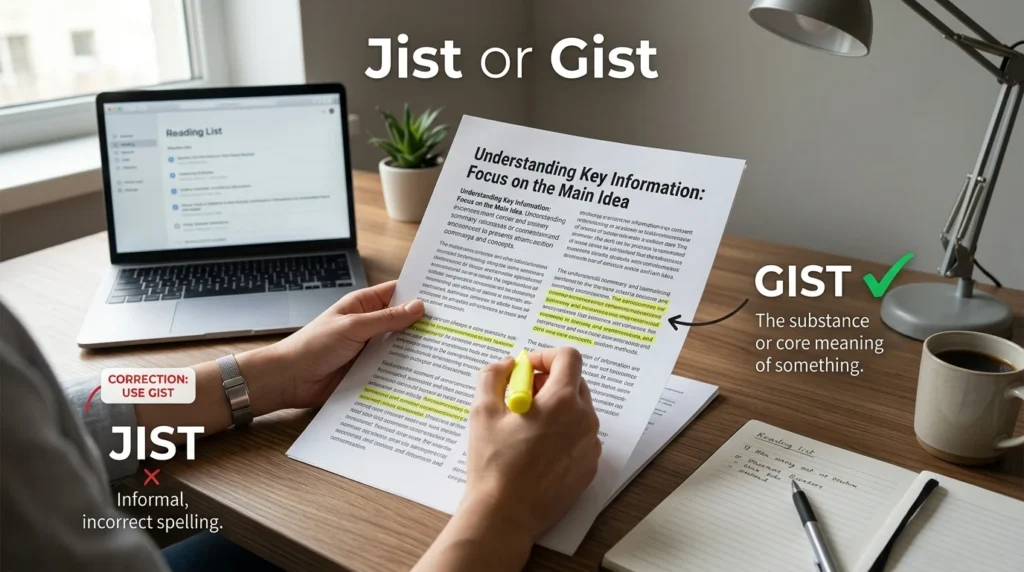
Gist is the correct spelling when you mean the main idea, meaning, or most important part of something. Jist is a common spelling mistake and is not the standard spelling of this word.
Have you ever written jist when you meant gist? You are not alone. These two spellings sound very similar, which makes the mistake easy to make. However, only gist is the standard spelling when you are talking about the main point or basic meaning of something.
For example, if someone explains a long story and you understand the most important part, you understand the gist of the story. The word is common in conversations, emails, articles, meetings, books, and everyday writing.
Understanding gist vs jist is simple once you connect the correct spelling with its meaning. In this guide, you will learn which word is correct, what gist means, how to use it, and why jist is considered incorrect.
What Does Gist Mean?
Gist means the main idea, central point, or general meaning of something.
When you understand the gist of something, you understand what it is mainly about without necessarily knowing every small detail.
For example:
I did not read the entire report, but I understand the gist.
This means the person understands the main point of the report even though they did not read every detail.
Another example:
Can you give me the gist of the conversation?
This asks someone to explain the most important part of the conversation.
Is Jist a Correct Word?
Jist is not the standard spelling when you mean the main idea or meaning of something.
The correct word is:
gist
So, if you want to say that you understand the main point, write:
I understand the gist.
Not:
I understand the jist.
The mistake usually happens because gist begins with a soft g sound, which can sound similar to the beginning of some words spelled with j.
Still, pronunciation does not change the spelling.
Gist vs Jist: What Is the Difference?
The difference is simple:
| Word | Correct? | Meaning |
|---|---|---|
| Gist | Yes | Main idea or central point |
| Jist | No | Common misspelling of gist |
There is no standard English meaning of jist that replaces the everyday meaning of gist.
Therefore, when you want to talk about the main idea of a conversation, article, message, story, or explanation, use gist.
Why Do People Spell Gist as Jist?
The main reason is pronunciation.
Gist is pronounced with a soft g sound. That sound is similar to the sound at the beginning of words such as job and jump.
Because of this, someone who hears the word before seeing it written may naturally guess that it starts with j.
That can lead to:
jist
instead of:
gist
English has many words where pronunciation does not make the spelling obvious. Gist is one of them.
The best solution is to remember the spelling rather than trying to spell it from sound.
How Do You Pronounce Gist?
Gist is pronounced roughly like jist.
The pronunciation can make the spelling confusing because the first sound is similar to the sound represented by j in many English words.
Even though it sounds like it begins with a j sound, the spelling is:
G-I-S-T
So remember:
It sounds like “jist,” but it is spelled “gist.”
That small distinction can help prevent the mistake.
What Is the Gist of Something?
When someone asks for the gist of something, they want the main point.
For example:
What is the gist of the article?
They are not necessarily asking you to explain every paragraph. They want a short explanation of what the article is mainly about.
You could answer:
The gist is that the company plans to expand next year.
The answer gives the central idea without unnecessary details.
Examples of Gist in Sentences
Here are some natural examples:
- I understand the gist of your message.
- She explained the gist of the story.
- Can you tell me the gist of the meeting?
- He quickly understood the gist of the argument.
- I caught the gist of what she was saying.
- The article gives the gist of the problem.
- We discussed the gist of the proposal.
- Did you get the gist of his explanation?
- She missed a few details but understood the gist.
- Let me give you the gist of the situation.
Each sentence uses gist to describe the central idea or general meaning.
Get the Gist
One of the most common expressions is:
get the gist
It means to understand the main idea of something.
For example:
I did not understand every word, but I got the gist.
This means the speaker did not understand every detail but understood the overall meaning.
You can also say:
Did you get the gist?
This is a natural way to ask whether someone understood the main point.
Another example:
After reading the first few pages, I got the gist of the story.
The Gist of the Conversation
The word gist is often used when discussing conversations.
Imagine that two coworkers have a long discussion about a new project. Later, another person asks what they discussed.
You might say:
The gist of the conversation was that the project needs more time.
You are giving the central point rather than repeating the entire conversation.
Another example:
I missed the meeting, so can you give me the gist?
This means:
Can you tell me the most important things that happened?
The Gist of a Story
You can also use gist when talking about stories.
For example:
I forgot some details, but I remember the gist of the story.
This means you remember the basic idea or main events.
You could also say:
What is the gist of the book?
The answer would usually be a short explanation of the book’s central idea or storyline.
The word works well because it allows you to talk about the main point without summarizing everything.
The Gist of an Article
If an article is several pages long, you may not need to remember every sentence.
You can say:
I read the article and understood the gist.
This means you understood what the article was mainly saying.
For example:
The gist of the article is that regular exercise can improve overall fitness.
The sentence gives the main idea in a short form.
The Gist of a Message
Gist is also useful when discussing emails and text messages.
For example:
I read your email, and I understand the gist.
Or:
Can you give me the gist of the message?
This can be especially useful when a message is long and you only need its main point.
For example:
The gist of the email is that the meeting has been moved to Friday.
That sentence gives the important information directly.
Gist in Professional Writing
The word gist can appear in professional communication too.
For example:
The gist of the proposal is to reduce unnecessary expenses.
Or:
I understand the gist of your recommendation.
However, in very formal documents, words such as summary, main point, or central idea may sometimes sound more precise.
For everyday professional communication, though, gist is perfectly natural.
Gist in Everyday Conversation
You will often hear gist in casual conversations.
For example:
I did not catch everything, but I got the gist.
Or:
Give me the gist of what happened.
These sentences sound natural because people often want the main information without hearing a long explanation.
Another common sentence is:
I get the gist.
This means:
I understand the basic idea.
Gist vs Summary
Gist and summary are related, but they are not exactly the same.
A gist is the central idea or basic meaning.
A summary usually gives a more organized account of the important points.
For example, if someone asks:
What is the gist of the article?
You might answer in one sentence.
If someone asks:
Can you summarize the article?
They may expect several sentences covering the main points.
So, gist is often shorter and more general than a full summary.
Gist vs Main Idea
Gist and main idea are very close in meaning.
For example:
I understand the gist of the article.
and:
I understand the main idea of the article.
Both sentences communicate a similar message.
The word gist is often more conversational, while main idea is especially common in education and reading exercises.
For example, a teacher might ask:
What is the main idea of this paragraph?
In everyday conversation, someone might ask:
What’s the gist?
Gist vs Point
The word point can also have a similar meaning.
Compare:
What is the gist of the conversation?
with:
What is the point of the conversation?
These can sometimes mean nearly the same thing, but point can have several other meanings.
Gist specifically focuses on the main idea or overall meaning.
For that reason, gist is useful when you want to talk about the general message of something.
Common Mistakes With Gist
The most common mistake is spelling gist as jist.
For example:
Incorrect:
I understand the jist.
Correct:
I understand the gist.
Another mistake is using gist when you actually need a detailed summary.
If someone asks for the gist, they usually want the central idea rather than every detail.
A third mistake is assuming that because gist sounds like jist, both spellings are acceptable.
They are not.
For standard English writing, use gist.
How to Remember the Spelling
A simple trick is to remember:
Gist = General Idea
Both words begin with G.
You can think:
Gist = General idea
This is not a grammar rule. It is simply a memory trick.
Another way to remember it is to connect gist with words such as:
- general meaning
- general idea
- main point
- central idea
Whenever you mean one of these, think of gist.
Gist in Reading
The word is especially useful when talking about reading.
Imagine you read a long news article quickly. You may not remember every fact, but you understand what the article is mainly about.
You can say:
I got the gist of the article.
This is different from saying:
I remember every detail.
The first sentence only claims that you understand the main idea.
That makes gist a useful word when discussing reading comprehension.
Gist in Listening
You can also understand the gist of spoken language.
For example:
I could not hear every word, but I understood the gist.
This means that some words were missed, but the overall meaning was clear.
The word is useful in conversations, meetings, lectures, interviews, and presentations.
Gist in Emails and Messages
Long emails often contain more information than you need.
Instead of reading every detail, you might ask someone:
What’s the gist of the email?
They might answer:
The gist is that the deadline has been moved to Monday.
This gives you the important information quickly.
The same idea works for text messages, group chats, announcements, and notices.
Gist and Understanding
Knowing the gist does not always mean you understand everything.
For example, imagine someone explains a complicated technical problem.
You may understand:
The computer has a serious software problem.
But you may not understand exactly which part of the system caused it.
In this case, you understand the gist, but not all the details.
This is one of the most useful ways to understand the word.
Practice: Gist or Jist?
Choose the correct spelling.
1. I understand the ___ of the story.
Answer: gist
2. Can you give me the ___ of the meeting?
Answer: gist
3. She quickly got the ___ of his explanation.
Answer: gist
4. I did not understand every detail, but I got the ___.
Answer: gist
5. What is the ___ of this article?
Answer: gist
In every example, gist is correct.
Rewrite the Incorrect Sentences
Here are some common mistakes and their corrections.
Incorrect:
I got the jist of the conversation.
Correct:
I got the gist of the conversation.
Incorrect:
Can you explain the jist?
Correct:
Can you explain the gist?
Incorrect:
I understand the jist of the article.
Correct:
I understand the gist of the article.
Incorrect:
She knows the jist of the problem.
Correct:
She knows the gist of the problem.
The pattern is always the same: replace jist with gist.
Is Gist a Noun or Verb?
Gist is commonly used as a noun when it means the main idea or central meaning.
For example:
I understand the gist.
She explained the gist of the story.
In these sentences, gist is a noun.
You will most often see it in phrases such as:
- the gist of the story
- the gist of the conversation
- the gist of the article
- the gist of the message
- the gist of the argument
- get the gist
Is Jist Ever Correct?
For the meaning discussed in this article, jist is not the standard spelling.
If you want to describe the main idea or basic meaning of something, write gist.
So:
gist = correct
jist = incorrect spelling
This is one of those words where pronunciation can easily lead to a spelling mistake.
Gist or Jist in Texting
In casual texting, people sometimes make spelling mistakes because they type quickly or spell words based on how they sound.
You may therefore see jist in messages.
However, seeing a spelling mistake frequently does not make it standard English.
If you are writing an email, school assignment, article, application, or professional message, use:
gist
For example:
I get the gist of what you’re saying.
Gist or Jist in School and Academic Writing
Students often use gist when discussing reading comprehension.
For example:
The gist of the paragraph is that technology has changed the way people communicate.
You may also see instructions such as:
Read the passage and identify its gist.
Because gist refers to the central meaning, it is useful when students need to understand a text without focusing on every detail.
Remember to spell it with a g.
Quick Comparison of Gist and Jist
| Feature | Gist | Jist |
|---|---|---|
| Standard spelling | Yes | No |
| Meaning | Main idea or central point | No standard meaning in this use |
| Common mistake | No | Yes |
| Example | I understand the gist. | I understand the jist. |
| Correct choice | Gist | Avoid |
The answer is straightforward: when you mean the main idea, use gist.
Final Tips
Keep these points in mind:
- Gist is the correct spelling.
- Jist is a common misspelling.
- Gist means the main idea or central meaning.
- You can understand the gist without knowing every detail.
- Get the gist means understand the main idea.
- The gist of the story means the central meaning of the story.
- Gist is commonly used as a noun.
- The word is useful in conversations, reading, writing, meetings, and messages.
- Remember: gist sounds like it starts with a J sound, but it is spelled with a G.
FAQs
Is gist or jist correct?
Gist is the correct spelling when you mean the main idea or central meaning of something. Jist is a common misspelling.
What does gist mean in simple words?
Gist means the main idea or most important point of something. If you understand the gist, you understand what something is mainly about.
Why is gist spelled with a G instead of a J?
The pronunciation of gist begins with a sound that can resemble the sound of the letter J in other words. That can make the spelling confusing, but the standard spelling is gist.
Can I say I got the gist of the conversation?
Yes. I got the gist of the conversation is a natural sentence. It means you understood the main point of the conversation without necessarily remembering every detail.
Is gist the same as summary?
They are similar, but not exactly the same. A gist is the basic idea or central point, while a summary can provide several important details from a longer piece of information.
Conclusion
Gist is the correct word when you want to describe the main idea, central point, or general meaning of something. You can talk about the gist of a story, article, conversation, email, meeting, message, or explanation.
Jist is a common spelling mistake caused mainly by the pronunciation of gist. Even though the word sounds as if it could begin with a J, the correct spelling begins with G.
The easiest way to remember it is simple: when you mean the general idea, think gist. So write “I understand the gist”, not “I understand the jist.”