

Quick Answer
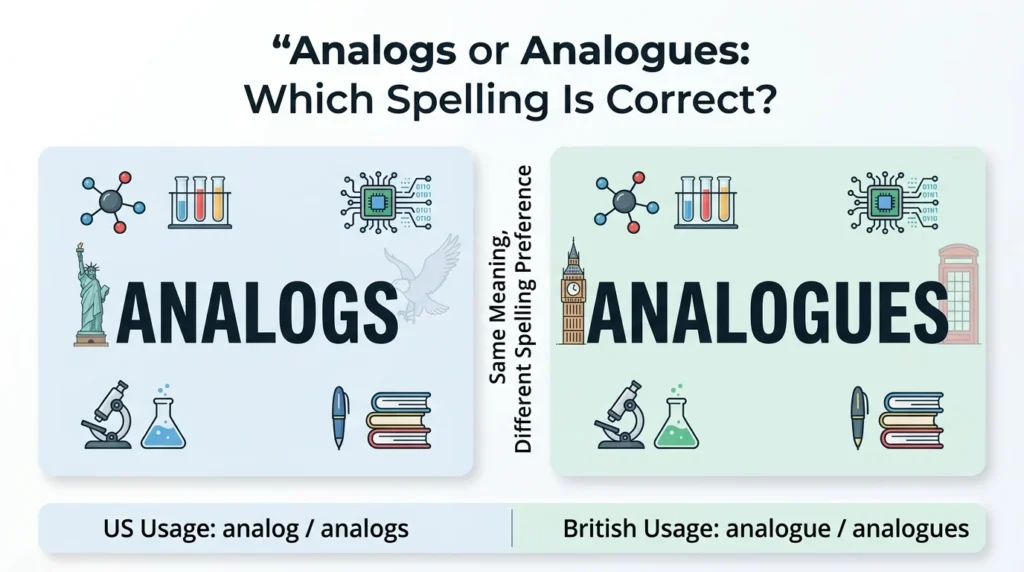
Analogs and analogues are both correct spellings. Analogs is widely used in American English, especially in technical, scientific, and technology contexts, while analogues is more common in British English. The right choice depends on your audience and the style of writing you are following.
The choice between analogs or analogues can be confusing because you may see both spellings in dictionaries, research papers, websites, and books. Unlike a simple spelling mistake, this is mainly a question of English variety and context. In American writing, analog is very common, especially when the word is used as an adjective, such as analog signal, analog technology, or analog device. The shorter spelling also appears as a noun, particularly in chemistry and other technical fields. British English commonly uses analogue, with analogues as the plural form. Merriam Webster lists analogue as a British spelling of analog and notes that analog is especially common in chemical contexts.
So, which one should you use? If you are writing for a US audience, analogs will often be the natural choice, particularly in technical content. However, analogues is not simply “wrong.” It is a legitimate spelling with a long history of use. The key is to understand the context, choose a consistent style, and avoid treating one spelling as universally correct.
Analogs or Analogues: The Basic Difference
The simplest way to understand the difference is to look at the two forms:
Analog → analogs
Analogue → analogues
Both refer to something that is similar or comparable to something else. They can also be used for particular scientific, biological, chemical, or technological concepts.
For example:
The researchers studied several analogs of the original compound.
A British publication might write:
The researchers studied several analogues of the original compound.
The basic meaning remains the same.
The difference is mainly the spelling convention being followed.
| Form | Common usage |
|---|---|
| analog | Common in American English and technical contexts |
| analogs | Plural form of analog |
| analogue | Common British spelling and also used in some American noun contexts |
| analogues | Plural of analogue |
This is why it is better to think of the pair as regional and contextual variants, rather than labeling one as correct and the other as incorrect.
What Does Analog Mean?
Analog can mean something that is similar or comparable to another thing.
For example:
The new system is an analog of the older design.
In this sentence, the new system resembles the older design in an important way.
The word has more specialized meanings, too. In chemistry, an analog can be a compound that has a structure similar to another compound but differs in some way. Merriam Webster specifically notes this chemical use and gives analog as the usual form in that context.
You may also know analog from technology.
Examples include:
analog signal
analog clock
analog recording
analog device
In these expressions, the word describes systems or information that involve continuously varying signals rather than digital values.
What Does Analogue Mean?
Analogue has the same basic meaning as analog when it refers to something similar or comparable.
For example:
The new product is an analogue of the older model.
It can also be used in scientific and biological contexts.
For instance:
The two structures are functional analogues.
The spelling with ue is particularly common in British English. Merriam Webster describes analogue as the chiefly British spelling of analog.
However, it is important not to assume that American English completely rejects analogue. American dictionaries still recognize the form. Collins, for example, lists analogue in American English and also gives analog as an alternative.
That distinction matters when writing an accurate article.
Is Analogs or Analogues Correct?
Both are correct.
The better question is:
Which spelling fits my audience and context?
If you are writing general American English or technical content for US readers, analogs is often the natural choice.
If you are writing British English, analogues is a familiar and standard choice.
There is also a useful context-based rule. In American technical writing, especially in areas such as chemistry and electronics, analog is very common. Merriam Webster notes that the shorter form is preferred in adjective uses such as analog watch and analog recording, while the noun can appear as either analog or analogue, depending on context.
Therefore, a blanket rule such as “analogs is always American and analogues is always British” is too simple.
When Should You Use Analogs?
Use analogs when it fits the style of your writing and audience.
For example:
Researchers developed several analogs of the original compound.
The study compared different analogs of the drug.
These systems are modern analogs of older designs.
This form is especially natural in American scientific and technical writing.
Chemistry Example
Scientists tested several chemical analogs during the experiment.
Here, analogs refers to compounds related to another compound.
Technology Example
The company created digital replacements for several older analog systems.
In this sentence, analog is being used as an adjective.
General Comparison
The two devices are analogs of one another.
Here, the noun means that the devices are comparable in some meaningful way.
When Should You Use Analogues?
Use analogues when you are following British English conventions or when the publication, organization, or field you are writing for prefers that form.
For example:
The researchers examined several analogues of the original compound.
A British academic paper may naturally use this spelling.
Likewise:
Historical analogues can help us understand the present situation.
The spelling is perfectly valid.
You should not automatically correct analogues to analogs simply because your own preferred style is American English.
Why Do the Two Spellings Exist?
The difference comes from the way English spelling developed in different regions.
Words ending in ogue often have shorter og forms in American English. Analog/analogue is one example.
However, English spelling is not perfectly consistent. Some words retain their longer forms in American English, while others have developed shorter alternatives.
That is why it is better to learn the usage of each word rather than apply one rule to every English word ending in ogue.
For analog, both forms remain recognizable and established.
Analogs or Analogues in American English
For a US audience, analog is an especially familiar spelling in technology and science.
You will commonly see:
analog signal
analog device
analog clock
analog recording
analog technology
analog circuit
chemical analog
drug analog
The plural analogs follows naturally when the noun is plural.
For example:
Researchers tested several drug analogs.
This sounds completely natural in American technical writing.
At the same time, American English can use analogue as a noun. That is why it is more accurate to say that analogs is a common American form, rather than claiming that analogues is always wrong in the US.
Analogs or Analogues in British English
British English commonly favors analogue and analogues.
For example:
The researchers studied several analogues of the compound.
The machine uses analogue technology.
The report discusses historical analogues.
This spelling is familiar to British readers and should not be treated as a spelling error.
If you are writing for a British publication, consistency matters more than trying to force American spelling into the article.
Analog as an Adjective
One reason analog appears so frequently in American writing is its use as an adjective.
For example:
analog clock
analog signal
analog audio
analog electronics
analog technology
In these phrases, analog describes the type of object or system.
For example:
The museum has an old analog clock.
The clock uses hands and a dial rather than a digital numerical display.
Another example:
The engineer measured the analog signal before converting it to digital data.
Here, analog describes the signal.
Analog as a Noun
The noun has a broader meaning.
An analog can be something that is similar or comparable to something else.
For example:
The new device is an analog of the older machine.
In chemistry:
The researchers created an analog of the original molecule.
In these cases, the word identifies something that has a meaningful relationship or similarity to another thing.
Merriam Webster defines an analog as something similar or comparable to another thing and also recognizes more specialized biological, chemical, and food-related meanings.
Analogue as a Noun
The noun analogue can carry the same meaning.
For example:
The new compound is an analogue of the original.
The historical event has several analogues.
The researchers examined a biological analogue.
This form is especially familiar in British English, although it also occurs in American English.
Analogs in Chemistry
Chemistry is one of the areas where the shorter analog spelling is particularly useful for US readers.
A chemical analog is a compound that resembles another compound but has a difference in structure or composition.
For example:
The researchers synthesized several analogs of the original molecule.
Another example:
One of the new analogs showed better stability.
The word does not mean that the two compounds are identical. Instead, they share an important structural relationship.
Merriam Webster specifically notes that chemical compounds of this type are usually analog in this sense.
Analogs in Medicine
Medical and pharmaceutical writing also uses analog frequently.
For example:
The researchers tested several drug analogs.
A new analog was developed to improve the treatment’s effectiveness.
The study compared the properties of several insulin analogs.
The exact meaning depends on the medical field, but the central idea is usually that the substance resembles another compound while having some difference.
For US medical content, analogs is a natural plural form.
Analogs in Biology
Biology has its own use of the word.
An analog can describe an organ or structure that performs a similar function to another structure but has a different origin or construction.
For example, different organisms can have structures that serve comparable functions even though they developed differently.
This is a technical use, so the surrounding context is important.
The word analogous is closely related.
For example:
The structures have analogous functions.
Merriam Webster defines analogous as meaning similar or comparable in a particular way.
Analogs in Technology
Technology provides one of the most familiar uses of analog.
You may hear about:
analog audio
analog video
analog signals
analog electronics
analog sensors
analog devices
For example:
The microphone produces an analog signal that can be converted into digital data.
The word analog here describes a type of signal.
Analog and Digital
Analog and digital systems handle information in different ways.
An analog signal can vary continuously.
A digital system represents information using discrete values.
This is why people often compare:
analog vs digital
For example:
Vinyl records use analog audio, while MP3 files store digital audio.
The distinction is technical, but the vocabulary is common in everyday discussions about technology.
Analog Clock and Digital Clock
A clock is an easy way to understand the technology-related meaning.
An analog clock usually has hands that move around a dial.
A digital clock normally displays numbers.
For example:
The classroom has an analog clock on the wall.
My phone shows the time on a digital display.
The American spelling is analog in the adjective.
Analog Signal and Digital Signal
An analog signal changes continuously over time.
A digital signal represents information using distinct values.
For example, sound exists as a continuously changing physical phenomenon. Electronic equipment can represent that information in analog form or convert it into digital data.
A simple sentence is:
The device converts an analog signal into digital information.
This is a common use of analog in engineering and technology.
Analogs vs Similar Things
An analog is related to the idea of similarity, but it is not simply another word for similar.
Consider:
The two products are similar.
This is a general statement.
Now compare:
The new product is an analog of the older design.
The second sentence suggests a more specific relationship between the two things.
The word often appears in technical, scientific, historical, and comparative discussions.
Analogs vs Equivalents
An analog and an equivalent can sometimes describe related ideas, but they are not identical.
An equivalent is something considered equal or interchangeable for a particular purpose.
An analog is something that resembles or corresponds to another thing.
For example:
The new compound is an analog of the original compound.
This does not necessarily mean that both compounds have exactly the same effects.
That distinction is important in scientific writing.
Analogs vs Alternatives
An alternative is another possible choice.
An analog is something comparable or similar.
For example:
We need an alternative to this software.
This means we need another option.
By contrast:
The new system is an analog of the older system.
This means the two systems have a meaningful similarity.
The words can appear in the same discussion, but they describe different relationships.
Common Spelling Mistakes
Writing Analogues When Your Style Requires Analogs
This is not necessarily a spelling error. It becomes a style issue when your publication specifically follows American conventions.
If your US publication uses analog, maintain that choice throughout the article.
Treating Analogues as Incorrect
This is another common mistake.
Analogues is a legitimate English spelling. It is particularly common in British English and remains recognized in American dictionaries as well.
Mixing Both Forms Without a Reason
Avoid switching randomly:
The study tested three analogs.
Then:
The next experiment used two analogues.
Unless there is a clear reason, this looks inconsistent.
Pick the spelling that matches your publication style.
Confusing Analog With Analogy
These words are related, but they are not interchangeable.
Analog can refer to something comparable to another thing.
Analogy refers to a comparison between two things.
For example:
The machine is an analog of the older design.
But:
The teacher used an analogy to explain the concept.
Analog vs Analogy
This distinction is useful for learners.
An analog is usually a thing.
An analogy is a comparison.
For example:
The new device is an analog of the old one.
The teacher used an analogy to make the lesson easier to understand.
The words are related in meaning, but they have different grammatical roles.
Analog vs Analogous
Analog is commonly used as a noun or adjective.
Analogous is an adjective.
For example:
The new compound is an analog of the original.
The two systems are analogous.
The first sentence identifies a thing.
The second describes a relationship.
Merriam Webster defines analogous as similar or comparable in a specific way.
Singular and Plural Forms
The spelling becomes easier when you look at the complete word family.
American Style
analog
analogs
British Style
analogue
analogues
Examples:
One analog was tested.
Several analogs were tested.
Or:
One analogue was tested.
Several analogues were tested.
Both patterns are grammatically correct.
Pronunciation
Analog and analogue are generally pronounced the same way.
That is one reason the difference can be difficult to notice in conversation.
When someone says the word aloud, you may not know whether they would spell it with -og or -ogue.
The difference becomes visible when the word is written.
How to Choose the Right Spelling
Ask yourself three simple questions.
Who Is Reading Your Writing?
If your audience is mainly American, analog/analogs will often fit naturally.
If your audience is British, analogue/analogues may be more appropriate.
What Style Guide Are You Following?
A company, university, journal, or publication may have its own style.
Follow that style when one exists.
What Field Are You Writing About?
Technical fields may have their own established preferences.
For example, analog is especially common in technical adjective phrases and chemical terminology.
A Simple Rule for US Writers
If you are creating general content for American readers, this is a useful starting point:
Use analog and analogs.
Examples:
analog signal
analog device
chemical analog
drug analogs
historical analogs
However, do not assume that every appearance of analogue in American writing is an error. The noun analogue is recognized in American English, so context still matters.
A Simple Rule for British Writers
For British English, analogue and analogues are familiar standard forms.
Examples:
analogue signal
analogue device
chemical analogue
historical analogues
If you are following British spelling throughout a document, consistency is the main goal.
Real World Examples
Science
The researchers tested several analogs of the original compound.
Medicine
Scientists are developing new drug analogs for further testing.
Technology
The factory still uses some analog equipment.
Electronics
The engineer measured the analog signal before processing it digitally.
History
Historians found several analogs to the earlier event.
General Writing
The new system is an analog of an older model.
British Style
The researchers examined several analogues of the original compound.
These examples show why context matters.
Quick Comparison Table
| Word | Meaning | Typical use |
|---|---|---|
| analog | Something similar or comparable; also a technical adjective | Common in US and technical writing |
| analogs | Plural of analog | Common US plural |
| analogue | Variant spelling of analog | Common in British English; also used as a noun in US English |
| analogues | Plural of analogue | Common British plural |
| analogous | Similar or comparable | Adjective |
| analogy | A comparison between things | Noun |
Practice Exercises
Choose the form that best fits each sentence.
Exercise One
- The researchers tested several chemical ______.
- The machine uses an ______ signal.
- The new device is an ______ of the older model.
- British researchers described the compounds as chemical ______.
- The two systems are ______ in several ways.
Answers
- analogs
- analog
- analog
- analogues
- analogous
Exercise Two
Choose the better word.
- The teacher used an ______ to explain the idea.
- The new compound is an ______ of the original.
- The two systems are ______.
Answers
- analogy
- analog
- analogous
This exercise shows that analog, analogy, and analogous are related but have different jobs in a sentence.
Correct the Sentences
Sentence One
The company developed several new analogues for the American technology market.
This sentence is not necessarily wrong. If the company’s style uses American technical terminology, analogs may be the more natural choice:
The company developed several new analogs for the American technology market.
Sentence Two
The engineer tested an analogues signal.
This is incorrect because analogues is plural.
Correct:
The engineer tested an analog signal.
Sentence Three
The researchers tested one analogs.
This is incorrect because analogs is plural.
Correct:
The researchers tested one analog.
Sentence Four
The researchers tested several analog.
This is incorrect because the plural is needed.
Correct:
The researchers tested several analogs.
FAQs
Are analogs and analogues both correct spellings?
Yes. Both are established spellings. Analogs is widely used in American English, while analogues is especially common in British English. The noun analogue also appears in American English.
Should I use analogs or analogues for a US audience?
For general US and technical writing, analogs is usually the natural choice. Still, check your publication or organization’s style if it has a specific preference.
What is the difference between analog and analogue?
The basic meaning is the same. Analog is the shorter spelling and is especially common in American technical usage, while analogue is strongly associated with British English and is also used as a noun in American English.
What is the plural of analog?
The plural is analogs. For example, “Scientists tested several analogs of the original compound.”
Are analogues wrong in American English?
No. Analogues is not simply an incorrect spelling. It is the plural of analogue, and American dictionaries recognize analogue as a noun variant. For a consistent US technical style, however, analogs may be the better choice.
Conclusion
The choice between analogs or analogues is more nuanced than simply calling one spelling right and the other wrong. Both forms are established in English. Analogs is widely used in American English, particularly in technology, science, chemistry, medicine, and other technical fields. Analogues is strongly associated with British English, although analogue and analogues can also appear in American writing, especially when the word is being used as a noun.
For a US focused website, analogs is usually the cleanest choice when you need the plural of analog. Use analog for the singular, as in “a chemical analog,” and analogs for more than one, as in “several chemical analogs.” If you are writing for a British publication, analogue and analogues may fit better. Most importantly, do not mix the forms without a reason. Follow the spelling style used by your audience, publication, or field. When the context is technical, also pay attention to whether the word is being used as a noun or an adjective. That small distinction can explain why both forms appear in reliable English sources.