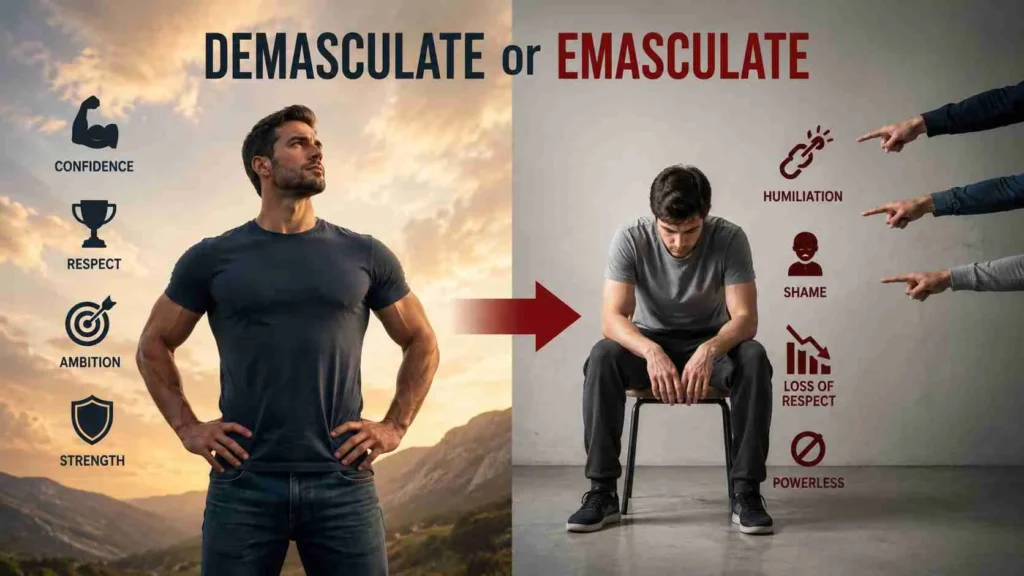

Many people search for demasculate or emasculate because the two words look similar and seem to carry the same meaning. The confusion often happens when people hear the word in conversation and then try to write it. Since both terms appear related to masculinity, many assume that either spelling is correct.
However, English vocabulary can be tricky. Some words follow historical language rules that make their spelling different from what people expect. This is exactly what happens with emasculate.
The word emasculate has been used in English for centuries and appears in dictionaries, academic texts, newspapers, books, and professional writing. Meanwhile, demasculate is generally viewed as a mistaken variation that developed through misunderstanding or informal usage.
Understanding demasculate or emasculate is important for students, writers, professionals, bloggers, and anyone who wants to communicate clearly. Using the correct word improves credibility and prevents grammar mistakes.
This guide explains the meaning, spelling, usage, history, examples, common mistakes, comparisons, exercises, and professional writing recommendations in simple language that is easy to understand.
Quick Overview
Emasculate is the correct English word.
Demasculate is generally considered incorrect or nonstandard.
Emasculate means to weaken, reduce strength, diminish confidence, or remove traditionally masculine characteristics.
The word is commonly used in psychology, literature, sociology, communication, media studies, and everyday conversation.
Definition of Emasculate
Emasculate is a verb.
It traditionally means to deprive a man of strength, vigor, confidence, authority, or traditional masculine traits.
Today, the word is often used figuratively rather than literally.
Examples
- Constant criticism can emasculate a person’s confidence.
- The character felt emasculated after losing his leadership role.
- The movie explores themes of identity and emasculation.
The word is frequently used when discussing confidence, authority, self image, social expectations, and gender roles.
Definition of Demasculate
Demasculate is generally not recognized as the standard English word.
Most major dictionaries do not list it as the preferred term.
People often create the word because they assume the prefix de should be added to masculine related words.
However, standard English already has the established word emasculate.
Therefore, professional writers, editors, teachers, and grammar experts recommend using emasculate.
Key Difference Between Demasculate or Emasculate
The primary difference is correctness.
Emasculate is accepted.
Demasculate is generally not accepted in standard English.
Quick Comparison Table
| Feature | Emasculate | Demasculate |
|---|---|---|
| Dictionary Accepted | Yes | Rarely |
| Standard English | Yes | No |
| Academic Writing | Yes | No |
| Professional Writing | Yes | No |
| Common Usage | Very Common | Rare |
| Recommended Word | Yes | No |
Visual Comparison of Demasculate or Emasculate
The comparison highlights that emasculate is the recognized word in dictionaries and professional writing, while demasculate is generally treated as an error.
Origin and History of Emasculate
The word emasculate comes from Latin roots.
Historically, it referred to removing male characteristics. Over time, its meaning expanded and became more figurative.
Today, people use emasculate to describe situations that reduce confidence, authority, power, or self esteem.
The word appears in literature, psychology, sociology, political commentary, and media discussions.
Because it has existed for centuries, emasculate became firmly established in English vocabulary.
Why People Confuse Demasculate or Emasculate
Several factors contribute to the confusion.
Similar Sound Patterns
People hear the word in conversation and assume another spelling exists.
Prefix Confusion
Many English words use the prefix de.
Examples include:
- Deactivate
- Devalue
- Deconstruct
- Degrade
As a result, some people mistakenly form demasculate.
Informal Online Usage
Incorrect spellings sometimes spread through social media and informal discussions.
Lack of Dictionary Verification
Many writers never check whether the word exists in standard dictionaries.
Meaning of Emasculate in Modern English
Modern usage focuses more on emotional and psychological meanings.
It often refers to reducing confidence, authority, status, or influence.
Examples include:
- Workplace situations
- Leadership challenges
- Relationship discussions
- Social commentary
- Literature analysis
The word does not always relate directly to gender.
Instead, it frequently describes a loss of strength or authority.
Emasculate in Psychology


6
Psychologists sometimes discuss emasculation when analyzing confidence and identity.
Examples may include:
- Loss of authority
- Social embarrassment
- Relationship conflict
- Workplace struggles
In psychological discussions, the term often refers to perceived loss of self worth rather than physical characteristics.
Emasculate in Literature
Literature frequently uses emasculate to explore character development.
Authors may describe characters who:
- Lose power
- Lose leadership
- Experience humiliation
- Face social pressure
Classic and modern novels often use the concept to examine identity and personal growth.
Emasculate in Relationships
Relationship discussions sometimes include the word emasculate.
Examples may involve:
- Constant criticism
- Public embarrassment
- Lack of respect
- Undermining authority
However, healthy relationships focus on mutual respect rather than power struggles.
Therefore, communication experts recommend constructive communication instead of criticism.
Emasculate in Workplace Settings
The word can also appear in professional discussions.
Examples include:
- Publicly dismissing an employee
- Ignoring leadership authority
- Undermining professional contributions
In workplace communication, respect and professionalism help prevent such situations.
Common Contexts Where Emasculate Is Used
The word appears in many fields.
Psychology
Confidence and self image discussions.
Sociology
Gender roles and social expectations.
Literature
Character analysis and storytelling.
Media
Cultural and social commentary.
Communication
Discussions about respect and authority.
Real World Examples
Example One
A manager repeatedly dismisses an employee’s ideas during meetings.
The employee feels emasculated because his professional contributions are ignored.
Example Two
A novel character loses political power and struggles with identity.
The author describes the experience as emasculating.
Example Three
A sports team captain loses leadership authority after organizational changes.
Commentators describe the situation as emotionally emasculating.
Example Four
A public figure faces repeated criticism that damages confidence and reputation.
Writers may describe this process as emasculation.
Advantages of Using the Correct Word
Using emasculate correctly offers several benefits.
Professional Credibility
Correct vocabulary improves trust.
Better Communication
Readers understand the intended meaning.
Academic Accuracy
Students receive better grades for proper language use.
Stronger Writing
Correct word choice improves overall quality.
Disadvantages of Using Demasculate
Using demasculate may create problems.
Reduced Credibility
Readers may question language skills.
Editing Corrections
Editors often replace the word.
Academic Issues
Teachers may mark it as incorrect.
Professional Concerns
Incorrect terminology can weaken professional communication.
Common Mistakes When Using Demasculate or Emasculate
Mistake One
Using demasculate in formal writing.
Correction:
Use emasculate.
Mistake Two
Assuming both words are acceptable.
Correction:
Only emasculate is standard English.
Mistake Three
Using the term without understanding context.
Correction:
Understand that the word often refers to confidence or authority.
Mistake Four
Confusing emotional meaning with physical meaning.
Correction:
Modern usage is usually figurative.
Mistake Five
Using the word excessively.
Correction:
Choose alternative terms when appropriate.
Related Words and Concepts
Several words share similar meanings.
Humiliate
To cause embarrassment.
Weaken
To reduce strength.
Undermine
To gradually reduce confidence or authority.
Diminish
To make smaller or less important.
Disempower
To remove power or influence.
Belittle
To make someone feel unimportant.
Emasculate Versus Humiliate
Although similar, these words are different.
Emasculate
Focuses on reducing strength, confidence, or authority.
Humiliate
Focuses on embarrassment or shame.
A person may feel humiliated without feeling emasculated.
Likewise, a person may feel emasculated without public embarrassment.
Emasculate Versus Undermine
These terms are closely related.
Emasculate
Often affects confidence and identity.
Undermine
Refers to weakening authority, influence, or support.
Undermining behavior may eventually lead to feelings of emasculation.
Third Visual Comparison Section


Understanding related terms helps writers choose the most accurate word for each situation.
Beginner to Advanced Understanding
Beginner Level
Emasculate is correct.
Demasculate is incorrect.
Intermediate Level
Emasculate means reducing confidence, strength, or authority.
Advanced Level
The term often appears in discussions about psychology, sociology, leadership, identity, literature, and communication.
Regional and Global Usage
The word emasculate is accepted worldwide.
It appears in:
- American English
- British English
- Canadian English
- Australian English
The spelling remains the same across these varieties.
Demasculate is rarely accepted in professional language.
Exercises With Answers
Question One
Which word is correct?
Answer: Emasculate
Question Two
Is demasculate standard English?
Answer: No.
Question Three
Can emasculate describe reduced confidence?
Answer: Yes.
Question Four
Is emasculate commonly used in literature?
Answer: Yes.
Question Five
Does emasculate always refer to physical changes?
Answer: No.
Question Six
Can the term be used figuratively?
Answer: Yes.
Question Seven
Which word appears in dictionaries?
Answer: Emasculate.
Question Eight
Should students use demasculate in essays?
Answer: No.
Question Nine
Can emasculate refer to authority loss?
Answer: Yes.
Question Ten
Is emasculate accepted in professional writing?
Answer: Yes.
FAQs
Is demasculate or emasculate correct?
Emasculate is the correct and accepted English word.
Is demasculate a real word?
It may appear occasionally, but it is generally considered nonstandard.
What does emasculate mean?
It means reducing strength, confidence, authority, or traditional masculine qualities.
Can emasculate be used in modern writing?
Yes. It appears frequently in professional and academic writing.
Why do people say demasculate?
Many people mistakenly create the word because of common English prefixes.
Is emasculate offensive?
It depends on context. The term can be sensitive in discussions about identity and gender.
Can women be described as emasculating someone?
The term is often used in relationship and social discussions, but context matters.
Does emasculate always refer to masculinity?
Modern usage often focuses on confidence, authority, or power rather than physical masculinity.
Is emasculate common in psychology?
Yes. It sometimes appears in discussions about confidence and identity.
Should writers use demasculate?
No. Professional writers should use emasculate.
Conclusion
Understanding demasculate or emasculate is important for accurate communication. While the two words may appear similar, only emasculate is recognized as the standard English term. It has a long history in the language and appears in dictionaries, literature, academic writing, psychology, sociology, and professional communication.
Today, emasculate is usually used figuratively. It often describes situations that reduce confidence, authority, influence, or self esteem. Meanwhile, demasculate is generally viewed as a mistaken variation and should be avoided in formal writing.
Whether you are writing an essay, article, blog post, research paper, or professional document, using emasculate correctly improves clarity and credibility. The simplest rule is easy to remember: emasculate is correct, demasculate is not. Following this guideline will help you communicate more effectively and avoid common vocabulary mistakes.