
Quick Answer
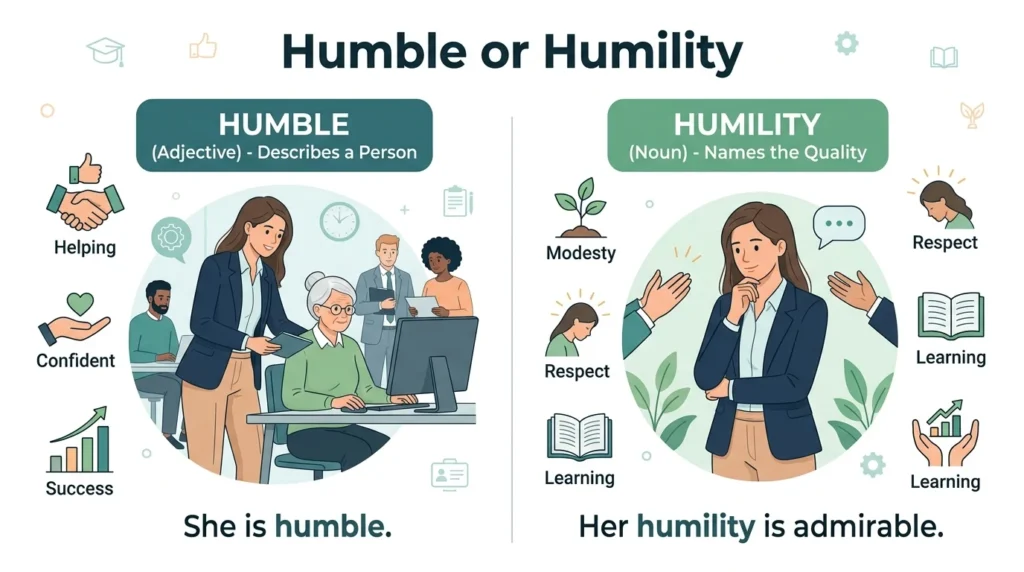
Humble is an adjective that describes a person, attitude, or behavior. Humility is a noun that describes the quality of being humble, especially having a modest view of yourself and your achievements.
Humble or humility can be confusing because both words describe the same general idea: modesty and a lack of excessive pride. However, they do different jobs in a sentence. Humble describes someone or something, while humility names the quality itself.
For example, you might say, “She is humble despite her success.” Here, humble describes the person. In another sentence, you could say, “Her humility impressed everyone.” This time, humility is the quality that impressed people.
The difference becomes much easier once you understand their parts of speech. Knowing how to use both words can help you write more naturally in conversations, school assignments, workplace communication, biographies, and everyday American English.
Humble vs Humility at a Glance
The basic difference is straightforward.
| Word | Part of Speech | Meaning | Example |
|---|---|---|---|
| Humble | Adjective | Modest and not overly proud | He is very humble. |
| Humility | Noun | The quality of being humble | Her humility is admirable. |
Think of it this way:
Humble = describes a person
Humility = describes the quality
That distinction will help you choose the right word in most sentences.
What Does Humble Mean?
Humble is an adjective.
It describes someone who does not act as if they are better, more important, or more talented than everyone else.
For example:
She is very humble despite winning several awards.
The word tells us something about her personality and behavior.
You can also use humble to describe someone’s attitude:
He has a humble attitude.
Another example is:
The athlete remained humble after becoming famous.
The person achieved success but did not become arrogant or overly proud.
What Does Humility Mean?
Humility is a noun.
It refers to the quality or condition of being humble.
For example:
His humility made him easy to work with.
Here, humility is not describing the person directly. Instead, it names the quality that the person possesses.
Other examples include:
- Her humility impressed the team.
- Success did not take away his humility.
- Leaders need humility as well as confidence.
- His humility made people respect him.
The word describes an inner quality rather than the person directly.
Humble and Humility in Simple Sentences
Compare these sentences:
Maria is humble.
Maria has humility.
Both sentences communicate a similar idea, but the grammar is different.
In the first sentence, humble describes Maria.
In the second sentence, humility is the quality Maria has.
Another pair makes the difference even clearer:
He is humble about his success.
His humility is obvious.
The first sentence uses an adjective. The second uses a noun.
When to Use Humble
Use humble when you want to describe a person, attitude, action, or situation.
For example:
She is a humble person.
He remained humble after his promotion.
They come from a humble background.
His response was humble and sincere.
You can also use humble as a verb, although this use is less common in everyday conversation.
As a verb, humble can mean to make someone less proud or to remind someone of their limitations.
For example:
The experience humbled him.
Here, the experience caused him to become more modest.
When to Use Humility
Use humility when you are talking about the quality of being humble.
For example:
Her humility is one of her best qualities.
He showed great humility after winning the award.
The experience taught him humility.
Good leaders often value humility.
Because humility is a noun, it often follows words such as:
- show
- demonstrate
- have
- value
- practice
- teach
- admire
For example:
She showed humility when she thanked her entire team.
Humble as an Adjective
The most common grammatical role of humble is adjective.
An adjective describes a noun or pronoun.
Examples:
He is humble.
She has a humble personality.
They are humble people.
We admired his humble attitude.
In each case, the word gives us information about a person or their behavior.
You can also use humble before a noun:
a humble leader
a humble student
a humble family
a humble response
This is different from humility, which names the quality itself.
Humility as a Noun
Since humility is a noun, it can act as the subject or object of a sentence.
For example:
Humility is an important quality.
Here, humility is the subject.
Another example:
Everyone admired her humility.
Here, humility is the object of the verb “admired.”
You can also use it after prepositions:
He spoke with humility.
She accepted the award with humility.
These structures are common in formal and everyday writing.
Is Being Humble the Same as Having Humility?
The ideas are closely connected, but the words are not interchangeable.
Being humble describes how someone behaves or presents themselves.
Having humility means possessing the quality of being humble.
For example:
John is humble.
This describes John.
John has humility.
This describes a quality John possesses.
The meaning is related, but the grammatical structure is different.
Humble vs Humility in the Workplace
Both words are common when people discuss leadership and professional behavior.
A humble employee does not constantly seek praise or act superior to coworkers.
For example:
Despite becoming the manager, she remained humble.
The noun form works differently:
Her humility helped her build trust with the team.
In workplace writing, humility is often associated with listening, accepting feedback, recognizing other people’s contributions, and admitting mistakes.
A successful person can have confidence while still showing humility.
Humble vs Humility in Leadership
Leadership provides many natural examples of this difference.
A humble leader listens to others and does not assume that they have every answer.
For example:
The company has a humble leader who listens to employees.
The quality can be described as:
The leader’s humility encourages employees to speak openly.
This distinction is useful because leadership writing often discusses both personal behavior and the qualities behind that behavior.
Humble vs Humility in Success
Success can reveal whether someone remains modest.
Consider this example:
She stayed humble after becoming successful.
The adjective describes her behavior.
Now compare:
Her humility remained strong despite her success.
The noun refers to the quality itself.
You may also hear:
Stay humble.
This means to remain modest and avoid becoming arrogant.
The phrase is common in everyday American speech.
Humble vs Humility in Everyday Conversation
These words are not limited to formal writing.
You can use humble in casual conversation:
He’s really humble.
She’s surprisingly humble for someone so successful.
I like him because he’s humble.
You can use humility when discussing someone’s character:
I really admire her humility.
His humility makes him easy to talk to.
In casual American English, humble is much more common in ordinary conversation. Humility often appears when people are discussing character, leadership, success, or personal growth.
Common Expressions With Humble
Several common phrases use humble.
Stay Humble
Stay humble even when you succeed.
This means to remain modest.
Humble Person
He is a humble person.
This describes someone who does not act superior.
Humble Beginnings
She came from humble beginnings.
This usually means that someone started life or a career with limited wealth, status, or advantages.
Humble Opinion
In my humble opinion, this is the better choice.
This is often shortened to IMHO in online communication.
The phrase can be sincere, but it can also be used humorously.
Common Expressions With Humility
Humility also appears in several common phrases.
Show Humility
A good leader should show humility.
Have Humility
He has the humility to admit when he is wrong.
With Humility
She accepted the award with humility.
Sense of Humility
The experience gave him a stronger sense of humility.
These expressions focus on the quality rather than directly describing the person.
Humble Does Not Always Mean Weak
Some people mistakenly think that being humble means having low confidence.
That is not necessarily true.
A humble person can be highly confident and successful. The difference is that they do not need to constantly prove that they are better than everyone else.
For example:
She is confident in her skills but remains humble.
This sentence shows that confidence and humility can exist together.
Healthy humility can involve recognizing your strengths while also understanding that you still have things to learn.
Humility Does Not Mean Putting Yourself Down
Another common misunderstanding is that humility means thinking badly about yourself.
That is not the basic meaning.
Humility is about having a balanced view of yourself. A humble person can recognize their achievements without constantly seeking admiration.
For example:
He was proud of his achievement but remained humble.
This is perfectly natural.
The person acknowledges success while avoiding excessive pride.
Humble or Humility: Common Mistakes
One common mistake is using humility after a linking verb when an adjective is needed.
Incorrect:
She is humility.
Correct:
She is humble.
Another common mistake is using humble when the sentence needs a noun.
Incorrect:
I admire his humble.
Correct:
I admire his humility.
A useful test is to ask what the sentence needs.
If you are describing someone, you probably need humble.
If you are naming the quality, you probably need humility.
Humble vs Humility vs Humbleness
You may also come across the word humbleness.
It has a similar meaning to humility, but humility is generally the more established and natural choice.
For example:
Her humility impressed everyone.
sounds more polished than:
Her humbleness impressed everyone.
Both can be understood, but humility is the stronger choice in most formal and professional contexts.
If you are writing an essay, article, business document, or professional biography, humility is usually preferable.
Humble vs Humility: Word Forms
Understanding related forms can make these words easier to use.
| Word | Type | Example |
|---|---|---|
| Humble | Adjective | He is humble. |
| Humility | Noun | His humility is admirable. |
| Humbly | Adverb | She humbly accepted the award. |
| Humbled | Verb or adjective | The experience humbled him. |
These forms are related but perform different grammatical jobs.
For example:
He is humble.
He accepted the praise humbly.
His humility impressed everyone.
The experience humbled him.
Learning the whole word family can improve both vocabulary and sentence structure.
Humble or Humility in a Sentence
Here are some simple examples to show the difference.
Humble
- She is very humble.
- He remained humble after his success.
- They are humble people.
- The athlete gave a humble response.
- He has a humble personality.
Humility
- Her humility is admirable.
- He showed humility after winning.
- His humility earned everyone’s respect.
- The experience taught her humility.
- Good leaders need humility.
Each word fits naturally because each has a different grammatical role.
How to Remember the Difference
A simple memory trick is to connect the endings with their jobs.
Humble describes someone.
He is humble.
Humility names the quality.
He has humility.
Think of it as:
Humble = what someone is like
Humility = the quality they have
That small distinction can help you choose the correct word quickly.
Practice Questions
Choose humble or humility in each sentence.
- She is very ___ despite her success.
- His ___ impressed everyone at the ceremony.
- The experience taught him ___.
- He remained ___ after receiving the award.
- Good leaders often show ___.
- She has a ___ personality.
- I admire his ___.
- The athlete gave a ___ response.
- Her ___ made people trust her.
- He is confident but still ___.
Answers
- humble
- humility
- humility
- humble
- humility
- humble
- humility
- humble
- humility
- humble
The easiest clue is the grammar around the blank. Words describing a person usually need the adjective humble, while sentences naming the quality usually need the noun humility.
Frequently Asked Questions
What is the difference between humble and humility?
Humble is an adjective used to describe someone or something as modest and not overly proud. Humility is a noun that refers to the quality of being humble.
Is it correct to say “I am humility”?
No. The natural sentence is “I am humble.” Since humble is an adjective, it can describe a person. Humility is a noun, so you could say, “I have humility” or “I value humility.”
Is humility a good quality?
Yes. Humility is generally considered a positive quality because it can involve modesty, openness to learning, appreciation for others, and a balanced view of personal achievements.
Can a confident person be humble?
Yes. Confidence and humility are not opposites. Someone can recognize their skills and achievements while remaining respectful, open to feedback, and unwilling to act superior to others.
What is the adjective form of humility?
The adjective form is humble. For example, “She is a humble leader.” The adverb form is humbly, as in “He humbly accepted the award.”
Conclusion
The difference between humble or humility mainly comes down to grammar. Humble is an adjective that describes a person, attitude, or behavior. Humility is a noun that names the quality of being humble.
For example, you can say, “She is humble despite her success.” If you want to talk about the quality itself, say, “Her humility is admirable.” Both words express the idea of modesty, but they cannot simply replace each other in every sentence.
A good way to remember the difference is simple: humble describes what someone is like, while humility names the quality they have. Once you understand that distinction, choosing between the two becomes much easier.