
Quick Answer
On and to are both correct English prepositions, but they have different purposes. On usually shows position, location, or contact with a surface, while to usually shows movement, direction, purpose, or a destination. Understanding when to use on or to helps improve grammar, writing accuracy, and everyday communication.
Many English learners struggle with on or to because both words appear in thousands of sentences every day. They are short words, yet they play an important role in English grammar. A small mistake involving these prepositions can completely change the meaning of a sentence.
For example, consider the difference between “The book is on the table” and “I walked to the table.” The first sentence describes location, while the second describes movement toward a destination. Because both words are common and often appear in similar situations, learners frequently confuse them.
Understanding on or to is important for students, professionals, writers, bloggers, and anyone who wants to communicate clearly. These prepositions appear in emails, business documents, academic writing, conversations, and online content. Learning the difference helps improve confidence and prevents common grammar mistakes.
This guide explains on or to in simple language. You will learn meanings, grammar rules, examples, common mistakes, real world usage, exercises with answers, and frequently asked questions.
Quick Overview
On usually indicates location, position, or contact.
To usually indicates movement, direction, or destination.
On answers the question where.
To often answers the question where to.
Both words are important in English grammar.
Definition of On
The preposition on is used to indicate position, contact, or location.
It often means something is touching a surface.
Examples:
- The phone is on the desk.
- The picture is on the wall.
- The laptop is on the table.
In these examples, the objects are physically resting on or attached to a surface.
Common Uses of On
- Position
- Location
- Contact
- Dates
- Days
- Devices
- Transportation
Examples:
- On Monday
- On television
- On the bus
- On the screen
Definition of To
The preposition to usually indicates movement, direction, destination, purpose, or relationship.
Examples:
- I went to school.
- She drove to the airport.
- They traveled to Canada.
In each example, to shows movement toward a place.
Common Uses of To
- Direction
- Destination
- Movement
- Purpose
- Relationships
Examples:
- Go to work
- Travel to London
- Give the book to Sarah
Key Difference Between On or To
The simplest difference is:
On shows position.
To shows movement.
Quick Comparison Table
| Feature | On | To |
|---|---|---|
| Main Purpose | Position | Movement |
| Indicates Location | Yes | Sometimes |
| Indicates Direction | No | Yes |
| Indicates Destination | No | Yes |
| Shows Contact | Yes | No |
| Common In Travel | Limited | Very Common |
Understanding Position Versus Movement
One of the easiest ways to understand on or to is by comparing position and movement.
Position Example
The keys are on the table.
The keys are already there.
No movement occurs.
Movement Example
I walked to the table.
Movement occurs toward the table.
This simple distinction helps in many situations.
Visual Comparison of On or To
Image Placement Suggestion
Create a professional educational comparison image titled On vs To. Use a clean white background with a 1600 by 900 ratio. On the left side show a book resting on a table labeled Position or Location. On the right side show a person walking toward a table labeled Movement or Direction. Use clear arrows, modern flat design, educational infographic style, and high resolution.
Using On for Location
Location is one of the most common uses of on.
Examples:
- The notebook is on the desk.
- The clock is on the wall.
- The glasses are on the shelf.
Notice that the objects are stationary.
They are not moving.
Using To for Direction
Direction is one of the most important uses of to.
Examples:
- Walk to the store.
- Drive to the office.
- Run to the finish line.
These examples show movement toward a destination.
Using On with Days and Dates
English uses on for specific days and dates.
Examples:
- On Monday
- On Tuesday
- On my birthday
- On January 10
Correct:
- The meeting is on Friday.
Incorrect:
- The meeting is to Friday.
Using To with Destinations
To commonly introduces destinations.
Examples:
- Travel to Paris.
- Move to Australia.
- Fly to Dubai.
Correct:
- We went to the museum.
Incorrect:
- We went on the museum.
Common Expressions with On
Many common English phrases use on.
Examples:
- On time
- On duty
- On vacation
- On television
- On the internet
- On the phone
These expressions must be memorized because they are standard usage.
Common Expressions with To
Many common phrases use to.
Examples:
- To work
- To school
- To bed
- To lunch
- To dinner
- To market
These phrases are extremely common in everyday English.
Second Visual Comparison Section
Image Placement Suggestion
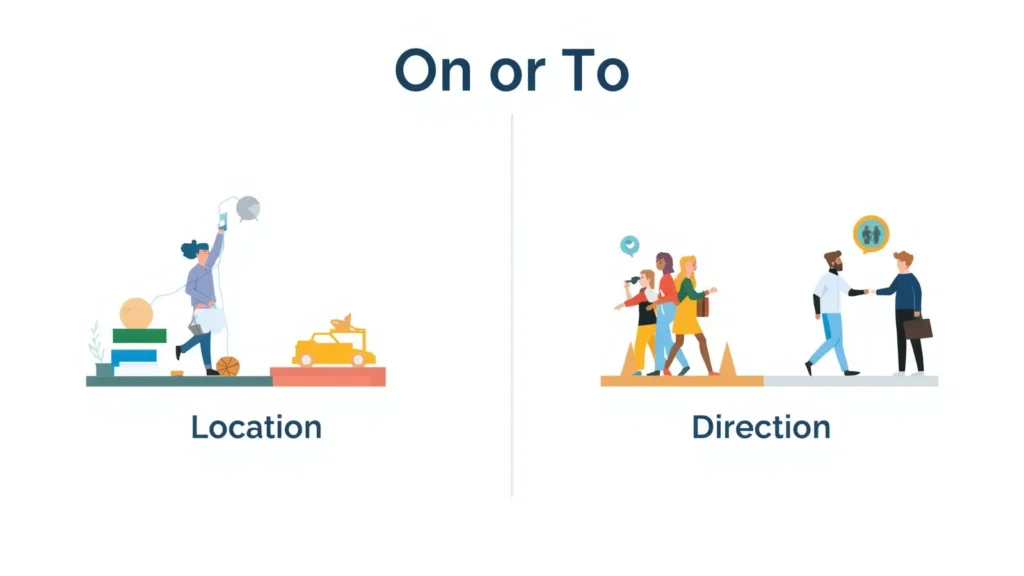
Create a professional infographic titled Location Versus Direction. Use a 1600 by 900 ratio. Show objects resting on surfaces on one side and people moving toward destinations on the other side. Include labels such as Location, Position, Movement, and Destination. Use clean educational design.
Real World Examples
Example One
The laptop is on the desk.
Location.
Example Two
I walked to the desk.
Movement.
Example Three
The meeting is on Wednesday.
Specific day.
Example Four
We traveled to Germany.
Destination.
Example Five
The photo is on the wall.
Position.
Common Mistakes with On or To
Mistake One
Incorrect:
- I went on school.
Correct:
- I went to school.
Mistake Two
Incorrect:
- The book is to the table.
Correct:
- The book is on the table.
Mistake Three
Incorrect:
- The meeting is to Monday.
Correct:
- The meeting is on Monday.
Mistake Four
Incorrect:
- We traveled on Canada.
Correct:
- We traveled to Canada.
Why English Learners Confuse On or To
Several factors contribute to confusion.
Similar Sentence Structures
Many sentences look similar.
Translation Differences
Some languages use one word where English uses two.
Memorization Challenges
English contains many fixed expressions.
Lack of Practice
Limited exposure often causes mistakes.
Related Prepositions
Understanding on or to becomes easier when compared with other prepositions.
In
Used for enclosed spaces.
Example:
- In the room
At
Used for specific points.
Example:
- At the station
Onto
Shows movement ending on a surface.
Example:
- Jump onto the table
Toward
Shows general direction.
Example:
- Walk toward the building
On Versus Onto
Many learners confuse on and onto.
On
Shows position.
Example:
- The bag is on the chair.
Onto
Shows movement.
Example:
- Place the bag onto the chair.
To Versus Toward
These words are similar but not identical.
To
Shows a specific destination.
Example:
- Walk to the store.
Toward
Shows general direction.
Example:
- Walk toward the store.
You may not necessarily arrive there.
Third Visual Comparison Section
Image Placement Suggestion
Create an educational infographic titled On, To, Onto, and Toward. Use a 1600 by 900 ratio. Show arrows and simple illustrations demonstrating position, destination, movement, and direction. Include clear labels and modern educational styling.
Advantages of Using the Correct Preposition
Better Communication
Readers understand your meaning immediately.
Improved Writing
Grammar becomes stronger.
Professional Credibility
Correct language builds trust.
Better Academic Results
Students avoid grammar mistakes.
Disadvantages of Incorrect Usage
Misunderstanding
Readers may become confused.
Grammar Errors
Writing quality decreases.
Professional Problems
Mistakes may affect credibility.
Academic Penalties
Students may lose marks.
Regional and Global Usage
The rules for on and to remain largely the same in:
- American English
- British English
- Canadian English
- Australian English
Although vocabulary may differ between regions, the grammatical distinction remains consistent.
Beginner to Advanced Understanding
Beginner Level
On means position.
To means movement.
Intermediate Level
On is often used with surfaces, dates, and devices.
To is often used with destinations and direction.
Advanced Level
Professional writing requires understanding fixed expressions, idioms, and context specific usage involving both prepositions.
Exercises With Answers
Question One
Choose the correct word.
The keys are ___ the table.
Answer: On
Question Two
Choose the correct word.
We traveled ___ London.
Answer: To
Question Three
The meeting is ___ Friday.
Answer: On
Question Four
She walked ___ the store.
Answer: To
Question Five
The picture is ___ the wall.
Answer: On
Question Six
We moved ___ Canada.
Answer: To
Question Seven
The program appeared ___ television.
Answer: On
Question Eight
He drove ___ the airport.
Answer: To
FAQs
Is on or to correct?
Both are correct depending on the sentence.
What is the main difference between on and to?
On usually shows position, while to usually shows movement or destination.
Can on indicate time?
Yes. It is used with specific days and dates.
Can to indicate location?
Usually it indicates movement toward a location.
Why do learners confuse on or to?
Because both words are common and translation rules differ across languages.
Do native speakers make mistakes with on or to?
Occasionally, but less frequently than learners.
Is it on Monday or to Monday?
The correct phrase is on Monday.
Is it go on school or go to school?
The correct phrase is go to school.
Is it on the wall or to the wall?
The correct phrase is on the wall.
How can I master on or to?
Practice common expressions and focus on the difference between position and movement.
Conclusion
Understanding on or to is essential for clear and correct English communication. Although both are small words, they perform very different grammatical functions. On usually indicates position, location, contact, days, dates, and certain fixed expressions. To typically indicates movement, direction, destination, purpose, and relationships.
A simple rule can help. If something is already in a place, on is often the correct choice. If something is moving toward a place, to is usually correct. This distinction applies in conversations, professional writing, academic work, travel descriptions, and everyday communication.
By learning common patterns, practicing examples, and recognizing context, you can confidently choose between on and to. Over time, correct usage becomes natural and significantly improves your English fluency.