

Quick Answer
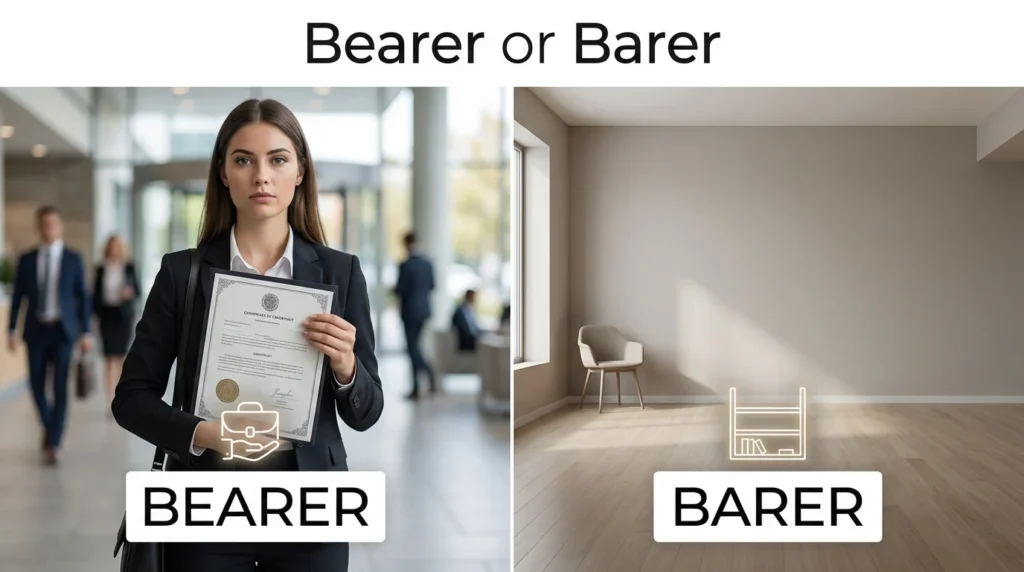
Bearer and barer are both correct words, but they have completely different meanings. Bearer means a person who carries or holds something, while barer means someone or something that makes something more exposed, plain, or uncovered.
Bearer and barer sound similar, but they do not mean the same thing. This small spelling difference can change the meaning of a sentence. Bearer is a common word used for someone who carries, delivers, or holds something. You may see it in phrases such as “bearer of good news,” “ticket bearer,” or “bearer bond.”
Barer, on the other hand, is the comparative form of bare. It means more uncovered, more exposed, or less covered than something else. It is much less common in everyday writing, which makes it easy to confuse with bearer.
The easiest way to remember the difference is to connect bearer with the verb bear, meaning to carry or hold. Barer comes from bare, meaning uncovered or exposed.
What Does Bearer Mean?
Bearer is a noun that refers to someone who carries, holds, delivers, or presents something.
The word comes from the verb bear, which can mean to carry or support.
For example:
- The bearer carried the message.
- The ticket bearer entered the theater.
- He was the bearer of good news.
- The flag bearer walked at the front of the group.
A bearer does not always carry a physical object. The word can also describe someone who brings information, news, a title, or a document.
For example:
She was the bearer of important news.
Here, she is not carrying the news in her hands. Instead, she is the person delivering it.
What Does Barer Mean?
Barer is the comparative form of bare.
The adjective bare means uncovered, empty, plain, or lacking something.
When you compare two things, you can use barer to mean “more bare.”
For example:
- The second wall was barer than the first.
- His feet looked barer without socks.
- The room became barer after the furniture was removed.
- The winter trees looked barer than they did in summer.
The word barer is grammatically correct, but it is less common than bearer.
That is why many people recognize bearer immediately but may hesitate when they see barer.
Bearer or Barer: What Is the Difference?
The main difference is meaning.
| Word | Meaning | Example |
|---|---|---|
| Bearer | Someone who carries, holds, or delivers something | He was the bearer of the message. |
| Barer | More uncovered, plain, or exposed | The room looked barer after the furniture was removed. |
A simple way to remember them is:
Bearer → bear → carry
Barer → bare → uncovered
The extra e in bearer helps connect it to bear.
Bearer as a Person Who Carries Something
One of the most direct meanings of bearer is a person who carries something.
For example:
The flag bearer led the parade.
The flag bearer is the person carrying the flag.
You can also see this use in formal events.
- The ring bearer carried the rings.
- The coffin bearers carried the coffin.
- The flag bearer stood at the front.
- The standard bearer carried the ceremonial flag.
These uses are common in ceremonies, weddings, funerals, military events, and public gatherings.
Bearer as Someone Who Delivers Something
Bearer can also mean someone who brings or delivers something.
One common phrase is:
bearer of good news
For example:
I am sorry to be the bearer of bad news.
This means the speaker is the person delivering unpleasant information.
Another example is:
She was the bearer of good news.
Here, she brought or delivered positive information.
The word can therefore refer to an information carrier, not only someone carrying a physical object.
Bearer in Tickets and Documents
Bearer often appears in formal documents and tickets.
A bearer can be the person who possesses or presents a document, ticket, or other item.
For example:
This ticket admits the bearer to the event.
This means the person who has the ticket can enter.
You may also see phrases such as:
- bearer of the ticket
- bearer of the certificate
- bearer of the document
- bearer of the card
The exact legal meaning can depend on the document.
Bearer in Finance
The word bearer also appears in financial language.
A bearer instrument is generally an instrument that belongs to whoever possesses it, subject to the applicable rules.
One familiar expression is bearer bond.
For example:
The document was issued as a bearer bond.
This is a specialized financial term, so its legal meaning should be understood in the context of the relevant financial rules.
The spelling is always bearer, not barer.
Bearer in Weddings
A familiar use of bearer is ring bearer.
A ring bearer is usually a child who carries the wedding rings during a wedding ceremony.
For example:
The ring bearer walked down the aisle before the bride.
The word refers to carrying the rings.
Other examples include:
- The ring bearer looked excited.
- Their son served as the ring bearer.
- The ring bearer carried the rings carefully.
This is one of the easiest everyday examples to remember.
Bearer in Ceremonies
Bearer is also common in formal ceremonies.
A person who carries a flag may be called a flag bearer.
Someone who carries a ceremonial object may also be called a bearer.
Examples:
- The flag bearer led the group.
- The torch bearer entered the stadium.
- The standard bearer stood beside the speaker.
- The coffin bearers moved slowly toward the entrance.
In each example, bearer connects with the idea of carrying something.
What Does Bare Mean?
To understand barer, you first need to understand bare.
Bare means uncovered, exposed, empty, plain, or without the usual covering.
Examples:
- He walked on the bare floor.
- The tree had bare branches.
- She stood with bare feet.
- The walls were bare.
- The shelf was completely bare.
When you compare two things, you can use barer.
For example:
The room looked barer after the paintings were removed.
This means the room looked more empty or uncovered than before.
Barer as a Comparative Form
Barer follows the normal comparative pattern for the adjective bare.
Think of the pattern:
bare → barer → barest
For example:
- The room is bare.
- The second room is barer.
- The attic is the barest room in the house.
However, natural wording can sometimes favor phrases such as more bare depending on the sentence and style.
Still, barer is a valid comparative form.
Examples of Barer
Here are some natural examples:
- The walls looked barer after the pictures were removed.
- His feet were barer than before.
- The room became barer after the furniture was sold.
- The trees looked barer in late winter.
- The landscape seemed barer after the leaves fell.
- The apartment appeared barer after the move.
In all of these examples, barer means more uncovered, empty, or plain.
Bearer vs Barer in Sentences
Compare these sentences carefully.
He was the bearer of the message.
This means he delivered the message.
The room looked barer after the furniture was removed.
This means the room looked more empty or uncovered.
Now compare:
The bearer carried the flag.
The walls looked barer without the paintings.
The meanings are completely different even though the words look and sound similar.
Common Phrases With Bearer
Some phrases make bearer easy to recognize.
Bearer of good news
This means someone who brings good news.
She was the bearer of good news.
Bearer of bad news
This means someone who delivers bad news.
I hate to be the bearer of bad news.
Ring bearer
A person who carries wedding rings during a ceremony.
Their nephew was the ring bearer.
Flag bearer
A person who carries a flag.
The flag bearer walked at the front.
Bearer bond
A financial term referring to a type of bond associated with possession.
The old document was a bearer bond.
Common Uses of Barer
Because barer is simply the comparative form of bare, it appears when two conditions are being compared.
For example:
This wall is barer than the other one.
The room became barer after the chairs were removed.
The trees looked barer after the storm.
His desk was barer than mine.
The comparison may be about physical covering, decoration, contents, or even figurative exposure.
Bearer or Barer in Everyday Writing
In everyday writing, bearer is much more common.
You might encounter it in:
- wedding descriptions
- event programs
- tickets
- formal announcements
- financial documents
- news writing
- historical writing
- expressions about delivering news
Barer is less common because writers often choose other wording.
For example, instead of:
The room looked barer.
Someone might write:
The room looked more empty.
Still, barer is correct when it fits the sentence.
Common Mistakes With Bearer and Barer
The most common mistake is using barer when you mean someone who carries something.
Incorrect:
He was the barer of good news.
Correct:
He was the bearer of good news.
Another mistake is using bearer when you mean something became more uncovered.
Incorrect:
The room became bearer after the furniture was removed.
Correct:
The room became barer after the furniture was removed.
The meaning should guide your spelling.
Ask yourself:
Is someone carrying or delivering something?
Use bearer.
Is something becoming more uncovered or empty?
Use barer.
Bearer and Bear
The connection between bearer and bear is useful.
The verb bear has several meanings, but one important meaning is to carry or support.
For example:
The bridge bears a heavy load.
From this idea of carrying comes bearer.
A bearer is someone who carries or delivers something.
Examples:
- bear → carry
- bearer → one who carries
This connection makes the spelling easier to remember.
Barer and Bare
The connection between barer and bare is even simpler.
Bare means uncovered or without something.
Add the comparative ending:
bare → barer
Examples:
The wall is bare.
The second wall is barer.
So if you are describing something as more uncovered, plain, or empty, barer is the correct word.
Bearer or Barer: Pronunciation
The two words are pronounced differently.
Bearer has two syllables.
Barer also has two syllables, but the vowel sounds differ.
Because they can sound similar in quick speech, spelling mistakes are common. That is why it helps to connect each word with its root.
Remember:
Bearer → bear → carry
Barer → bare → uncovered
Learning the root is more useful than trying to remember the spelling alone.
Bearer in Professional Writing
Bearer is useful in formal and professional contexts.
For example:
The bearer of this certificate is entitled to the stated benefits.
You may also see it in official documents, financial language, or formal notices.
Another example is:
The bearer must present valid identification.
The exact requirements depend on the document or organization, but the word itself refers to the person holding or presenting something.
Barer in Descriptive Writing
Barer can be useful when describing a physical scene.
For example:
The room looked barer after the old furniture was removed.
It can also describe nature:
The trees looked barer as winter approached.
The word creates a clear comparison between two states.
It can also have a figurative sense:
His explanation left the truth barer than before.
In such cases, the meaning depends on context.
Bearer or Barer: Which One Should You Use?
Choose bearer when you mean:
- a person who carries something
- a person who delivers something
- someone who presents a document
- someone associated with carrying a ceremonial object
- a person who brings news
- a person who possesses a bearer instrument
Choose barer when you mean:
- more uncovered
- more exposed
- more empty
- more plain
- less covered or decorated
The spelling becomes much easier once you identify the meaning.
Easy Memory Trick
Use this simple trick:
BEARER has BEAR in it.
A bear can bear or carry a load.
So:
Bearer = someone who carries or delivers something.
Now look at:
BARER comes from BARE.
Bare means uncovered.
So:
Barer = more bare or uncovered.
This small connection can help you avoid the spelling mistake.
Practice: Bearer or Barer?
Choose the correct word.
- He was the ______ of the message.
- The room looked ______ after the furniture was removed.
- She served as the ring ______.
- The walls became ______ after the pictures were taken down.
- I hate to be the ______ of bad news.
- The flag ______ walked at the front of the parade.
- The trees looked ______ during winter.
- The ticket allows entry to the ______.
Answers
- bearer
- barer
- bearer
- barer
- bearer
- bearer
- barer
- bearer
Bearer or Barer: Quick Comparison
Here is the simplest way to remember the difference:
Bearer
Meaning: A person who carries, holds, presents, or delivers something.
Example:
He was the bearer of the letter.
Barer
Meaning: More uncovered, empty, exposed, or plain.
Example:
The room looked barer after the decorations were removed.
If the sentence involves carrying, think bearer.
If it involves being more bare, think barer.
Final Tips
Keep these points in mind:
- Bearer is a noun.
- Bearer relates to the verb bear, meaning to carry or support.
- Barer is the comparative form of bare.
- Barer means more uncovered, empty, exposed, or plain.
- “Bearer of good news” is a common expression.
- “Ring bearer” is a common wedding term.
- “Flag bearer” refers to someone carrying a flag.
- “The room looked barer” describes a room that became more empty or plain.
- When someone carries or delivers something, use bearer.
- When something becomes more uncovered or plain, use barer.
FAQs
What is the difference between bearer and barer?
Bearer means a person who carries, holds, presents, or delivers something. Barer is the comparative form of bare and means more uncovered, exposed, empty, or plain.
Is bearer of good news correct?
Yes. Bearer of good news is correct. It refers to someone who brings or delivers good news.
Is barer a real word?
Yes. Barer is the correct comparative form of bare. For example, “The room looked barer after the furniture was removed.”
Is it ring bearer or ring barer?
The correct phrase is ring bearer because the person carries the wedding rings.
How can I remember bearer or barer?
Remember the roots. Bearer contains bear, which can mean to carry. Barer comes from bare, which means uncovered. So, bearer carries while barer is more bare.
Conclusion
Bearer and barer are both correct words, but they serve different purposes. Bearer refers to someone who carries, holds, presents, or delivers something. It appears in common phrases such as ring bearer, flag bearer, and bearer of good news.
Barer comes from bare and means more uncovered, exposed, empty, or plain. It is used when comparing two things or two states, such as a room that becomes barer after furniture is removed.
The easiest way to remember the difference is to focus on the root word. Bearer comes from bear and connects with carrying. Barer comes from bare and connects with being uncovered. Once you make that connection, choosing the right spelling becomes much easier.