
Quick Answer
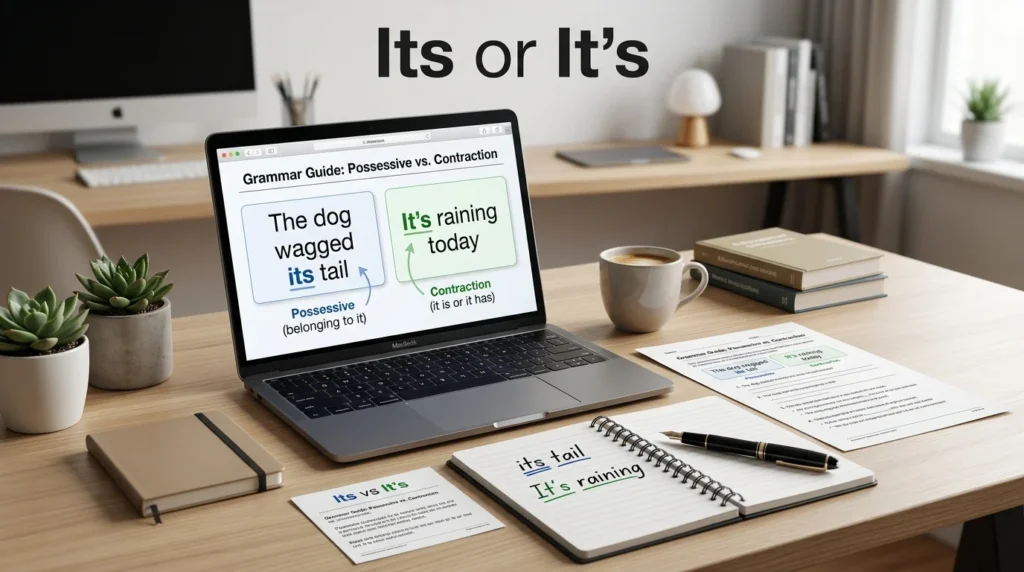
Its shows possession, while it’s is a contraction of it is or it has. A simple trick is to replace it’s with it is or it has. If the sentence still makes sense, it’s is correct.
Its or it’s is one of the most common confusing word pairs in English. The two forms look almost identical, but they have different jobs in a sentence.
The confusion usually comes from the apostrophe. In many English words, an apostrophe shows possession. For example, Sarah’s book means the book belongs to Sarah. However, it’s does not show possession. Instead, it is a shortened form of it is or it has.
Its works as a possessive word. It tells us that something belongs to or is connected with something else.
For example:
The dog wagged its tail.
Here, its shows that the tail belongs to the dog.
Understanding this small difference can help you avoid one of the most common grammar mistakes in everyday writing.
What Does Its Mean?
Its is a possessive word.
It shows that something belongs to, comes from, or is connected with something previously mentioned.
For example:
- The cat cleaned its paws.
- The company changed its policy.
- The tree lost its leaves.
- The phone has lost its signal.
- The car needs its tires checked.
In each sentence, its connects one thing with another.
Look at this example:
The bird opened its wings.
The wings belong to the bird, so its is correct.
There is no apostrophe in its.
What Does It’s Mean?
It’s contains an apostrophe because it is a contraction.
It can mean:
it is
or
it has
For example:
It’s cold outside.
This means:
It is cold outside.
Another example:
It’s been a long day.
This means:
It has been a long day.
The apostrophe joins the shortened form together.
So, whenever it’s appears in a sentence, ask yourself whether you can replace it with it is or it has.
Its vs It’s: The Main Difference
The easiest way to understand the difference is to remember this:
Its = possession
It’s = it is or it has
Compare these examples:
The dog hurt its leg.
The leg belongs to the dog, so its is correct.
Now look at:
It’s raining outside.
Replace it’s with it is:
It is raining outside.
The sentence still works, so it’s is correct.
Here is another pair:
The company changed its name.
The name belongs to or is connected with the company.
It’s changed a lot over the years.
Here, it’s means it has.
Once you understand this difference, choosing the correct form becomes much easier.
Why Does Its Not Have an Apostrophe?
This is where many learners get confused.
Usually, an apostrophe can show possession:
John’s car
Maria’s phone
The dog’s bowl
But its is an exception to that pattern.
The possessive form is simply:
its
Not:
it’s
The apostrophe in it’s changes its function completely.
Compare:
The company changed its logo.
and:
It’s changing its logo.
The first its shows possession.
The second it’s means it is.
How to Test Its or It’s
There is a very simple test.
Whenever you are unsure, replace it’s with:
it is
or:
it has
If the sentence still makes sense, use it’s.
If the replacement sounds wrong, you probably need its.
Example One
The dog wagged it’s tail.
Replace it’s:
The dog wagged it is tail.
That does not make sense.
So the correct sentence is:
The dog wagged its tail.
Example Two
It’s a beautiful morning.
Replace it’s:
It is a beautiful morning.
That works.
Therefore, it’s is correct.
Example Three
It’s been raining all day.
Replace it’s:
It has been raining all day.
That works too.
Therefore, it’s is correct.
Its as a Possessive Word
Its works much like other possessive words such as my, your, his, her, our, and their.
Compare:
- My phone
- Your phone
- His phone
- Her phone
- Our phone
- Their phone
- Its phone
For example:
The company updated its website.
The website is connected with the company.
Another example:
The machine stopped because its battery was empty.
The battery belongs to or is part of the machine.
In both sentences, its shows a relationship of possession or connection.
It’s as a Contraction of It Is
One of the most common uses of it’s is as a shortened form of it is.
Examples:
It’s hot today.
Meaning:
It is hot today.
It’s difficult to explain.
Meaning:
It is difficult to explain.
It’s time to leave.
Meaning:
It is time to leave.
It’s a good idea.
Meaning:
It is a good idea.
This test works in most simple cases.
It’s as a Contraction of It Has
It’s can also mean it has.
This often happens before a past participle.
Examples:
It’s been a busy week.
Meaning:
It has been a busy week.
It’s already started.
Meaning:
It has already started.
It’s changed since last year.
Meaning:
It has changed since last year.
It’s happened before.
Meaning:
It has happened before.
This is why the replacement test should include both it is and it has.
Common Examples With Its
Here are some natural examples of its:
- The dog chased its ball.
- The company released its new product.
- The house needs its roof repaired.
- The phone lost its connection.
- The tree dropped its leaves.
- The restaurant changed its menu.
- The computer needs its battery replaced.
- The school updated its rules.
- The bird returned to its nest.
- The car lost its mirror.
In every example, its shows possession or connection.
Common Examples With It’s
Here are examples of it’s:
- It’s raining.
- It’s getting late.
- It’s a beautiful day.
- It’s hard to believe.
- It’s time to go.
- It’s been a great experience.
- It’s already finished.
- It’s changed since yesterday.
- It’s not ready yet.
- It’s possible.
Try replacing it’s with it is or it has.
You will see why the apostrophe belongs there.
Its or It’s in Everyday Writing
This mistake appears often in texts, emails, social media posts, school assignments, and casual messages.
For example:
The company changed it’s policy.
This is incorrect if the intended meaning is that the policy belongs to the company.
The correct sentence is:
The company changed its policy.
Now consider:
It’s changing the policy.
This is correct because it’s means:
It is changing the policy.
The difference can be just one apostrophe, but the grammar changes.
Its or It’s in Professional Writing
The distinction matters in professional writing because a small grammar mistake can make a sentence look careless.
Consider:
The business updated it’s website.
The correct version is:
The business updated its website.
Now compare:
It’s important to update the website.
Here, it’s is correct because the sentence means:
It is important to update the website.
Both forms can appear in professional writing. The important thing is using the correct one.
Its or It’s in Academic Writing
The same rule applies in essays, reports, research papers, and assignments.
For example:
The study changed its focus.
Here, its shows that the focus belongs to or is connected with the study.
Another example:
It’s difficult to reach a conclusion from limited data.
Here, it’s means it is.
Academic writing may use fewer contractions in some formal styles, but when it’s is used, its meaning remains the same.
Its or It’s With Animals
Its is very common when describing animals.
Examples:
The cat licked its paws.
The horse moved its head.
The bird built its nest.
The dog found its toy.
In each sentence, the object belongs to or is connected with the animal.
You can think of its as answering the question:
Whose?
The cat’s paws.
The horse’s head.
The bird’s nest.
The dog’s toy.
Therefore, its is correct.
Its or It’s With Objects
We also use its for things and objects.
Examples:
The phone lost its charge.
The car needs its engine checked.
The computer restarted because its system crashed.
The house needs its windows replaced.
The word its connects the object with something that belongs to it or is part of it.
Common Mistakes
The biggest mistake is using it’s whenever you want to show possession.
For example:
The dog wagged it’s tail.
This is wrong.
The correct sentence is:
The dog wagged its tail.
Another common mistake is forgetting the apostrophe when it is is intended.
For example:
Its going to rain.
This is wrong.
The correct sentence is:
It’s going to rain.
Why?
Because the sentence means:
It is going to rain.
A quick replacement test catches both mistakes.
Its or It’s: A Simple Trick
Use this three-step method.
Step One
Find its or it’s in your sentence.
Step Two
If you wrote it’s, replace it with it is.
If that does not work, try it has.
Step Three
If neither replacement works, use its.
For example:
The company changed its name.
Try:
The company changed it is name.
That does not work.
So use:
its
Another example:
It’s getting dark.
Try:
It is getting dark.
That works.
So use:
it’s
This small test can solve most its or it’s problems.
Its vs It’s in Questions
The same rule applies in questions.
For example:
Is it using its old name?
The first it is part of the question.
The second its shows possession or connection.
Another example:
Is it true that it’s closed?
Here, it’s means:
it is
So:
Is it true that it is closed?
The sentence still makes sense.
Its or It’s in Negative Sentences
You can also use it’s in negative sentences.
For example:
It’s not ready.
This means:
It is not ready.
Another example:
It’s not working.
This means:
It is not working.
However, its can also appear in the same sentence:
The machine is not working because its battery is dead.
Here, its shows that the battery belongs to or is part of the machine.
This is a good example of why context matters.
Its or It’s in Longer Sentences
Longer sentences can make the difference harder to notice.
Consider:
The company said it’s changing its policy next month.
There are two different forms in one sentence.
It’s means:
it is
Its shows possession or connection:
its policy
So the sentence means:
The company said it is changing its policy next month.
Both forms are correct because they have different jobs.
Its or It’s With There and Their
Another common problem is mixing its, it’s, there, and their.
These words have different functions.
Its = possession
It’s = it is or it has
Their = possession belonging to them
There = a place or used to introduce something
Examples:
The dog found its toy.
It’s under the table.
Their dog is outside.
The toy is over there.
Learning these differences can prevent several common grammar mistakes at once.
Its or It’s Practice
Choose the correct word in each sentence.
1. The dog lifted ___ head.
Answer: its
The head belongs to the dog.
2. ___ going to be a busy day.
Answer: it’s
It means it is.
3. The company changed ___ logo.
Answer: its
The logo belongs to or is connected with the company.
4. ___ already started.
Answer: it’s
It means it has already started.
5. The tree lost ___ leaves.
Answer: its
The leaves belong to the tree.
6. ___ difficult to explain.
Answer: it’s
It means it is difficult to explain.
7. The phone lost ___ connection.
Answer: its
The connection belongs to or is associated with the phone.
8. ___ been a long week.
Answer: it’s
It means it has been a long week.
Its or It’s: Quick Comparison
| Word | Function | Meaning | Example |
|---|---|---|---|
| its | Possessive | Belonging to it | The dog wagged its tail. |
| it’s | Contraction | It is | It’s cold today. |
| it’s | Contraction | It has | It’s been a long day. |
This table gives you the main rule in one place.
If you are showing possession, use its.
If you mean it is or it has, use it’s.
How to Remember the Difference
Here is the easiest rule to remember:
Its has no apostrophe because it shows possession.
It’s has an apostrophe because it is a contraction.
Then use the replacement trick.
Ask:
Can I replace it with “it is”?
If yes, use it’s.
If not, try:
Can I replace it with “it has”?
If yes, use it’s.
If neither works, you probably need its.
For example:
The dog hurt its paw.
You cannot say:
The dog hurt it is paw.
So its is correct.
But:
It’s getting cold.
becomes:
It is getting cold.
So it’s is correct.
Final Tips
Keep these rules in mind:
- Its shows possession or connection.
- It’s means it is.
- It’s can also mean it has.
- Do not use it’s to show possession.
- Do not use its when you mean it is.
- Use the replacement test when you are unsure.
- Check both it is and it has.
- Remember that the apostrophe in it’s signals a contraction.
- Read the complete sentence before choosing the form.
- Practice with short examples until the difference feels natural.
FAQs
What is the difference between its and it’s?
Its shows possession or connection, while it’s is a shortened form of it is or it has.
Is its possessive?
Yes. Its is a possessive form used to show that something belongs to or is connected with something.
When should I use it’s?
Use it’s when you mean it is or it has. For example, “It’s cold” means “It is cold,” while “It’s been fun” means “It has been fun.”
Why does its not have an apostrophe?
Because its is already the possessive form. The apostrophe in it’s has a different job: it shows that words have been shortened.
How can I easily remember its or it’s?
Try replacing it’s with it is or it has. If the sentence still makes sense, it’s is correct. If neither replacement works, its is usually the right choice.
Conclusion
The difference between its and it’s is small but important. Its shows possession or a connection with something, while it’s is a contraction of it is or it has.
The easiest way to choose correctly is to use the replacement test. If you can replace it’s with it is or it has, keep the apostrophe. If the sentence needs a possessive word, use its without an apostrophe.
Remember the simple rule:
Its = possession
It’s = it is or it has
Once this pattern becomes familiar, one of the most common English grammar mistakes becomes much easier to avoid.