

Quick Answer
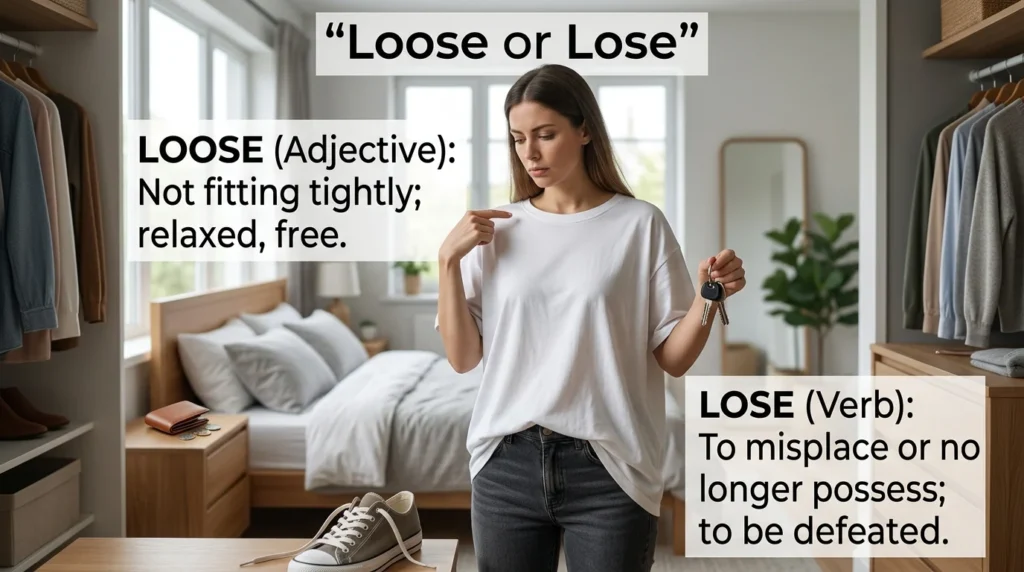
Loose and lose are both correct words, but they have different meanings. Loose usually means not tight, not firmly attached, or free, while lose is mainly a verb meaning to misplace something, fail to win, or stop having something.
Loose or lose is one of the most common word pairs people mix up in English. The two words look almost the same, but their meanings are very different. The extra o in loose can make the spelling confusing, especially when you are writing quickly.
The easiest way to separate them is to focus on meaning. Loose usually describes something that is not tight or securely fixed. Lose describes an action or change, such as misplacing your phone, failing to win a game, or no longer having something.
Once you connect each word with its main meaning, choosing between loose and lose becomes much easier.
What Does Loose Mean?
Loose usually means not tight, not firmly attached, or free from restraint.
It is commonly used as an adjective.
For example:
- My shirt is loose.
- The door handle is loose.
- She wore a loose jacket.
- The rope became loose.
- The dog got loose.
You can often replace loose with an idea such as not tight or not firmly held.
For example:
My shoes are loose.
This means the shoes do not fit tightly.
The screw is loose.
This means the screw is not firmly secured.
The word can describe clothing, objects, animals, hair, ropes, connections, and many other things.
What Does Lose Mean?
Lose is mainly a verb.
It can mean to misplace something, stop having something, fail to win, or experience a reduction.
For example:
- I do not want to lose my phone.
- She might lose her keys.
- Our team could lose the game.
- He does not want to lose his job.
- They may lose money.
- I need to lose weight.
The exact meaning depends on the sentence, but the general idea involves something no longer being kept, possessed, won, or maintained.
Loose or Lose: What Is the Difference?
The simplest difference is:
Loose = not tight or not securely fixed
Lose = misplace, no longer have, or fail to win
Compare these sentences:
My shoelaces are loose.
The shoelaces are not tight.
I might lose my shoes.
The shoes may become lost or unavailable to me.
Here is another pair:
The screw is loose.
The screw is not tightly secured.
Do not lose the screw.
You should not misplace it.
The spelling is close, but the meanings are completely different.
Loose as an Adjective
The most common use of loose is as an adjective.
An adjective describes a person, place, thing, or condition.
Examples:
- loose clothing
- loose shoes
- loose hair
- loose soil
- loose papers
- loose rope
- loose screws
- loose teeth
Consider:
She bought a loose sweater.
The sweater is not tight against her body.
Another example:
One of the chair legs is loose.
The leg is not firmly attached.
This is why loose often connects with the idea of space, movement, or lack of tightness.
Loose Can Also Mean Free
Loose can describe something that is no longer restrained.
For example:
The dog got loose.
This means the dog escaped from the place where it was being held.
You can also say:
The horse broke loose.
This means the horse became free from its restraint.
Another common expression is:
Let loose.
This means to allow someone or something to move freely or behave without restraint.
For example:
The children were let loose in the playground.
Here, loose does not mean “not tight.” It carries the idea of being free.
Loose Clothing
Clothing is one of the easiest ways to remember loose.
If clothing is not tight, it is loose.
Examples:
- She prefers loose jeans.
- He wore a loose shirt.
- These pants are too loose.
- I like loose-fitting clothes.
- The jacket feels loose around my shoulders.
You would not use lose in these sentences.
For example:
These pants are too lose.
That is incorrect.
The correct sentence is:
These pants are too loose.
Loose Objects
Loose can also describe an object that is not securely attached.
Examples:
- The screw is loose.
- The handle is loose.
- The button is loose.
- The wire is loose.
- The wheel is loose.
- The tooth feels loose.
Here, the object has some unwanted movement because it is not firmly secured.
A useful question is:
Is something not tight or not securely attached?
If yes, loose is usually the right word.
Loose Hair
The word can also describe hair that is not tied or secured.
Examples:
- She wore her hair loose.
- He let his hair hang loose.
- Her loose hair moved in the wind.
In these sentences, loose means free or not tied back.
This is another easy connection to remember.
Loose Change
You may have heard the phrase loose change.
It means small coins that are not kept in a wallet, purse, or another organized place.
For example:
I found some loose change in my car.
Here, loose describes the coins as separate or not stored together.
This phrase is useful because it shows that loose does not always mean physically loose in the sense of being poorly attached.
Lose as a Verb
Unlike loose, lose is mainly used as a verb.
It can describe several common situations.
Misplacing Something
I always lose my keys.
This means you cannot find your keys because you misplaced them.
Failing to Win
Our team might lose the game.
This means the team might not win.
No Longer Having Something
She could lose her job.
This means she could stop having her job.
Reducing Something
He wants to lose weight.
This means he wants his body weight to decrease.
These meanings are different, but they all use lose.
Lose Something
One of the most common uses of lose is when something is misplaced.
Examples:
- Do not lose your wallet.
- I lost my phone yesterday.
- She lost her keys.
- He lost his passport.
- They lost the documents.
Notice the spelling:
lose
There is only one o between the l and s.
This is one of the most important things to remember.
Lose a Game
Use lose when someone fails to win a competition or game.
Examples:
- We do not want to lose.
- They lost the game.
- Our team could lose tonight.
- She hates to lose.
- He lost the final match.
You should never write:
We might loose the game.
The correct sentence is:
We might lose the game.
The game is not becoming loose. Your team is failing to win it.
Lose Weight
Another very common phrase is lose weight.
Examples:
- She wants to lose weight.
- He is trying to lose weight.
- I need to lose a few pounds.
- Regular exercise can help with weight management.
The correct spelling is always:
lose weight
Not:
loose weight
Why?
Because lose is the verb describing a reduction or decrease.
Lose Money
Use lose when money is no longer kept or when an investment results in a financial loss.
Examples:
- I do not want to lose money.
- The company could lose money.
- He lost money on the investment.
- We cannot afford to lose more money.
Again, lose is the correct word because the sentence describes a loss.
Lose Time
You can also lose time.
Examples:
- We cannot lose any more time.
- The delay caused us to lose time.
- I do not want to lose valuable time.
- We lost several hours because of traffic.
The idea is that available time has been wasted or taken away.
Lose Your Temper
Lose appears in many common expressions.
One of them is:
lose your temper
This means to become angry and stop controlling your emotions.
Example:
Try not to lose your temper during the meeting.
You may also hear:
- lose your patience
- lose your mind
- lose your balance
- lose your focus
- lose your confidence
- lose your way
- lose your nerve
All of these use lose, not loose.
Loose or Lose in Common Sentences
Here are some quick comparisons:
| Meaning | Correct Word | Example |
|---|---|---|
| Not tight | Loose | My shoes are loose. |
| Misplace something | Lose | Do not lose your keys. |
| Not firmly attached | Loose | The handle is loose. |
| Fail to win | Lose | We cannot lose this game. |
| Free from restraint | Loose | The dog got loose. |
| Reduce weight | Lose | She wants to lose weight. |
| Small coins | Loose | I have some loose change. |
| Stop having something | Lose | He could lose his job. |
The pattern becomes clear when you focus on the meaning instead of the spelling.
Loose vs Lose Pronunciation
The pronunciation also helps separate these words.
Loose sounds like moose.
It ends with an s sound.
Lose sounds like choose.
It ends with a z sound.
So:
loose = sounds like moose
lose = sounds like choose
This difference can help when speaking, although spelling is still the main challenge when writing.
Why Do People Confuse Loose and Lose?
The words are easy to mix up because their spelling is very similar.
Both begin with lo and contain the letters l, o, and s.
The biggest visual difference is the extra o in loose.
There is also another reason. English spelling does not always make pronunciation obvious. The s in lose sounds like a z, while the s in loose has a regular s sound.
Because of this, writers sometimes choose the wrong word when typing quickly.
The best solution is to connect each word with its meaning.
Loose or Lose in Everyday Writing
Both words appear frequently in everyday communication.
You might write:
I do not want to lose my phone.
Or:
My phone case is loose.
You might say:
We cannot lose the game.
Or:
One of my shoelaces is loose.
These examples show why the difference matters.
One word describes a condition.
The other describes an action or change.
Loose or Lose in Professional Writing
The distinction also matters in business and professional writing.
For example:
The company could lose customers.
This means the company may no longer have those customers.
But:
The connection is loose.
This means the connection is not secure.
Another example:
We cannot afford to lose time.
But:
The cable appears loose.
Using the wrong word can change the meaning of the sentence or make it look like a simple spelling mistake.
Loose vs Loosen
There is another word worth learning:
loosen
Many writers use loose when they actually need loosen.
Loosen means to make something less tight.
For example:
Please loosen the knot.
He loosened his tie.
She loosened the screw.
The difference is simple:
Loose describes a condition.
Loosen describes the action of making something less tight.
Compare:
The knot is loose.
The knot is already not tight.
Please loosen the knot.
Someone needs to make it less tight.
Loose vs Looser
Looser means more loose.
For example:
These pants are looser than my old pair.
This is a comparison.
You can also say:
This shirt feels looser.
Do not confuse looser with loser.
They look similar but have completely different meanings.
Lose vs Lost
The past tense of lose is lost.
Examples:
I lose my keys sometimes.
I lost my keys yesterday.
The word does not become loosed when you mean misplacing something.
Correct:
I lost my wallet.
Incorrect:
I loosed my wallet.
The basic forms are:
- lose
- loses
- losing
- lost
For example:
I lose things easily.
She loses her keys.
He is losing money.
They lost the game.
Loose vs Loosed
Loosed does exist, but it comes from the less common verb loose, meaning to release or set free.
For example:
The hunter loosed the arrow.
This is very different from:
The hunter lost the arrow.
The first sentence means the arrow was released.
The second means the arrow could no longer be found or kept.
In ordinary modern writing, you will usually encounter loose as an adjective and lose as a verb.
Common Mistakes
Mistake 1: Loose Weight
Incorrect:
I want to loose weight.
Correct:
I want to lose weight.
Mistake 2: Loose the Game
Incorrect:
Our team might loose the game.
Correct:
Our team might lose the game.
Mistake 3: Lose Clothing
Incorrect:
She bought lose pants.
Correct:
She bought loose pants.
Mistake 4: Loose My Phone
Incorrect:
I do not want to loose my phone.
Correct:
I do not want to lose my phone.
Mistake 5: Lose Screw
Incorrect:
The screw is lose.
Correct:
The screw is loose.
These mistakes are common because the words look so similar.
An Easy Memory Trick
Here is a simple trick:
Loose has an extra O because something has extra room.
Think:
loose shirt = extra room
loose shoes = extra room
loose rope = extra movement
For lose, remember:
lose = something goes away
You can lose:
- your keys
- your phone
- a game
- money
- time
- your job
- your temper
- your focus
Another useful sentence is:
I can lose my loose change.
The first word is lose because you might misplace the coins.
The second is loose because the coins are not stored securely together.
Practice Questions
Choose loose or lose in each sentence.
Question 1
My jacket is too ______.
Answer: loose
The jacket is not tight.
Question 2
Do not ______ your wallet.
Answer: lose
You do not want to misplace it.
Question 3
The screw is ______.
Answer: loose
The screw is not securely attached.
Question 4
Our team cannot afford to ______ this game.
Answer: lose
The team cannot afford to fail to win.
Question 5
She wants to ______ weight.
Answer: lose
The phrase is lose weight.
Question 6
The dog got ______ from the yard.
Answer: loose
The dog became free.
Question 7
I found some ______ change under the sofa.
Answer: loose
The coins were separate and not stored in a wallet or container.
Question 8
He does not want to ______ his job.
Answer: lose
He does not want to stop having his job.
Quick Test
Try these without looking at the answers.
- The door handle is ______.
- I might ______ my keys.
- She prefers ______ clothing.
- We cannot ______ this opportunity.
- The horse broke ______.
- He wants to ______ five pounds.
- The rope is ______.
- They could ______ the match.
Answers
- loose
- lose
- loose
- lose
- loose
- lose
- loose
- lose
If you can separate these examples correctly, you have understood the main difference.
Loose or Lose: Quick Rule
When you are unsure, ask yourself one question:
Am I talking about something being not tight or free?
If yes, use loose.
The shirt is loose.
The dog is loose.
The screw is loose.
If you are talking about misplacing something, failing to win, or no longer having something, use lose.
I might lose my phone.
We could lose the game.
She may lose her job.
This rule covers most everyday uses.
Final Tips
Remember these points:
- Loose usually means not tight or not securely attached.
- Lose is mainly a verb.
- You can lose a phone, game, job, opportunity, or amount of money.
- You can have loose clothing, screws, ropes, hair, or change.
- Lose weight is correct.
- Loose weight is incorrect.
- Lose the game is correct.
- Loose the game is incorrect.
- Loose rhymes with moose.
- Lose rhymes with choose.
- Loosen means to make something less tight.
- Lost is the past tense of lose.
FAQs
What is the main difference between loose and lose?
Loose usually means not tight, not secure, or free. Lose is mainly a verb meaning to misplace something, fail to win, or stop having something.
Is it lose weight or loose weight?
The correct phrase is lose weight. Lose is the verb used when someone’s weight decreases. Loose weight is incorrect in standard English.
Is it loose or lose clothing?
Use loose. For example, “She prefers loose clothing.” Here, loose means the clothing is not tight.
Is it lose or loose a game?
The correct phrase is lose a game. For example, “Our team does not want to lose the game.”
How can I easily remember loose and lose?
Remember that loose has an extra o, which you can connect with extra room or freedom. Lose means something goes away, such as when you lose your keys, lose a game, or lose money.
Conclusion
Loose and lose are different words with different meanings. Loose usually describes something that is not tight, firmly attached, or restrained. Lose is mainly a verb used when you misplace something, fail to win, or no longer have something.
The easiest way to remember the difference is to connect loose with extra space or freedom and lose with something going away. Your shirt can be loose, but you can lose your shirt. Your shoelaces can be loose, but you can lose your shoes.
Once you focus on meaning instead of the similar spelling, choosing between loose and lose becomes much easier.