

Quick Answer
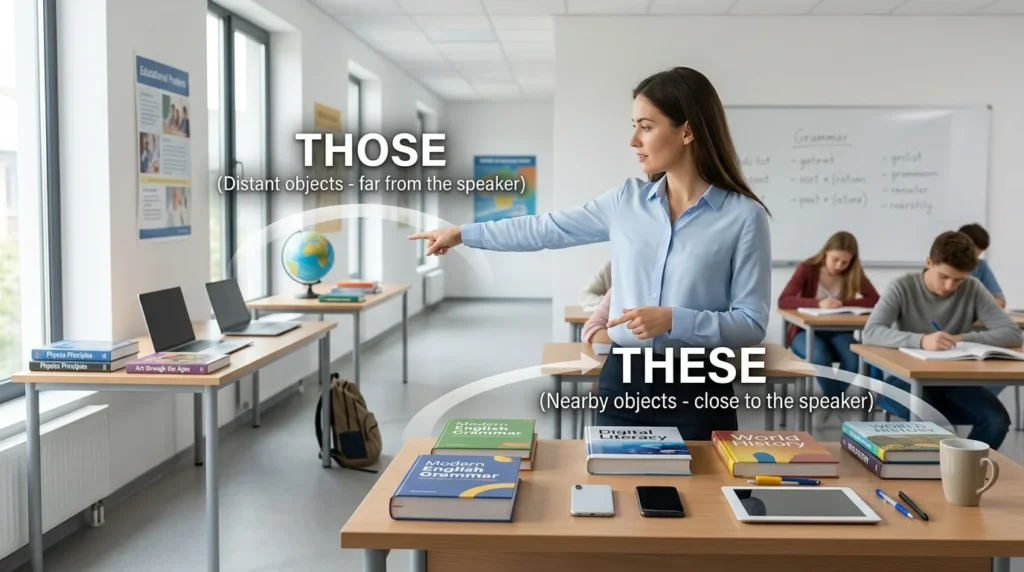
These is used for two or more people or things that are near you. Those is used for two or more people or things that are farther away. Both are plural demonstrative words, but the main difference is distance.
Many English learners know that these and those are plural words, yet choosing the right one can still feel confusing. Both words point to more than one person, place, animal, or thing. The difference becomes clear when you think about where the things are in relation to you.
Use these when the people or things are close. Use those when they are farther away. For example, you might say, “These shoes are comfortable” when you are holding or wearing them. If you point to shoes across the room, you would say, “Those shoes look expensive.”
The same idea works in everyday speech, writing, shopping, school, work, and conversation. Once you understand the simple rule, these or those becomes much easier to use correctly.
What Does These Mean?
These is a plural demonstrative pronoun or determiner. It points to two or more people or things that are close to the speaker.
For example:
- These books are mine.
- These cookies taste great.
- These students are in my class.
- These shoes are new.
- I like these pictures.
The word these can come before a noun.
These flowers are beautiful.
It can also stand alone as a pronoun.
These are beautiful.
In both cases, these refers to more than one thing that is considered close.
What Does Those Mean?
Those is also a plural demonstrative pronoun or determiner. It points to two or more people or things that are farther from the speaker.
For example:
- Those houses are beautiful.
- Those cars are expensive.
- Those students are waiting outside.
- I like those paintings.
- Those cookies look delicious.
Like these, those can appear before a noun or stand alone.
Those shoes are mine.
Or:
Those are mine.
The main idea is that those usually points to things that are farther away.
These vs Those
The easiest way to remember the difference is to focus on distance.
| Word | Number | Distance | Example |
|---|---|---|---|
| These | Plural | Near | These books are useful. |
| Those | Plural | Far | Those books are useful. |
There is also a useful four-word pattern:
This = one thing near you.
That = one thing far from you.
These = two or more things near you.
Those = two or more things far from you.
For example:
- This book is mine.
- That book is mine.
- These books are mine.
- Those books are mine.
This pattern makes demonstrative words much easier to remember.
When Should You Use These?
Use these when you are talking about multiple things that are close to you.
Consider a person holding two phones. They might say:
These phones are mine.
Someone standing beside a table may say:
These plates need to be washed.
A teacher holding several papers might say:
These papers belong to my students.
The distance does not always have to be physical. Sometimes these refers to ideas, events, or things that are close in time or discussion.
For example:
These days, many people work from home.
Here, these days means the current period.
You can also use these to introduce something you are about to explain.
These are the reasons I decided to leave.
When Should You Use Those?
Use those when you are talking about multiple things that are farther away.
Imagine several cars parked across the street.
Those cars belong to the visitors.
If you see mountains in the distance, you could say:
Those mountains look beautiful.
You can also use those for things that are distant in time or less connected to the current situation.
For example:
Those were difficult years.
The years are not physically distant objects. Instead, those creates a sense of distance from the present.
Another example is:
I remember those days.
Here, those days refers to a past period.
These and Those With Nouns
Both words can directly describe plural nouns.
Examples with these:
- These books
- These people
- These ideas
- These problems
- These shoes
- These questions
Examples with those:
- Those books
- Those people
- Those ideas
- Those problems
- Those shoes
- Those questions
The noun after these or those must normally be plural.
Correct:
These apples are fresh.
Correct:
Those houses are old.
Incorrect:
These apple is fresh.
Incorrect:
Those house is old.
For one item, use this or that instead.
These and Those as Pronouns
These and those can also work without a noun.
For example:
These are my keys.
The word these replaces a noun phrase such as “these keys.”
Similarly:
Those are my shoes.
Here, those replaces “those shoes.”
More examples include:
- These are delicious.
- Those are expensive.
- These belong to me.
- Those look better.
- These are the ones I wanted.
- Those are the people we met yesterday.
This use is very common in everyday conversation.
These or Those for People
Both words can refer to people.
If a group is nearby, use these.
These are my friends.
If the group is farther away, use those.
Those are my neighbors.
The same rule applies when introducing people.
For example, if you are standing with two coworkers, you might say:
These are my coworkers, Sarah and Mike.
If you point toward two people across the room, you might say:
Those are my coworkers.
The choice depends on the relationship between the speaker and the people being mentioned.
These or Those for Time
These and those can also show time.
These often refers to the present or a period close to now.
Examples:
- These days, life moves quickly.
- These weeks have been very busy.
- These moments are important.
Those can refer to a past or more distant period.
Examples:
- Those were happy days.
- I miss those summer evenings.
- Those years changed my life.
This use is important because distance does not always mean physical distance. English can use demonstrative words to show time, emotional distance, or connection.
These or Those in Everyday Conversation
You will hear these and those often in daily speech.
Imagine you are shopping with a friend. You pick up two shirts and say:
Do you like these?
Your friend points to shirts on another rack:
I like those better.
The words make the conversation shorter and clearer.
Other examples include:
These are really comfortable.
Those look too expensive.
Can you pass me these?
Why don’t you try those?
I bought these yesterday.
I saw those at the store last week.
These simple words help speakers point to specific things without repeating their names.
These or Those in Writing
These and those are common in both casual and formal writing.
For example:
These findings show a clear change in customer behavior.
Here, these refers to findings that have just been discussed.
Another example:
Those results were different from earlier studies.
Here, those can create distance from the results being discussed.
In formal writing, make sure the reader can clearly understand what these or those refers to. A vague demonstrative can make a sentence confusing.
Instead of writing:
These show that the problem is serious.
You can write:
These results show that the problem is serious.
The second sentence gives the reader a clear noun.
These or Those in Professional English
Both words are useful in workplace communication.
Examples with these:
These documents need your signature.
These changes will improve the process.
These numbers show strong growth.
Examples with those:
Those reports were completed last month.
Those customers have already received their orders.
Those changes caused several problems.
In professional writing, clarity matters. If these or those refers to an earlier idea, make the reference clear.
For example:
The team reviewed three proposals. These proposals were sent to management.
This is clearer than simply saying:
The team reviewed three proposals. These were sent to management.
Both can be correct, but the first version is easier to follow.
Common Mistakes With These and Those
Several mistakes appear when learners confuse singular and plural demonstratives.
Using These With a Singular Noun
Incorrect:
These book is interesting.
Correct:
This book is interesting.
If there is one book, use this.
Using Those With a Singular Noun
Incorrect:
Those car is mine.
Correct:
That car is mine.
Use that for one thing that is farther away.
Using These for Distant Things
Imagine a group of houses far away.
Less natural:
These houses are beautiful.
More natural:
Those houses are beautiful.
If the houses are close to you, these houses works better.
Using Those for Nearby Things
If you are holding two books, you would normally say:
These books are mine.
Not:
Those books are mine.
Unless you are intentionally creating distance or referring to them in a special context.
These, Those, This, and That
Learning all four words together is easier than learning them separately.
| Singular or Plural | Near | Far |
|---|---|---|
| Singular | This | That |
| Plural | These | Those |
Examples:
This apple is fresh.
That apple is fresh.
These apples are fresh.
Those apples are fresh.
This four-word system covers most basic uses.
Think of it as two questions:
Is it one or more than one?
Is it near or far?
One plus near gives you this.
One plus far gives you that.
More than one plus near gives you these.
More than one plus far gives you those.
How These and Those Work With Verbs
Because these and those are plural, they normally take plural verbs when they act as the subject.
Correct:
These are my books.
Correct:
Those look expensive.
Correct:
These seem useful.
Correct:
Those were difficult questions.
Avoid using a singular verb with a plural subject.
Incorrect:
These is my books.
Correct:
These are my books.
Incorrect:
Those was expensive.
Correct:
Those were expensive.
This is a simple subject-verb agreement rule.
These or Those in Questions
These and those are often used in questions.
Examples:
What are these?
What are those?
Are these your shoes?
Are those your keys?
Do you want these?
Do you like those?
You can also use them when asking someone to identify something.
For example:
What are those things on the table?
Or:
What are these called?
Because the words point to specific objects, they make questions more direct.
These or Those With Ideas
These and those do not only refer to physical objects. They can also refer to ideas, statements, actions, or situations.
For example:
These are the main points of the report.
Here, these refers to ideas.
Those were the reasons for the decision.
Here, those refers to reasons.
You might also say:
These ideas could help the team.
Or:
Those suggestions were useful.
The words still create a sense of closeness or distance, even when the subject is abstract.
These or Those in Academic Writing
Academic writing often uses demonstratives to connect ideas.
For example:
These results suggest that the method is effective.
The word these points back to results that were just presented.
Another example:
Those findings support the earlier conclusion.
The word those can refer to findings discussed previously.
For clear academic writing, avoid making the reader guess what the demonstrative refers to. If the reference is not obvious, add a noun.
Instead of:
These prove the theory.
Write:
These findings support the theory.
This small change can make the sentence much clearer.
These or Those in Different Situations
The same rule works in many everyday situations.
At Home
These plates are clean.
Those plates need washing.
At a Store
I like these shoes.
I don’t like those shoes.
At School
These books are required.
Those books belong to the library.
At Work
These files are ready.
Those files need to be reviewed.
While Traveling
These bags are mine.
Those bags belong to the other passengers.
Talking About Memories
These moments are special.
Those memories still make me smile.
The context changes, but the basic idea stays the same.
A Simple Trick to Remember These or Those
Use this memory trick:
These = near
Those = far
You can connect these with this.
This and these both refer to things that are close.
You can connect those with that.
That and those both refer to things that are farther away.
So remember:
This → These
That → Those
For example:
This car → These cars
That car → Those cars
This pattern makes the difference easy to remember.
Practice: Choose These or Those
Fill in each blank with these or those.
- ______ books on my desk are new.
- Look at ______ birds in the sky.
- Can you wash ______ dishes beside me?
- I remember ______ days when we were children.
- ______ shoes I am wearing are comfortable.
- Who owns ______ cars across the street?
- ______ are the files you requested.
- ______ are the mountains in the distance.
Answers
- These
- Those
- These
- Those
- These
- Those
- These
- Those
The first, third, fifth, and seventh examples refer to things that are close or connected to the current situation. The others create a sense of distance.
These or Those: Quick Comparison
Here is the simplest comparison to remember:
These points to multiple things that are near.
Those points to multiple things that are far.
Use these for:
- Nearby objects
- Current situations
- Recent ideas
- Present periods
- People who are close
Use those for:
- Distant objects
- Past situations
- Earlier ideas
- Distant periods
- People who are farther away
The words can also express emotional or conversational distance. That is why context matters.
Frequently Asked Questions
Are these and those plural words?
Yes. These and those are plural demonstrative words. These usually refers to things that are near, while those usually refers to things that are farther away.
What is the difference between these and those?
The main difference is distance. These points to two or more nearby things, while those points to two or more things that are farther away.
Is it correct to say these books?
Yes. These books is correct because books is plural and these normally refers to nearby people or things.
Is those used for singular nouns?
No. Those normally goes with plural nouns. For one thing that is farther away, use that. For example, “That car is mine.”
Can these and those refer to ideas?
Yes. They can refer to ideas, results, situations, events, and other abstract things. For example, “These ideas are useful” and “Those were difficult times” are both correct.
Conclusion
The difference between these or those is simple once you focus on number and distance. Both words refer to more than one person or thing. Use these when the things are near or closely connected to the current situation. Use those when they are farther away, earlier, or more distant in context.
Remember the four-word pattern: this for one nearby thing, that for one distant thing, these for several nearby things, and those for several distant things.
With regular practice, these demonstrative words become natural. Pay attention to whether you are pointing to something close or creating distance from it, and choosing the right word becomes much easier.