
Quick Answer
Dying is the correct everyday spelling when you mean losing life, approaching death, fading away, or gradually coming to an end. Dieing is not the normal spelling of the verb die in everyday English.
The words dieing and dying are easy to confuse because they look almost the same. If you know that the verb is die, it may seem logical to add ing and write dieing. However, English has a special spelling pattern for verbs that end in ie.
When die takes the ing form, ie changes to y. That gives us dying, not dieing.
The word dying can describe a person, animal, plant, battery, business, tradition, or anything else that is gradually losing life, energy, strength, or activity. There is also another word, dyeing, which means changing the color of something.
What Does Dying Mean?
Dying is the ing form of the verb die.
In its most direct sense, it means approaching death or no longer being able to live.
For example:
- The old man is dying.
- The injured animal is dying.
- The plant is dying.
- The flowers are dying.
- The tree is dying.
The word can also have a broader meaning.
Something can be described as dying when it is slowly disappearing, becoming weaker, or losing its activity.
For example:
- The old tradition is dying.
- The small business is dying.
- The industry is slowly dying.
- My phone battery is dying.
- The fire is dying.
So, dying does not always refer directly to a living person or animal.
What Does Dieing Mean?
For ordinary English, dieing is not the correct form of die when you mean approaching death.
For example:
❌ The plant is dieing.
The correct sentence is:
✅ The plant is dying.
Likewise:
❌ The flowers are dieing.
✅ The flowers are dying.
Most everyday writers should simply use dying when talking about death, decline, or something coming to an end.
There can be rare technical uses connected with a manufacturing die, but that is a very specialized meaning and is not the normal spelling people need in everyday writing.
Why Is Dying Correct Instead of Dieing?
The answer comes from a spelling rule.
When some verbs end in ie, the ie changes to y before ing is added.
For example:
- die → dying
- lie → lying
- tie → tying
- vie → vying
So:
die + ing → dying
Not:
die + ing → dieing
This pattern is easy to miss because many other verbs simply drop a final e before taking ing.
For example:
- make → making
- write → writing
- hope → hoping
- drive → driving
But verbs ending in ie follow a different pattern.
Die or Dying
The difference between die and dying is mainly grammatical.
Die is the base form of the verb.
Examples:
- Plants die without water.
- Everyone will die someday.
- Some animals die during the winter.
Dying describes an action or process that is happening.
Examples:
- The plant is dying.
- The flowers are dying.
- The animal is dying.
- The battery is dying.
The basic pattern is:
die → dying
Remembering this pair can help you avoid writing dieing.
Dying in Everyday English
You can use dying in many everyday situations.
For example:
My phone is dying.
This usually means the battery is almost empty.
You might also say:
The flowers are dying.
Here, the flowers are losing their health and are not expected to survive.
Another example is:
The fire is dying.
This means the fire is becoming weaker and is gradually going out.
These uses show that dying can describe a gradual loss of life, energy, strength, or activity.
Dying When Talking About People
The most direct use of dying relates to a person approaching death.
Examples include:
- The patient is dying.
- The soldier was dying from his injuries.
- She was afraid that she was dying.
- The doctor said the patient was dying.
- He spent his final hours surrounded by family.
Because this meaning is serious, the word should be used carefully.
In everyday conversation, people sometimes use dying in an exaggerated way as well.
For example:
I’m dying of embarrassment.
This does not normally mean that the person is actually dying. It is an informal expression showing a very strong feeling.
Dying When Talking About Animals
Dying can also describe animals.
Examples:
- The bird is dying.
- The injured dog was dying.
- The fish are dying because the water is polluted.
- The farmer noticed that some of the animals were dying.
Again, the spelling is dying.
Never use dieing simply because you are talking about an animal instead of a person.
Dying When Talking About Plants
Plants can also be dying.
Examples:
- My houseplant is dying.
- The leaves are turning brown, and the plant is dying.
- The flowers are dying because they need water.
- Several trees are dying after the drought.
This is one of the easiest ways to remember the correct spelling.
Think:
The plant is dying.
Not:
The plant is dieing.
Dying as a Figurative Expression
English often uses dying in a figurative sense.
Something does not have to be alive to be described as dying.
For example:
The tradition is dying.
This means the tradition is becoming less common.
You could also say:
The old industry is dying.
This means the industry is gradually losing importance or activity.
Other examples include:
- The language is slowly dying.
- The custom is dying out.
- The small town is dying.
- Interest in the sport is dying.
- The old technology is dying out.
These examples use dying to describe gradual disappearance or decline.
Dying and Technology
You will often see dying used with electronic devices.
For example:
My phone is dying.
This usually means the battery is almost empty.
You might also hear:
My laptop is dying.
Depending on the context, this could mean the battery is almost empty or the device is experiencing serious problems.
Other examples:
- My tablet is dying.
- The battery is dying.
- The remote’s batteries are dying.
- My computer is slowly dying.
This is a common informal use of the word.
Dying and Fire
The word dying can describe a fire that is becoming weaker.
For example:
The fire is dying.
You can also say:
The flames are dying down.
Here, dying suggests that the fire is gradually losing strength and will eventually go out.
This is a figurative use, but it sounds natural in everyday English.
Dying or Dyeing
There is another word that causes even more confusion: dyeing.
The difference is important.
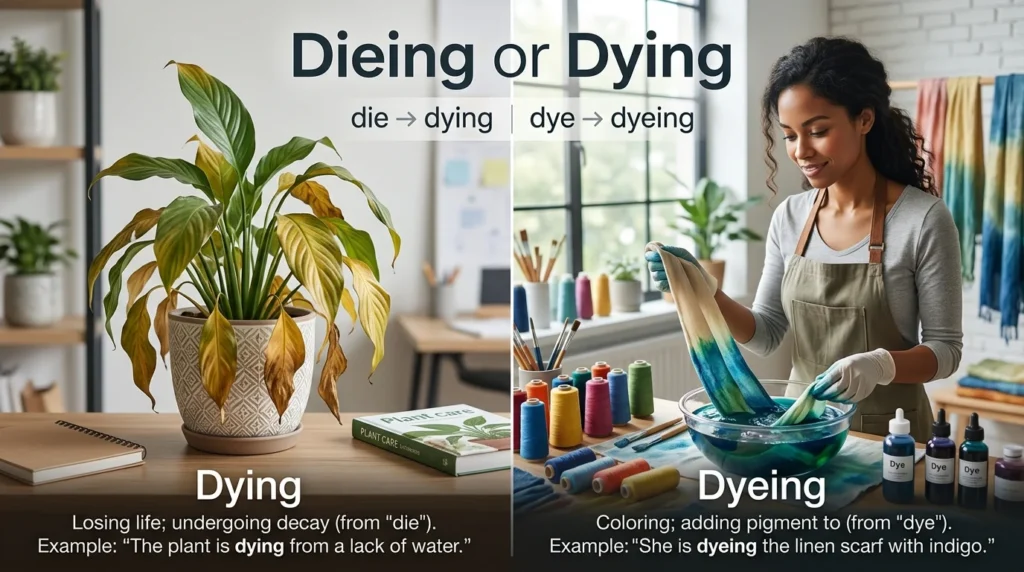
Dying comes from die and relates to death, decline, fading, or ending.
Dyeing comes from dye and means changing the color of something.
Compare these sentences:
The plant is dying.
She is dyeing her hair.
The first sentence is about losing life.
The second sentence is about changing color.
The extra e in dyeing matters.
Dyeing Hair or Dying Hair
This is one of the most common spelling mistakes.
If you mean changing the color of your hair, use:
dyeing
Correct:
She is dyeing her hair brown.
Incorrect:
She is dying her hair brown.
The second sentence could sound as if the person’s hair is somehow approaching death rather than being colored.
The same distinction applies to clothing and fabric.
Correct:
They are dyeing the fabric blue.
Incorrect:
They are dying the fabric blue.
So remember:
dye → dyeing = changing color
die → dying = approaching death or gradually ending
Died or Dyed
The confusion does not stop with dying and dyeing. The past forms are also different.
Died comes from die.
Dyed comes from dye.
Compare:
Her grandfather died last year.
She dyed her hair last year.
These two words look similar, but their meanings are completely different.
A simple comparison is:
| Base Verb | Past Form | Ing Form | Meaning |
|---|---|---|---|
| die | died | dying | lose life or gradually end |
| dye | dyed | dyeing | change color |
Learning these forms together makes the difference easier to remember.
Common Mistakes With Dieing and Dying
One common mistake is simply adding ing to die.
A writer may think:
die + ing = dieing
That looks logical, but it is not the standard spelling.
The correct form is:
die → dying
Another mistake is using dying when talking about hair color.
For example:
❌ She is dying her hair red.
Better:
✅ She is dyeing her hair red.
A third mistake is assuming that dieing is an alternative spelling of dying.
It is not the normal alternative. If you mean death or decline, use dying.
Is Dieing Ever a Word?
There is a rare technical use of dieing related to a manufacturing die, which is a tool used to cut, shape, or form material.
This meaning is very different from ordinary dying.
For most readers and writers, this technical form is unlikely to be useful.
If you are writing about ordinary life, death, decline, plants, animals, batteries, businesses, traditions, or similar topics, use dying.
For example:
The battery is dying.
The tree is dying.
The old tradition is dying.
Do not use dieing in these sentences.
Dieing or Dying in American English
There is no major American spelling variation here.
When die means to lose life or come to an end, the normal ing form is:
dying
For example:
- The plant is dying.
- The animal is dying.
- The battery is dying.
- The business is dying.
- The tradition is dying.
The spelling does not change simply because of regional English.
Dieing or Dying in British English
British English also uses:
dying
The same spelling rule applies.
For example:
The flowers are dying.
The old tradition is dying.
So, unlike some spelling pairs that change between regional varieties, dying remains the standard spelling in both major forms of English.
How to Remember Dying
The easiest memory trick is to remember the base word.
Start with:
die
Then remember:
die → dying
You can also group it with other words that follow the same pattern:
- lie → lying
- tie → tying
- die → dying
The ie changes to y before ing.
Once you remember this small group, dieing will start to look wrong.
Dying in Common Phrases
The word dying appears in several common expressions.
Dying of laughter
This informal expression means laughing extremely hard.
Example:
That joke had me dying of laughter.
Dying to know
This means being extremely eager to know something.
Example:
I’m dying to know what happened.
Dying for something
This means wanting something very strongly.
Example:
I’m dying for a cold drink.
Dying out
This means gradually disappearing or becoming less common.
Example:
Some old traditions are dying out.
These expressions usually have figurative meanings.
Dying vs Dead
Dying and dead are not the same.
Dying describes a process that is happening.
Dead describes a completed state in which something is no longer alive.
Compare:
The plant is dying.
This means the plant is still in the process of losing life.
The plant is dead.
This means the plant has already died.
The same distinction can apply to people, animals, plants, and some figurative situations.
Dying vs Die
The words die and dying also have different grammatical roles.
Use die as the base verb:
Plants need water or they may die.
Use dying after forms of be when describing an ongoing process:
The plant is dying.
You can also use dying as part of a phrase:
She is dying to see the movie.
Understanding the verb forms makes the spelling much easier.
Practice Questions
Choose dieing, dying, or dyeing.
1. The flowers are ______ because they have not received enough water.
Answer: dying
2. She is ______ her hair black this weekend.
Answer: dyeing
3. My phone battery is ______.
Answer: dying
4. The old tradition is slowly ______ out.
Answer: dying
5. They are ______ the fabric a darker color.
Answer: dyeing
6. The injured animal was ______.
Answer: dying
7. She ______ her shirt blue yesterday.
Answer: dyed
8. His grandfather ______ many years ago.
Answer: died
The main lesson is simple: dying comes from die, while dyeing comes from dye.
Quick Comparison
| Word | Meaning | Example |
|---|---|---|
| dying | Approaching death or gradually ending | The plant is dying. |
| dyeing | Changing the color of something | She is dyeing her hair. |
| dieing | Rare technical term connected with a manufacturing die | Used only in specialized contexts |
For ordinary writing, you will usually need either dying or dyeing, depending on what you mean.
Final Tips
Keep these rules in mind:
- Dying is the normal ing form of die.
- Dieing is not the normal spelling when talking about death.
- Dyeing means changing the color of something.
- Died comes from die.
- Dyed comes from dye.
- Verbs ending in ie can change ie to y before ing.
- Remember die → dying.
- Use dying for people, animals, plants, batteries, fires, traditions, and things that are gradually ending.
- Use dyeing for hair, clothes, fabric, and other things being colored.
- Treat dieing as a rare technical term rather than the ordinary spelling of dying.
FAQs
Is dieing or dying correct?
Dying is the correct standard spelling when you mean approaching death, losing life, fading, or gradually coming to an end. Dieing is not the normal everyday form of die.
Why is dying spelled with a y instead of dieing?
The verb die follows a spelling pattern in which ie changes to y before ing is added. That gives us die → dying, just as lie → lying and tie → tying.
Is dieing ever correct?
In ordinary writing, you should use dying. A rare technical use of dieing can appear in manufacturing when it relates to working with a tool called a die. This specialized meaning is very uncommon in everyday English.
What is the difference between dying and dyeing?
Dying comes from die and relates to death, decline, or something gradually ending. Dyeing comes from dye and means changing the color of something. For example, a plant can be dying, while someone can be dyeing a shirt.
Is dying spelled the same in American and British English?
Yes. Dying is the standard spelling in both American and British English when it comes from the verb die. The regional spelling difference does not change this word.
Conclusion
When you are choosing between dieing or dying, the correct everyday form is dying. The word comes from die, and English changes the final ie to y before adding ing. That gives us dying, just as we get lying from lie and tying from tie.
There is also an important difference between dying and dyeing. Dying relates to death, decline, or something gradually ending, while dyeing means changing the color of something. Once you remember die → dying and dye → dyeing, the spelling becomes much easier to get right.