

Quick Answer
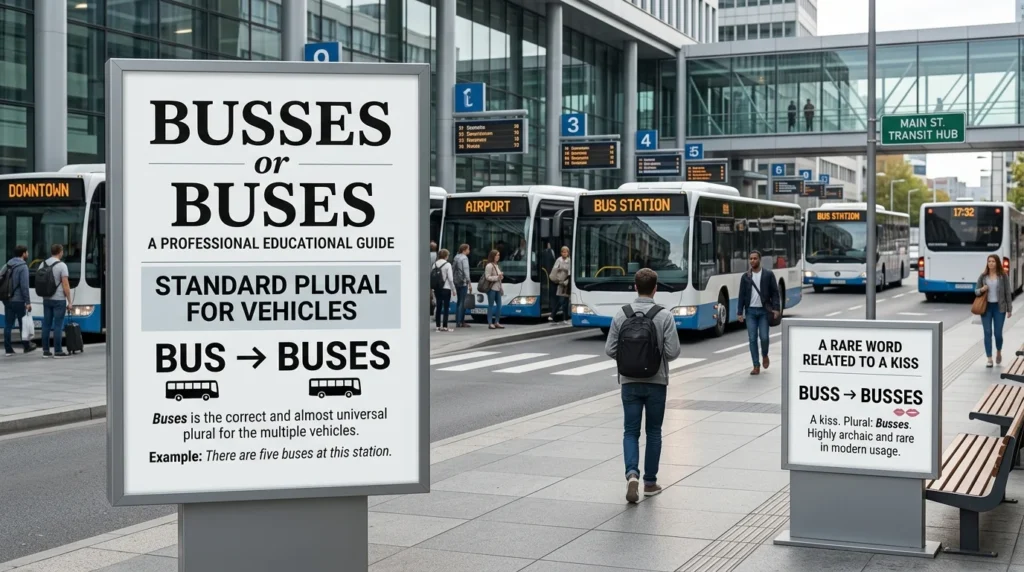
Buses is the standard plural spelling of bus when you mean two or more vehicles used to carry passengers. Busses can also be a real word, but it has a different meaning and is much less common.
If you need the plural of bus, should you write buses or busses? The answer can be confusing because both spellings exist in English, but they do not usually mean the same thing.
When you are talking about passenger vehicles, the normal plural is buses. For example, you would write, “Several buses arrived at the station.”
Busses is also a legitimate word in some contexts. It can be the plural form of buss, an old-fashioned word meaning a kiss. It can also appear as a verb form in certain uses. Because of that difference, choosing the right spelling depends on what you mean.
For everyday writing about public transportation, school transportation, or city travel, buses is the word you want.
What Does Bus Mean?
A bus is a large vehicle designed to carry several passengers.
You may see buses on city streets, highways, school routes, airport roads, and public transportation networks.
Examples include:
- The bus arrived at eight.
- I take the bus to work.
- The school bus picked up the students.
- A bus stopped outside the station.
- We waited for the next bus.
When you have more than one, the standard plural is buses.
For example:
Three buses were waiting outside the station.
What Does Buses Mean?
Buses is the standard plural of bus when the word refers to passenger vehicles.
Examples:
- The buses are full this morning.
- Several buses stopped at the station.
- School buses lined up outside the building.
- The city added more buses to the route.
- Two buses arrived at the same time.
This is the spelling you should normally use when writing about transportation.
What Does Busses Mean?
Busses can be a real English word, but it has a different use.
It can be the plural of buss, which means a kiss. The word buss is uncommon in modern everyday English and can sound old-fashioned or literary.
For example:
The poem described several affectionate busses.
Here, busses has nothing to do with transportation.
That is why a sentence about public transportation should normally use buses, not busses.
Buses or Busses: What Is the Difference?
The easiest way to understand the difference is to look at the base word.
Bus → buses
This means more than one passenger vehicle.
Buss → busses
This can refer to more than one kiss, although this use is uncommon.
Here is a simple comparison:
| Word | Meaning | Example |
|---|---|---|
| bus | One passenger vehicle | The bus is late. |
| buses | More than one passenger vehicle | The buses are late. |
| buss | A kiss, usually literary or old-fashioned | He gave her a buss. |
| busses | More than one buss | The story mentioned several busses. |
For ordinary transportation writing, buses is the correct choice.
Is Buses or Busses Correct?
If you are talking about two or more buses, use buses.
For example:
The buses were crowded.
That is the normal spelling.
Busses is not normally the plural you should use for public transportation.
However, it would be inaccurate to say that busses is never a word. It has other uses connected to the word buss.
So the better rule is:
Buses = passenger vehicles
Busses = plural of buss in its less common sense
When Should You Use Buses?
Use buses whenever you are talking about multiple passenger vehicles.
This includes:
- city buses
- school buses
- tour buses
- airport buses
- shuttle buses
- public buses
- transit buses
- long-distance buses
Examples:
The city needs more buses.
Five buses arrived at the terminal.
The school owns twenty buses.
Airport buses run every thirty minutes.
In each example, buses is the natural spelling.
Buses in Public Transportation
Public transportation is one of the most common contexts for the word.
For example:
The city operates hundreds of buses.
Several buses were delayed by traffic.
New buses will be added to the route.
The buses stop near the train station.
The plural buses makes the meaning clear immediately.
Using busses in these sentences would usually distract the reader and may look like a spelling mistake.
Buses for School Transportation
School transportation also commonly uses the word buses.
Examples:
- The school has six buses.
- The buses arrive before the students.
- Several school buses were parked outside.
- The district ordered new buses.
- The buses carry students to nearby schools.
The phrase school buses is especially common.
Remember:
One school bus
but:
Three school buses
Buses for Airport Transportation
Airports often use shuttle buses to move passengers between terminals, parking areas, hotels, and transportation centers.
Examples:
The airport has free shuttle buses.
Two buses were waiting outside Terminal 2.
The hotel provides buses for airport transfers.
Again, buses is the standard plural.
Buses in Everyday Conversation
You will hear and see buses in many everyday situations.
For example:
I missed the buses.
Where are the buses?
The buses are running late.
We need two buses for the trip.
The buses were packed this morning.
These sentences are simple, natural, and common.
If the topic is transportation, choose buses.
Why Does Buses Have One S Before the Ending?
The spelling of bus creates a small problem because the word already ends in s.
To make the plural, English commonly adds es:
bus → buses
This is similar to several other words that end in certain consonant sounds.
For example:
box → boxes
class → classes
dish → dishes
bus → buses
So you should not simply add one s to make the plural:
buss
That creates a different word.
Bus, Buses, and Buss
These three forms can look confusing, so it helps to separate them.
Bus
One passenger vehicle.
The bus is coming.
Buses
More than one passenger vehicle.
The buses are coming.
Buss
A rare word meaning a kiss.
He gave her a gentle buss.
Busses
More than one buss.
The novel described their affectionate busses.
The transportation word is bus, so its normal plural is buses.
Common Mistakes With Buses and Busses
One common mistake is writing busses when you mean multiple vehicles.
For example:
The busses are waiting outside.
For transportation, the preferred spelling is:
The buses are waiting outside.
Another mistake is assuming that busses cannot ever be correct.
It can be correct when it relates to buss, meaning a kiss. That meaning, however, is uncommon in modern everyday English.
A third mistake is forgetting the es ending.
The correct plural is:
bus → buses
not:
bus → buss
Buses in Professional Writing
When writing about transportation, travel, city planning, schools, or logistics, use buses for the plural of bus.
Examples:
The company operates a fleet of buses.
The city plans to purchase electric buses.
The school district replaced several older buses.
The transportation department added buses during peak hours.
This spelling is clear and standard.
Buses in Travel Writing
Travel articles and guides often mention buses because they are a common form of transportation.
Examples:
Buses connect the airport with downtown.
Several buses leave the station each morning.
Tourists can use local buses to reach the historic district.
The hotel offers shuttle buses to nearby attractions.
Whenever the word refers to vehicles, use buses.
Buses in Business
Businesses can also own or operate buses.
For example:
The company provides buses for employees.
The tour operator has several buses.
The hotel uses buses to transport guests.
The organization rented two buses for the event.
Again, buses is the correct choice for multiple vehicles.
Buses vs Bus’s
Another spelling that can cause confusion is bus’s.
This is different from buses.
Buses is plural:
The buses are outside.
Bus’s is normally a possessive form:
The bus’s door is open.
Here, bus’s means something belongs to one bus.
Compare:
The buses are clean.
This means several buses are clean.
The bus’s windows are clean.
This means the windows belonging to one bus are clean.
The apostrophe changes the function of the word.
Buses vs Buses’
You may also encounter buses’, which is a plural possessive form.
For example:
The buses’ doors were locked.
Here, the doors belong to multiple buses.
Compare the three forms:
bus = one vehicle
bus’s = belonging to one bus
buses = more than one bus
buses’ = belonging to more than one bus
Understanding these forms can prevent many punctuation mistakes.
Buses or Busses in American English
For ordinary transportation writing, buses is the form you should use.
Examples:
- city buses
- school buses
- public buses
- tour buses
- airport buses
If you are writing a sentence such as:
The buses arrived at noon.
there is no need to use busses.
The spelling buses clearly communicates that you mean vehicles.
Is Busses Ever Correct?
Yes, but its use is much narrower.
Busses can be the plural of buss, a noun referring to a kiss. The word buss is not common in everyday modern conversation.
You might encounter it in older books, poetry, historical writing, or deliberately old-fashioned language.
For example:
The old poem describes several busses exchanged by the lovers.
This is a completely different meaning from transportation.
Therefore, do not use busses for city vehicles just because the spelling looks like a possible plural of bus.
How to Remember Buses
A simple memory trick is:
One bus, two buses.
Think about the word as a vehicle:
bus → buses
If you are talking about transportation, remember that the plural normally ends in es.
You can also connect it with familiar words:
class → classes
glass → glasses
bus → buses
This makes the spelling easier to remember.
Examples of Buses
Here are some natural examples:
- The buses arrived early.
- Several buses were delayed.
- We waited for the buses.
- The city bought new buses.
- The school operates ten buses.
- The buses were crowded.
- Two buses stopped at the same station.
- The airport provides shuttle buses.
- Electric buses are becoming more common.
- The company rented buses for the trip.
All of these sentences use buses correctly.
Examples of Busses
The word busses is much less common.
When it appears as the plural of buss, the context usually involves kissing.
Examples:
- The novel describes several busses.
- The poem mentions affectionate busses.
- The historical story includes playful busses.
These examples sound literary because buss itself is not a common modern word.
That is why most people looking for the plural of bus should choose buses.
Practice Questions
Choose buses or busses in each sentence.
1. Several ______ arrived at the station.
Answer: buses
The sentence refers to passenger vehicles.
2. The school purchased three new ______.
Answer: buses
These are school transportation vehicles.
3. The poem described several affectionate ______.
Answer: busses
Here, the word refers to kisses.
4. We waited for the city ______.
Answer: buses
The sentence is about public transportation.
5. The airport operates free shuttle ______.
Answer: buses
The word refers to multiple vehicles.
Buses or Busses: Quick Comparison
| Question | Correct Choice |
|---|---|
| More than one bus | buses |
| City transportation | buses |
| School transportation | buses |
| Airport transportation | buses |
| More than one kiss in the rare literary sense | busses |
| Standard plural for bus | buses |
This gives you the easiest rule:
If you mean vehicles, write buses.
Final Tips
Keep these rules in mind:
- Bus is the singular form.
- Buses is the standard plural for passenger vehicles.
- Busses is a different word form with a much less common meaning.
- Buss can mean a kiss.
- Busses can be the plural of buss.
- Use buses for city, school, airport, tour, and public transportation.
- Do not use busses as the normal plural of a passenger vehicle.
- Bus’s is a possessive form referring to one bus.
- Buses’ is a plural possessive form referring to multiple buses.
- When in doubt about transportation, choose buses.
FAQs
Is buses or busses the correct plural of bus?
Buses is the standard plural when you mean more than one passenger vehicle. Busses has a different and much less common use connected with the word buss.
Is busses ever a correct spelling?
Yes. Busses can be the plural of buss, an uncommon word meaning a kiss. However, it is not the normal spelling for multiple transportation vehicles.
Why is the plural of bus buses instead of busses?
The standard plural is formed by adding es to bus, giving buses. The spelling busses represents a different word form rather than the usual plural of the transportation noun.
Should I write school buses or school busses?
Write school buses when referring to vehicles that transport students. This is the standard plural spelling of bus.
What is the difference between buses and bus’s?
Buses is the plural of bus, meaning more than one vehicle. Bus’s is normally possessive and means something belongs to one bus, as in “the bus’s door.”
Conclusion
When you are talking about more than one passenger vehicle, buses is the spelling you want. It is the standard plural of bus and works for school buses, city buses, airport buses, tour buses, and other forms of transportation.
Busses is not simply a second spelling of the same word. It can be the plural of buss, an uncommon word meaning a kiss. Because that meaning is rare in modern everyday English, busses can easily cause confusion when used in transportation writing.
The easiest rule is simple: one bus, two buses. If you are talking about vehicles, choose buses.