

Quick Answer
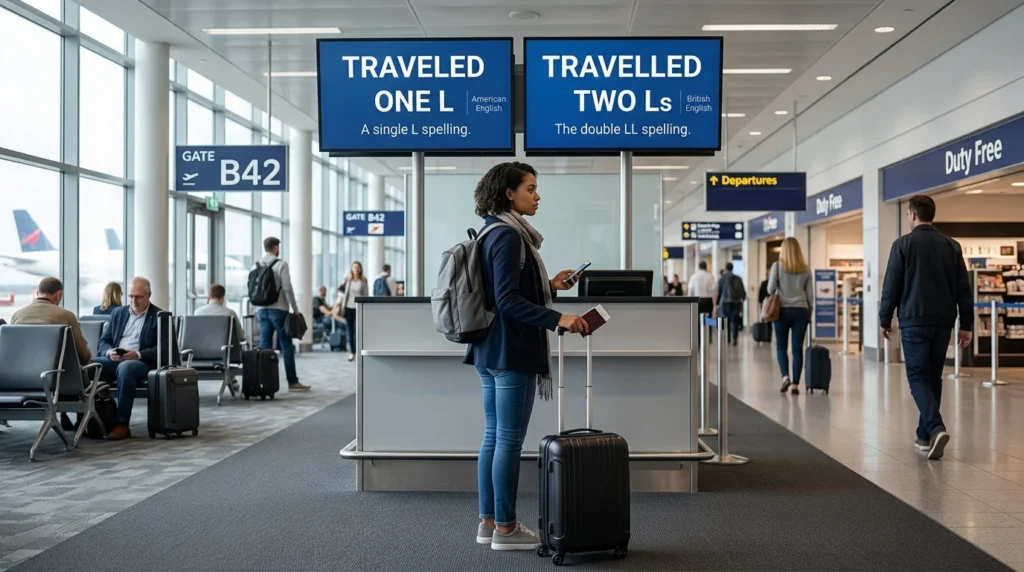
Traveled and travelled are both correct spellings of the past tense and past participle of travel. Traveled is the standard American spelling, while travelled is the standard British spelling.
Have you ever typed traveled and wondered if it should have two l’s? Or maybe you wrote travelled after seeing the word spelled with one l somewhere else?
The good news is that neither spelling is automatically wrong. Traveled and travelled have the same meaning. The difference comes from regional spelling conventions. American English normally uses traveled, while British English normally uses travelled.
You can use either form to describe someone who went from one place to another. The choice becomes important when you want your writing to follow one consistent style. Understanding this small spelling difference also makes related words such as traveling, travelling, traveler, and traveller easier to remember.
What Does Traveled Mean?
Traveled is the past tense and past participle of travel in American English.
The verb travel means to go from one place to another. It can describe a short trip, a long journey, regular movement for work, or visits to different places.
Examples:
- I traveled to Florida last summer.
- She traveled across the country by train.
- We traveled together for two weeks.
- He traveled for work last month.
- They traveled to several cities during their vacation.
The spelling with one l is the usual American form.
What Does Travelled Mean?
Travelled has the same meaning as traveled.
The difference is that travelled is the spelling normally used in British English.
Examples:
- I travelled to London last summer.
- She travelled across the country by train.
- We travelled together for two weeks.
- He travelled for work last month.
- They travelled to several cities during their holiday.
There is no change in meaning. The extra l simply reflects a different spelling convention.
Traveled or Travelled: What Is the Difference?
The main difference is the spelling style.
| Spelling | Common usage | Example |
|---|---|---|
| Traveled | American English | She traveled to Texas. |
| Travelled | British English | She travelled to London. |
Both words are forms of the verb travel.
The important thing to remember is that traveled is not a shortened version of travelled, and travelled is not a more complete version of traveled. They are simply two accepted regional spellings.
Is Traveled or Travelled Correct?
Both are correct.
If you are following American English, use traveled.
If you are following British English, use travelled.
For example:
We traveled to Chicago last year.
and:
We travelled to Manchester last year.
Both sentences use the past tense correctly.
The spelling changes, but the grammar and meaning remain the same.
When Should You Use Traveled?
Use traveled when your writing follows American spelling.
You might use it in:
- School assignments
- Business emails
- Travel articles
- Personal stories
- Resumes
- News writing
- Website content
- Everyday messages
Examples:
I traveled to New York for a conference.
My family traveled by car.
She traveled alone for the first time.
We traveled through several states.
The one l spelling is the natural choice in standard American writing.
When Should You Use Travelled?
Use travelled when your writing follows British spelling.
Examples:
I travelled to London for a conference.
My family travelled by train.
She travelled alone for the first time.
We travelled through several countries.
The spelling is especially useful when the rest of your writing follows British conventions.
The important point is consistency. Do not switch between traveled and travelled randomly in the same article.
Traveled or Travelled in Everyday Sentences
Both spellings work naturally in everyday English.
American style:
We traveled to the beach last weekend.
British style:
We travelled to the beach last weekend.
American style:
She traveled with her parents.
British style:
She travelled with her parents.
American style:
He traveled thousands of miles for work.
British style:
He travelled thousands of miles for work.
The sentence structure does not change. Only the spelling of the verb changes.
Traveled or Travelled for Past Events
Both forms can describe an action that happened in the past.
For example:
I traveled to Boston last year.
The word traveled tells us that the trip happened in the past.
British spelling gives:
I travelled to Boston last year.
You can also use the word with a specific time:
- We traveled there yesterday.
- She traveled abroad last summer.
- He traveled for work last month.
- They traveled across the state last weekend.
With British spelling, simply use travelled.
Traveled or Travelled With Have and Has
Both spellings can also be used as past participles.
American English:
I have traveled to many places.
She has traveled extensively for work.
They have traveled together before.
British English:
I have travelled to many places.
She has travelled extensively for work.
They have travelled together before.
The grammar remains the same.
The only difference is the spelling of the past participle.
Traveled or Travelled in Professional Writing
The word is common in professional writing because many people travel for work.
Examples include:
I traveled to Denver to meet the client.
She traveled frequently during her previous job.
Our team traveled to several offices during the project.
A British-style document might use:
I travelled to Manchester to meet the client.
She travelled frequently during her previous job.
Our team travelled to several offices during the project.
Neither form is more professional. The spelling simply needs to match the style of the document.
Traveled or Travelled in Travel Writing
Travel blogs, magazines, guides, and personal stories often use these words.
American example:
We traveled along the coast and stopped at several small towns.
British example:
We travelled along the coast and stopped at several small towns.
You can also use the word when describing previous trips:
She has traveled to more than twenty countries.
or:
She has travelled to more than twenty countries.
Again, both sentences are grammatically correct.
Traveled or Travelled With Different Types of Travel
The word travel is flexible.
You can travel:
- By car
- By plane
- By train
- By bus
- By boat
- On foot
- Across a country
- Around a city
- Between cities
- Abroad
Examples:
We traveled by train.
She traveled across the country.
They traveled abroad last year.
He traveled between cities for work.
The British spelling simply changes traveled to travelled.
Traveling or Travelling
The same regional spelling difference appears in the ing form.
American English:
traveling
British English:
travelling
Examples:
I am traveling this weekend.
She enjoys traveling alone.
British style:
I am travelling this weekend.
She enjoys travelling alone.
This gives you a useful word family:
American English
- travel
- traveled
- traveling
- traveler
British English
- travel
- travelled
- travelling
- traveller
Once you remember one form, the others become easier to recognize.
Traveler or Traveller
The noun also follows the same spelling pattern.
Traveler is the common American spelling.
Traveller is the common British spelling.
Examples:
He is an experienced traveler.
She is a frequent traveler.
British style:
He is an experienced traveller.
She is a frequent traveller.
Both forms describe a person who travels.
Well-Traveled or Well-Travelled
You may also see this word in phrases describing someone with a lot of travel experience.
American English:
She is a well-traveled writer.
British English:
She is a well-travelled writer.
Both forms are correct within their respective spelling systems.
The same difference appears with phrases such as:
- well-traveled road
- well-travelled road
- widely traveled
- widely travelled
- less-traveled path
- less-travelled path
Common Mistakes With Traveled and Travelled
One common mistake is assuming that traveled is the only correct spelling.
That is not true.
Another mistake is assuming that travelled contains an unnecessary letter.
It does not. The double l is a normal spelling pattern in British English.
A third mistake is mixing the two forms in one piece of writing.
For example:
She traveled to London and later travelled to Paris.
This may look inconsistent if the whole article is supposed to follow one spelling style.
It is better to choose one form and use it throughout.
Does the Extra L Change the Meaning?
No.
The extra l does not create a new word.
These sentences have the same meaning:
We traveled across the country.
We travelled across the country.
Both say that we went from one part of the country to another.
The difference is spelling, not meaning.
Does the Extra L Change the Pronunciation?
No.
Traveled and travelled are normally pronounced the same way.
The extra written l does not create a different spoken word.
This is another reason the difference can be confusing. You can hear the word clearly but still not know which spelling the writer is using.
Why Do People Write It With Two L’s?
English has different spelling traditions in different regions.
In this particular word family, British spelling normally keeps the double l in forms such as travelled, travelling, and traveller.
American spelling normally uses one l in traveled, traveling, and traveler.
This difference is not a difference in grammar ability. It is simply part of the spelling system being followed.
Traveled or Travelled in School Writing
Students may encounter both forms in books and online sources.
If the assignment follows American English, traveled is the natural choice.
Example:
During summer vacation, we traveled to several states.
If the assignment follows British English, travelled fits the style:
During the summer holiday, we travelled to several countries.
The important thing is to follow the spelling convention expected by the school or teacher.
Traveled or Travelled in Resumes
The word can appear on a resume when describing work that involved frequent trips.
For example:
Traveled frequently to meet clients across the region.
Or:
Traveled to multiple locations to support company projects.
If the resume follows British spelling, you may see:
Travelled frequently to meet clients across the region.
The choice should match the spelling style used in the rest of the resume.
Traveled or Travelled in Business Emails
Business emails can use either spelling.
American style:
I traveled to Dallas last week and met with the sales team.
British style:
I travelled to Birmingham last week and met with the sales team.
Neither is more formal.
The important thing is to maintain the same spelling style throughout your communication.
A Simple Memory Trick
Here is an easy way to remember the difference.
Think:
Traveled = one L
Travelled = two Ls
Then connect them with the regional style:
American English → traveled
British English → travelled
You can extend the same pattern to the related forms:
American
- traveled
- traveling
- traveler
British
- travelled
- travelling
- traveller
This makes the spelling easier to remember without memorizing a long grammar rule.
Practice Questions
Choose the form that fits the requested spelling style.
Question 1
American English:
We ______ to California last summer.
Answer: traveled
Question 2
British English:
They ______ across Scotland by train.
Answer: travelled
Question 3
American English:
She has ______ to several countries.
Answer: traveled
Question 4
British English:
He has ______ extensively for work.
Answer: travelled
Question 5
American English:
My family ______ by car.
Answer: traveled
Question 6
British English:
My family ______ by car.
Answer: travelled
The important lesson is that the sentence does not become grammatically different. Only the spelling changes.
Quick Comparison
| Word | Meaning | Common spelling |
|---|---|---|
| Traveled | Went from one place to another | American English |
| Travelled | Went from one place to another | British English |
| Traveling | Going from one place to another | American English |
| Travelling | Going from one place to another | British English |
| Traveler | A person who travels | American English |
| Traveller | A person who travels | British English |
This word family follows a clear regional pattern.
Which Spelling Should You Use?
If you are writing in American English, choose traveled.
If you are writing in British English, choose travelled.
For example, an American-style sentence would be:
I traveled to New York last month.
A British-style sentence would be:
I travelled to London last month.
Neither version is universally better. The right choice depends on the spelling system you are following.
Final Tips
Remember these simple points:
- Traveled is correct.
- Travelled is also correct.
- Both words have the same meaning.
- Traveled is the standard American spelling.
- Travelled is the standard British spelling.
- The same difference appears in traveling and travelling.
- It also appears in traveler and traveller.
- The pronunciation is normally the same.
- The extra l does not change the tense.
- Avoid switching between the two forms without a reason.
- Choose one spelling style and keep it consistent.
FAQs
Is traveled or travelled correct?
Both are correct. Traveled is the standard American spelling, while travelled is the standard British spelling.
Is traveled the American spelling?
Yes. Traveled with one l is the normal American spelling of the past tense and past participle of travel.
Is travelled wrong in American English?
No. It is a recognized spelling, but traveled is the form normally expected when following standard American spelling.
Is it traveling or travelling?
Both spellings are correct. American English normally uses traveling, while British English normally uses travelling.
Are traveled and travelled pronounced the same?
Yes. The two spellings are normally pronounced the same way. The difference is in spelling rather than pronunciation.
Conclusion
Traveled and travelled are two correct spellings of the same verb form. They describe the same action and follow the same grammar. The only real difference is the spelling convention used in different varieties of English.
For American English, use traveled with one l. For British English, use travelled with two l’s. The same pattern appears in related words such as traveling and travelling and traveler and traveller.
If you are unsure which one to choose, first look at the spelling style of the rest of your writing. Once you choose a style, stay consistent. That simple habit will prevent most traveled or travelled spelling mistakes.