
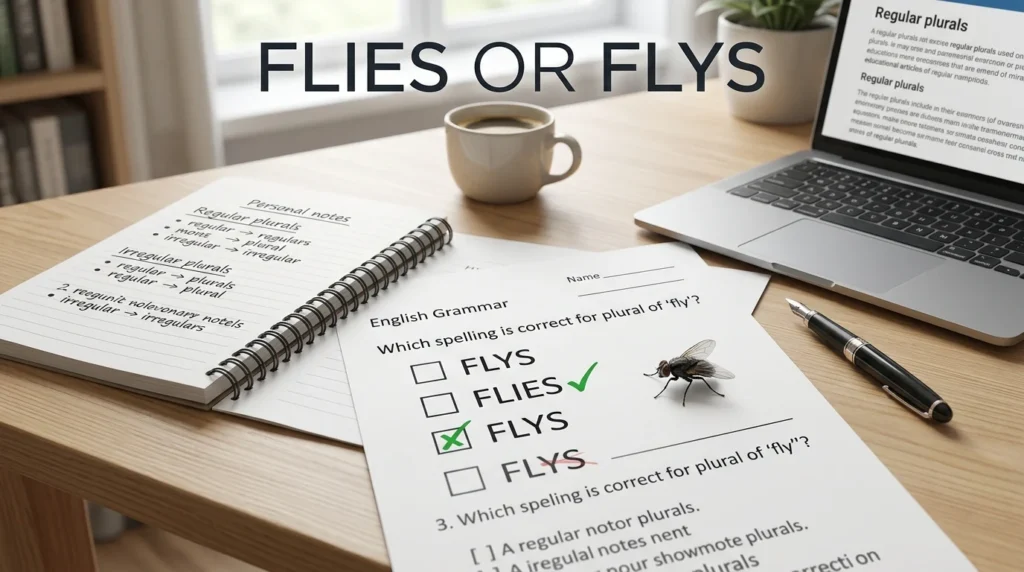

Quick Answer
Flies is the correct standard spelling, while flys is normally incorrect. Use flies for more than one fly and for the verb form used with he, she, it, or another singular subject.
The choice between flies or flys looks simple, but it can easily cause a spelling mistake. The confusion usually comes from a common English pattern. Many words become plural or take a third-person verb ending by simply adding s, so it may seem natural to write flys. However, fly follows a different spelling pattern.
The correct form is flies. It can be used as the plural of the noun fly, meaning more than one insect. It can also be the present-tense form of the verb fly, as in “She flies home every Friday.” Once you understand why the y changes, the spelling becomes much easier to remember.
What Does Flies Mean?
Flies has two main uses in standard English.
First, it is the plural form of fly, the name of a flying insect.
For example:
- There are flies in the kitchen.
- Several flies landed on the window.
- The flies were buzzing around the food.
Second, flies is a form of the verb fly.
For example:
- She flies to Chicago every month.
- The bird flies over the trees.
- The plane flies above the clouds.
- Time flies when you are having fun.
So, the meaning of flies depends on how it is used in the sentence.
What Does Flys Mean?
In ordinary modern English, flys is not the standard spelling you should use.
If you mean more than one insect, write:
flies
If you mean that one person, animal, aircraft, or thing moves through the air, write:
flies
For example:
The bird flies south.
Not:
The bird flys south.
Similarly:
Three flies are on the wall.
Not:
Three flys are on the wall.
There can be unusual cases where Flys appears as part of a name, brand, title, or other special wording. Those cases do not change the normal spelling rule.
Flies or Flys: What Is the Difference?
The basic difference is simple:
| Word | Correct in Standard English? | Main Use |
|---|---|---|
| flies | Yes | Plural noun or verb |
| flys | No, normally | Usually a spelling mistake |
The important thing is that flies is not just the plural form of the insect.
It is also a verb.
Compare these sentences:
The flies are near the window.
Here, flies is a noun.
The eagle flies over the mountain.
Here, flies is a verb.
The spelling is the same in both cases.
Why Is Flies Correct?
The spelling comes from a common English rule involving words that end in a consonant followed by y.
The word fly ends with:
l + y
The l is a consonant.
When a word ending in consonant plus y changes form in this way, the y often changes to i and es is added.
So:
fly → flies
The same pattern appears in other words:
- baby → babies
- city → cities
- story → stories
- party → parties
- family → families
- try → tries
- cry → cries
This is why flys does not follow the standard pattern.
Flies as a Plural Noun
When flies is a noun, it means more than one fly.
The singular form is:
one fly
The plural form is:
two flies
For example:
A fly landed on the table.
But:
Three flies landed on the table.
More examples:
- The flies are bothering us.
- Several flies entered the room.
- We saw flies near the trash can.
- The kitchen window was covered with flies.
- The children tried to chase the flies away.
The important rule is:
fly → flies
Not:
fly → flys
Flies as a Verb
Flies is also a verb form.
The base verb is fly.
When the subject is he, she, it, or another singular subject, the verb becomes flies.
Compare:
- I fly.
- You fly.
- We fly.
- They fly.
- He flies.
- She flies.
- It flies.
For example:
I fly to Boston every summer.
But:
She flies to Boston every summer.
Another example:
Birds fly south in winter.
But:
The eagle flies south in winter.
The subject determines the verb form.
Time Flies or Time Flys?
The correct expression is:
Time flies.
Not:
Time flys.
For example:
Time flies when you are having fun.
Here, flies is a verb.
The subject is time, which is singular. Therefore, the correct form is flies.
You can see the same pattern in:
Time flies quickly.
Time flies when you are busy.
It feels like time flies during vacation.
The spelling flys is incorrect in these sentences.
She Flies or She Flys?
The correct sentence is:
She flies to New York every Monday.
Not:
She flys to New York every Monday.
Why?
Because she is a singular third-person subject, so the verb needs its correct third-person form:
fly → flies
The same rule works with he and it:
- He flies every week.
- She flies every month.
- It flies through the air.
This is one of the most common situations where people accidentally write flys.
A Bird Flies or A Bird Flys?
The correct sentence is:
A bird flies over the house.
Not:
A bird flys over the house.
The subject a bird is singular. Therefore, the verb must be flies.
Compare:
Birds fly over the house.
Here, birds is plural, so we use the base verb fly.
This gives us a useful comparison:
One bird flies.
Two birds fly.
The same pattern works with many other subjects.
One Fly or Two Flies?
When talking about the insect, remember this simple pattern:
One fly
Two flies
For example:
I saw one fly near the window.
I saw two flies near the window.
You do not add s directly to create flys.
The spelling changes from y to ies.
Flies vs Fly’s
Another form that can cause confusion is fly’s.
The apostrophe changes the meaning.
Flies can be:
- the plural of fly
- the verb form of fly
Fly’s usually shows possession or a shortened form in a particular sentence.
For example:
The fly’s wings are damaged.
Here, fly’s means the wings belong to the fly.
Compare:
The flies are near the window.
Here, flies simply means more than one fly.
So:
flies ≠ fly’s
The apostrophe matters.
Flies vs Flying
These forms are related, but they do different jobs.
Fly is the base form.
Flies is the third-person singular present form.
Flying is the present participle or gerund form.
Examples:
Birds fly south.
The eagle flies south.
The eagle is flying south.
Notice the different forms:
fly → flies → flying
You should not replace one with another without considering the sentence.
Flies vs Flew
Flies and flew are both forms of the verb fly, but they refer to different times.
Flies is used for present actions or regular actions.
The plane flies every morning.
Flew is the past tense.
The plane flew yesterday.
So:
She flies to Denver every week.
But:
She flew to Denver last week.
This distinction can help prevent another common mistake.
Flies vs Flown
Flown is another form of fly.
It is normally used with helping verbs such as has, have, or had.
For example:
The bird has flown away.
They have flown across the country.
The main forms are:
- fly
- flies
- flew
- flown
- flying
Each one has its own grammatical use.
Common Mistakes With Flies and Flys
Writing “Time Flys”
Incorrect:
Time flys so quickly.
Correct:
Time flies so quickly.
The subject time is singular, so the correct verb is flies.
Writing “She Flys”
Incorrect:
She flys to work every morning.
Correct:
She flies to work every morning.
The verb changes from fly to flies.
Writing “Two Flys”
Incorrect:
Two flys landed on the food.
Correct:
Two flies landed on the food.
Here, flies is the plural noun.
Writing “The Plane Flys”
Incorrect:
The plane flys over the city.
Correct:
The plane flies over the city.
The subject the plane is singular.
Adding Only S
A common mistake is treating fly like a word such as car.
You might think:
fly + s = flys
But this does not follow the spelling pattern for this word.
Instead:
fly → flies
Other Words That Follow the Same Pattern
The spelling rule becomes easier when you compare fly with other words.
For nouns:
- baby → babies
- city → cities
- country → countries
- story → stories
- lady → ladies
For verbs:
- try → tries
- cry → cries
- carry → carries
- study → studies
- worry → worries
These examples show the same basic change.
The final y changes before the ending is added.
When Does Y Stay?
Not every word ending in y changes to ies.
If the y comes after a vowel, the spelling usually stays the same and you simply add s.
For example:
- day → days
- boy → boys
- toy → toys
- play → plays
- enjoy → enjoys
- stay → stays
Compare:
fly → flies
but:
play → plays
Why?
Because fly ends in consonant plus y, while play ends in vowel plus y.
This difference explains why the spelling of flies looks unusual.
Flies in Everyday Sentences
Here are some natural examples:
- Flies were buzzing around the kitchen.
- The bird flies over the lake.
- My brother flies to work twice a month.
- Time flies when everyone is having fun.
- Several flies landed near the window.
- The eagle flies high above the valley.
- She flies home every Friday.
- A small plane flies over the neighborhood.
- The flies disappeared after the door was closed.
- He flies for work several times a year.
Each sentence uses flies correctly.
Flies in Professional Writing
The word flies can appear in professional writing just as naturally as in casual conversation.
For example:
The aircraft flies between several major cities.
Or:
The company operates a service that flies to multiple destinations.
It can also appear in reports about insects:
The study examined how flies respond to changes in temperature.
There is no informal limitation on the word. Flies is a normal standard English form.
Is Flys Ever Correct?
For normal English writing, you should use flies.
However, you may occasionally see Flys in a proper name, username, business name, product name, title, or other intentionally chosen spelling.
If a specific name officially uses Flys, changing it to Flies could make the name inaccurate.
That is different from using flys as an ordinary English word.
For regular writing, remember:
Use flies.
How to Remember the Correct Spelling
Use this simple trick:
Fly changes to flies.
Think of the final y changing into ie before the s.
So:
fly → flies
You can connect it with:
try → tries
cry → cries
baby → babies
Once you remember these examples, flys will start to look obviously unusual.
Quick Comparison of Fly Forms
| Form | Use | Example |
|---|---|---|
| fly | Base verb or singular insect | I fly often. |
| flies | Plural noun or singular verb form | The flies are outside. |
| flew | Past tense | The bird flew away. |
| flown | Past participle | The bird has flown away. |
| flying | Present participle or gerund | The bird is flying. |
| flys | Not standard for normal use | Avoid it. |
This table gives you the main forms at a glance.
Practice Questions
Choose the correct word.
1. The bird ___ over the lake.
Answer: flies
The subject is singular, so flies is correct.
2. Several ___ entered the room.
Answer: flies
More than one insect means we need the plural noun flies.
3. My sister ___ to California every summer.
Answer: flies
The subject my sister is singular.
4. Time ___ when you are enjoying yourself.
Answer: flies
The correct expression is time flies.
5. Two ___ were sitting near the window.
Answer: flies
The plural of fly is flies.
6. They ___ home every December.
Answer: fly
The subject they is plural, so the base verb is used.
A Simple Rule for Remembering Flies
You only need to remember three things:
One insect: fly
More than one insect: flies
He, she, it, or one singular subject: flies
Examples:
One fly is on the wall.
Three flies are on the wall.
The bird flies over the wall.
That covers most everyday uses.
Final Tips
Keep these points in mind:
- Flies is the standard correct spelling.
- Flys is normally incorrect.
- Flies can be a plural noun.
- Flies can also be a verb.
- The plural of fly is flies.
- The third-person singular form of fly is flies.
- Write time flies, not “time flys.”
- Write she flies, not “she flys.”
- Fly’s is different because the apostrophe can show possession.
- Flew, flown, and flying are different forms of the same verb.
- Proper names can sometimes use unusual spellings, but that does not change the standard English rule.
FAQs
Is it flies or flys?
The correct standard spelling is flies. Use it when you mean more than one fly or when fly becomes the third-person singular present-tense verb.
What is the plural of fly?
The plural of fly is flies. For example, “Several flies were near the window.”
Is it time flies or time flys?
The correct expression is time flies. Here, flies is the present-tense verb used with the singular subject time.
Why does fly become flies instead of flys?
The word fly ends in a consonant followed by y. In this spelling pattern, the y changes to i and es is added, giving flies.
Can flys ever be used?
In normal English writing, flys should be avoided. You may see it in a proper name, brand, title, or username, where the unusual spelling is intentional. For the ordinary word, use flies.
Conclusion
The correct spelling is flies, not flys, in standard English. The word flies has two common jobs: it can mean more than one flying insect, and it can be the present-tense form of fly used with a singular subject.
The easiest examples to remember are one fly, two flies and I fly, but she flies. The spelling follows the consonant plus y pattern, which changes the ending from y to ies.
So, when you are writing a sentence such as “The bird flies over the house” or “There are flies in the kitchen,” choose flies every time.