
Quick Answer:
In texting, MB most commonly means “my bad.” It is a casual way to admit a mistake or apologize for a small error.
If someone sends MB in a text, they are usually saying “my bad.” The phrase is a quick, informal way to admit that they made a mistake, misunderstood something, or caused a small problem. For example, “MB, I forgot to call you” means “My bad, I forgot to call you.” MB is common in casual texting, social media chats, gaming conversations, and messages between friends. The exact meaning can depend on context, but “my bad” is the most common use when MB appears as a short reply or apology.
Key Facts About MB
| Term | Meaning | Common Use |
|---|---|---|
| MB | My Bad | Admitting a mistake |
| Tone | Casual | Texting and chats |
| Purpose | Informal apology | Small mistakes |
| Common setting | Messages and social media | Everyday conversation |
What Does MB Mean in Text?
MB usually stands for “my bad.” People use it when they want to acknowledge a mistake without giving a long explanation.
For example:
- “MB, I sent the wrong address.”
- “MB, I didn’t see your message.”
- “MB, I thought you were already there.”
- “MB, I forgot about the meeting.”
In these examples, MB works as a short and casual apology.
Why Do People Use MB?
Text messages often favor short expressions. Instead of typing “my bad,” someone can simply write MB.
It can save time while still showing that the person recognizes the mistake. The abbreviation is especially common when the mistake is minor and does not require a serious apology.
For example:
“MB, I grabbed your charger.”
This sounds casual and friendly. It is different from a formal apology such as “I apologize for taking your charger.”
MB Meaning and Tone
The tone of MB is usually relaxed and informal. It can communicate accountability without making the conversation sound overly serious.
However, tone depends on the situation. If someone uses MB after making a major mistake, the short response may feel too casual.
For a small mistake:
“MB, wrong chat.”
For a serious situation, a fuller apology is usually clearer and more respectful.
MB vs Sorry
MB and sorry can both acknowledge a mistake, but they do not always sound the same.
MB feels casual and conversational.
Sorry can work in both casual and more serious situations.
For example:
“MB, I forgot your book.”
“Sorry, I forgot your book.”
Both acknowledge the mistake, but MB has a more relaxed tone.
MB vs My Bad
There is no major difference in meaning between MB and my bad when MB is being used as an abbreviation.
MB: “I sent the wrong file.”
My bad: “I sent the wrong file.”
Both communicate that the sender recognizes the mistake. The main difference is that MB is shorter.
How to Know What MB Means
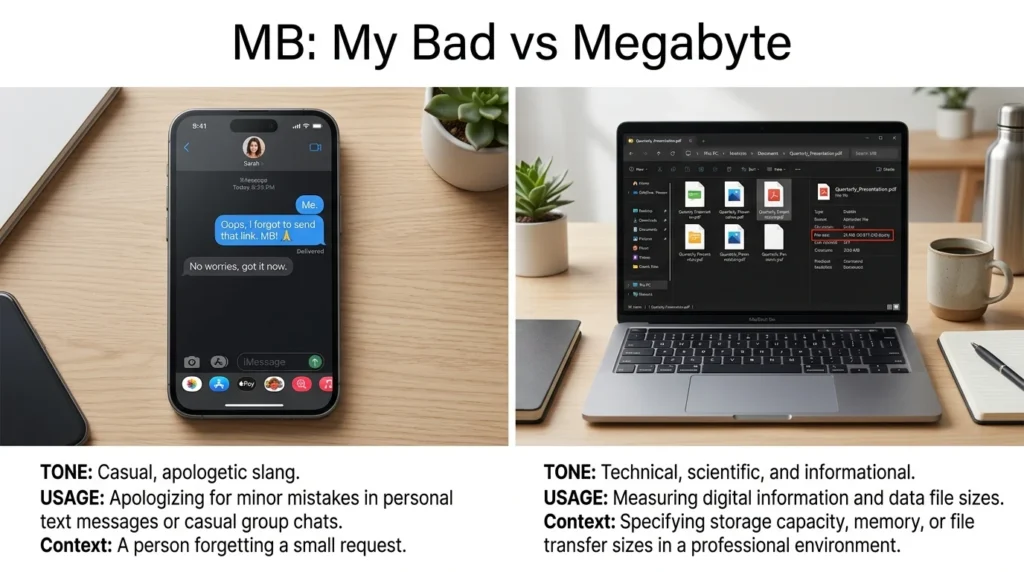
Context is important because MB can have other meanings outside casual texting.
When MB appears after a mistake, misunderstanding, or accidental action, “my bad” is usually the intended meaning.
For example:
“MB, I thought you said 7.”
Here, MB clearly means “my bad.”
If the conversation is about computers, file sizes, or technology, MB may instead refer to megabyte. The surrounding topic tells you which meaning applies.
Is MB Formal?
No. MB is mainly an informal texting abbreviation.
It works well in:
- Text messages
- Group chats
- Social media
- Gaming chats
- Casual conversations
It is generally better to write a complete phrase in formal emails, academic work, business documents, and official communication.
Examples of MB in Text
Here are some natural examples:
“MB, I forgot to reply.”
Meaning: My bad, I forgot to reply.
“MB, wrong number.”
Meaning: My bad, I contacted the wrong person.
“MB, I took your seat.”
Meaning: My bad, I took your seat.
“Oh MB, I misunderstood you.”
Meaning: My bad, I misunderstood you.
Common Mistake With MB
One common mistake is assuming that MB always means “my bad.” In texting, that is a common meaning, but context matters.
In technology, MB often means megabyte, a unit used to describe digital data. Therefore, a message such as “The file is 20 MB” is not an apology.
Always look at the full sentence before deciding what MB means.
FAQs
What does MB mean in texting?
MB usually means “my bad.” It is a casual way to admit a mistake or give a quick apology.
What does MB mean from a girl or guy?
MB has the same basic meaning regardless of who sends it. If it appears after a mistake, it most likely means “my bad.”
Is MB rude in a text?
Usually, no. MB is normally casual rather than rude. However, using it for a serious mistake can sometimes seem too informal.
Does MB mean my bad or megabyte?
It can mean either. In casual conversations, MB often means “my bad.” In technology-related conversations, it can mean megabyte.
Can I use MB in formal writing?
It is better to avoid MB in formal writing. Use “my mistake,” “I apologize,” or another complete phrase when the situation requires a professional tone.
Conclusion
MB most commonly means “my bad” in casual text messages. It is a short way to admit a small mistake, misunderstanding, or accidental action.
The meaning can change with context. In everyday chats, MB often works as an informal apology, while technology discussions may use MB to mean megabyte. Reading the surrounding message makes the intended meaning easy to identify.
See Also More :
- wtv meaning in text: The Correct Spelling, Meaning and Usage Explained
- Ion meaning in text: The Correct Spelling, Meaning and Usage Explained
- wya meaning in text: The Correct Spelling, Meaning and Usage Explained