
Quick Answer
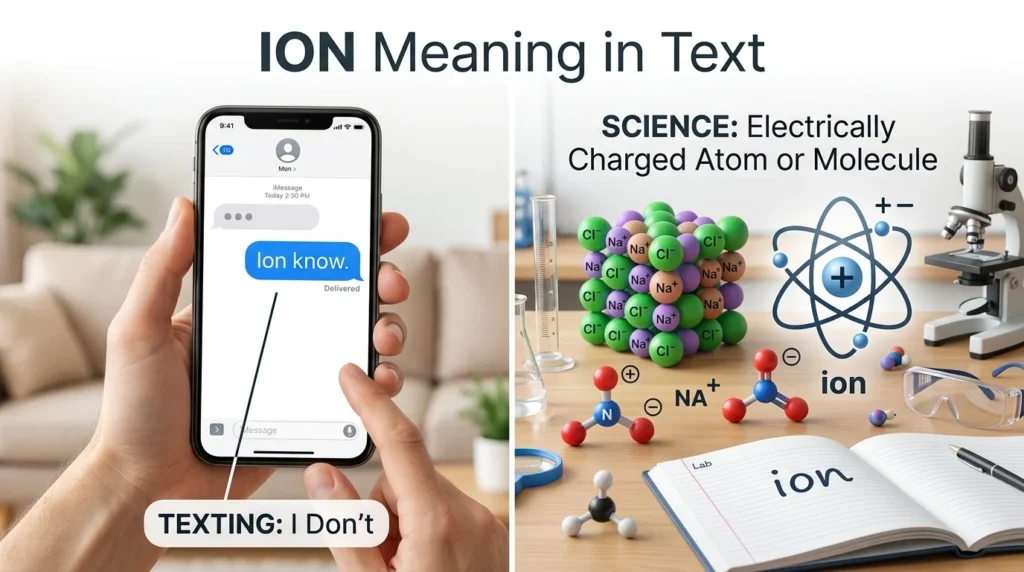
ION usually means “I don’t” in casual texting and online slang. It is often used at the beginning of a sentence, such as “ion know” meaning “I don’t know.”
The search for ion meaning in text often comes from seeing messages such as “ion know,” “ion want to,” or “ion care.” Unlike many texting abbreviations, ION is usually not an acronym where each letter represents the first letter of a separate word. Instead, it is an informal written form of “I don’t.” The spelling developed through casual speech and online communication, where people often write words the way they sound. This article explains what ION means, where it comes from, how people use it, how its tone can change, and when you should choose standard English instead.
What Does ION Mean in Text?
In casual texting, ION usually means “I don’t.”
It is especially common before verbs and expressions such as:
- “Ion know” means “I don’t know.”
- “Ion want that” means “I don’t want that.”
- “Ion care” means “I don’t care.”
- “Ion think so” means “I don’t think so.”
- “Ion remember” means “I don’t remember.”
The spelling ion represents the way “I don’t” can sound when spoken quickly in some informal speech patterns. People then carry that pronunciation into text.
Common ION Meanings
| Expression | Standard English | Example |
|---|---|---|
| Ion know | I don’t know | “Ion know what happened.” |
| Ion want | I don’t want | “Ion want to go.” |
| Ion care | I don’t care | “Ion care about that.” |
| Ion think | I don’t think | “Ion think he is coming.” |
| Ion remember | I don’t remember | “Ion remember his name.” |
The intended meaning is usually clear from the words that follow ION.
Why Do People Write ION Instead of “I Don’t”?
People use ION because casual online communication often reflects spoken language.
When people speak quickly, “I don’t” can sound compressed. Some speakers then represent that sound in writing as “ion.” Social media, texting, music, memes, and online communities have helped this spelling become recognizable to more readers.
ION also gives a message a distinctly casual voice. Someone who writes:
“I don’t know.”
is using standard English.
Someone who writes:
“Ion know.”
is intentionally using informal internet or conversational spelling.
The second version can feel more relaxed, humorous, expressive, or connected to a particular style of speech.
Origin and Background of ION
ION does not have one universally documented starting point as a texting abbreviation. Its use is better understood as a form of phonetic or nonstandard spelling that reflects casual pronunciation of “I don’t.”
Informal spellings like this can spread through spoken language and popular culture before becoming common in digital communication. Texting and social media make these forms especially visible because people can reproduce speech patterns directly on a screen.
ION is also associated with informal language styles found in online communities and some varieties of contemporary American speech. Its use should not be treated as a formal spelling rule. Standard English still uses “I don’t.”
Different Meanings and Contexts of ION
The meaning of ION is usually straightforward in casual messages, but the tone can change according to the context.
Text Messages
In a private text, ION usually means “I don’t.”
“Ion know what to tell you.”
The sender means:
“I don’t know what to tell you.”
Social Media
ION can appear in captions, comments, replies, and posts.
“Ion even know why I posted this.”
The writer is using an informal spelling to create a conversational tone.
TikTok
Short phrases such as “ion know” or “ion care” may appear in captions and comments.
The meaning remains “I don’t know” or “I don’t care.”
A user might comment:
“Ion think I could do that.”
The phrase means:
“I don’t think I could do that.”
Snapchat
Friends may use ION naturally in casual messages.
“Ion wanna go out tonight.”
This means:
“I don’t want to go out tonight.”
Online Comments
ION can make a comment sound more conversational.
“Ion see the problem.”
The writer means:
“I don’t see the problem.”
Friend to Friend Conversations
This is one of the most natural settings for ION.
“Ion know bro.”
The message simply means “I don’t know.”
Romantic Conversations
ION can appear in casual conversations between people who are dating or talking.
“Ion want you to leave yet.”
This means “I don’t want you to leave yet.”
The abbreviation itself does not prove romantic intent. The rest of the conversation provides that context.
Workplace Communication
ION is generally not suitable for professional writing. A workplace message should normally use standard English.
Instead of:
“Ion know when the report is due.”
write:
“I don’t know when the report is due.”
ION Meaning From a Guy
When a guy writes ION, the abbreviation itself usually has the same basic meaning: “I don’t.”
For example:
“Ion know what you mean.”
means:
“I don’t know what you mean.”
If he writes:
“Ion wanna argue.”
he means:
“I don’t want to argue.”
The important point is that ION does not automatically reveal his feelings or intentions. The words around it, the previous messages, and his normal communication style provide more information.
For example, “Ion know” may simply show uncertainty. It does not necessarily mean he is avoiding the conversation.
ION Meaning From a Girl
A girl using ION generally uses it in the same way. It is an informal representation of “I don’t.”
For example:
“Ion think that is a good idea.”
means:
“I don’t think that is a good idea.”
Or:
“Ion wanna talk about it.”
means:
“I don’t want to talk about it.”
The abbreviation does not carry a special meaning simply because a girl uses it. Interpret the complete message and conversation instead of assigning a hidden intention to ION itself.
Tone and Emotional Meaning of ION
ION can make a message feel different from the standard phrase “I don’t.”
Casual Tone
“Ion know lol.”
This sounds relaxed and conversational.
Playful Tone
“Ion even know 😂”
The wording and emoji can make the message humorous.
Frustrated Tone
“Ion care anymore.”
The words that follow ION create the emotional weight.
Dismissive Tone
“Ion care.”
This may sound blunt or dismissive, especially if the conversation is serious.
Uncertain Tone
“Ion know.”
This may simply show that the person does not have an answer.
Capitalization can also change the visual feel:
“ion know”
looks very casual.
“ION KNOW”
can appear more forceful or dramatic.
Punctuation matters too:
“Ion know.”
may sound flat or final.
“Ion know?”
can suggest uncertainty.
The relationship between the people matters as well. A friend may use ION naturally, while the same spelling in a professional conversation could appear careless or overly informal.
Real Life Examples of ION in Text
Example 1: Asking About Plans
Person A: “Are you coming with us tonight?”
Person B: “Ion know yet.”
Here, ION means “I don’t.” The complete meaning is “I don’t know yet.”
Example 2: Talking About Food
Person A: “Do you want pizza?”
Person B: “Ion want pizza today.”
The sender means “I don’t want pizza today.”
Example 3: Talking About a Movie
Person A: “Did you like the movie?”
Person B: “Ion think it was that good.”
The sender means “I don’t think it was that good.”
Example 4: Asking About Someone
Person A: “Where is Mike?”
Person B: “Ion know.”
This is simply an informal way to say “I don’t know.”
Example 5: Setting a Boundary
Person A: “Can we talk about what happened?”
Person B: “Ion wanna talk about it right now.”
The message means “I don’t want to talk about it right now.”
Example 6: Casual Humor
Person A: “Why did you buy another pair of shoes?”
Person B: “Ion know 😂”
Here, the speaker may be joking about making an unnecessary purchase.
Example 7: Showing Disagreement
Person A: “I think we should cancel.”
Person B: “Ion think we should cancel yet.”
The sender means “I don’t think we should cancel yet.”
Practical Usage of ION
ION is easiest to understand when you treat it as an informal replacement for “I don’t.”
Common patterns include:
- Ion know
- Ion want
- Ion need
- Ion care
- Ion think
- Ion remember
- Ion like it
- Ion understand
- Ion see it
- Ion wanna go
- Ion gotta do that
For example:
“Ion remember where I put my keys.”
This means:
“I don’t remember where I put my keys.”
Another example:
“Ion wanna watch that movie.”
This means:
“I don’t want to watch that movie.”
The spelling is intentionally informal. If you are writing for an audience that expects standard English, use “I don’t” instead.
Formal or Informal Usage
ION is informal internet and conversational slang.
It is appropriate mainly when the goal is to reproduce a casual speaking style.
ION Can Work In
- Text messages
- Casual group chats
- Social media comments
- Memes
- Informal captions
- Casual online communities
- Conversations between close friends
ION Should Usually Be Avoided In
- Business emails
- Resumes
- Cover letters
- Academic essays
- School assignments
- Professional reports
- Formal presentations
- Customer service messages
- Official documents
For example, this is appropriate for a casual text:
“Ion know if I can make it.”
For professional communication, write:
“I don’t know if I can make it.”
The second version follows standard written English and is clearer for a broad audience.
Common Mistakes People Make With ION
Mistake 1: Thinking ION Is a Standard Spelling
ION is not the standard written form of “I don’t.”
Correct standard English: “I don’t.”
Informal texting style: “Ion.”
Mistake 2: Assuming ION Always Means “I Don’t”
In ordinary texting, that is usually the intended meaning. However, an abbreviation can have different meanings in technical or specialized settings.
Always consider the context.
Mistake 3: Reading ION as the Chemical Term
An ion is also a scientific term for an electrically charged atom or molecule. That meaning is completely different from the texting slang.
In a chemistry discussion:
“The sodium ion has a positive charge.”
Here, “ion” is a scientific word, not texting slang.
Mistake 4: Thinking ION Is an Acronym
ION is usually better understood as a phonetic spelling of “I don’t” rather than a traditional acronym where each letter represents a separate word.
Mistake 5: Using ION in Formal Writing
A reader may understand it, but it can make professional or academic writing look overly casual.
Use “I don’t” in formal contexts.
Mistake 6: Assuming the Tone Is Always Negative
“Ion know” may sound uncertain, while “ion care” can sound dismissive. The emotional meaning comes mainly from the complete sentence, not ION alone.
Related Words and Expressions
Several informal expressions are closely related to ION.
I Don’t
This is the standard English form.
“I don’t know.”
It works in both casual and formal settings.
IDK
IDK means “I don’t know.” Unlike ION, it abbreviates the entire phrase.
“IDK what happened.”
Both “IDK” and “ion know” can express uncertainty, but they come from different types of informal writing.
IDC
IDC means “I don’t care.”
“IDC what they think.”
ION can appear in the same sentence:
“Ion care what they think.”
Both communicate a similar idea, but IDC is a conventional abbreviation while ION is a phonetic spelling.
IMO
IMO means “in my opinion.”
It is used to introduce a personal view rather than express “I don’t.”
NGL
NGL means “not gonna lie.”
It introduces an honest or direct statement.
“NGL, I do not like it.”
It serves a different purpose from ION.
ION vs IDK
ION and IDK are sometimes confused because both can appear when someone does not know something. Their structures are different.
| Term | Meaning | Main Use | Example |
|---|---|---|---|
| ION | I don’t | Informal phonetic spelling | “Ion know.” |
| IDK | I don’t know | Text abbreviation | “IDK.” |
| I Don’t Know | I do not know | Standard English | “I don’t know.” |
The difference is simple. ION can replace “I don’t” within a sentence, while IDK commonly replaces the complete phrase “I don’t know.”
For example:
“Ion know where he went.”
and:
“IDK where he went.”
Both can communicate the same basic idea.
ION vs “I Don’t”
The biggest difference between ION and “I don’t” is formality.
| Form | Style | Example |
|---|---|---|
| ION | Very casual | “Ion want to go.” |
| I don’t | Standard English | “I don’t want to go.” |
Use ION when intentionally writing in a casual online voice. Use I don’t when clarity and standard grammar matter.
Social Media Usage of ION
ION appears across many social media environments because users often write captions and comments in the same style they use while speaking.
TikTok
Users may write:
“Ion know why this is so funny.”
The phrase creates a casual, conversational tone.
A comment might say:
“Ion think I could wear that.”
This means “I don’t think I could wear that.”
Snapchat
Friends may write:
“Ion wanna leave yet.”
The abbreviation fits the relaxed style of a private message.
X
A casual post might say:
“Ion understand how people do this.”
Again, ION means “I don’t.”
Discord
Online communities may use ION naturally in fast conversations.
“Ion know what happened.”
The meaning stays the same even when the platform changes.
The spelling generally does not change its core meaning across these platforms. What changes is the style of the surrounding conversation.
Professional Usage of ION
ION is generally not appropriate for professional communication.
Imagine receiving this workplace message:
“Ion know if the client replied.”
The meaning is understandable, but the wording is too casual for many professional settings.
A better version is:
“I don’t know if the client replied.”
The standard version looks cleaner and avoids confusion.
For formal communication, always consider your audience. Even if coworkers use slang privately, a report, email to a client, resume, or business document should normally follow standard written English.
Regional and Generational Usage
ION is strongly associated with informal online communication and conversational language. Its familiarity can vary between age groups and online communities.
People who spend significant time on social media, messaging platforms, gaming communities, and internet culture may recognize ION quickly. Other readers may interpret “ion” as the scientific word instead.
The expression can also reflect speech patterns associated with particular communities. However, it would be too broad to say that everyone in a certain age group or region uses ION.
Online slang spreads across geographic boundaries, but individual usage still varies.
Why Context Matters With ION
Context is especially useful because ion has a completely separate meaning in science.
Compare these two examples:
“Ion know what happened.”
Here, ION is informal texting language meaning “I don’t.”
Now consider:
“The ion has a positive charge.”
Here, ion is a scientific noun.
The surrounding words make the intended meaning clear.
When you see ION in a text message followed by a verb such as “know,” “want,” “care,” or “think,” the slang interpretation is usually easy to identify.
How to Reply to ION
You can respond normally by focusing on the complete sentence.
If someone writes:
“Ion know.”
you might say:
“That’s okay.”
or:
“No worries. I’ll find out.”
If someone says:
“Ion wanna go.”
you could reply:
“That’s fine. Maybe another time.”
There is no special response required simply because someone used ION. Treat it as an informal version of “I don’t.”
Practice Questions
Question 1
What does “ion know” usually mean?
Question 2
Is ION standard English spelling?
Question 3
What does “ion care” mean?
Question 4
Which is more appropriate for a professional email: “Ion know” or “I don’t know”?
Question 5
Can the word “ion” have a meaning outside texting slang?
Answers
1. “Ion know” usually means “I don’t know.”
2. No. ION is an informal phonetic spelling used in casual communication.
3. “Ion care” means “I don’t care.”
4. “I don’t know” is the appropriate choice for professional writing.
5. Yes. An ion is also a scientific term for an electrically charged atom or molecule.
FAQs
1. What does ION mean in texting?
ION usually means “I don’t” in casual texting. It is commonly followed by words such as “know,” “want,” “care,” or “think.”
2. Is ION the same as IDK?
Not exactly. ION is an informal spelling of “I don’t,” while IDK is an abbreviation for the complete phrase “I don’t know.”
3. Is ION grammatically correct?
ION is not standard English spelling. It is an informal representation of speech used in texting, social media, and casual online communication.
4. What does “ion wanna” mean?
“Ion wanna” means “I don’t want to.” It is an informal texting form that reflects casual pronunciation.
5. Can ION mean something else?
Yes. Outside texting slang, “ion” is a standard scientific word referring to an electrically charged atom or molecule. Context tells you which meaning applies.
Conclusion
The most common ion meaning in text is “I don’t.” It is an informal phonetic spelling that appears in phrases such as “ion know,” “ion care,” and “ion want.” People mainly use it in casual texts, social media posts, comments, and online conversations where conversational language feels natural.
ION should not be confused with standard English spelling or with the scientific term “ion.” Use “I don’t” in professional and formal writing, while ION can work when you intentionally want a relaxed online voice. The words surrounding ION usually make its intended meaning clear.