
Quick Answer:
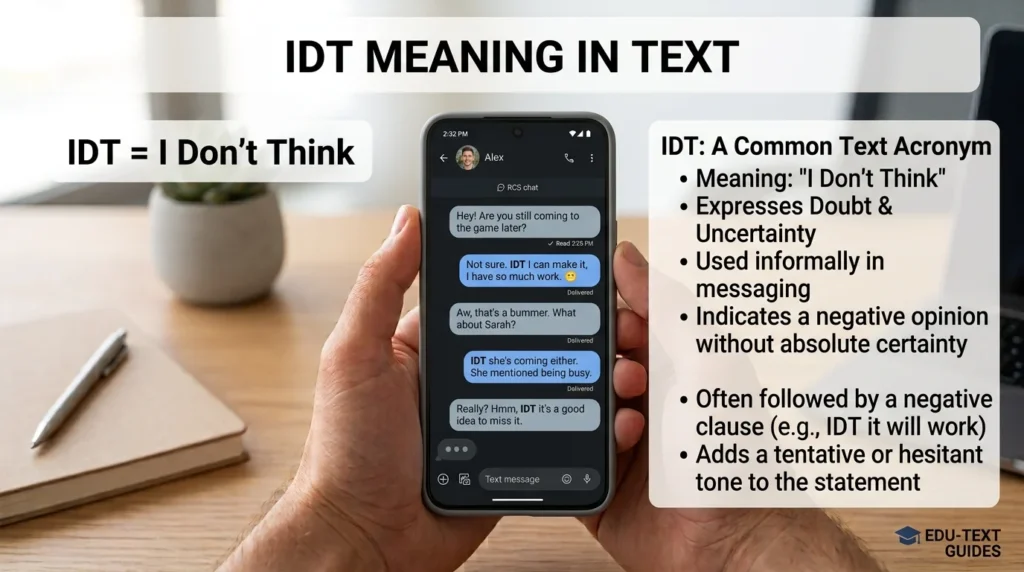
In text messages, IDT most commonly means “I Don’t Think.” People use it to express doubt, disagreement, or an uncertain opinion in casual conversations.
If someone sends you IDT in a text, they are usually saying “I don’t think.” It is a short texting abbreviation used when someone disagrees with an idea or is not confident that something is true. For example, “IDT that will work” means “I don’t think that will work.” IDT is informal and commonly appears in texting, social media messages, and casual online conversations. Understanding the sentence around it helps you identify the exact tone.
Key Facts About IDT
| Term | Meaning | Common Use |
|---|---|---|
| IDT | I Don’t Think | Doubt or disagreement |
| Type | Text abbreviation | Casual messaging |
| Tone | Informal | Everyday conversations |
| Example | IDT that’s true | Expressing doubt |
What Does IDT Mean in Text?
IDT means “I Don’t Think.” It is usually placed before an opinion or statement that the sender does not fully agree with.
For example:
- “IDT we should go.”
- “IDT that’s right.”
- “IDT he knows about it.”
- “IDT I’ll be able to come.”
In each example, IDT makes the statement sound less direct than simply saying “No.”
What Does IDT Mean in a Text From Someone?
When someone uses IDT, they are generally expressing doubt, disagreement, or uncertainty.
For example:
“IDT she is coming.”
This means:
“I don’t think she is coming.”
The person is giving their belief, but they are not claiming complete certainty.
IDT Tone in Texting
The tone of IDT depends on the rest of the message.
“IDT so.”
This can sound like a simple disagreement.
“IDT that’s going to happen.”
This expresses doubt about an expected event.
“IDT you’re wrong.”
This can sound more direct because it challenges another person’s statement.
IDT itself is not automatically rude or angry. The surrounding words provide more information about the sender’s attitude.
IDT vs IDK
IDT and IDK are different abbreviations.
| Abbreviation | Meaning | Use |
|---|---|---|
| IDT | I Don’t Think | Expresses doubt or an opinion |
| IDK | I Don’t Know | Shows lack of knowledge |
For example:
“IDT he’ll come.” means “I don’t think he’ll come.”
“IDK if he’ll come.” means “I don’t know if he’ll come.”
The first expresses a belief. The second says the person does not know.
IDT vs IMO
IMO means “In My Opinion.” It directly introduces a personal viewpoint.
“IDT this is a good idea.”
This means the person does not think it is a good idea.
“IMO this is a good idea.”
This means the person is giving their opinion that it is a good idea.
Both can introduce personal views, but they communicate different ideas.
Is IDT Formal or Informal?
IDT is an informal texting abbreviation. It works well in casual conversations with friends, family, and people who commonly use text abbreviations.
For professional emails, academic writing, or formal documents, writing “I don’t think” is usually clearer and more appropriate.
How to Reply to IDT
Your response depends on what the person is saying.
If someone texts:
“IDT we have enough time.”
You could reply:
- “Maybe you’re right.”
- “Let’s check.”
- “I think we do.”
- “Okay, we can leave earlier.”
A natural response should address the idea behind the message rather than the abbreviation itself.
Common Examples of IDT
“IDT that’s true.”
Meaning: I don’t think that’s true.
“IDT I can make it.”
Meaning: I don’t think I can make it.
“IDT he knows.”
Meaning: I don’t think he knows.
“IDT we need one.”
Meaning: I don’t think we need one.
Common Mistake With IDT
One common mistake is assuming that IDT means the sender is completely certain. In most conversations, “I don’t think” expresses a belief or judgment, not absolute proof.
The context matters. A person may change their mind if they receive new information.
FAQs
What does IDT mean in texting?
IDT usually means “I Don’t Think.” It is used to express doubt, disagreement, or an uncertain opinion.
What does IDT mean from a girl or guy?
The meaning does not change based on who sends it. IDT normally means “I don’t think” regardless of the sender.
Is IDT rude in texting?
Not necessarily. IDT is generally neutral, but the complete sentence can make the message sound friendly, direct, or slightly dismissive.
What is the difference between IDT and IDK?
IDT means “I Don’t Think,” while IDK means “I Don’t Know.” IDT expresses a belief, whereas IDK shows that someone lacks information.
Can I use IDT in formal writing?
It is better to write “I don’t think” in formal writing. IDT is mainly used in casual digital communication.
Conclusion
IDT in text usually means “I Don’t Think.” People use it to express doubt, disagreement, or a personal belief without making an absolute statement.
The abbreviation is common in casual messaging but is not suitable for most formal writing. To understand its exact tone, read the complete sentence and consider the conversation around it.
See Also More :
- WYLL Meaning in Text: The Correct Meaning, Usage and Examples Explained
- MYF Meaning in Text: The Correct Meaning, Usage and Examples Explained
- YW Meaning in Text: The Correct Meaning, Usage and Examples Explained