
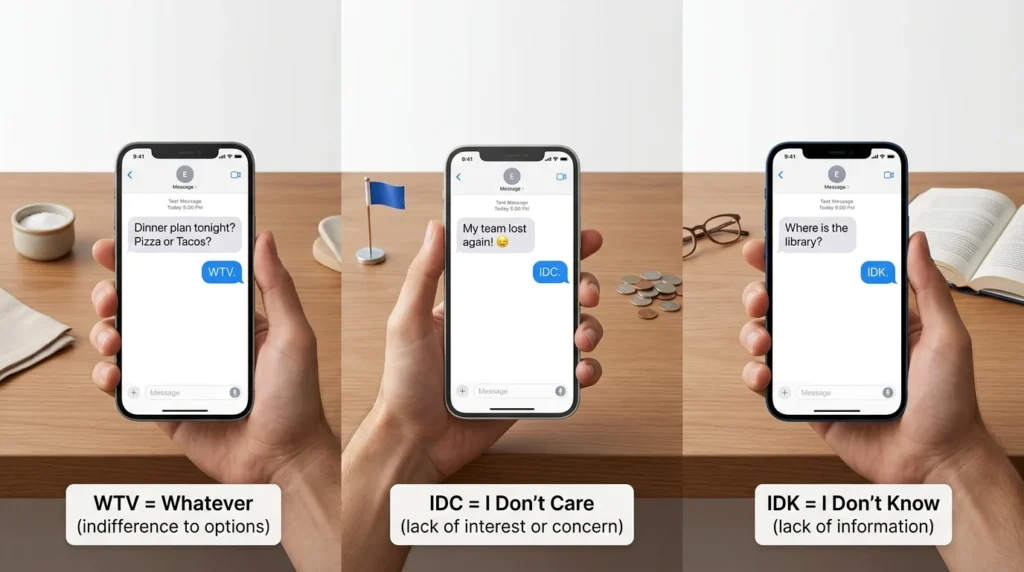

Quick Answer
WTV usually means “Whatever” in text messages, chats, and social media. It is a casual abbreviation people use to show indifference, acceptance, or that they do not want to continue discussing something.
If you searched for wtv meaning in text, you may have seen someone use these three letters in a message and wondered what they meant. WTV is a common texting abbreviation for “whatever.” People often use it when they do not have a strong preference, want to dismiss a minor issue, or simply want to keep a conversation short.
The tone can change a lot depending on the situation. A friend may use WTV casually, while another person may use it when they are annoyed or no longer interested in an argument. That is why the surrounding conversation matters. This guide explains what WTV means, how people use it, what its tone can suggest, how to reply, and when you should avoid it.
Key Facts About WTV
| Category | Details |
|---|---|
| Main Meaning | Whatever |
| Type | Texting abbreviation |
| Main Purpose | Showing indifference, acceptance, or dismissal |
| Writing Style | Casual and informal |
| Common Places | Text messages, group chats, social media, gaming chats |
| Typical Tone | Casual, indifferent, dismissive, annoyed, or accepting |
| Formal Use | Not recommended |
| Standard English Equivalent | Whatever |
What Does WTV Mean in Text?
The most common WTV meaning in text is “Whatever.”
It is a shortened version of the complete word. Instead of typing:
“Whatever.”
someone may simply write:
“WTV.”
The exact feeling behind the message depends on context.
For example:
Person A: “Do you want pizza or burgers?”
Person B: “WTV.”
Here, WTV may mean that Person B does not care which option they choose.
In another conversation, it could sound more dismissive:
Person A: “I still think you should apologize.”
Person B: “WTV.”
In this case, the sender may be signaling that they do not want to discuss the issue anymore.
So, while the basic meaning stays the same, the tone can change significantly.
Why Do People Use WTV?
People use WTV mainly because texting encourages short and quick messages.
Typing three letters is faster than typing the complete word. More importantly, WTV can communicate a certain casual attitude.
Common reasons include:
- They do not have a preference.
- They want to accept either option.
- They do not think something matters.
- They want to end a minor discussion.
- They are annoyed with the conversation.
- They are being playful.
- They want a short response.
For example:
“What time should we go?”
“WTV works.”
The sender is saying that any suggested time is acceptable.
By contrast:
“You keep arguing about this.”
“WTV.”
may sound more dismissive.
The words around WTV often tell you more about the intended tone than the abbreviation itself.
WTV Meaning in Different Contexts
WTV can appear in many types of casual digital conversations. The meaning remains “whatever,” but the purpose may differ.
WTV in Text Messages
In ordinary texting, WTV can be used when someone does not have a strong opinion.
“Where should we eat?”
“WTV, you pick.”
Here, the sender is giving the other person freedom to decide.
WTV When Making Plans
Friends may use WTV when they are flexible about plans.
“Movie or bowling?”
“WTV you want.”
This suggests that the sender is willing to go along with the choice.
WTV in an Argument
During an argument, WTV can sound dismissive.
“You never listen.”
“WTV.”
The sender may be signaling that they do not want to continue the disagreement.
This is one reason WTV should be interpreted carefully. A short message can sound much colder than the sender intended.
WTV in Group Chats
In a group chat, someone might use WTV when the group is discussing a minor choice.
“Should we meet at 6 or 7?”
“WTV works for me.”
Here, the meaning is closer to “Either option is fine.”
WTV in Romantic Conversations
A person may use WTV in a conversation with a partner or romantic interest.
“Do you want to stay home tonight?”
“WTV you want.”
This can simply show flexibility.
However, if the conversation has already become tense, the same abbreviation may sound irritated or emotionally distant.
WTV on Social Media
WTV can appear in comments, direct messages, captions, and replies.
For example:
“WTV, I am not worried about it.”
The person is showing that they do not consider the issue important.
The platform does not normally change the core meaning. Context changes the tone.
Does WTV Always Sound Rude?
No. WTV is not automatically rude, but it can sound dismissive depending on how it is used.
Compare these examples:
“WTV you want is fine with me.”
This sounds flexible and accepting.
Now compare:
“WTV.”
That short reply may sound uninterested, annoyed, or dismissive.
Other factors can affect the tone:
- Punctuation
- Previous messages
- Emojis
- The relationship between the people
- The subject being discussed
- Whether the conversation is serious
- Whether the person normally uses texting abbreviations
For example:
“WTV 😂”
may feel playful in the right conversation.
But:
“WTV.”
can feel much colder.
The abbreviation itself does not determine the emotion.
WTV Meaning From a Guy
If a guy sends WTV, the basic meaning is usually “whatever.” The reason he uses it depends on the conversation.
For example:
“Where do you want to eat?”
“WTV you want.”
This can mean he is happy with any choice.
But:
“Why are you still talking about this?”
“WTV.”
could suggest that he does not want to continue the discussion.
WTV alone does not prove that a guy is angry, uninterested, or romantically interested. The surrounding conversation gives the useful context.
WTV Meaning From a Girl
The same general rule applies when a girl sends WTV.
She may use it to show that she has no preference:
“Which movie should we watch?”
“WTV you choose.”
Or she may use it to end a disagreement:
“I already explained what happened.”
“WTV.”
The meaning is still “whatever,” but the emotional tone depends on the situation.
It is better to read the complete conversation rather than assign a specific emotional meaning to the abbreviation.
WTV Meaning With Different Tones
One of the most useful things to understand about WTV is that its tone is flexible.
Indifferent
“Pizza or tacos?”
“WTV.”
The sender does not care which option is selected.
Accepting
“We can meet at 5 or 6.”
“WTV works.”
The sender is comfortable with either option.
Dismissive
“You need to listen to me.”
“WTV.”
The response may suggest that the sender does not want to engage further.
Annoyed
“We have talked about this five times.”
“WTV.”
The short response may indicate frustration.
Playful
“WTV 😂”
The emoji can make the message feel lighter.
Casual
“WTV, I will go with you.”
The sender may simply be keeping the conversation relaxed.
Because of these variations, WTV should not be interpreted without looking at the surrounding messages.
Real Life Examples of WTV
Example 1: Choosing Food
Person A: “Pizza or burgers?”
Person B: “WTV you want.”
The person does not have a preference.
Example 2: Choosing a Movie
Person A: “Comedy or action?”
Person B: “WTV.”
The sender is letting the other person decide.
Example 3: Ending a Small Argument
Person A: “I told you that was not my fault.”
Person B: “WTV.”
The response may suggest that the person does not want to continue arguing.
Example 4: Making Plans
Person A: “Do you want to meet Friday or Saturday?”
Person B: “WTV works.”
The sender is flexible about the day.
Example 5: Casual Conversation
Person A: “What do you want to watch tonight?”
Person B: “WTV you pick.”
The sender is happy for the other person to choose.
Example 6: Frustrated Reply
Person A: “You never take my advice.”
Person B: “WTV.”
Here, the short answer may sound annoyed or dismissive.
Example 7: Playful Text
Person A: “You always pick the worst movies.”
Person B: “WTV 😂”
The emoji can make the reply feel less serious.
How to Use WTV Naturally
WTV works best in casual conversations where both people understand texting slang.
You can use it as a short response:
“WTV.”
You can also place it inside a longer sentence:
“WTV you want is fine.”
“WTV works for me.”
“WTV, you choose.”
“WTV happens.”
The last example is less common but can be understood as a casual version of “Whatever happens.”
A longer message can sometimes make your meaning clearer. If you simply write “WTV,” the other person may not know whether you are being relaxed, annoyed, or dismissive.
If the conversation is important, adding a few words can prevent confusion.
Is WTV Formal or Informal?
WTV is informal texting language.
It is suitable for casual conversations but should generally be avoided in professional, academic, and official writing.
Appropriate Situations
WTV can work in:
- Text messages
- Friend group chats
- Casual social media messages
- Gaming chats
- Informal Discord conversations
- Casual comments
- Conversations with people who understand texting slang
Situations to Avoid
Avoid WTV in:
- Business emails
- Job applications
- Resumes
- Academic assignments
- Formal reports
- Official letters
- Customer service communication
- Professional workplace messages
Instead of:
“WTV.”
you could write:
“Either option works for me.”
That sounds much clearer and more professional.
Common Mistakes People Make With WTV
Mistake 1: Assuming WTV Is Always Rude
WTV can be dismissive, but it can also mean that someone simply has no preference.
Mistake 2: Ignoring Context
A one-word message can have different tones depending on what came before it.
Mistake 3: Using WTV in Formal Writing
WTV is texting slang. It is not suitable for most professional or academic situations.
Mistake 4: Assuming WTV Means Anger
A person may use WTV because they are flexible, not because they are upset.
Mistake 5: Confusing WTV With Other Abbreviations
WTV is usually short for “whatever.” It should not automatically be confused with abbreviations that have unrelated meanings.
Mistake 6: Overusing WTV
Using the abbreviation repeatedly can make your messages sound uninterested. In serious conversations, complete sentences are often clearer.
Related Texting Expressions
WTV belongs to a larger group of casual texting abbreviations.
IDC
IDC means “I Don’t Care.”
It can express a lack of preference, but it may sound more direct than WTV.
“Where do we eat?”
“IDC.”
IDK
IDK means “I Don’t Know.”
It shows uncertainty rather than indifference.
“What should we do?”
“IDK.”
TBH
TBH means “To Be Honest.”
It is often used before a personal opinion.
“TBH, I like the first one better.”
IMO
IMO means “In My Opinion.”
It introduces a personal view.
“IMO, the second movie is better.”
WYD
WYD means “What You Doing?”
It asks about someone’s activity rather than showing indifference.
WYA
WYA means “Where You At?”
It asks about someone’s location or whereabouts.
These abbreviations may appear together in the same conversation, but they serve different purposes.
WTV vs Whatever
WTV and “whatever” have the same basic meaning, but their style is different.
| Expression | Style | Example |
|---|---|---|
| WTV | Very casual texting | “WTV works.” |
| Whatever | Casual spoken or written English | “Whatever works.” |
| Either is fine | Neutral | “Either option is fine.” |
| I have no preference | More formal | “I have no preference.” |
The complete word is usually clearer, especially when the conversation is important.
WTV is mainly useful when the people involved are comfortable with texting abbreviations.
WTV vs IDC
WTV and IDC can sometimes communicate a similar idea, but they are not always interchangeable.
WTV means “whatever.”
IDC means “I don’t care.”
For example:
“Pizza or burgers?”
“WTV.”
This may mean either choice is fine.
But:
“Pizza or burgers?”
“IDC.”
This more directly says that the person does not care.
Because IDC can sound blunt, WTV may feel softer in some casual situations. However, tone always depends on the conversation.
WTV vs IDK
These abbreviations communicate different ideas.
| Abbreviation | Meaning | Main Idea |
|---|---|---|
| WTV | Whatever | Indifference or acceptance |
| IDC | I Don’t Care | Lack of concern or preference |
| IDK | I Don’t Know | Uncertainty |
| TBH | To Be Honest | Introducing an honest opinion |
| IMO | In My Opinion | Introducing a personal view |
For example:
“What should we order?”
WTV: Either option is fine.
IDC: I do not care which one.
IDK: I do not know what to choose.
The difference is small in some conversations, but the intended message can change.
Social Media Usage of WTV
WTV can appear in direct messages, comments, group conversations, and casual posts.
A person might reply:
“WTV 😂”
to a friend’s playful message.
Snapchat
Someone may use WTV in a short conversation:
“WTV, I will go.”
TikTok
WTV can appear in comments or direct messages when someone wants to dismiss a minor disagreement.
Discord
In gaming chats, WTV may be used when a player does not have a preference.
“Which map?”
“WTV.”
Friends may use WTV in casual comments or messages.
The main meaning remains “whatever.” The platform does not create a completely different meaning.
Professional Alternatives to WTV
When writing professionally, replace WTV with a phrase that clearly communicates your intended meaning.
If you mean either choice is acceptable, use:
“Either option works for me.”
If you mean you have no preference, use:
“I have no preference.”
If you mean you are flexible, use:
“I am flexible with either option.”
If you want to politely end a minor discussion, use:
“I am fine with your decision.”
These phrases are clearer and more appropriate in workplace communication.
How to Reply to WTV
Your response depends on what the sender appears to mean.
If they are simply saying they have no preference, you can make the decision:
“Okay, let’s get pizza.”
If they sound annoyed, you may want to clarify:
“Are you upset?”
If they seem to be ending the conversation:
“No problem.”
If the message feels unclear:
“What do you mean?”
You can also respond casually:
“Haha, okay.”
The best response depends on the conversation rather than the abbreviation alone.
Does WTV Mean “Whatever” in Texting?
Yes. In ordinary texting, WTV most commonly stands for “whatever.”
It is a shortened form used in casual digital communication. The abbreviation may express indifference, flexibility, acceptance, or dismissal.
For example:
“WTV works for me.”
shows flexibility.
But:
“WTV.”
may sound dismissive if it appears during an argument.
The word itself remains the same, while the emotional tone comes from context.
Regional and Generational Use of WTV
Texting abbreviations can vary between age groups, social circles, and online communities.
Some people regularly use abbreviations such as WTV, IDC, IDK, WYD, and WYA. Others prefer complete words and may not recognize every shortcut immediately.
This means that familiarity can vary even when the basic meaning is clear.
If you are messaging someone who rarely uses slang, writing “whatever” instead of WTV may make your meaning easier to understand.
Practice Questions
Question 1
What does WTV usually mean in text messages?
Question 2
Is WTV formal or informal language?
Question 3
What can WTV mean when someone is choosing between two options?
Question 4
What does IDC mean?
Question 5
Can WTV sound dismissive?
Answers
1. WTV usually means “whatever.”
2. WTV is informal texting language.
3. It can mean that the sender has no preference and is comfortable with either option.
4. IDC means “I Don’t Care.”
5. Yes. Depending on the conversation, WTV can sound dismissive, annoyed, or uninterested.
FAQs
1. What does WTV mean in a text?
WTV usually means “whatever.” It is a casual abbreviation commonly used in text messages, chats, and social media conversations.
2. Does WTV mean rude?
Not always. WTV can be neutral or accepting when someone has no preference, but a very short “WTV” can sound dismissive or annoyed in certain conversations.
3. What does WTV mean from a guy?
It usually means “whatever.” The tone depends on the conversation. He may be showing flexibility, indifference, or a desire to stop discussing something.
4. What does WTV mean from a girl?
It generally means “whatever.” The surrounding messages determine whether it sounds casual, accepting, annoyed, or dismissive.
5. Is WTV appropriate for formal writing?
No. WTV is informal texting slang. In professional or academic writing, use phrases such as “whatever,” “either option works,” or “I have no preference,” depending on the intended meaning.
Conclusion
The most common wtv meaning in text is “whatever.” It is a short, informal abbreviation used in texts, group chats, social media, and other casual conversations. Depending on the situation, WTV can show that someone has no preference, accepts either choice, wants to keep things simple, or does not want to continue a discussion.
The most important part of understanding WTV is context. A friendly message such as “WTV works for me” can show flexibility, while a one-word “WTV” during an argument may sound dismissive. Because the abbreviation is informal, it is better to use clearer phrases in professional or academic communication. When the meaning or tone could be misunderstood, writing the complete word or sentence is the safer choice.