
Quick Answer
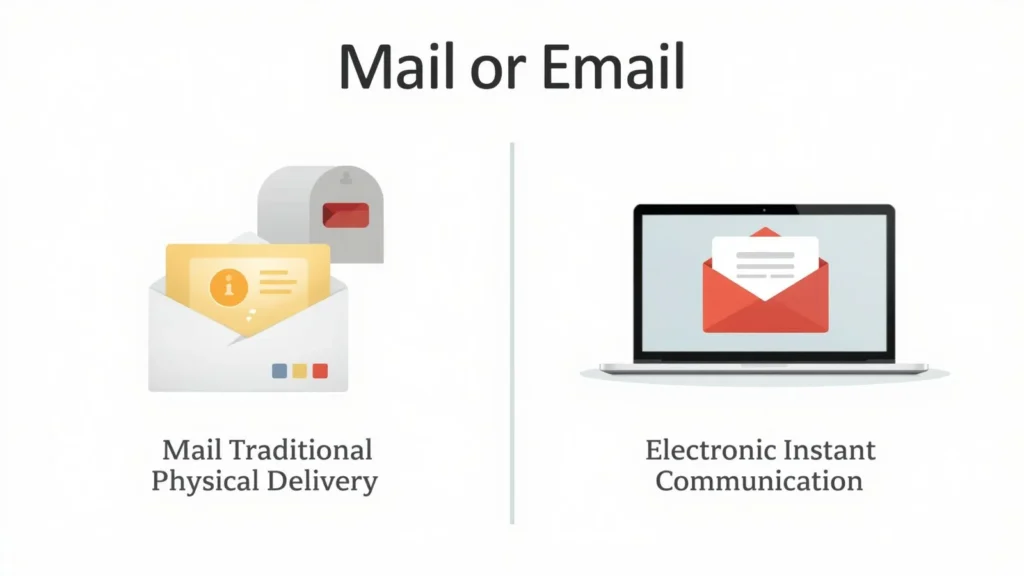
Email is the modern and most correct term for electronic messages sent over the internet. Mail is a broader word that can mean either postal letters or electronic messages depending on context. In modern digital communication, email is preferred for clarity and professionalism.
Many people get confused between mail or email because both words are commonly used in daily communication. In some cases, people say “send me a mail” while others say “send me an email.” This creates confusion, especially for students, office workers, and beginners learning English.
The confusion comes from language evolution. Traditionally, mail referred to physical letters delivered by postal services. However, with the rise of the internet, electronic messaging became popular and the term email was introduced to clearly describe digital messages.
Today, both words are still used, but their meaning depends on context. In professional, academic, and technical writing, email is considered the correct and clear term. Using the wrong term may not always be a serious mistake, but it can create ambiguity in communication.
Understanding mail or email is important because communication is a major part of education, business, and personal life. Clear writing helps avoid misunderstandings and improves professionalism.
In this guide, you will learn the difference between mail and email, their meanings, usage rules, real world examples, common mistakes, and much more in simple language.
Quick Overview
Email refers to electronic messages sent online.
Mail can mean postal letters or email depending on context.
Email is more specific and modern.
Mail is more general and traditional.
Key Difference Between Mail or Email


4
The main difference is clarity and usage.
Email specifically refers to electronic messages.
Mail can refer to physical letters or digital messages depending on usage.
Comparison Table
| Feature | ||
|---|---|---|
| Meaning | Postal or general messages | Electronic messages |
| Medium | Physical or digital | Internet only |
| Clarity | Less specific | Very specific |
| Usage | Traditional | Modern |
| Professional use | Sometimes | Highly preferred |
What Is Mail
Mail traditionally refers to letters or documents sent through postal services. Before the internet, people used mail to communicate over long distances.
Mail includes:
- Letters
- Parcels
- Postcards
- Official documents
In modern usage, “mail” can sometimes also mean electronic messages, but this is less precise.
What Is Email
Email stands for electronic mail. It is a digital method of sending messages through the internet.
Email allows users to:
- Send messages instantly
- Attach files
- Communicate globally
- Store message history
Email is widely used in business, education, and personal communication.
Why People Confuse Mail or Email
The confusion happens because:
Similar Meaning Origin
Email originally comes from “electronic mail.”
Language Shortcut
People shorten email to mail in casual speech.
Regional Usage
In some regions, people commonly say “send me a mail.”
Lack of Formal Training
Beginners often do not know the technical difference.
Real World Usage Examples
- Please send me an email with details.
- I received an email from my teacher.
- Check your email inbox.
Less clear usage:
- Send me a mail (could mean postal or email).
- I got a mail (ambiguous).
Mail vs Email in Business Communication


5
In business settings, clarity is very important.
Email is preferred because:
- It is instant
- It is traceable
- It is professional
- It supports attachments
Mail is still used for:
- Legal documents
- Physical contracts
- Official certificates
Advantages of Email
- Fast communication
- Global reach
- Low cost
- Easy file sharing
- Record keeping
Disadvantages of Email
- Spam messages
- Requires internet
- Security risks
- Can be ignored easily
Advantages of Mail
- Physical proof
- Legal acceptance
- No internet required
- Tangible documents
Disadvantages of Mail
- Slow delivery
- Costly in some cases
- Risk of loss
- Limited reach
Common Mistakes
Mistake One
Using “mail” when you mean email
Correction: Use email for digital communication
Mistake Two
Assuming both words are always interchangeable
Correction: Context matters
Mistake Three
Using informal “mail” in professional writing
Correction: Use email for clarity
Related Comparisons
- Letter vs Email
- Post vs Email
- Gmail vs Email
- Inbox vs Mailbox
- Communication methods comparison
Beginner to Advanced Understanding
Beginner Level
Mail can mean letters or email.
Email means internet messages.
Intermediate Level
Email is a type of electronic communication.
Mail is broader and less specific.
Advanced Level
In linguistics and IT, email is a structured digital protocol for communication, while mail is a general term covering both physical and electronic messaging systems.
Exercises With Answers
Question One
What does email mean?
Answer: Electronic mail
Question Two
Which is more specific?
Answer: Email
Question Three
Can mail mean postal letters?
Answer: Yes
Question Four
Which is preferred in business?
Answer: Email
Question Five
Is email faster than mail?
Answer: Yes
Frequently Asked Questions
Is mail and email the same?
No, email is digital and mail can be physical or digital.
Which is correct mail or email?
Email is more correct for digital communication.
Can I say send me a mail?
Yes in casual English, but email is better in formal writing.
Is email short for mail?
Email means electronic mail.
Which is used in offices?
Email is mostly used.
Is postal mail still used?
Yes for documents and parcels.
What is inbox mail?
It usually refers to email inbox.
Is email safe?
It depends on security settings.
Can mail be digital?
Yes but it is less specific.
Which is better for communication?
Email is faster and more reliable.
Conclusion
Understanding mail or email is important for clear communication. Mail is a general term that can refer to physical letters or digital messages, while email specifically means electronic communication over the internet.
In modern usage, email is the preferred and professional choice because it is fast, clear, and widely accepted in business, education, and personal communication. Mail still exists for physical delivery of documents and packages, but in digital conversations, email is always more accurate.
Using the correct term helps avoid confusion and improves writing quality. Whether you are a student, professional, or casual user, choosing the right word ensures better understanding and communication.