
Quick Answer
Polyurea and epoxy are two popular coating materials used for floors and surfaces. Polyurea cures very fast, is flexible, and handles extreme conditions well. Epoxy cures more slowly, forms a hard and durable surface, and is often used for indoor flooring.
Many people compare polyurea vs epoxy when choosing a coating for floors, garages, or industrial surfaces. Both materials protect surfaces, improve appearance, and increase durability. However, they behave very differently.
Epoxy has been used for many years. It creates a strong and glossy surface. Because of this, it is common in homes, warehouses, and commercial buildings. In contrast, polyurea is newer and more advanced. It cures very quickly and offers high flexibility.
As a result, people often choose polyurea for outdoor areas and harsh environments. Meanwhile, epoxy is popular for indoor use because it is cost effective and easy to apply.
Understanding polyurea vs epoxy helps you choose the right coating for your needs. This guide explains everything in simple language.
Quick Overview
Polyurea cures very fast and is flexible
Epoxy cures slowly and is rigid
Polyurea works well outdoors
Epoxy works best indoors
Both provide protection and durability
Key Difference Between Polyurea vs Epoxy


6
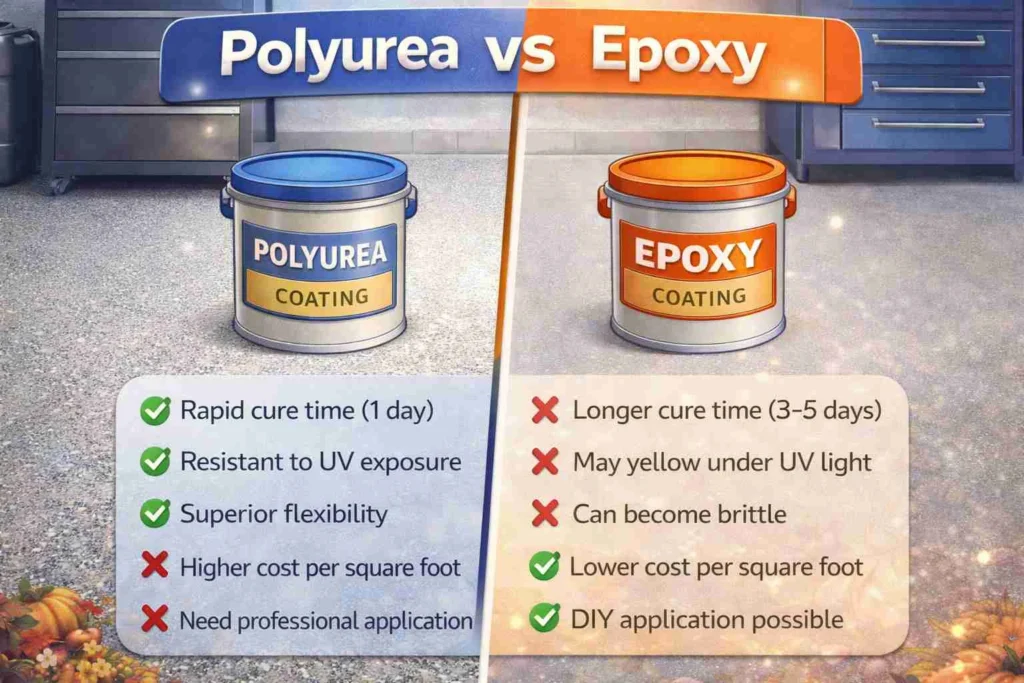
The main difference is curing speed and flexibility.
Polyurea dries within hours
Epoxy takes days to fully cure
Polyurea is flexible and crack resistant
Epoxy is hard but can crack under stress
How Polyurea Works


5
Polyurea is a fast reacting coating. It is usually sprayed onto surfaces. It bonds quickly and forms a flexible protective layer.
Because it cures so fast, professionals must apply it carefully. It is ideal for outdoor and industrial use.
How Epoxy Works


6
Epoxy is a mixture of resin and hardener. It is applied in layers and takes time to cure.
It creates a smooth, glossy, and hard surface. Because of this, it is commonly used in homes and garages.
Comparison Table
| Feature | Polyurea | Epoxy |
|---|---|---|
| Cure time | Very fast | Slow |
| Flexibility | High | Low |
| Durability | Very high | High |
| UV resistance | Excellent | Poor |
| Cost | Higher | Lower |
| Best use | Outdoor and industrial | Indoor and residential |
Durability and Performance
Polyurea offers excellent durability. It resists cracks, chemicals, and temperature changes. Therefore, it performs well in harsh environments.
Epoxy is also durable but less flexible. Over time, it may crack under heavy stress or temperature changes.
Environmental Resistance
Polyurea resists UV rays, water, and extreme temperatures. As a result, it works well outdoors.
Epoxy does not handle sunlight well. It may turn yellow or degrade when exposed to UV light.
Cost Comparison
Polyurea usually costs more due to advanced properties and professional application.
Epoxy is more affordable. Therefore, it is a popular choice for homes and small projects.
Advantages and Disadvantages
Polyurea Advantages
Fast curing
Flexible
UV resistant
Long lasting
Polyurea Disadvantages
Higher cost
Requires skilled application
Epoxy Advantages
Affordable
Easy to apply
Smooth finish
Epoxy Disadvantages
Slow curing
Can crack
Not UV resistant
Real World Examples
A homeowner uses epoxy for a garage floor because it is affordable.
An industrial site uses polyurea for heavy duty protection.
Outdoor surfaces often use polyurea because it handles sunlight better.
Common Mistakes
People think both coatings are the same
They have different properties
Some choose epoxy for outdoor use
Polyurea is better for sunlight
Some ignore curing time
Polyurea dries much faster
Related Comparisons
Polyurea vs polyurethane
Epoxy vs resin
Industrial coating vs residential coating
Beginner to Advanced Understanding
Beginner Level
Polyurea is flexible
Epoxy is hard
Intermediate Level
Polyurea is better for outdoors
Epoxy is better for indoors
Advanced Level
Material selection depends on environment, budget, and performance needs
Regional and Practical Usage
Polyurea is used in industrial and commercial projects worldwide.
Epoxy is widely used in homes, garages, and small businesses.
Exercises With Answers
1 Question
Which coating cures faster
Answer Polyurea
2 Question
Which is more flexible
Answer Polyurea
3 Question
Which is cheaper
Answer Epoxy
4 Question
Which is better for outdoors
Answer Polyurea
5 Question
Which creates a glossy finish
Answer Epoxy
FAQs
Is polyurea better than epoxy?
Polyurea is better for durability and outdoor use, while epoxy is better for budget projects.
Which lasts longer polyurea or epoxy?
Polyurea usually lasts longer due to flexibility and resistance.
Can epoxy crack?
Yes, it can crack under stress.
Is polyurea waterproof?
Yes, it provides strong water resistance.
Which is cheaper?
Epoxy is generally cheaper.
Can I use epoxy outside?
It is not recommended due to UV damage.
Why is polyurea expensive?
Because of advanced performance and fast curing.
Conclusion
Polyurea vs epoxy is an important comparison when choosing surface coatings. Polyurea is fast curing, flexible, and highly durable, making it ideal for outdoor and industrial use. Epoxy is affordable, strong, and easy to apply, making it perfect for indoor applications.
Although both materials provide protection, their performance differs significantly. Polyurea handles harsh conditions better, while epoxy works well for controlled environments.
Choosing the right coating depends on your needs, budget, and environment. Understanding these differences ensures better results and long term performance.