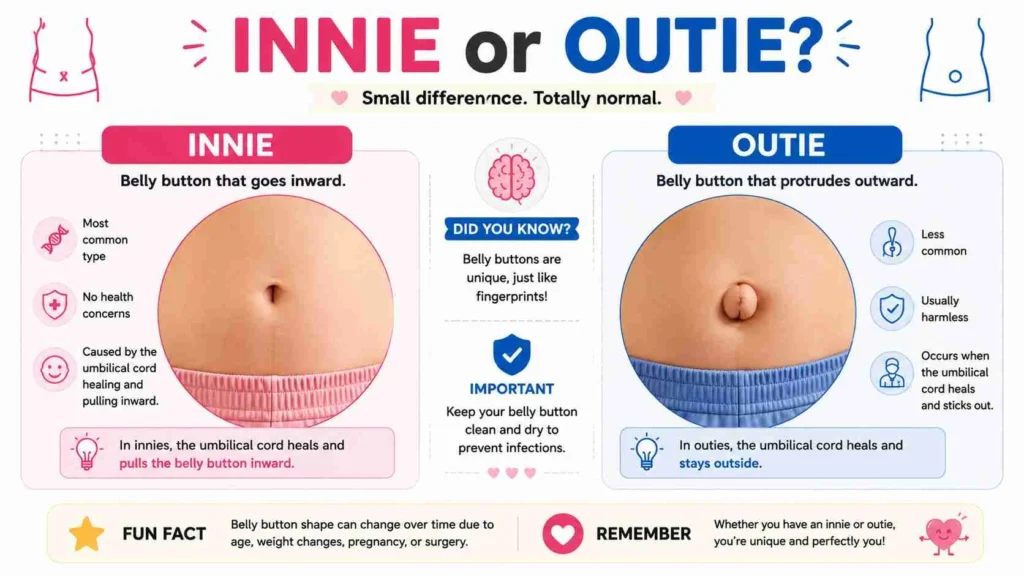

An innie or outie describes the way a belly button looks after the umbilical cord has healed. Most people have an innie, where the navel curves inward, while an outie extends slightly outward from the surrounding skin. Both are normal body variations and usually have little to do with overall health.
The shape can develop because of natural anatomy, how the umbilical cord healed, genetics, or changes around the abdomen.
In this guide, you’ll learn the main differences between innies and outies, what causes each type, the different belly button shapes, basic anatomy, health facts, and when a change in your belly button may deserve medical attention.
Quick Overview
An innie belly button curves inward.
An outie belly button sticks outward.
Both types are normal and healthy.
Most people have innies.
Outies are less common.
The difference usually depends on healing after birth.
Key Difference Between Innie or Outie


The main difference is appearance.
An innie forms inward into the stomach area.
An outie extends outward from the abdomen.
Both develop after the umbilical cord heals.
What Is an Innie Belly Button
An innie belly button curves inward. This is the most common type of belly button.
After birth, the umbilical cord dries and falls off. During healing, the skin pulls inward in most babies. Therefore, the belly button forms an inward shape.
Characteristics of an Innie
- Curves inward
- Most common type
- Usually flat or slightly deep
- Easy to clean
Many people have different innie shapes. Some are deep, while others are shallow.
What Is an Outie Belly Button
An outie belly button sticks outward from the stomach. This type is less common.
Outies usually happen because of how tissue healed after birth. Sometimes extra scar tissue or a small umbilical hernia causes the belly button to push outward.
Characteristics of an Outie
- Protrudes outward
- Less common
- May appear rounded
- Can change during pregnancy or weight changes
Most outies are harmless and natural.
Belly Button Healing Process
The belly button forms after the umbilical cord heals.
Before birth, the umbilical cord connects the baby to the mother. It carries nutrients and oxygen. After birth, doctors cut the cord, leaving a small stump.
Over time, the stump dries and falls off. Then the skin heals and forms either an innie or outie.
This process usually takes a few weeks.
Comparison Table
| Feature | Innie | Outie |
|---|---|---|
| Appearance | Curves inward | Sticks outward |
| Commonness | Very common | Less common |
| Cause | Normal healing | Tissue healing or hernia |
| Cleaning | Easier | Slightly more attention needed |
| Health risk | Usually none | Usually none |
Why Do Some People Have Outies
Many myths exist about outies. However, most outies happen naturally.
Common Causes
- Healing differences after birth
- Extra scar tissue
- Umbilical hernia
- Skin formation variations
Doctors explain that the way the cord is cut does not determine innie or outie shape.
Are Innie and Outie Belly Buttons Genetic
Genetics may play a small role, but healing is more important.
Some families seem to have similar belly button shapes. However, doctors say belly button appearance mainly depends on tissue healing after birth.
Therefore, parents cannot fully predict whether a baby will have an innie or outie.
Are Outie Belly Buttons Dangerous
Most outies are harmless.
However, some outies relate to umbilical hernias. A hernia happens when tissue pushes through a weak area near the belly button.
Signs of Concern
- Pain
- Swelling
- Redness
- Sudden changes
If these symptoms appear, medical advice is important.
Medical Conditions Related to Belly Buttons
Umbilical Hernia
This occurs when tissue pushes outward through abdominal muscles.
Belly Button Infection
Poor cleaning may cause irritation or infection.
Granuloma
Some babies develop small growths after cord healing.
Most conditions are treatable.
Innie or Outie During Pregnancy


Pregnancy can temporarily change belly button shape.
As the stomach expands, some innies become temporary outies. After pregnancy, the belly button often returns to normal.
This change is common and usually harmless.
Cultural Views About Belly Buttons
Different cultures have unique beliefs about belly buttons.
Some cultures consider outies lucky. Others view innies as more common or attractive.
Modern society often focuses on appearance because of fashion, fitness, and social media. However, both types are normal.
Body Image and Confidence
Some people feel insecure about their belly button shape. However, innies and outies are natural body variations.
Fitness models, athletes, and celebrities can have either type. Therefore, belly button shape does not define beauty or health.
Understanding this helps improve body confidence.
Real World Examples
Example One Newborn Baby
A newborn develops an innie after the cord heals naturally.
Example Two Adult With Outie
An adult has an outie because of mild scar tissue formation.
Example Three Pregnancy Changes
A pregnant woman notices her innie temporarily becomes an outie.
Advantages and Disadvantages
Innie Advantages
- More common
- Easier to clean
- Less noticeable under clothing
Innie Disadvantages
- Deep innies may trap dirt
Outie Advantages
- Unique appearance
- Easy to identify during cleaning
Outie Disadvantages
- More sensitive to friction
- May feel noticeable under tight clothing
Common Myths About Innie or Outie
Myth One Doctors Cause Outies
False. Cutting the umbilical cord does not determine belly button shape.
Myth Two Outies Are Dangerous
False. Most are completely harmless.
Myth Three Only Babies Have Outies
False. Adults can naturally have outies too.
Myth Four Belly Button Shape Can Be Controlled
False. Healing mostly determines the result.
Common Mistakes People Make
Mistake One Thinking Outies Are Abnormal
Correction Outies are natural body variations
Mistake Two Ignoring Painful Swelling
Correction Pain may indicate a hernia or infection
Mistake Three Believing Belly Button Shape Reflects Health
Correction Both types are healthy in most cases
Related Comparisons
Innie vs Umbilical Hernia
An innie is normal anatomy, while a hernia is a medical condition.
Outie vs Hernia
Some outies are caused by hernias, but many are harmless.
Belly Button Piercing Considerations
Piercings may differ depending on belly button shape.
Beginner to Advanced Understanding
Beginner Level
An innie goes inward.
An outie sticks outward.
Intermediate Level
Healing after birth determines belly button shape.
Advanced Level
Tissue formation, scar healing, and abdominal structure influence belly button appearance.
Scientific Explanation of Belly Button Formation
The belly button is technically a scar. After birth, the body closes the opening where the umbilical cord was attached.
Scar tissue forms differently in every person. Therefore, belly buttons vary in depth, size, and shape.
This natural variation explains why innies and outies exist.
Belly Button Hygiene Tips
Keeping the belly button clean is important.
Cleaning Tips
- Wash gently with soap and water
- Dry thoroughly
- Avoid harsh chemicals
- Monitor redness or odor
Deep innies may collect lint or dirt more easily.
Fitness and Belly Button Appearance
Exercise and weight changes can affect how the belly button looks.
Weight gain may deepen an innie. Weight loss may make an outie more visible.
However, exercise does not change basic belly button type permanently.
Cosmetic Surgery and Belly Buttons
Some people choose cosmetic surgery to change belly button appearance.
Reasons Include
- Hernia repair
- Cosmetic preference
- Tummy tuck procedures
Doctors generally recommend surgery only for medical reasons.
Regional and Global Perspectives
Innie belly buttons are more common worldwide. Outies are rare in most populations.
Social media and celebrity culture have increased interest in belly button appearance and body image.
Exercises With Answers
Question One
Which belly button type curves inward
Answer Innie
Question Two
Which type sticks outward
Answer Outie
Question Three
What causes belly button shape
Answer Healing after birth
Question Four
Are most outies dangerous
Answer No
Question Five
Can pregnancy change belly button appearance
Answer Yes
FAQs
What is the difference between innie or outie belly buttons?
An innie curves inward, while an outie sticks outward.
Are outie belly buttons rare?
Yes, most people have innies.
Can doctors control innie or outie formation?
No, healing determines the shape.
Is an outie dangerous?
Usually no, but pain or swelling needs medical attention.
Can pregnancy cause an outie?
Yes, pregnancy can temporarily push the belly button outward.
Are innies more attractive than outies?
Beauty is subjective, and both are normal.
Can exercise change belly button type?
No, exercise does not permanently change it.
Do outies need special cleaning?
Not usually, but gentle hygiene is important.
Can adults develop an outie later in life?
Yes, hernias or surgery can change appearance.
Why do babies develop different belly buttons?
Because tissue heals differently in each baby.
Conclusion
Understanding innie or outie belly buttons helps explain a simple but interesting part of human anatomy. An innie curves inward, while an outie extends outward. Both types form naturally after the umbilical cord heals.
Most people have innies, but outies are also normal and healthy. In many cases, belly button shape depends on tissue healing and body structure rather than medical problems.