

Quick Answer
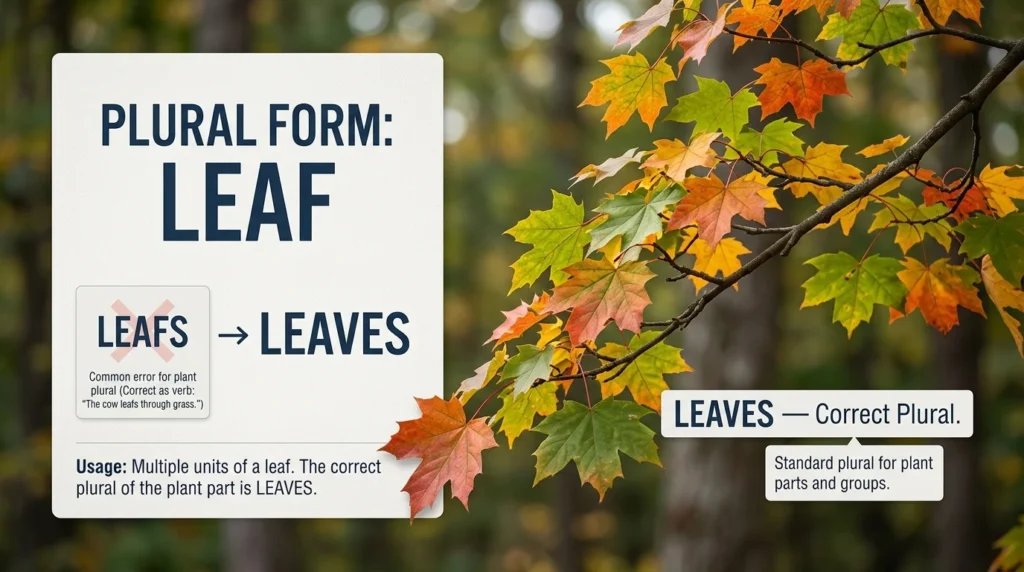
Leaves is the correct plural of leaf when you mean the green parts of a plant or tree. Leafs is generally not used for plant leaves, but it can be correct as a verb in a different context.
The words leafs and leaves look almost identical, so it is easy to wonder which one is correct. If you are talking about the green parts that grow on trees and plants, the correct plural form is leaves.
For example, you would say, “The leaves are falling from the trees,” not “The leafs are falling from the trees.”
However, leafs is not always wrong. It can appear as a verb in certain contexts, especially when leaf is used as a verb meaning to move through pages quickly. The important point is that leaves is the normal plural form of the noun leaf, while leafs has a much narrower use.
What Does Leaf Mean?
Leaf is a noun that usually refers to the flat, thin part of a plant or tree that grows from a stem or branch.
For example:
- A green leaf fell from the tree.
- The plant has a large leaf.
- I found a leaf on the sidewalk.
- The leaf turned yellow in the fall.
The word leaf can also have other meanings in English.
For example, a leaf can refer to a sheet or page in a book.
You might say:
Turn to the next leaf of the old manuscript.
However, the most common everyday meaning is the part of a plant or tree.
What Is the Plural of Leaf?
The standard plural of leaf is leaves.
The spelling changes from f to v before adding es.
So:
leaf → leaves
Examples:
- one leaf
- two leaves
- many leaves
- green leaves
- dry leaves
- fallen leaves
This is an example of an irregular plural because you do not simply add s to the original word.
Is Leafs Correct?
For the normal plural of leaf, leafs is not the standard form.
If you are talking about more than one leaf on a tree, plant, or branch, use leaves.
Incorrect for the usual plant meaning:
The leafs are turning brown.
Correct:
The leaves are turning brown.
Incorrect:
I picked up several leafs from the yard.
Correct:
I picked up several leaves from the yard.
So, when leaf is a noun referring to plant parts, remember:
Leaf → Leaves
Why Does Leaf Become Leaves?
The change from leaf to leaves is part of an older English plural pattern.
Some English nouns ending in f or fe change their spelling when they become plural.
For example:
- leaf → leaves
- knife → knives
- wife → wives
- life → lives
- wolf → wolves
However, English does not apply this pattern to every word ending in f.
For example:
- roof → roofs
- belief → beliefs
- chef → chefs
That is why it is useful to learn common plural forms individually.
For leaf, the standard plural is leaves.
Leaf vs Leaves
The easiest way to understand the difference is to look at number.
Leaf means one.
Leaves means more than one.
Examples:
There is a leaf on the ground.
There are several leaves on the ground.
Another example:
The leaf is green.
The leaves are green.
The noun changes from singular to plural, and the verb may change with it.
Examples of Leaf
Here are some natural examples using the singular form:
- The leaf is bright green.
- A leaf fell from the tree.
- She picked up a leaf.
- The insect was sitting on a leaf.
- This leaf has a strange shape.
- A single leaf covered the small flower.
- The leaf became dry after several hot days.
Each example refers to one leaf.
Examples of Leaves
Use leaves when talking about more than one:
- The leaves are falling.
- The tree has beautiful green leaves.
- We collected dry leaves from the yard.
- The leaves changed color in the fall.
- Several leaves were floating in the water.
- The wind blew the leaves across the street.
- The plant has large leaves.
Here, leaves is the correct plural form.
Leafs vs Leaves: The Main Difference
The two words have different grammatical roles.
| Word | Main Use | Example |
|---|---|---|
| leaf | Singular noun | A leaf fell from the tree. |
| leaves | Plural noun | The leaves fell from the tree. |
| leafs | Verb in limited contexts | He leafs through the magazine. |
For everyday writing about trees and plants, leaves is the word you need.
What Does Leafs Mean?
Although leafs is not the normal plural of leaf, it can be a valid verb form.
The verb leaf can mean to move through the pages of something, usually quickly or casually.
For example:
He leafs through the magazine while waiting.
Here, leafs is a verb.
It does not mean several leaves from a tree.
This distinction is important because it explains why you may occasionally see leafs in correctly written English.
Leafs as a Verb
When leaf is used as a verb, leafs can be the third-person singular present form.
For example:
She leafs through the catalog.
He leafs through the old photo album.
The customer leafs through the magazine before buying it.
In these sentences, leafs describes an action.
It does not describe multiple plant leaves.
So, the word can be correct, but its meaning and grammatical function are different.
Leaves as a Verb
Interestingly, leaves can also be a verb.
It can be the third-person singular form of leave.
For example:
She leaves the house at eight.
He leaves work early on Fridays.
The train leaves at noon.
In these sentences, leaves has nothing to do with plants.
This means leaves can have more than one grammatical role depending on the sentence.
It can be:
- The plural of leaf
- A form of the verb leave
Context tells you which meaning is intended.
Leaves as a Plant Noun
The most common use of leaves is the plural of leaf.
For example:
The leaves on the tree are turning yellow.
Here, leaves refers to several plant structures.
Another example:
The gardener removed the dead leaves.
Again, the word means more than one leaf.
This is the meaning most people have in mind when asking whether leafs or leaves is correct.
Leaves as a Verb
Now consider:
She leaves for work at seven.
Here, leaves is not related to trees.
It comes from the verb leave.
Another example:
The bus leaves every thirty minutes.
The meaning is that the bus departs.
So, leaves can mean different things depending on context.
That is one reason the word is much more common than leafs.
Common Mistakes With Leafs and Leaves
One of the most common mistakes is simply adding s to leaf.
Someone may think:
leaf + s = leafs
That would make sense if leaf followed a regular plural pattern.
However, the standard plural is leaves.
Another mistake is using leafs when talking about several trees or plants.
For example:
The leafs are beautiful in autumn.
The correct sentence is:
The leaves are beautiful in autumn.
A third mistake is assuming that leafs is always wrong.
It can be correct when leaf functions as a verb.
Leaves in Nature
The word leaves appears frequently when talking about nature.
Examples include:
- autumn leaves
- fallen leaves
- green leaves
- dry leaves
- fresh leaves
- yellow leaves
- red leaves
- tree leaves
- plant leaves
For example:
The ground was covered with fallen leaves.
Or:
The trees were full of bright green leaves.
These are natural and standard uses.
Leaves in Gardening
Gardeners also use leaves frequently.
For example:
Remove the damaged leaves from the plant.
The leaves need more sunlight.
Water the soil without soaking the leaves.
The plant has healthy leaves.
When talking about multiple parts of a plant, leaves is the standard plural.
Leaves in Science
The word leaves is also common in biology and science.
A plant’s leaves play important roles in processes such as photosynthesis.
You might read or write sentences such as:
The leaves absorb sunlight.
Healthy leaves help the plant produce food.
Some plants have very large leaves.
In scientific writing, leaves remains the normal plural form of leaf.
Leaves in Everyday Conversation
You do not need formal language to use leaves correctly.
People commonly say:
Look at all these leaves.
The leaves are everywhere.
Can you rake the leaves?
The leaves are falling again.
I love the colors of the leaves in the fall.
These sentences sound natural in everyday conversation.
Leaf and Leaves in Different Sentences
Compare these examples:
I found a leaf.
One leaf.
I found five leaves.
More than one leaf.
Now compare:
The leaf is wet.
One leaf.
The leaves are wet.
Several leaves.
This simple comparison can help you remember the plural form.
How to Remember Leaf or Leaves
A useful memory trick is:
One leaf → many leaves
Think of the f changing to v.
The same type of change appears in several familiar words:
- knife → knives
- wife → wives
- life → lives
- wolf → wolves
You do not need to apply the rule to every English word ending in f. Just remember that leaf belongs to the group that normally changes to leaves.
Practice Questions
Choose leafs or leaves for each sentence.
Question One
The tree has hundreds of green ______.
Answer: leaves
There is more than one leaf, so the plural noun is leaves.
Question Two
A dry ______ fell onto my jacket.
Answer: leaf
The sentence describes one leaf.
Question Three
The children collected colorful ______ from the ground.
Answer: leaves
The sentence refers to several leaves.
Question Four
He ______ through the magazine while waiting.
Answer: leafs
Here, leafs is a verb meaning that he moves through the pages of the magazine.
Question Five
The gardener removed the dead ______.
Answer: leaves
The gardener removed multiple plant leaves.
Quick Grammar Test
Ask yourself one question:
Am I talking about more than one plant leaf?
If the answer is yes, use leaves.
For example:
The leaves are falling.
If you are describing an action involving pages, leafs may be correct as a verb.
For example:
He leafs through the book.
This simple test will solve most leafs vs leaves questions.
Leaf, Leaves, and Leave
There is another word that looks very similar: leave.
These three forms can easily cause confusion.
Leaf is usually a plant part.
A leaf fell from the tree.
Leaves can be the plural of leaf.
The leaves fell from the tree.
Leave can mean to go away or depart.
I need to leave now.
Leaves can also be the third-person form of leave.
She leaves at six.
The spelling may look similar, but the meanings are different.
Leaves or Leafs in Writing
When writing about trees, plants, gardens, forests, or nature, use leaves for the plural.
For example:
The leaves covered the sidewalk.
Avoid:
The leafs covered the sidewalk.
When writing about someone moving through pages, leafs can work as a verb.
For example:
He leafs through the newspaper.
Knowing the context makes the choice easy.
Why Leafs Looks Correct but Usually Is Not
English has many regular plurals that simply add s.
For example:
- book → books
- tree → trees
- flower → flowers
- plant → plants
Because of this, it is natural to think:
leaf → leafs
But English has many irregular plural forms.
The standard form is:
leaf → leaves
That is why simply adding s does not work here.
Leaf or Leaves: Quick Comparison
| Singular | Plural | Example |
|---|---|---|
| leaf | leaves | The leaves are falling. |
| leaf | leaves | She picked up three leaves. |
| leaf | leaves | The plant has large leaves. |
For the noun referring to plant parts, the pattern is always easy to remember:
One leaf.
Two or more leaves.
Final Tips
Remember these simple rules:
- Leaf is the singular noun.
- Leaves is the normal plural noun.
- Leafs is not the standard plural of leaf.
- Leafs can be correct as a verb in certain contexts.
- Leaves can also be a form of the verb leave.
- Use leaves when talking about several plant leaves.
- Think leaf → leaves rather than leaf → leafs.
- Context tells you whether leaves refers to plants or the verb leave.
FAQs
Is leafs or leaves correct?
Leaves is the correct plural of leaf when you are talking about plant parts. Leafs is not the normal plural form, although it can be used as a verb in certain contexts.
What is the plural of leaf?
The standard plural of leaf is leaves. For example, you would say, “The leaves are falling from the tree.”
Why does leaf change to leaves?
Leaf has an irregular plural form. Instead of simply adding s, the spelling changes from f to v and adds es, creating leaves.
Can leafs ever be correct?
Yes. Leafs can be correct when leaf is being used as a verb. For example, “He leafs through the magazine” means that he quickly looks through its pages.
Is leaves also a verb?
Yes. Leaves can be the third-person singular form of leave. For example, “She leaves home at seven.” It can also be the plural noun for leaf, so the meaning depends on context.
Conclusion
When you are talking about more than one leaf on a tree or plant, leaves is the correct word. The plural changes from leaf to leaves, rather than simply adding an s.
Leafs is not the normal plural, but it is not completely useless. It can appear as a verb when someone moves through pages, as in “He leafs through the magazine.” Meanwhile, leaves can also function as a verb when it comes from leave.
The easiest rule to remember is simple: one leaf, many leaves. If you are talking about plant leaves, choose leaves.