

Quick Answer
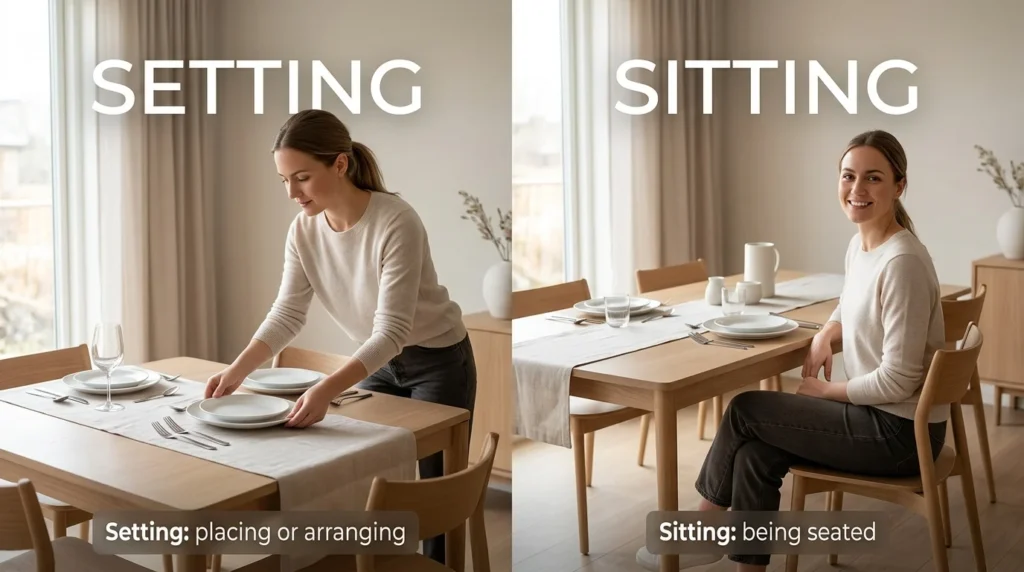
Setting and sitting are both correct words, but they have different meanings. Setting usually refers to placing something, adjusting something, or the surroundings of a story, while sitting means being in a seated position.
Setting and sitting look and sound similar, so it is easy to mix them up. However, they come from two different verbs and describe different actions or ideas. Setting comes from the verb set, while sitting comes from the verb sit.
You may see both words in everyday conversations, school writing, books, work emails, and descriptions of places or events. For example, someone can be sitting in a chair, while another person is setting a book on a table. A movie can also have a beautiful setting, while an actor may be sitting in a room.
Once you understand the difference between set and sit, choosing between setting and sitting becomes much easier.
What Does Setting Mean?
Setting is the present participle and gerund form of the verb set. It can describe the action of putting, placing, adjusting, or arranging something.
For example:
- She is setting the books on the table.
- He is setting the alarm for seven.
- They are setting the table for dinner.
- I am setting the temperature to 70 degrees.
Setting can also be a noun. In that use, it can describe the surroundings or conditions in which something happens.
For example:
- The setting of the movie was beautiful.
- The story has a small-town setting.
- The restaurant has a relaxed setting.
It can also refer to a control or adjustment on a device.
For example:
- Check the brightness setting.
- Change the privacy settings on your account.
- The camera has several useful settings.
What Does Sitting Mean?
Sitting is the present participle and gerund form of the verb sit.
It means being in a seated position or spending time in a particular place while seated.
For example:
- She is sitting on the couch.
- He is sitting at his desk.
- They are sitting in the waiting room.
- I have been sitting here for an hour.
The word can also describe a period when someone is seated.
For example:
- We had a long sitting during the meeting.
- The artist began another sitting with the model.
In everyday English, however, sitting most often refers to being seated.
Setting vs Sitting: What Is the Difference?
The easiest way to understand the difference is to look at their base verbs.
Set → setting
Sit → sitting
The verb set usually means to put, place, arrange, adjust, or establish something.
The verb sit means to rest your body in a seated position.
Compare these sentences:
She is setting the books on the shelf.
She is sitting on the chair.
In the first sentence, she is placing something.
In the second sentence, she is seated.
That simple difference will help you avoid most mistakes.
Setting as an Action
When setting describes an action, it usually means putting something in a particular position or making an adjustment.
Here are some examples:
- He is setting the plates on the table.
- She is setting the alarm.
- I am setting the timer.
- They are setting up the equipment.
- We are setting the rules for the game.
The object often comes after setting.
For example:
She is setting the cup on the counter.
Here, setting means placing the cup somewhere.
Sitting as an Action
Sitting describes the action or state of being seated.
Examples include:
- The child is sitting on the floor.
- She is sitting beside her friend.
- He is sitting in the front row.
- They are sitting outside.
- I am sitting at my desk.
The word often appears with location words such as on, in, at, beside, or near.
For example:
He is sitting in the waiting room.
The sentence tells us where he is while he is seated.
Setting in a Story
One important meaning of setting has nothing to do with placing objects.
In literature, movies, and television, setting means the time and place where a story happens.
For example:
The setting of the novel is a small town in Maine.
The setting can include:
- location
- time period
- environment
- culture
- social conditions
- historical background
Consider this example:
The story is set in New York during the 1990s.
Here, set means the story takes place in a particular time and place.
The noun is:
The setting is New York in the 1990s.
This meaning is very common in school assignments and book reviews.
Setting on a Device
Setting is also commonly used for controls on electronic devices and software.
A setting is an option that allows you to control how something works.
Examples include:
- brightness setting
- volume setting
- privacy setting
- security setting
- language setting
- display setting
- notification setting
For example:
Open the settings menu and change the display options.
You may also see the plural settings when a device or application has several controls.
For example:
Check your account settings.
This meaning is completely different from sitting.
Setting the Table
One very common phrase is setting the table.
It means arranging plates, glasses, forks, knives, spoons, and other items on a table before a meal.
For example:
The children are setting the table for dinner.
This does not mean that the children are sitting at the table.
Compare:
They are setting the table.
They are arranging things.
They are sitting at the table.
They are seated at the table.
The two sentences describe different actions.
Sitting at the Table
Sitting at the table means being seated at a table.
For example:
Everyone was sitting at the table.
You can also say:
She is sitting at the kitchen table.
This is different from:
She is setting the table.
In the second sentence, she is preparing the table by placing items on it.
These two phrases are easy to confuse because they often appear in the same situation.
Setting Up vs Sitting Down
Another useful comparison is setting up and sitting down.
Setting up means preparing or arranging something.
Examples:
- We are setting up the chairs.
- They are setting up the equipment.
- She is setting up the room.
Sitting down means moving into a seated position.
Examples:
- Please sit down.
- He is sitting down.
- She sat down beside me.
These expressions describe completely different actions.
Setting and Sitting in Everyday English
Both words appear frequently in everyday conversations.
Imagine a family preparing for dinner.
One person might say:
I am setting the table.
Another person might say:
I am sitting in the dining room.
Both statements are correct, but they describe different activities.
Here are more examples:
- She is setting the alarm before bed.
- He is sitting on the bed.
- They are setting up the chairs.
- The guests are sitting in the living room.
- I am setting the temperature.
- She is sitting near the window.
The context usually makes the difference clear.
Common Mistakes With Setting and Sitting
A common mistake is using sitting when the intended meaning is placing something.
Incorrect:
She is sitting the plates on the table.
Correct:
She is setting the plates on the table.
Another mistake is using setting when the intended meaning is being seated.
Incorrect:
He is setting on the chair.
Correct:
He is sitting on the chair.
Remember the base verbs:
Set → setting
Sit → sitting
This simple connection makes the spelling and meaning easier to remember.
Setting or Sitting in Professional Writing
Both words can appear in professional communication.
For example:
I am setting up the meeting room.
The team is sitting in the conference room.
You might also use setting when discussing rules, systems, or goals.
Examples:
- The manager is setting new goals.
- The company is setting clear expectations.
- Please check your account settings.
- The team is sitting in the conference room.
In professional writing, using the correct word helps prevent confusion.
Setting or Sitting in Academic Writing
Students often encounter setting when writing about books, stories, films, and research.
For example:
The setting of the novel creates a sense of isolation.
You may also see sitting when describing people or animals.
For example:
The students were sitting quietly during the lecture.
Another academic use of setting refers to the environment where something takes place.
For example:
The study took place in a clinical setting.
Here, setting means the environment or place.
Set, Sit, and Their Forms
Understanding the base verbs makes this comparison much easier.
Set
The verb set has several meanings, including putting something somewhere, adjusting something, or establishing something.
Examples:
- Set the book on the desk.
- Set the alarm.
- Set the table.
- Set a goal.
Its present participle is:
setting
Sit
The verb sit means to be seated or to take a seated position.
Examples:
- Sit on the chair.
- Sit beside me.
- Sit here.
Its present participle is:
sitting
The extra t in sitting is important.
Why Does Sitting Have Two Ts?
When sit becomes sitting, the final consonant is doubled before adding ing.
So:
sit + ing = sitting
Not:
siting
The spelling siting does exist, but it comes from the word site and has a different meaning.
For example:
The company is siting the new factory near the highway.
Here, siting means choosing a location for something.
For everyday use, though, when you mean being seated, the correct spelling is sitting.
Setting vs Siting
This is another spelling difference worth knowing.
Setting comes from set.
Sitting comes from sit.
Siting comes from site.
Compare:
They are setting the equipment on the floor.
They are sitting on the floor.
The company is siting the factory near the highway.
These words look similar, but each has a different meaning.
Setting in Different Contexts
The word setting has several common meanings.
It can mean placing something:
She is setting the glass on the table.
It can mean adjusting something:
He is setting the alarm.
It can mean the surroundings of a story:
The setting of the movie is a coastal town.
It can mean an option on a device:
Change the brightness setting.
It can mean an environment:
The school provides a safe learning setting.
It can also relate to establishing something:
The company is setting new goals.
Because of these different meanings, setting is a very flexible word.
Sitting in Different Contexts
Sitting mainly relates to being seated, but it can appear in several situations.
For example:
She is sitting on the sofa.
A person can also sit in a particular place:
He is sitting in the back of the classroom.
Someone can sit for an event:
We were sitting through a long presentation.
Animals can sit too:
The dog is sitting by the door.
The word can also describe remaining in a place:
The package has been sitting on the porch all day.
Here, the package is not literally seated. The phrase means it has remained in that location.
Quick Comparison Examples
These pairs make the difference easy to see.
Setting:
She is setting the books on the desk.
Sitting:
She is sitting at the desk.
Setting:
He is setting the alarm.
Sitting:
He is sitting on the bed.
Setting:
They are setting the table.
Sitting:
They are sitting at the table.
Setting:
She is setting up the chairs.
Sitting:
She is sitting in one of the chairs.
The surrounding words often provide a useful clue.
How to Remember Setting vs Sitting
Use this simple memory trick:
Setting = set something.
Sitting = sit somewhere.
If a person is placing, arranging, adjusting, or establishing something, you probably need setting.
If a person is in a seated position, you probably need sitting.
For example:
I am setting the books on the shelf.
Think: I am placing something.
I am sitting on the sofa.
Think: I am seated.
This rule works in most everyday situations.
Practice: Setting or Sitting?
Choose the correct word.
- She is ______ on the couch.
- He is ______ the alarm for six.
- They are ______ the table for dinner.
- The children are ______ in the classroom.
- I am ______ the temperature on the thermostat.
- We were ______ near the window.
- The story has a beautiful ______.
- She is ______ the books on the shelf.
- He is ______ at his desk.
- Please check your privacy ______.
Answers
- sitting
- setting
- setting
- sitting
- setting
- sitting
- setting
- setting
- sitting
- settings
Setting or Sitting: Which One Should You Use?
Choose setting when you mean placing, arranging, adjusting, establishing, or describing the environment of a story or event.
Choose sitting when you mean being seated or remaining in a place.
A quick test is to ask yourself:
Am I talking about putting or arranging something?
If yes, use setting.
Am I talking about being seated?
If yes, use sitting.
For example:
She is setting the plates.
She is arranging them.
She is sitting at the table.
She is seated.
Final Tips for Using Setting and Sitting
Keep these points in mind:
- Setting comes from set.
- Sitting comes from sit.
- Setting can mean placing or arranging something.
- Setting can also mean the background or environment of a story.
- Setting can refer to an option on a device.
- Sitting means being in a seated position.
- Setting the table means arranging things on the table.
- Sitting at the table means being seated there.
- Sitting has two t letters.
- Context usually makes the correct word easy to identify.
FAQs
Is setting or sitting correct?
Both setting and sitting are correct words. They have different meanings. Setting comes from set and often means placing, arranging, or adjusting something. Sitting comes from sit and means being in a seated position.
What is the difference between setting and sitting?
Setting usually means placing, arranging, adjusting, or establishing something. Sitting means being seated or remaining in a particular place. For example, “She is setting the table” and “She is sitting at the table” describe different actions.
Is it setting the table or sitting the table?
The correct phrase is setting the table. It means arranging plates, glasses, utensils, and other items before a meal.
Is it sitting on a chair or setting on a chair?
The correct phrase is sitting on a chair when you mean being seated. Setting on a chair is not standard for this meaning.
How do you remember setting and sitting?
Remember set equals setting and sit equals sitting. If someone is placing or arranging something, use setting. If someone is seated, use sitting.
Conclusion
Setting and sitting are both correct, but they come from different verbs and have different meanings. Setting comes from set and can describe placing, arranging, adjusting, or establishing something. It can also refer to the environment of a story or an option on a device.
Sitting comes from sit and normally describes being in a seated position. The easiest way to remember the difference is to connect each word to its base verb: set becomes setting, while sit becomes sitting.
Once you focus on the action, the choice becomes simple. If something is being placed or arranged, use setting. If someone is seated, use sitting.