
Quick Answer
I is used as the subject of a sentence, while myself is used mainly as a reflexive or emphatic pronoun. Say “I went to the store,” not “Myself went to the store.”
I and myself both refer to the same person, but they do not work in the same way. Many people use myself when they think it sounds more formal or polite. However, that can lead to incorrect sentences.
The word I usually acts as the subject of a sentence. It tells us who performs an action. Myself, on the other hand, usually refers back to the subject or adds emphasis. For example, “I hurt myself” is correct because myself refers back to I. You can also say, “I made the cake myself” when you want to emphasize that you did it personally.
Knowing this simple difference will help you avoid one of the most common pronoun mistakes in English.
What Does I Mean?
I is a first-person singular pronoun.
It refers to the person who is speaking or writing. Most importantly, I is normally used as the subject of a sentence.
Examples:
- I work from home.
- I like coffee.
- I finished the project.
- I called my friend.
- I need some help.
- I went to the store.
In each sentence, I performs or experiences the action.
For example:
I finished the report.
The person who finished the report is the speaker. Therefore, I is the correct pronoun.
What Does Myself Mean?
Myself is a reflexive pronoun.
It normally refers back to the person represented by I.
Examples:
- I hurt myself.
- I taught myself to cook.
- I introduced myself.
- I bought myself a new phone.
- I looked at myself in the mirror.
In these sentences, myself refers back to the subject I.
For example:
I hurt myself.
Here, I performs the action, and myself receives the action.
That is why we do not normally use myself as the main subject.
I or Myself: What Is the Difference?
The easiest way to understand the difference is to look at their grammatical roles.
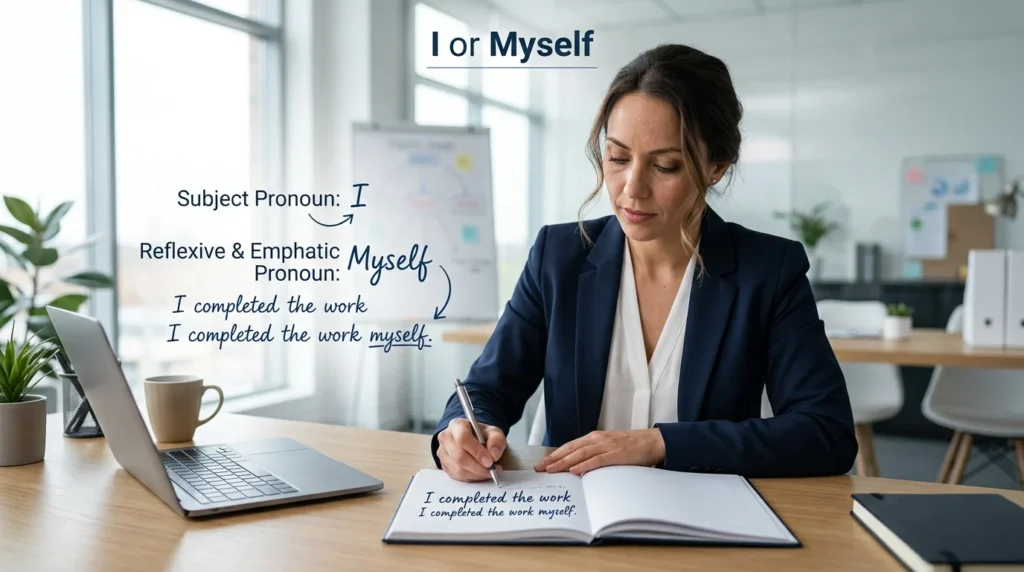
I is generally a subject pronoun.
Myself is generally a reflexive or emphatic pronoun.
Compare:
I completed the task.
I completed the task myself.
The first sentence simply tells us who completed the task.
The second sentence adds emphasis. It tells us that the speaker personally completed it.
Another example:
I introduced myself.
Here, I is the subject and myself refers back to the subject.
This is the basic pattern to remember.
When Should You Use I?
Use I when you are the subject of the sentence.
A simple test is to ask:
Who is doing the action?
If the answer is the speaker, I may be correct.
Examples:
- I wrote the email.
- I understand the problem.
- I need more time.
- I called the doctor.
- I finished my homework.
- I want to learn English.
- I visited my family.
Here, I performs the action in every sentence.
Do not replace I with myself simply because the sentence sounds more formal.
Incorrect:
Myself completed the report.
Correct:
I completed the report.
When Should You Use Myself?
Use myself when it refers back to I or when you want to add emphasis.
There are two main uses.
Reflexive Use
A reflexive pronoun refers back to the subject.
Examples:
- I cut myself.
- I blamed myself.
- I reminded myself.
- I taught myself.
- I introduced myself.
In each case, the action comes back to the speaker.
Emphatic Use
Myself can also emphasize that the speaker personally did something.
Examples:
- I made the dinner myself.
- I checked the document myself.
- I spoke to the manager myself.
- I fixed the problem myself.
Here, myself adds emphasis.
Why Is “Myself” Often Used Incorrectly?
Many speakers believe myself sounds more professional than I.
This often happens in introductions or workplace conversations.
For example, someone may say:
Myself John, and I work in sales.
This is not standard English.
A better sentence is:
I am John, and I work in sales.
Another common example is:
Please contact Sarah or myself.
In standard formal English, the more natural choice is:
Please contact Sarah or me.
The problem is not that myself is a bad word. The problem is using it where another pronoun is grammatically required.
I vs Myself in a Sentence
Consider these examples:
I went to the meeting.
Correct.
Myself went to the meeting.
Incorrect.
Now consider:
I prepared the presentation myself.
Correct.
Here, myself adds emphasis.
Another example:
I introduced myself to the new manager.
Correct.
Here, myself is reflexive because the speaker introduced the speaker.
These examples show why context matters.
I or Myself After “and”
One of the most common mistakes involves sentences with I and another person.
For example:
Sarah and I went shopping.
This is correct because Sarah and I are the subjects.
A common mistake is:
Sarah and myself went shopping.
This is incorrect in standard English.
The correct sentence is:
Sarah and I went shopping.
Now look at an object:
The manager spoke to Sarah and me.
Here, me is the correct object pronoun.
You would not normally say:
The manager spoke to Sarah and myself.
unless myself is being used reflexively or for a specific emphasis.
I or Myself in Formal Writing
Formal writing does not require you to replace I with myself.
In fact, using myself unnecessarily can make a sentence sound awkward.
For example:
Myself and my colleague reviewed the proposal.
Better:
My colleague and I reviewed the proposal.
Another example:
The director asked my colleague and myself to attend.
Better:
The director asked my colleague and me to attend.
Clear grammar is more important than trying to sound formal.
I or Myself in Professional Emails
Professional emails often create confusion because people want to sound polite.
For example:
Please contact myself if you have any questions.
This is usually incorrect.
Write:
Please contact me if you have any questions.
Another example:
Myself and John will attend the meeting.
Better:
John and I will attend the meeting.
You do not need to use myself to make an email sound professional.
Simple grammar usually sounds more natural and confident.
I or Myself With Reflexive Verbs
Some verbs naturally work with reflexive pronouns.
For example:
- introduce myself
- hurt myself
- blame myself
- remind myself
- teach myself
- express myself
- prepare myself
- defend myself
Examples:
I introduced myself to the class.
I reminded myself to call her.
I taught myself how to play guitar.
I need to prepare myself for the interview.
In each example, myself connects back to the subject I.
I or Myself for Emphasis
Sometimes myself is correct because you want to stress that you personally performed an action.
For example:
I cleaned the entire house myself.
This means nobody else did the cleaning.
You can also say:
I personally cleaned the entire house.
Both sentences emphasize personal involvement.
More examples:
- I spoke to the customer myself.
- I checked the figures myself.
- I wrote the letter myself.
- I built the website myself.
- I saw the accident myself.
In these sentences, myself adds emphasis.
I, Me, or Myself?
Understanding I, me, and myself together makes this topic much easier.
I
Use I as the subject.
I called him.
Me
Use me as an object.
He called me.
Myself
Use myself when the action comes back to the speaker or when you want emphasis.
I called myself.
I did it myself.
Think of the three forms like this:
I = subject
Me = object
Myself = reflexive or emphasis
Common Mistakes With I and Myself
Mistake 1: Myself as the Subject
Incorrect:
Myself went to the office.
Correct:
I went to the office.
Mistake 2: Myself Instead of Me
Incorrect:
She called myself.
Correct:
She called me.
Mistake 3: Myself and Another Person
Incorrect:
Myself and David attended the meeting.
Correct:
David and I attended the meeting.
Mistake 4: Unnecessary Myself
Incorrect:
Please send the file to myself.
Correct:
Please send the file to me.
Mistake 5: Forgetting Reflexive Use
Incorrect:
I introduced me to the new team.
Correct:
I introduced myself to the new team.
These mistakes are easy to fix once you identify the role of the pronoun.
A Simple Test for I or Me
There is a useful trick for sentences containing another person.
Remove the other person and see what sounds correct.
For example:
Sarah and I went to the store.
Remove Sarah:
I went to the store.
That sounds correct.
Now:
The teacher spoke to Sarah and me.
Remove Sarah:
The teacher spoke to me.
That also sounds correct.
This test can help you choose between I and me.
A Simple Test for Myself
Ask whether myself refers back to I.
For example:
I hurt myself.
Yes. Myself refers back to I.
I made the meal myself.
Yes. Myself emphasizes that I personally made the meal.
But:
Myself went to the store.
No. There is no subject for myself to refer back to.
Therefore, use I.
I or Myself in Introductions
Introductions are a common place where people misuse myself.
Incorrect:
Myself David.
Incorrect:
Myself David, I am the new sales manager.
Better:
I am David.
Or:
My name is David.
You can use myself later if it has a reflexive or emphatic role.
For example:
Let me introduce myself.
This is correct.
Here, myself refers back to me, the speaker.
I or Myself in Job Interviews
Job interviews can also create confusion.
A candidate might say:
Myself James. I have five years of experience.
A more natural version is:
I am James, and I have five years of experience.
You can correctly use myself in a sentence such as:
I taught myself several programming languages.
Or:
I prepared myself for the interview by researching the company.
The important point is to use the pronoun according to its grammatical role.
I or Myself in Everyday Speech
In casual conversation, I is extremely common.
Examples:
- I am tired.
- I need some food.
- I forgot my keys.
- I will call you later.
- I want to go home.
Myself appears when the meaning requires it.
Examples:
- I hurt myself.
- I made it myself.
- I introduced myself.
- I told myself to stay calm.
Native speakers do not normally replace every use of I with myself.
I or Myself With “By”
The phrase by myself is very common.
It means alone or without help.
Examples:
- I went there by myself.
- I finished the project by myself.
- I live by myself.
- I learned it by myself.
Here, myself is correct because the phrase means that the speaker did something alone or without assistance.
You can also use on my own with a similar meaning.
I completed the project on my own.
I completed the project by myself.
Both are natural.
I or Myself in Academic Writing
Academic writing sometimes uses first-person language, depending on the type of paper.
When the writer needs to identify an action, I can be correct.
For example:
I analyzed the results.
I examined three different studies.
If emphasis is needed:
I conducted the experiment myself.
Using myself simply to avoid I does not make academic writing more formal.
Clear and direct writing is usually better.
Practice: Choose I or Myself
Choose the correct word in each sentence.
- ___ went to the store.
- I hurt ___ while playing basketball.
- ___ completed the assignment.
- I made the cake ___.
- ___ and Sarah attended the meeting.
- She asked ___ to wait outside.
- I introduced ___ to the new teacher.
- ___ will call you tomorrow.
Answers
- I
- myself
- I
- myself
- I
- me
- myself
- I
Notice that number 6 uses me, not myself, because the pronoun receives the action.
More Examples to Remember
Here are some quick examples:
Correct:
I am ready.
Incorrect:
Myself am ready.
Correct:
I introduced myself.
Incorrect:
I introduced me.
Correct:
John and I went home.
Incorrect:
John and myself went home.
Correct:
She called me.
Incorrect:
She called myself.
Correct:
I completed the work myself.
Incorrect:
Myself completed the work.
These patterns cover most everyday situations.
Final Tips
Remember these simple rules:
- Use I as the subject.
- Use me as the object.
- Use myself as a reflexive pronoun.
- Use myself when you want to add emphasis.
- Use by myself to mean alone or without help.
- Do not use myself just because it sounds more formal.
- In introductions, say I am or my name is, not myself.
- In phrases such as “John and I,” choose the pronoun based on its role in the sentence.
Once you understand these roles, choosing between I and myself becomes much easier.
FAQs
Is I or myself correct?
Both are correct, but they have different grammatical roles. I is normally used as a subject, while myself is used as a reflexive or emphatic pronoun.
Can I say “myself” instead of “I”?
Usually no. You should not use myself as a replacement for I when I is the subject. Say “I went home,” not “Myself went home.”
Is “John and myself” grammatically correct?
It depends on the sentence, but it is often incorrect when myself is being used instead of I or me. For example, say “John and I went to the store” and “She called John and me.”
Is it correct to say “Myself John” in an introduction?
No. In standard English, say “I am John” or “My name is John.” You can correctly say “Let me introduce myself.”
When should I use myself in a sentence?
Use myself when the action refers back to you, such as “I hurt myself,” or when you want to add emphasis, such as “I did it myself.” It also appears in phrases such as “by myself.”
Conclusion
I and myself both refer to the speaker, but they serve different grammatical purposes. I normally acts as the subject of a sentence, while myself works mainly as a reflexive pronoun or adds emphasis.
Use I when you perform the action: “I finished the work.” Use myself when the action comes back to you: “I hurt myself.” You can also use it for emphasis: “I checked the work myself.”
The most important rule is simple: do not choose myself just because it sounds more formal. Good English depends on using the correct pronoun for its role in the sentence.