

Quick Answer
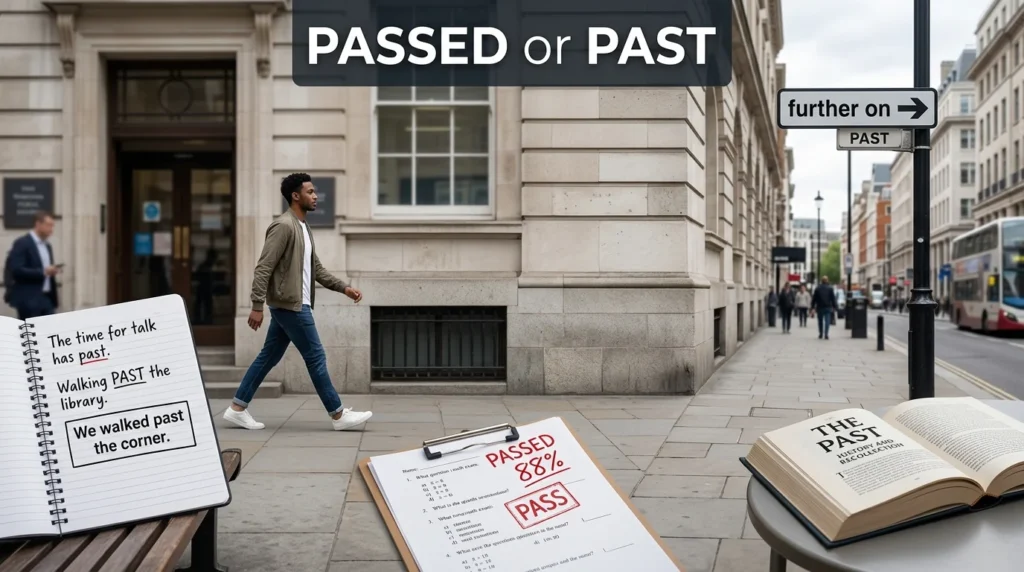
Passed and past are both correct words, but they have different meanings and uses. Passed is usually the past tense of pass, while past can refer to an earlier time, movement beyond something, or a time that has already happened.
Passed or past is a common English confusion because the two words sound almost the same in everyday speech. However, they do different jobs in a sentence. Passed usually comes from the verb pass and tells us that someone or something moved, succeeded, handed something over, or went through an action. Past, on the other hand, often refers to an earlier time or something beyond a particular point.
For example, you can say, “She passed the exam,” but you would say, “She walked past the school.” You can also say, “That happened in the past.”
Once you understand their roles, choosing between passed and past becomes much easier.
What Does Passed Mean?
Passed is most often the past tense and past participle of the verb pass.
The word can have several meanings depending on the sentence.
It can mean that someone moved by something:
The car passed our house.
It can mean that someone succeeded in a test:
Maria passed the exam.
It can mean that someone handed something to another person:
He passed me the salt.
It can also describe the movement of time:
Three hours passed before they arrived.
So, passed is connected to an action.
What Does Past Mean?
Past usually refers to a time before now.
For example:
We talked about the past.
She lived there in the past.
I have learned from my past mistakes.
However, past has other uses too.
It can describe movement beyond a place or point:
Walk past the library and turn left.
It can also describe a time on a clock:
It is ten past six.
So, past can relate to earlier time, movement beyond something, or time shown on a clock.
Passed or Past: What Is the Difference?
The easiest way to understand the difference is to look at their basic roles.
Passed is usually a verb.
Past is often a noun, adjective, adverb, or preposition.
Compare these sentences:
The runner passed me.
The runner walked past me.
In the first sentence, passed describes the action of overtaking or moving ahead of someone.
In the second sentence, past describes the movement beyond the speaker.
Another example:
She passed the test.
She studied the events of the past.
These words may sound similar, but their meanings are different.
Passed as a Verb
The most common use of passed is as the past form of pass.
Examples include:
- He passed the exam.
- She passed the ball.
- The car passed the truck.
- We passed the store.
- Time passed quickly.
- They passed the message to me.
- The train passed the station.
In each case, passed describes something that happened.
This is a useful clue. If you need an action word describing something that happened before now, passed may be the correct choice.
Past as a Noun
Past can work as a noun when it refers to an earlier period of time.
Examples:
- We cannot change the past.
- She often thinks about her past.
- His past was difficult.
- The past can teach us useful lessons.
- They wanted to leave the past behind.
Here, past does not describe an action. It refers to time that has already happened.
A simple question can help:
Are you talking about an earlier time?
If yes, past may be the word you need.
Past as a Preposition
Past can also show movement beyond a person, place, or point.
For example:
Walk past the bank.
The dog ran past me.
She drove past the school.
We walked past the restaurant.
In these sentences, past tells us that someone or something moved beyond a particular point.
Notice the difference:
He passed the school.
He walked past the school.
The first sentence uses passed as the verb.
The second uses past to describe where he moved.
Past as an Adjective
Past can describe something connected with an earlier time.
Examples:
- past events
- past mistakes
- past experiences
- past relationships
- past presidents
- past problems
For example:
We should learn from past mistakes.
Here, past describes mistakes that happened before now.
Another example:
She talked about her past experiences.
The experiences happened earlier in her life.
Past as an Adverb
Past can also work as an adverb when it describes movement beyond a certain point.
For example:
The car drove past.
This means the car continued beyond the place where the speaker was.
Another example:
I watched the train go past.
Here, past describes the train’s movement beyond the speaker.
Passed or Past in Everyday Sentences
The easiest way to learn this difference is to see the words in natural sentences.
Passed
I passed the grocery store on my way home.
She passed the exam.
He passed the ball to his teammate.
The bus passed us.
Several hours passed.
Past
I walked past the grocery store.
She talked about her past.
He drove past my house.
We moved past the problem.
It is five past three.
These examples show why the two words cannot always replace each other.
Passed a Test or Past a Test?
The correct expression is:
I passed the test.
Here, passed is the past tense of pass.
It means you achieved the required result.
Do not write:
I past the test.
That is incorrect.
You can also say:
She passed her final exam.
He passed the driving test.
They passed the class.
The word passed describes success in these sentences.
Walked Past or Walked Passed?
The correct phrase is:
She walked past me.
Not:
She walked passed me.
Why?
Because past describes the movement beyond the person.
For example:
The man walked past the window.
The children ran past the house.
We drove past the stadium.
You are describing movement beyond a location or person, so past is needed.
Passed Me or Past Me?
Both can appear in English, but they work differently.
The runner passed me.
Here, passed is the verb. It means the runner moved ahead of me.
The runner walked past me.
Here, past is a preposition describing movement beyond me.
This difference is small but important.
If you can identify the main action as pass, then passed may be correct.
If you are describing movement beyond a person or place, past is often correct.
Passed Away or Past Away?
The correct phrase is:
passed away
This is a polite expression meaning that someone died.
For example:
Her grandfather passed away last year.
His uncle passed away peacefully.
Do not write past away.
The expression comes from the verb pass, so the past-tense form is passed.
This is one of the most important phrases to remember.
Passed Time or Past Time?
Both expressions can be correct, but they mean different things.
Passed time can refer to time that moved by.
For example:
The hours passed quickly.
You can also use pass the time:
We played cards to pass the time.
Past time can refer to a time that has already happened.
For example:
That belongs to the past.
You might also hear:
It is past time to leave.
Here, past means that the expected time has already gone.
Passed by or Past?
These can also cause confusion.
Passed by usually describes an action.
The bus passed by our house.
She passed by without saying hello.
Past can describe movement beyond something.
She walked past the house.
Compare:
The car passed by.
The car drove past the store.
Both are correct, but their structures differ.
Past and Time
One of the most common uses of past involves time.
You can use past to describe a time before now:
We lived there in the past.
You can also use it when telling the time:
It is ten past eight.
The meeting starts at quarter past nine.
I arrived at five past seven.
In these examples, past refers to minutes after the hour.
For example:
ten past six
means ten minutes after six.
Passed and the Movement of Time
Passed can also be connected with time, but it describes time moving forward.
Examples:
The years passed quickly.
Two hours passed before the doctor arrived.
Several minutes passed in silence.
Here, passed is the verb.
This creates an important difference:
The past is the time that has already happened.
Time passed quickly.
The first sentence uses past as a noun.
The second uses passed as a verb.
Passed by the House or Past the House?
Both forms can be correct.
For example:
The car passed the house.
This means the car moved beyond the house.
You can also say:
The car drove past the house.
The structure is different.
In the first sentence, passed is the verb.
In the second sentence, past works as a preposition.
A useful test is to look at the word before the location.
If you already have a movement verb such as walked, drove, or ran, you may need past:
walked past
drove past
ran past
If pass itself is the main verb, you may need passed:
passed the house
passed the car
passed the store
Common Mistakes With Passed and Past
One common mistake is writing:
I past the exam.
The correct version is:
I passed the exam.
Another common mistake is:
She walked passed me.
The correct version is:
She walked past me.
A third mistake is:
He past away last year.
The correct phrase is:
He passed away last year.
These mistakes happen because passed and past sound very similar.
The best solution is to focus on meaning instead of sound.
How to Remember Passed
Think of passed as an action.
You can:
- pass a test
- pass a ball
- pass a car
- pass a person
- pass a message
- pass a building
- pass away
When the word describes something that happened as an action, passed is often the right choice.
A simple memory line is:
Passed = an action happened.
How to Remember Past
Think of past as time or a position beyond something.
You can talk about:
- the past
- past events
- past mistakes
- past experiences
- walking past a store
- driving past a house
- ten past five
A simple memory line is:
Past = earlier time or beyond a point.
Passed or Past in School Writing
Students often use these words in essays and assignments.
For example:
She passed her final exam.
Here, passed is correct because it describes the action of successfully completing the exam.
Another example:
The story takes place in the past.
Here, past is correct because it refers to an earlier period.
You might also write:
The character walked past the old building.
Again, past is correct because it describes movement beyond the building.
Passed or Past in Business Writing
Both words can appear in professional communication.
Examples with passed:
The proposal passed the review stage.
The deadline passed yesterday.
The message was passed to the manager.
Examples with past:
We reviewed past sales figures.
The company learned from past mistakes.
The report compares current results with past results.
The correct word depends on the role it plays in the sentence.
Passed or Past in Casual Conversation
Both words are common in everyday speech.
You might say:
I passed your house yesterday.
Or:
I drove past your house yesterday.
You might also say:
Let’s leave the past behind.
Or:
A lot of time has passed.
These are natural phrases that you may hear regularly.
Passed or Past in Questions
Here are some common questions:
Did you pass the test?
Correct answer:
Yes, I passed the test.
Another:
Did you walk past my house?
Correct answer:
Yes, I walked past your house.
Notice how the question itself helps you choose the word.
Pass becomes passed when it is used as the past-tense action.
Past stays past when it describes time or movement beyond something.
Practice Questions
Choose passed or past in each sentence.
1. She ______ the exam on her first attempt.
2. We walked ______ the old theater.
3. He has learned from his ______ mistakes.
4. Two hours ______ before they arrived.
5. The car drove ______ us at high speed.
6. My grandfather ______ away many years ago.
7. I walked ______ the store without stopping.
8. She ______ the message to her manager.
9. We cannot change the ______.
10. The train ______ the station without stopping.
Answers
1. passed
She successfully completed the exam.
2. past
The phrase describes movement beyond the theater.
3. past
The mistakes happened earlier.
4. passed
The sentence describes time moving by.
5. past
The car moved beyond us.
6. passed
The correct phrase is passed away.
7. past
The person moved beyond the store.
8. passed
The person handed or transferred the message.
9. past
The sentence refers to earlier time.
10. passed
The train moved beyond the station.
Quick Trick for Choosing Passed or Past
When you are unsure, ask yourself a simple question:
Is this word describing an action?
If yes, try passed.
She passed the exam.
He passed the ball.
The car passed us.
If you are talking about earlier time or movement beyond a point, try past.
The past cannot be changed.
Walk past the store.
I learned from my past mistakes.
This trick will not solve every possible sentence, but it works well for many common examples.
Passed vs Past: Quick Comparison
| Word | Main Role | Example |
|---|---|---|
| Passed | Past form of pass | She passed the test. |
| Passed | Movement beyond something | The car passed us. |
| Passed | Time moving by | Three hours passed. |
| Past | Earlier time | He lives in the past. |
| Past | Beyond a point | Walk past the school. |
| Past | Time on a clock | It is ten past five. |
The biggest clue is the meaning.
Passed usually connects to the action pass.
Past usually connects to earlier time or something beyond a point.
Final Tips
Remember these simple rules:
- Passed is usually the past tense of pass.
- Past often refers to earlier time.
- Passed can describe movement, success, transfer, or time moving by.
- Past can describe time, location, or movement beyond something.
- Say passed the test, not past the test.
- Say walked past the store, not walked passed the store.
- Say passed away, not past away.
- Say past mistakes when talking about mistakes from earlier times.
- Say time passed when describing time moving by.
- Focus on meaning instead of pronunciation because the words sound similar.
FAQs
What is the difference between passed and past?
Passed is usually the past tense of the verb pass. Past often refers to an earlier time or something beyond a particular point. For example, “She passed the test” and “She walked past the school.”
Is it passed the test or past the test?
The correct phrase is passed the test when you mean that someone successfully completed the test. Passed is the past tense of pass.
Is it walked past or walked passed?
The correct phrase is walked past. For example, “She walked past the store.” Here, past describes movement beyond the store.
Is it passed away or past away?
The correct phrase is passed away. It is a polite expression used when talking about someone’s death.
How can I remember passed vs past?
Think of passed as an action related to pass, such as passing a test, passing a car, or passing a ball. Think of past as earlier time or something beyond a point, such as the past, past mistakes, or walking past a building.
Conclusion
Passed and past sound very similar, but they do not have the same meaning. Passed usually comes from the verb pass and describes an action that already happened. It can refer to succeeding, moving beyond something, handing something over, or time moving by.
Past commonly refers to an earlier period of time. It can also describe movement beyond a place or person and appears in expressions used to tell time.
The easiest way to remember the difference is to connect passed with an action and past with earlier time or something beyond a point. Once you look at what the sentence means, choosing the correct word becomes much easier.