

Quick Answer
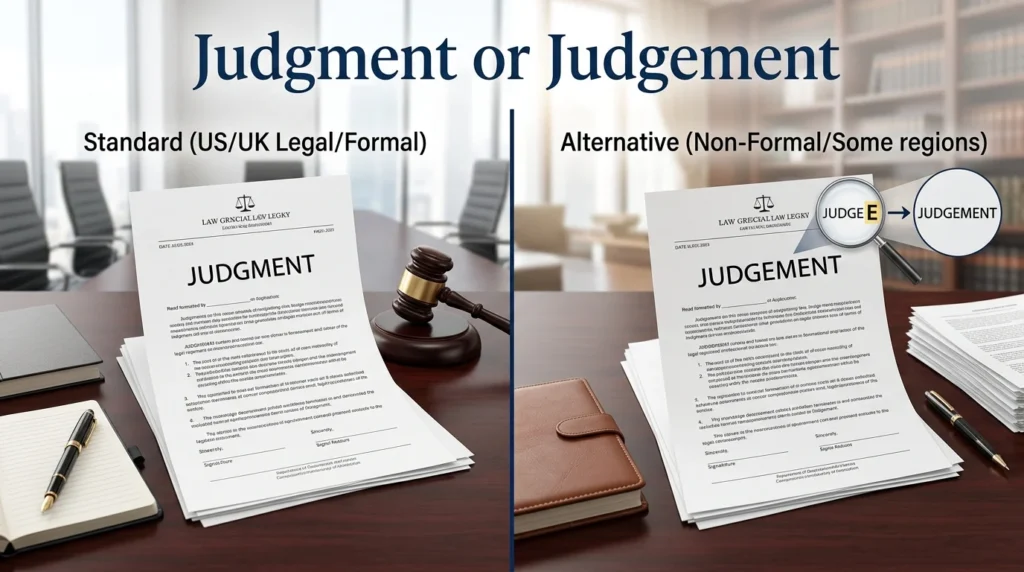
Judgment and judgement are both accepted spellings of the same word. Judgment is the standard spelling in American English, while judgement is common in British English, especially in general writing.
Choosing between judgment and judgement can be confusing because both spellings appear in books, articles, business writing, and everyday communication. The only visible difference is the extra e, but that small difference can make writers wonder which form is actually correct.
The good news is that the two spellings have the same basic meaning. Both can describe an opinion, a decision, the ability to make sensible choices, or an official decision made by a court.
The main difference is spelling style. Judgment is the form normally used in American English. Judgement is widely used in British English for general writing. Once you know this distinction, choosing the right form becomes much easier.
What Does Judgment Mean?
Judgment is a noun that can describe a decision, opinion, or ability to make sensible decisions.
For example:
- She showed excellent judgment.
- His judgment was based on experience.
- I trust her judgment.
- The judge delivered the final judgment.
- Good judgment can prevent serious mistakes.
The word can describe both everyday decisions and formal legal decisions.
For example, if someone chooses not to drive during a snowstorm, you might say:
That was a good judgment call.
If a court makes an official ruling, that ruling can also be called a judgment.
What Does Judgement Mean?
Judgement has the same basic meaning as judgment.
The extra e does not create a new meaning.
Examples include:
- She showed good judgement.
- His judgement was influenced by experience.
- I trust her judgement.
- We questioned his judgement.
- She made a quick judgement about the situation.
This spelling is especially common in British English general writing.
Therefore, judgement is not simply a misspelling. It is a recognized spelling of the word.
Judgment or Judgement: What Is the Difference?
The main difference is regional spelling preference.
| Spelling | Common Use | Example |
|---|---|---|
| Judgment | American English | She showed good judgment. |
| Judgement | British general writing | She showed good judgement. |
| Judgment | Legal writing | The court issued a judgment. |
The meaning does not change.
For example:
He used good judgment.
and:
He used good judgement.
Both sentences say that he made sensible decisions.
The spelling is different, but the idea is the same.
Is Judgment or Judgement Correct?
Both are correct.
However, the preferred form depends on the type of English you are using.
If you follow American English, use judgment.
If you follow British English, judgement is common in general writing.
There is also an important legal use of judgment. Court decisions are commonly written as judgment, even in British legal contexts.
So the safest simple rule is:
American English: judgment
British general English: judgement
Legal writing: judgment is widely preferred
When Should You Use Judgment?
Use judgment when following American spelling conventions.
Examples:
- She has excellent judgment.
- His judgment was correct.
- You need good judgment in difficult situations.
- I questioned his judgment.
- The manager showed sound judgment.
- The court issued its judgment.
The spelling is also useful when discussing a formal court decision.
For example:
The judge announced the judgment after reviewing the evidence.
Here, judgment refers to the official decision of the court.
When Should You Use Judgement?
Use judgement when following British spelling conventions in general writing.
Examples:
- She has excellent judgement.
- His judgement was correct.
- You need good judgement in difficult situations.
- I questioned his judgement.
- The manager showed sound judgement.
- She made a careful judgement about the situation.
The word means the same thing as judgment.
The difference is simply the spelling convention.
Judgment or Judgement in American English
In American English, judgment is the standard form.
For example:
She used good judgment when making the decision.
His judgment was affected by his emotions.
The manager showed sound judgment.
The court issued its judgment.
The spelling judgement is not the normal choice for American writing.
If you are writing an article, essay, email, report, or professional document using American spelling, judgment is the better choice.
Judgment or Judgement in British English
British English commonly uses judgement in general writing.
For example:
She showed good judgement.
His judgement was based on years of experience.
I trust your judgement.
It was a poor judgement call.
However, judgment is also used in British English, especially in legal contexts.
That means the British rule is not as simple as saying that judgement is always correct and judgment is always wrong.
Both forms can appear, depending on the context.
Judgment in Legal Writing
Legal writing is one of the most important places where judgment appears.
A judgment can refer to the formal decision made by a court or judge.
For example:
- The court issued its judgment.
- The judge delivered the final judgment.
- The written judgment explained the decision.
- The lawyer reviewed the court’s judgment.
- The judgment was appealed.
This legal meaning is different from everyday phrases such as:
She has good judgment.
In the first case, judgment refers to a formal legal decision. In the second, it refers to someone’s ability to make sensible choices.
The spelling judgment is widely used for the legal meaning.
Judgment as Good Decision Making
Another common meaning of judgment is the ability to make sensible choices.
For example:
He has good judgment.
This means he usually makes smart and sensible decisions.
You might also say:
She showed excellent judgment during the emergency.
This suggests that she handled the situation wisely.
Other examples include:
- Good judgment is important at work.
- His judgment helped the team avoid a problem.
- She trusted her own judgment.
- The manager questioned his judgment.
In British general writing, you may see judgement in these same sentences.
Judgment Call vs Judgement Call
The phrase judgment call refers to a decision that requires personal evaluation rather than a simple answer.
For example:
Choosing the cheaper option was a judgment call.
Another example:
The manager had to make a judgment call.
The phrase is especially common in American English.
In British writing, you may also see:
It was a judgement call.
Both forms express the same idea.
A judgment call usually involves uncertainty. There may not be one obvious answer, so someone has to use experience and reasoning to decide.
Good Judgment and Poor Judgment
The word often appears with adjectives that describe the quality of a decision.
Good Judgment
Good judgment means making sensible choices.
Example:
She showed good judgment by checking the contract carefully.
Poor Judgment
Poor judgment means making an unwise or careless choice.
Example:
He showed poor judgment when he ignored the warning.
Sound Judgment
Sound judgment means reliable and sensible decision making.
Example:
The manager is known for sound judgment.
Bad Judgment
Bad judgment means making a poor decision.
Example:
Driving while exhausted was an example of bad judgment.
These expressions are common in professional and everyday communication.
Judgment vs Decision
Judgment and decision are related, but they are not always the same.
A decision is a choice made between options.
For example:
We made a decision to leave early.
Judgment can describe the thinking or ability behind that decision.
For example:
She used good judgment when deciding to leave early.
The first sentence focuses on the choice.
The second focuses on the quality of the thinking behind the choice.
Judgment vs Opinion
Judgment can also be similar to opinion, but the two words are not identical.
An opinion is what someone thinks or believes about something.
For example:
In my opinion, the movie was too long.
A judgment can involve forming an opinion after considering information.
For example:
She made a judgment about the situation after reviewing the evidence.
An opinion can be casual. A judgment often suggests evaluation or careful consideration.
Judgment vs Criticism
The word judgment can sometimes relate to criticism, especially when someone evaluates another person.
For example:
Try not to make a quick judgment about him.
This means you should not form an opinion about him too quickly.
However, judgment does not always mean criticism.
For example:
She used good judgment during the emergency.
This is positive and has nothing to do with criticizing another person.
The meaning depends on the sentence.
Common Expressions With Judgment
The word appears in many common phrases.
Good Judgment
She showed good judgment.
This means she made sensible choices.
Poor Judgment
His poor judgment caused problems.
This means his decisions were not wise.
Better Judgment
Against my better judgment, I agreed to go.
This means the person believed they should probably make a different choice.
Judgment Call
It was a judgment call.
This means the decision depended on personal evaluation.
Judgment Day
Judgment Day can refer to a religious concept involving final judgment.
Example:
The story describes Judgment Day.
The capitalization can depend on the religious context and style being followed.
Common Mistakes With Judgment and Judgement
One common mistake is assuming that judgement is always wrong.
That is not true.
Another mistake is assuming that judgment is only an American spelling.
That is also too simple. The shorter spelling is used in British English too, particularly in legal contexts.
A third mistake is mixing the two spellings in the same document.
For example:
She showed good judgment, but later questioned her own judgement.
If there is no reason for the spelling to change, this looks inconsistent.
Choose one spelling style and keep it consistent.
How to Remember Judgment or Judgement
The easiest rule is:
Judgment = American English
Judgement = common British general spelling
You can also connect the spelling with other words in your writing.
If your writing uses forms such as:
- color
- favorite
- center
- organize
then judgment will usually fit that spelling style.
If your writing uses forms such as:
- colour
- favourite
- centre
- organise
then judgement may fit the same style.
This is not a perfect rule for every word, but it can help you recognize the broader spelling pattern.
Examples With Judgment
Here are some natural examples using judgment:
- She trusted her judgment.
- His judgment was surprisingly accurate.
- Good judgment takes experience.
- The manager showed sound judgment.
- I questioned his judgment.
- It was a difficult judgment call.
- The court issued its judgment.
- The judge explained the judgment.
- He made a poor judgment.
- She used better judgment this time.
Examples With Judgement
Here are examples using judgement:
- She trusted her judgement.
- His judgement was surprisingly accurate.
- Good judgement takes experience.
- The manager showed sound judgement.
- I questioned his judgement.
- It was a difficult judgement call.
- She made a quick judgement.
- His judgement improved with experience.
- We should avoid making a rushed judgement.
- Her judgement was based on careful research.
Notice that the meaning stays the same.
Only the spelling changes.
Practice: Judgment or Judgement?
Choose the spelling that fits the style.
1. She showed excellent ______ during the crisis.
American: judgment
British general writing: judgement
2. I trust your ______.
American: judgment
British general writing: judgement
3. The court issued its final ______.
Answer: judgment
4. He made a quick ______ about the situation.
American: judgment
British general writing: judgement
5. It was a difficult ______ call.
American: judgment
British general writing: judgement
The important point is that the extra e does not change the meaning.
Which Spelling Should You Use?
If you are writing in American English, choose judgment.
If you are writing in British English and discussing general decisions or opinions, judgement is a common choice.
If you are writing about a formal court decision, judgment is widely used.
The best approach is to decide on your spelling style before you begin writing and keep it consistent.
Quick Comparison of Judgment and Judgement
| Feature | Judgment | Judgement |
|---|---|---|
| Basic meaning | Decision, opinion, or ability to decide | Same |
| American English | Standard | Usually avoided |
| British general writing | Used | Common |
| Legal writing | Common | Less common |
| Extra letter | No extra e | Includes e |
| Meaning | Same | Same |
This table gives you the main rule without making the difference more complicated than it needs to be.
Final Tips
Keep these points in mind:
- Judgment and judgement refer to the same word.
- Both spellings can be found in English.
- Judgment is the standard American spelling.
- Judgement is common in British general writing.
- Judgment is widely used in legal writing.
- Neither spelling changes the basic meaning.
- Good judgment means sensible decision making.
- A judgment call is a decision based on personal evaluation.
- Keep one spelling style consistent throughout your writing.
- Do not assume that judgement is always a spelling mistake.
FAQs
Is judgment or judgement correct?
Both spellings are accepted. Judgment is the standard spelling in American English, while judgement is common in British general writing.
Is judgement British or American?
Judgement is mainly associated with British English and is common in British general writing. American English normally uses judgment.
Is judgment the correct American spelling?
Yes. Judgment is the standard spelling used in American English.
Should I use judgment or judgement in legal writing?
Judgment is the widely used form for a formal court decision, including in many British legal contexts.
Does judgment and judgement have the same meaning?
Yes. The two spellings have the same basic meanings, including an opinion, a decision, the ability to make sensible decisions, and a formal decision made by a court.
Conclusion
Judgment and judgement are two spellings of the same word. They can describe someone’s ability to make sensible decisions, an opinion formed after thinking, or a formal decision made by a court.
For American writing, judgment is the clear choice. In British general writing, judgement is common, although judgment is also used, especially in legal contexts.
So, neither spelling needs to confuse you. Remember the simple rule: judgment is the standard American form, while judgement is a common British form. Most importantly, choose the spelling that matches the style of your writing and use it consistently.