
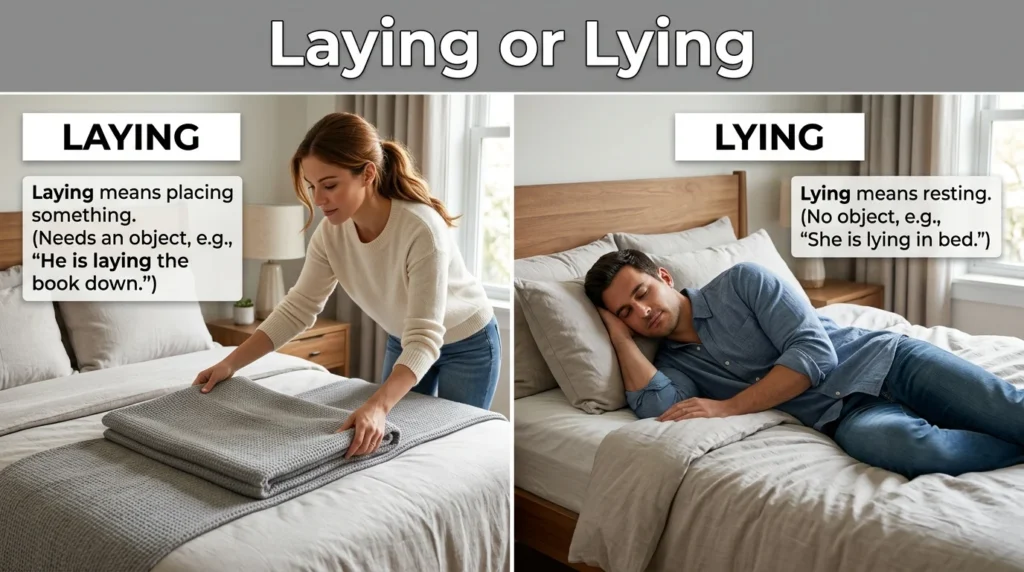

Quick Answer
Laying and lying are both correct words, but they come from different verbs. Laying means putting something down, while lying means being or resting in a flat or horizontal position.
Laying or lying is one of those English grammar questions that confuses even people who know the basic rules. The problem comes from two similar verbs: lay and lie. Their forms change in ways that are not always easy to remember.
The simple rule is this: laying means putting something somewhere, while lying means resting or being in a position. For example, you are laying a book on the table, but the book is lying on the table. The difference becomes much easier when you ask one question: Is someone putting something down, or is someone simply resting there?
What Does Laying Mean?
Laying is the present participle form of the verb lay.
The verb lay usually means to put or place something somewhere. It normally takes an object.
For example:
- I am laying the book on the desk.
- She is laying the clothes on the bed.
- He is laying the cards on the table.
- They are laying the foundation for the building.
- The worker is laying the tiles.
In each example, someone is placing something.
That object can be a physical item, such as a book or card, or something more abstract, such as a foundation or plan.
What Does Lying Mean?
Lying is the present participle form of the verb lie when lie means to rest or remain in a certain position.
For example:
- I am lying on the bed.
- She is lying on the couch.
- The dog is lying on the floor.
- He was lying in the grass.
- They are lying under the blanket.
Here, the person or animal is not putting another object somewhere. The subject itself is resting or remaining in a position.
That is the main difference between laying and lying.
Laying vs Lying: The Main Difference
The easiest way to understand the difference is to look at the object.
Laying usually means:
putting something down
Lying usually means:
resting or being in a position
Compare these two sentences:
She is laying the baby on the bed.
Here, she is putting the baby on the bed.
Now compare:
The baby is lying on the bed.
Here, the baby is resting on the bed.
The first sentence uses laying because someone is placing something. The second uses lying because the subject is resting.
The Verb Lay
The verb lay means to put or place something somewhere.
It needs an object in its normal use.
Examples:
- Lay the book on the table.
- She laid the keys beside the phone.
- He is laying the jacket on the chair.
- We laid the papers on the desk.
Notice that something is being placed in each example.
The object can be easy to spot:
Lay the book on the table.
She laid the keys beside the phone.
He is laying the jacket on the chair.
This is why laying normally connects with the idea of placing something.
The Verb Lie
The verb lie means to rest, recline, or remain in a particular position.
It does not normally take a direct object in this meaning.
Examples:
- I like to lie down after work.
- She is lying on the couch.
- The cat is lying under the table.
- He lay on the beach for an hour.
- They were lying in bed.
Here, the subject is resting.
Nothing is being placed by the subject.
That distinction helps you decide whether you need laying or lying.
Why Laying and Lying Are So Confusing
The confusion gets worse because the past forms of lay and lie do not follow the pattern many learners expect.
Here is the basic pattern for the two verbs:
| Verb | Present | Past | Present Participle |
|---|---|---|---|
| Lay | lay | laid | laying |
| Lie | lie | lay | lying |
This creates an especially confusing pair:
Yesterday, I lay on the couch.
But:
Yesterday, I laid the book on the couch.
The words look similar, but they come from different verbs.
Learning the verb families instead of memorizing one isolated word makes the difference much easier.
Laying Examples
Here are some natural examples with laying:
- She is laying the baby on the bed.
- I am laying the papers on the desk.
- He is laying the blanket on the floor.
- They are laying bricks for the new wall.
- The farmer is laying seeds in the soil.
- She is laying the plates on the table.
- He is laying his clothes on the chair.
- We are laying the foundation for the project.
In every sentence, something is being placed or put somewhere.
Lying Examples
Now look at lying:
- She is lying on the bed.
- I am lying on the couch.
- He is lying on the floor.
- The dog is lying beside the door.
- The child is lying under the blanket.
- They are lying in the grass.
- The cat is lying near the window.
- He is lying down for a few minutes.
Here, the subject is resting or remaining in a position.
Laying on the Bed vs Lying on the Bed
This is one of the most common areas of confusion.
Consider:
I am lying on the bed.
This means you are resting on the bed.
Now consider:
I am laying the blanket on the bed.
This means you are putting the blanket on the bed.
The difference is clear once you identify what is being placed.
You can also say:
She is laying the baby on the bed.
The baby is the object being placed.
But:
The baby is lying on the bed.
The baby is the one resting.
Laying Something Down
The phrase laying something down means placing something in a lower or resting position.
Examples:
- I am laying the book down.
- She is laying the phone down.
- He is laying the keys down.
- They are laying the tools down.
- We are laying the bags down.
Notice that something follows the verb.
That object helps you recognize laying.
If you can naturally ask “laying what?”, the answer often gives you the object.
For example:
She is laying what?
The blanket.
That tells you laying is the right form.
Lying Down
The phrase lying down means resting with your body in a horizontal position.
Examples:
- I am lying down.
- She is lying down on the couch.
- He is lying down because he feels tired.
- The dog is lying down near the door.
- They are lying down on the grass.
There is no object being placed.
The subject is simply changing or remaining in a resting position.
Laying vs Lying in Everyday Speech
People often use these words when talking about sleep, rest, furniture, pets, and daily activities.
For example:
I am lying on the couch.
This means you are resting there.
But:
I am laying the blanket on the couch.
This means you are putting the blanket there.
Another example:
The dog is lying on the rug.
The dog is resting.
She is laying the dog on the rug.
She is physically placing the dog there.
These small changes can completely change the meaning of a sentence.
Laying Eggs
There is another very common use of laying.
Animals can lay eggs.
For example:
- The hen is laying eggs.
- The turtle is laying eggs.
- The bird is laying eggs.
- The fish are laying eggs.
Here, laying means producing or depositing eggs.
This use has nothing to do with someone resting on a surface.
The verb still involves something being produced or placed.
Laying the Foundation
Laying can also be used in figurative expressions.
For example:
The company is laying the foundation for future growth.
Nobody is physically putting a foundation down in this sentence. The phrase means creating the basic conditions needed for something that will happen later.
Other examples include:
- laying the groundwork
- laying the foundation
- laying the tiles
- laying the carpet
- laying the table
These expressions all connect with the basic idea of putting or establishing something.
Lying in Bed
One of the most common correct expressions is:
I am lying in bed.
This means you are resting in bed.
You can also say:
She is lying in bed reading a book.
He was lying in bed when the phone rang.
The child is lying in bed.
Using laying in these sentences would change the grammar because the person is not placing an object.
However, you can use laying if an object follows it:
She is laying the baby in bed.
The baby is being placed in bed.
Lying on the Couch
The same rule applies to furniture.
Correct:
I am lying on the couch.
This means you are resting on the couch.
Correct:
I am laying a blanket on the couch.
This means you are placing a blanket there.
The difference is not the couch. The difference is what the verb is doing.
Laying on the Table vs Lying on the Table
These two sentences are also different:
She is laying the book on the table.
She is putting the book there.
The book is lying on the table.
The book is already there and is resting on the surface.
This is one of the best examples for remembering the rule.
Laying = placing something.
Lying = something is already resting there.
Common Mistakes With Laying and Lying
One common mistake is saying:
I am laying on the bed.
When you mean that you are resting on the bed, the standard form is:
I am lying on the bed.
Another common mistake is saying:
She is lying the book on the desk.
If she is putting the book on the desk, the correct form is:
She is laying the book on the desk.
A third mistake happens in the past tense:
Yesterday, I laid on the couch.
If you mean that you rested on the couch, the correct sentence is:
Yesterday, I lay on the couch.
These forms can feel strange at first, but the verb pattern makes them easier to understand.
Lay vs Lie
Before understanding laying vs lying, it helps to understand lay vs lie.
Lay
Lay means to put something somewhere.
Example:
I lay the book on the desk.
Lie
Lie means to rest or be in a position.
Example:
I lie on the couch when I need to relax.
The biggest clue is the object.
If you are placing something, use lay.
If you are resting yourself, use lie.
Laid vs Lay
The past tense creates another common problem.
The past tense of lay is laid.
Example:
I laid the book on the table yesterday.
The past tense of lie is lay.
Example:
I lay on the couch yesterday.
So:
I laid the book down.
But:
I lay down.
That difference is important.
Laying vs Lying With People
You can use laying when one person puts another person somewhere.
For example:
The nurse is laying the baby in the crib.
The baby is the object.
But if the baby is resting there, you say:
The baby is lying in the crib.
The same pattern works with adults:
He is laying his child on the bed.
versus:
His child is lying on the bed.
The first sentence describes an action of placement. The second describes a position.
Laying vs Lying With Objects
Objects can also help you understand the difference.
For example:
She is laying the phone on the table.
The phone is being placed.
Afterward:
The phone is lying on the table.
The phone is now resting there.
This simple sequence can make the rule easy to remember:
First, someone lays the phone down. Then the phone lies on the table.
How to Choose Between Laying and Lying
When you are unsure, ask yourself:
Am I putting something somewhere?
If yes, use laying.
I am laying the book on the desk.
If not, ask:
Am I or is something resting in a position?
If yes, use lying.
I am lying on the desk.
This quick test works in many everyday sentences.
A Simple Memory Trick
Here is an easy way to remember the difference:
Lay = place
Lie = rest
Then add the ing ending:
Laying = placing
Lying = resting
For example:
She is laying the keys down.
She is placing the keys.
She is lying on the sofa.
She is resting.
Once you connect the words with these two ideas, the difference becomes much easier.
Practice Questions
Choose laying or lying in each sentence.
1. The cat is ______ on the sofa.
Answer: lying
The cat is resting on the sofa.
2. She is ______ the book on the desk.
Answer: laying
She is putting the book on the desk.
3. I am ______ in bed.
Answer: lying
You are resting in bed.
4. He is ______ the jacket on the chair.
Answer: laying
He is placing the jacket on the chair.
5. The dog is ______ under the table.
Answer: lying
The dog is resting under the table.
6. The farmer is ______ seeds in the soil.
Answer: laying
The farmer is putting the seeds into the soil.
7. She is ______ on the grass.
Answer: lying
She is resting on the grass.
8. He is ______ the papers on the counter.
Answer: laying
He is placing the papers there.
Laying or Lying in Common Sentences
Here are some quick examples to make the difference clearer.
Correct:
I am lying on the couch.
Correct:
I am laying a blanket on the couch.
Correct:
The baby is lying in the crib.
Correct:
She is laying the baby in the crib.
Correct:
The keys are lying on the table.
Correct:
He is laying the keys on the table.
The pattern remains the same in every example.
Why “I Am Laying Down” Causes Confusion
You may hear people say:
I am laying down.
In casual speech, this is common in some varieties of English. However, when lay is being used to mean “rest,” the standard grammatical form is:
I am lying down.
The reason is that lie is the verb for resting.
Compare:
I am lying down.
with:
I am laying the book down.
The first describes your position. The second describes you putting something down.
Why “Laying” Is Not Always Wrong
It is important not to think that laying is incorrect.
The word is completely correct when it comes from lay.
Examples:
She is laying the baby down.
He is laying the plates on the table.
The bird is laying eggs.
Workers are laying bricks.
So the problem is not the word laying itself.
The problem occurs when someone uses laying where lying is needed.
Why “Lying” Is Not Always About Dishonesty
Another source of confusion is that lying can also be the present participle of lie meaning to tell an untruth.
For example:
He is lying to me.
Here, lying means telling something untrue.
But:
He is lying on the couch.
Here, lying means resting on the couch.
The spelling is the same, but the meaning comes from context.
Lying as Resting vs Lying as Not Telling the Truth
These two uses are easy to separate.
Lying on the bed
means resting on the bed.
Lying to someone
means telling someone something untrue.
Examples:
She is lying on the floor.
She is resting there.
She is lying to her friend.
She is not telling the truth.
The words look identical, but the surrounding sentence tells you which meaning is intended.
Final Comparison
| Form | Basic Meaning | Example |
|---|---|---|
| lay | put or place | Lay the book here. |
| lie | rest or be positioned | Lie on the bed. |
| laying | putting or placing | She is laying the book down. |
| lying | resting or being positioned | She is lying on the bed. |
| laid | past form of lay | She laid the book down. |
| lay | past form of lie | She lay on the bed. |
The important pair for this article is simple:
Laying = putting something somewhere
Lying = resting or being somewhere
Final Tips
Remember these rules:
- Laying comes from lay.
- Laying usually means putting or placing something.
- Lying comes from lie when it means resting or being in a position.
- Say I am lying on the bed when you mean you are resting.
- Say I am laying the book on the bed when you mean you are placing the book there.
- Laying eggs is also correct.
- Lying can also mean telling an untruth, depending on context.
- The past tense of lay is laid.
- The past tense of lie is lay.
- A useful memory trick is lay equals place, lie equals rest.
FAQs
Is it laying down or lying down?
When you mean resting your body, the standard form is lying down. For example, “I am lying down on the couch.” Laying is used when you are putting something down, such as “I am laying the book down.”
What is the difference between laying and lying?
Laying means putting or placing something somewhere. Lying means resting or remaining in a particular position. For example, “She is laying the blanket on the bed” means she is placing the blanket there, while “She is lying on the bed” means she is resting there.
Is “I am laying on the bed” correct?
If you mean that you are resting on the bed, the standard form is “I am lying on the bed.” Use laying when an object is being placed, such as “I am laying the clothes on the bed.”
Is laying the correct word for putting something down?
Yes. Laying is the correct form when lay means putting or placing something. For example, “He is laying the keys on the table.”
Why is lying so confusing in English?
The confusion comes from the similar verbs lay and lie, plus their unusual past forms. Lay means to put something down, while lie means to rest or be in a position. Their forms also change differently, which makes them easy to mix up.
Conclusion
The difference between laying and lying becomes much easier once you focus on the action.
Use laying when someone is putting or placing something somewhere. Use lying when someone or something is resting or remaining in a particular position.
For example, “She is laying the baby on the bed” means she is placing the baby there. “The baby is lying on the bed” means the baby is resting there.
The easiest memory rule is lay equals place and lie equals rest. Keep that idea in mind, and you will be able to choose between laying and lying with much more confidence.