

Quick Answer
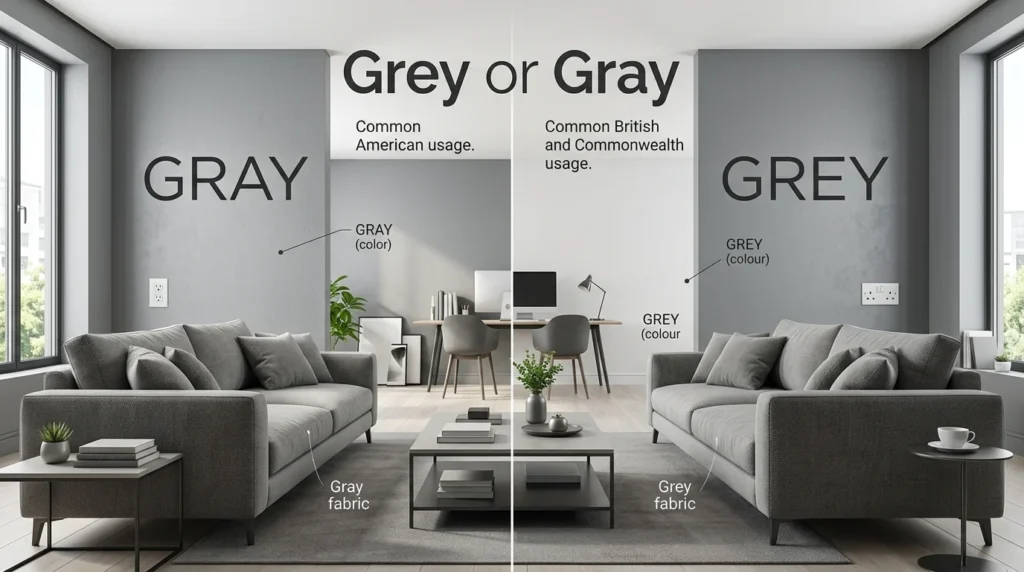
Grey and gray are both correct spellings of the same color. Gray is the standard spelling in American English, while grey is more common in British English. The meaning and pronunciation stay the same.
Have you ever typed grey and wondered if it should be gray? Or perhaps you have seen gray in one place and grey in another and thought that one of them must be wrong.
The good news is that both spellings are correct. The difference is mainly based on regional spelling habits. In American English, gray is the usual form. In British English, grey is more common.
Both words describe the same color between black and white. You can talk about a gray car, grey clouds, gray hair, or a grey sweater. The choice of spelling does not change the color or the basic meaning.
Once you understand the simple regional difference, choosing between grey or gray becomes easy.
What Does Gray Mean?
Gray is a word used for a color that sits between black and white.
It can work as an adjective, noun, or verb.
As an adjective:
- She bought a gray jacket.
- The gray sky looked cloudy.
- He has gray hair.
As a noun:
- Gray is a neutral color.
- I like this shade of gray.
- The room has several shades of gray.
As a verb:
- His hair began to gray.
- The sky started to gray before the storm.
The spelling gray is especially common in American English.
What Does Grey Mean?
Grey has the same meaning as gray.
It describes the same color and can also function as a noun, adjective, or verb.
Examples:
- She bought a grey jacket.
- The grey sky looked cloudy.
- He has grey hair.
- I like this shade of grey.
- His hair began to grey.
The main difference is simply the spelling.
Grey is the form more commonly used in British English.
Grey or Gray: What Is the Difference?
There is no meaningful difference in the color itself.
The main difference is regional spelling.
| Spelling | Common Usage | Example |
|---|---|---|
| Gray | American English | The car is gray. |
| Grey | British English | The car is grey. |
Both sentences describe the same color.
The pronunciation is also the same in normal English speech.
Therefore, you should not think of gray and grey as two different colors. They are two spellings of the same word.
Is Gray or Grey Correct?
Both are correct.
This is one of those English spelling differences where regional preference matters.
If you are using American English, gray is the standard choice.
If you are using British English, grey is the more common choice.
Neither spelling should automatically be treated as wrong. The important thing is to follow one spelling style consistently.
When Should You Use Gray?
Use gray when following American spelling conventions.
For example:
- The wall is gray.
- She has gray eyes.
- I bought a gray shirt.
- The gray clouds covered the sky.
- His hair is turning gray.
- They painted the room light gray.
You will also see gray in many American books, websites, product descriptions, school materials, and business documents.
When Should You Use Grey?
Use grey when following British spelling conventions.
Examples include:
- The wall is grey.
- She has grey eyes.
- I bought a grey shirt.
- The grey clouds covered the sky.
- His hair is turning grey.
- They painted the room light grey.
The meaning does not change.
Only the preferred spelling changes.
Gray or Grey for Hair
Both spellings are commonly used to describe hair that has lost some of its natural color.
Examples:
My grandfather has gray hair.
My grandfather has grey hair.
Both sentences are correct.
You can also use the word as a verb:
Her hair is starting to gray.
or:
Her hair is starting to grey.
The choice depends on the spelling style being used.
Gray or Grey for Eyes
The word can describe eye color as well.
For example:
- She has gray eyes.
- He has gray-blue eyes.
- Her eyes looked gray in the sunlight.
With British spelling:
- She has grey eyes.
- He has grey-blue eyes.
- Her eyes looked grey in the sunlight.
Again, the meaning is unchanged.
Gray or Grey for Clothes
Clothing descriptions often use this color word.
Examples:
- He wore a gray sweater.
- She bought a gray coat.
- I like that dark gray shirt.
- The shoes are gray.
British spelling:
- He wore a grey sweater.
- She bought a grey coat.
- I like that dark grey shirt.
- The shoes are grey.
If you are writing product descriptions, consistency is especially useful. Pick one spelling style and keep it throughout your descriptions.
Gray or Grey for the Sky
The color is also frequently used to describe cloudy weather.
For example:
The sky turned gray before the storm.
Or:
The sky turned grey before the storm.
Both sentences are correct.
You might also see:
- gray clouds
- grey clouds
- a gray sky
- a grey sky
- dark gray clouds
- dark grey clouds
The spelling does not change the meaning.
Gray or Grey as a Noun
The word can refer to the color itself.
For example:
Gray is a calming color.
Or:
Grey is a calming colour.
You can also talk about different shades:
- a shade of gray
- a shade of grey
- light gray
- light grey
- dark gray
- dark grey
The noun form follows the same regional spelling pattern.
Gray or Grey as a Verb
Many people know gray and grey as color words, but both can also function as verbs.
As a verb, the word means to become gray or to make something become gray.
For example:
His hair began to gray with age.
British spelling:
His hair began to grey with age.
You might also say:
The sky began to gray.
or:
The sky began to grey.
The same regional spelling pattern applies.
Graying or Greying
The difference continues when the word takes the ing ending.
American spelling commonly uses:
graying
British spelling commonly uses:
greying
Examples:
His hair is graying.
His hair is greying.
Both sentences are correct.
The choice depends on the spelling style.
This gives you a useful pattern:
American style
- gray
- graying
- grayed
British style
- grey
- greying
- greyed
Grayed or Greyed
The past form can also appear with either spelling.
For example:
His hair has grayed.
British spelling:
His hair has greyed.
The word can also appear in technology and design.
For example:
The button is grayed out.
A British-style interface may use:
The button is greyed out.
The meaning is the same: the button is unavailable or visually disabled.
Gray Area or Grey Area
You may have heard the expression gray area or grey area.
It describes a situation that is not clearly right or wrong, allowed or forbidden, or easy to classify.
For example:
The situation falls into a gray area.
British spelling:
The situation falls into a grey area.
The phrase is useful because it describes uncertainty or a lack of clear boundaries.
The spelling still follows the regional pattern.
Gray or Grey in Professional Writing
Both forms work in professional writing.
For example:
The report uses a gray background.
A British-style document might say:
The report uses a grey background.
Neither sentence is less professional.
The important thing is consistency.
If the rest of your document follows American spelling, gray will usually fit naturally.
If the document follows British spelling, grey will usually fit naturally.
Switching between both forms without a reason can make the writing look inconsistent.
Gray or Grey in Design and Art
Designers, artists, photographers, and other creative professionals often use this word when describing shades and tones.
Examples include:
- light gray
- dark gray
- warm gray
- cool gray
- gray background
- gray tones
- gray walls
- gray furniture
British spelling changes these to:
- light grey
- dark grey
- warm grey
- cool grey
- grey background
- grey tones
- grey walls
- grey furniture
The color remains the same.
Gray or Grey in Technology
You may see both spellings in software and technology.
For example:
The button is grayed out.
This usually means the button cannot currently be selected.
In British spelling:
The button is greyed out.
You may also see descriptions such as:
- gray text
- grey text
- gray screen
- grey screen
- gray background
- grey background
The choice depends on the language style used by the product or organization.
Common Mistakes With Grey and Gray
One common mistake is thinking that grey is always wrong.
It is not.
Another mistake is thinking that gray is always wrong because you learned the spelling grey.
It is not.
A third mistake is mixing both forms in the same document.
For example:
The wall is gray, but the gray sofa is next to a grey table.
This is not grammatically incorrect, but if you are following one spelling system, using both forms can make the writing look uneven.
A cleaner approach is to choose one form and use it consistently.
Gray vs Grey Pronunciation
Gray and grey are normally pronounced the same way.
The spelling changes, but the pronunciation does not.
That means you generally cannot hear which spelling someone intends to use.
You learn the spelling from the written form.
This is one reason the two words can confuse English learners. They sound identical but look slightly different on the page.
Gray vs Grey and Color vs Colour
The spelling difference often appears alongside another regional spelling difference.
American English commonly uses:
gray
and:
color
British English commonly uses:
grey
and:
colour
For example:
The gray color looks modern.
A British-style version would be:
The grey colour looks modern.
This is a useful reminder that regional spelling choices often work together.
Special Names That Use Gray or Grey
There are some cases where you should not change the spelling simply because you are using a different variety of English.
Proper names have their own established spelling.
For example, Earl Grey is the established name of the tea. You should not change the spelling to Earl Gray simply because you are writing in American English. Similarly, names and titles should normally keep their official spelling.
This is an important point:
Regional spelling rules do not give you permission to change someone’s name or an established proper name.
Greyhound or Grayhound?
The dog breed is spelled:
greyhound
not grayhound.
This is a special case because the spelling is part of the established word rather than a simple choice between the two color spellings.
So, do not assume that every word containing grey can be changed to gray.
How to Remember Gray or Grey
A simple memory trick can make this spelling much easier.
Think:
GrAy = American English
The A can remind you of America.
Then:
GrEy = British English
The E can remind you of England.
This is only a memory trick, but it is easy to remember.
So:
Gray → American
Grey → British
Practice: Gray or Grey?
Choose the form that fits the spelling style.
1. The sky looks ______ today.
American: gray
British: grey
2. She bought a ______ sweater.
American: gray
British: grey
3. His hair is turning ______.
American: gray
British: grey
4. The room has several shades of ______.
American: gray
British: grey
5. The button is ______ out.
American: grayed
British: greyed
The important lesson is that both regional forms can be correct.
Gray or Grey: Quick Comparison
| Word Form | American English | British English |
|---|---|---|
| Main color | gray | grey |
| Present participle | graying | greying |
| Past form | grayed | greyed |
| Example | gray hair | grey hair |
| Example | gray sky | grey sky |
| Example | gray jacket | grey jacket |
The spelling changes, but the basic meaning remains the same.
Which Spelling Should You Use?
If your writing follows American English, use gray.
If your writing follows British English, use grey.
For example, choose:
The walls are gray.
or:
The walls are grey.
Both are correct.
You do not need to worry that one spelling is somehow less intelligent or less professional. The important thing is to match the spelling style of your writing.
Final Tips
Keep these simple points in mind:
- Gray and grey are both correct.
- They describe the same color.
- They normally have the same pronunciation.
- Gray is the standard American spelling.
- Grey is more common in British English.
- The same pattern applies to graying and greying.
- The same pattern applies to grayed and greyed.
- Gray area and grey area have the same meaning.
- Proper names should keep their established spelling.
- Greyhound is spelled with grey.
- Choose one regional spelling style and use it consistently.
FAQs
Is gray or grey the correct spelling?
Both are correct. Gray is the standard spelling in American English, while grey is more common in British English.
Is grey wrong in American English?
No. Grey is a recognized spelling, although gray is the usual choice in American English.
Is gray the American spelling?
Yes. Gray is the standard American spelling of the color.
Do gray and grey mean the same thing?
Yes. They have the same basic meaning and refer to the same color. The difference is mainly regional spelling.
Is it grayed or greyed?
Both forms are used. Grayed follows the common American spelling pattern, while greyed follows the common British spelling pattern.
Conclusion
Grey and gray are both correct. They are two spellings of the same color, and the meaning does not change between them.
The main difference is regional. Gray is the standard form in American English, while grey is more common in British English. The same pattern appears in related forms such as graying and greying and grayed and greyed.
For everyday writing, the easiest rule is simple: choose gray for American spelling and grey for British spelling. Then keep that choice consistent throughout your writing.
Also remember that established names and special words may keep a fixed spelling. For example, Earl Grey and greyhound should not automatically be changed.