

Quick Answer
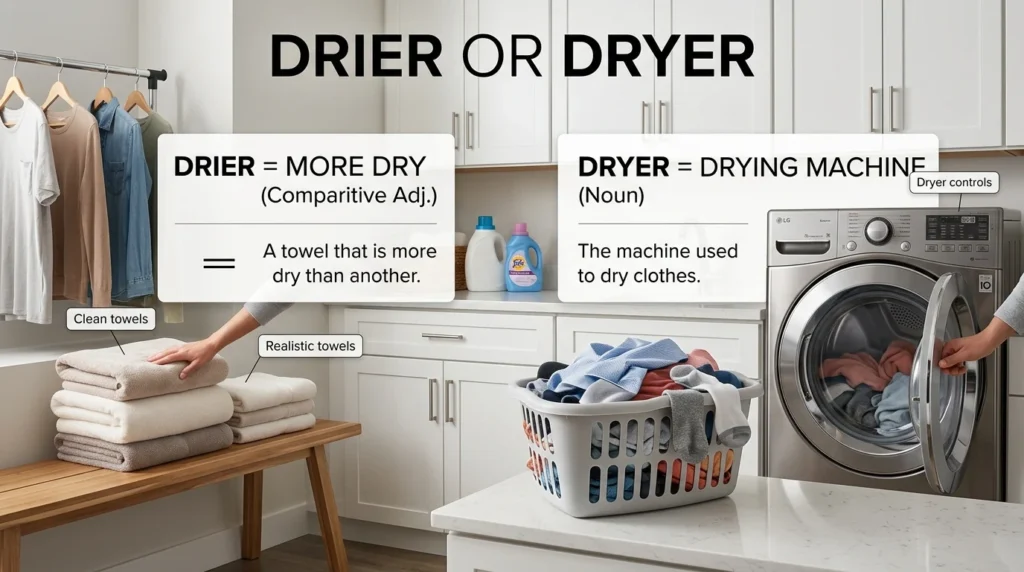
Drier and dryer can both be correct, but they do not always mean the same thing. Drier usually means “more dry,” while dryer commonly refers to a machine that removes moisture from clothes, hair, or other materials.
Drier or dryer is a common spelling question because the two words look almost identical and sound the same in normal speech. The difference becomes easier once you look at how each word works in a sentence.
Drier is usually the comparative form of dry. If one thing has less moisture than another, you can say it is drier. For example, “This towel is drier than that one.”
Dryer, on the other hand, is commonly a noun for a machine that makes something dry. You may use a clothes dryer after washing laundry or a hair dryer after taking a shower.
There is one extra detail: drier can also be used as another spelling for a drying machine. So context matters.
What Does Drier Mean?
Drier most commonly means more dry.
It is the comparative form of the adjective dry.
The basic pattern is:
dry → drier → driest
For example:
- This towel is drier than the other one.
- The air feels drier today.
- The soil is drier than it was yesterday.
- This climate is drier than the climate near the coast.
- My skin feels drier during the winter.
In each example, drier compares two conditions.
One thing has less moisture than another.
Cambridge Dictionary lists drier as the comparative form of dry.
What Does Dryer Mean?
Dryer is commonly a noun for a machine or device that dries something.
For example:
- I put the clothes in the dryer.
- My hair dryer stopped working.
- The dryer is making a strange noise.
- We need a new clothes dryer.
- She used a dryer after washing her hair.
A dryer can remove moisture from clothes, hair, food, grain, and other materials.
Cambridge Dictionary lists dryer as a noun for a machine that dries things and notes that drier can also be used for this meaning.
Drier or Dryer: What Is the Difference?
The easiest way to understand the difference is to look at the job each word is doing.
| Word | Common Meaning | Example |
|---|---|---|
| drier | more dry | The towels are drier now. |
| dryer | a machine that dries something | Put the towels in the dryer. |
So:
The clothes are drier.
Here, drier describes the clothes.
But:
The clothes are in the dryer.
Here, dryer names the machine.
This distinction will solve most spelling questions.
Drier as the Comparative Form of Dry
When you compare something with another thing, drier is usually the word you want.
For example:
Arizona is drier than a humid coastal area.
This towel is drier than mine.
The ground became drier after several sunny days.
My hands feel drier in cold weather.
The word drier tells us that something has less moisture than something else.
You can think of it as:
dry + comparison = drier
This is similar to other comparative forms such as:
- cold → colder
- warm → warmer
- dark → darker
- light → lighter
- dry → drier
Why Does Dry Become Drier?
The spelling changes because dry ends in y.
When dry becomes a comparative adjective, the y changes to i before er is added.
So:
dry → drier
Not:
dryer
when you mean “more dry.”
This is an important spelling point.
For example:
The weather is drier this week.
Here, drier means more dry.
The spelling dryer is normally used for the machine meaning, although dryer can occasionally be seen as a spelling of the comparative in informal usage.
Dryer as a Machine
When you are talking about an appliance or device, dryer is the word most people expect.
Examples include:
- clothes dryer
- hair dryer
- hand dryer
- grain dryer
- food dryer
For example:
The clothes are still wet, so I put them in the dryer.
Here, dryer is the name of the machine.
Another example:
She bought a new hair dryer.
The device produces moving air, often with heat, to help remove moisture from hair.
Drier Can Also Mean a Dryer Machine
This is where the comparison becomes slightly tricky.
Drier is not always wrong when you mean a machine.
Dictionaries recognize drier as another spelling for a drying machine.
For example, you may encounter:
The hand drier is broken.
However, dryer is the spelling most readers are likely to recognize immediately for common appliances such as a clothes dryer or hair dryer.
That makes dryer a practical choice when you are clearly naming a machine.
Drier in Weather Descriptions
One of the most common uses of drier is when talking about weather or climate.
Examples:
- The summer months are drier.
- The western region is drier than the eastern region.
- This year has been drier than last year.
- The air becomes drier during the colder months.
- Farmers are preparing for drier conditions.
In these sentences, drier means that there is less moisture.
It can refer to rainfall, air, soil, or general environmental conditions.
Drier for Clothes
You can use drier to describe clothes after they have lost some moisture.
For example:
The clothes are drier than they were an hour ago.
This means the clothes have less water in them now.
Notice the difference:
The clothes are drier.
The word describes their condition.
The clothes are in the dryer.
The word identifies the machine.
This is one of the easiest ways to remember the difference.
Drier for Hair
The same idea works with hair.
For example:
My hair is drier now.
Here, drier describes the condition of the hair.
But:
I need a new hair dryer.
Here, dryer refers to the device.
You can use both words in one sentence:
My hair is getting drier after using the hair dryer.
The first word describes the result, while the second names the device.
Drier for Skin
Drier is also common when talking about skin.
Examples:
- My skin feels drier in winter.
- This soap can make your skin drier.
- My hands are drier than usual.
- The air in the room makes my skin feel drier.
Here, drier is clearly a comparative adjective.
It tells us that the skin has less moisture than before or compared with something else.
Drier for Soil
The word is also useful when discussing plants, farming, gardening, and outdoor conditions.
Examples:
The soil is drier than it was last week.
Some plants grow better in drier soil.
The upper layer of soil became drier after several sunny days.
In these sentences, drier describes the amount of moisture in the soil.
There is no machine involved.
Drier for Food
When talking about food, drier can describe a change in moisture.
For example:
The cake became drier after being left uncovered.
These crackers are drier than the ones we bought yesterday.
The bread feels drier today.
The word describes the condition of the food.
A machine that removes moisture could be called a dryer, depending on the context.
Dryer for Clothes
The most familiar use of dryer is probably a clothes dryer.
Examples:
- I need to empty the dryer.
- The dryer finished its cycle.
- The clothes are still in the dryer.
- The dryer is full of towels.
- We bought a new dryer last month.
In these sentences, dryer is a noun.
It names an appliance.
The machine takes wet clothes and helps remove the moisture from them.
Dryer for Hair
A hair dryer is another common use.
Examples:
- Where is my hair dryer?
- I left my hair dryer in the bathroom.
- This hair dryer has several heat settings.
- She used a hair dryer before leaving.
- My old hair dryer stopped working.
Again, dryer names a device.
The word is not describing how dry the hair is.
Dryer for Hands
You may also see hand dryer in public bathrooms.
For example:
The hand dryer is not working.
I used the hand dryer after washing my hands.
A hand dryer blows air over wet hands to help remove moisture.
The same spelling applies because the word identifies a machine.
Drier or Dryer in a Sentence
A useful trick is to look at what comes after or around the word.
Compare these two sentences:
The towel is drier now.
The towel is in the dryer.
In the first sentence, the word describes the towel.
In the second sentence, the word identifies the appliance.
Another pair:
My hair feels drier today.
I need a new dryer.
This simple comparison makes the difference much easier to see.
Common Mistakes With Drier and Dryer
One common mistake is assuming that dryer is always the correct spelling because it contains the word dry.
That is not always true.
If you mean more dry, the standard comparative spelling is drier.
For example:
The air is drier today.
Another mistake is assuming that drier can never refer to a machine.
It can. Drier is also recognized as a spelling for a drying machine.
Still, dryer is very common for everyday appliance names.
A third mistake is confusing the noun and adjective roles.
Ask yourself:
Am I describing something, or am I naming a machine?
That question often gives you the answer immediately.
Drier vs Dryer in Everyday Writing
For everyday writing, use drier when you mean more dry.
Examples:
The weather is drier today.
My clothes are drier now.
The soil looks drier.
Use dryer when you mean a device:
The dryer is running.
Put the clothes in the dryer.
I bought a new hair dryer.
This rule is simple enough for most everyday situations.
Drier vs Dryer in Professional Writing
The same distinction works in professional writing.
For example, a weather report might say:
The region will experience drier conditions this week.
A product manual might say:
Place the clothes inside the dryer.
A gardening guide might say:
The plant can tolerate drier soil.
A workplace notice might say:
Please clean the hand dryer after maintenance.
The surrounding sentence makes the meaning clear.
Drier or Dryer in American English
For standard American writing, drier is the normal comparative form when you mean more dry.
For example:
The climate is drier in this region.
For machines, dryer is very common:
The clothes are in the dryer.
There is no need to replace drier with dryer when you are making a comparison.
Likewise, you do not need to write drier every time you mean a machine.
The meaning determines the spelling.
Drier or Dryer for a Clothes Machine
If you are talking about the appliance used to dry clothes, dryer is the clearest choice.
For example:
I need to buy a new dryer.
The dryer is running.
The dryer stopped halfway through the cycle.
You could encounter drier in some dictionaries and varieties of English, but dryer is the familiar spelling for this everyday appliance.
Drier or Dryer for a Hair Machine
The same applies to a hair dryer.
Write:
hair dryer
rather than using drier if you want the most familiar everyday form.
Examples:
My hair dryer is in the bathroom.
She packed her hair dryer for the trip.
The hair dryer has two speed settings.
The word is naming a device.
Drier or Dryer for Comparative Meaning
When you mean that something has become more dry, use drier.
Examples:
The towel became drier.
The air feels drier.
The ground is drier.
The bread is drier than yesterday.
The paint is drier now.
In each case, the word compares the current condition with an earlier or different condition.
Drier, Dryer, and Driest
It can help to see the complete comparison pattern.
Dry
The towel is dry.
Drier
The towel is drier than before.
Driest
This is the driest towel in the basket.
The word dryer does not belong to this adjective pattern in the same way. It is commonly used as a noun for a drying device.
So remember:
dry → drier → driest
But:
dryer = a machine or device
Drier or Dryer: Pronunciation
In many varieties of English, drier and dryer are pronounced the same or very similarly.
That is one reason the spelling can cause confusion.
When speaking, context usually tells the listener what you mean.
For example:
The clothes are drier.
and:
The clothes are in the dryer.
The surrounding words make the meaning clear.
Because the words can sound alike, spelling becomes especially important in writing.
How to Remember Drier vs Dryer
Use this simple trick:
If you mean more dry, think:
dry → drier
If you mean a machine, think:
dryer
For example:
The room is drier.
This describes the room.
Turn on the dryer.
This names the machine.
You can also remember the phrase:
Drier describes. Dryer dries.
It is not a rule for every possible dictionary use, but it is a useful shortcut for everyday writing.
Practice Questions
Choose drier or dryer in each sentence.
Question 1
The weather is getting ______.
Answer: drier
The sentence means the weather is becoming more dry.
Question 2
Put the wet towels in the ______.
Answer: dryer
The sentence refers to a machine.
Question 3
My skin feels ______ during the winter.
Answer: drier
The word describes the condition of the skin.
Question 4
I need to buy a new clothes ______.
Answer: dryer
The word names an appliance.
Question 5
The soil is ______ than it was yesterday.
Answer: drier
The sentence compares the moisture level of the soil.
Question 6
She used a hair ______ after her shower.
Answer: dryer
The word refers to a hair-drying device.
Question 7
The bread became ______ after sitting out overnight.
Answer: drier
The bread has lost moisture.
Question 8
The ______ is making a loud noise.
Answer: dryer
The sentence refers to the machine.
More Examples of Drier
Here are some natural examples where drier means more dry:
- The desert air is drier than the air near the ocean.
- My clothes are drier now.
- The ground looks drier after the hot weather.
- This towel is drier than that one.
- The winter air can make your skin drier.
- The paint is drier than it was this morning.
- The bread became drier after several hours.
- This region is drier than the northern part of the state.
- The leaves became drier during the heat wave.
- The soil is much drier than expected.
More Examples of Dryer
Here are examples where dryer refers to a machine:
- The dryer is running.
- The clothes are in the dryer.
- I cleaned the dryer filter.
- We bought a new dryer.
- The dryer stopped working.
- She used a hair dryer.
- The hand dryer is broken.
- The dryer finished its cycle.
- He opened the dryer door.
- The clothes came out of the dryer warm.
Drier or Dryer: Quick Comparison
| Question | Correct Word |
|---|---|
| More dry | drier |
| A clothes machine | dryer |
| More dry air | drier |
| A hair machine | dryer |
| More dry soil | drier |
| A hand-drying machine | dryer |
| More dry clothes | drier |
| A machine that dries clothes | dryer |
There is one important exception to keep in mind: drier can also be used as another spelling for a drying machine.
Final Tips
Remember these points:
- Drier usually means more dry.
- Dryer commonly means a machine that dries something.
- Dryer is common in phrases such as clothes dryer and hair dryer.
- Drier is the standard comparative form of dry.
- The comparative pattern is dry, drier, driest.
- Both words can sound the same in speech.
- Context helps distinguish them.
- Drier can also be used for a drying machine, so it is not always wrong in that meaning.
- When writing about an everyday appliance, dryer is usually the clearest choice.
- When you mean “more dry,” choose drier.
FAQs
Is drier or dryer correct?
Both can be correct, but they usually have different jobs. Drier normally means “more dry,” while dryer commonly means a machine that dries clothes, hair, or another material.
Is drier the correct comparative form of dry?
Yes. The standard comparative form is drier. The basic pattern is dry, drier, driest.
Is a clothes drier or clothes dryer correct?
Clothes dryer is the familiar spelling for the appliance. However, drier can also be used as another spelling for a drying machine in some English usage.
Should I write hair drier or hair dryer?
Hair dryer is the more familiar everyday spelling for the device used to dry hair. Hair drier can also be found, but hair dryer is usually the clearer choice.
How can I easily remember drier and dryer?
Use drier when you mean “more dry” and dryer when you mean a machine. For example, “The towel is drier” describes the towel, while “The towel is in the dryer” names the machine.
Conclusion
The difference between drier and dryer becomes simple once you focus on meaning. Drier is normally the comparative form of dry, so it means that something has become more dry or contains less moisture than something else. You can use it for air, soil, clothes, skin, food, weather, and many other things.
Dryer is commonly a noun for a machine that removes moisture. That is why you will often see phrases such as clothes dryer, hair dryer, and hand dryer. However, drier can also be used as another spelling for a drying machine, so context still matters.
For everyday writing, remember the easiest rule: drier means more dry, while dryer usually means the machine. Once you learn that difference, choosing the right spelling becomes much easier.