
Quick Answer
WSG usually means “What’s good?” in text messages and online conversations. It is a casual way to ask “What’s up?” or “How are you doing?” and is often used as a friendly greeting.
The search for wsg meaning in text usually comes from seeing the abbreviation in a message, social media comment, or chat. WSG is a short, casual greeting that has become common in online conversations. Instead of typing “What’s good?” or “What’s up?”, someone may simply send “WSG?” to start a conversation.
The expression is usually friendly and relaxed. It can be used between friends, people who know each other online, or members of casual communities. However, the exact tone can depend on the relationship and the surrounding messages. This guide explains what WSG means, where it comes from, how people use it, how to respond, and when a more standard greeting is a better choice.
What Does WSG Mean in Text?
The most common meaning of WSG in texting is “What’s good?”
In everyday English, “What’s good?” is a casual way to ask:
- “What’s up?”
- “How are you?”
- “What are you doing?”
- “How’s everything going?”
- “What’s going on?”
For example:
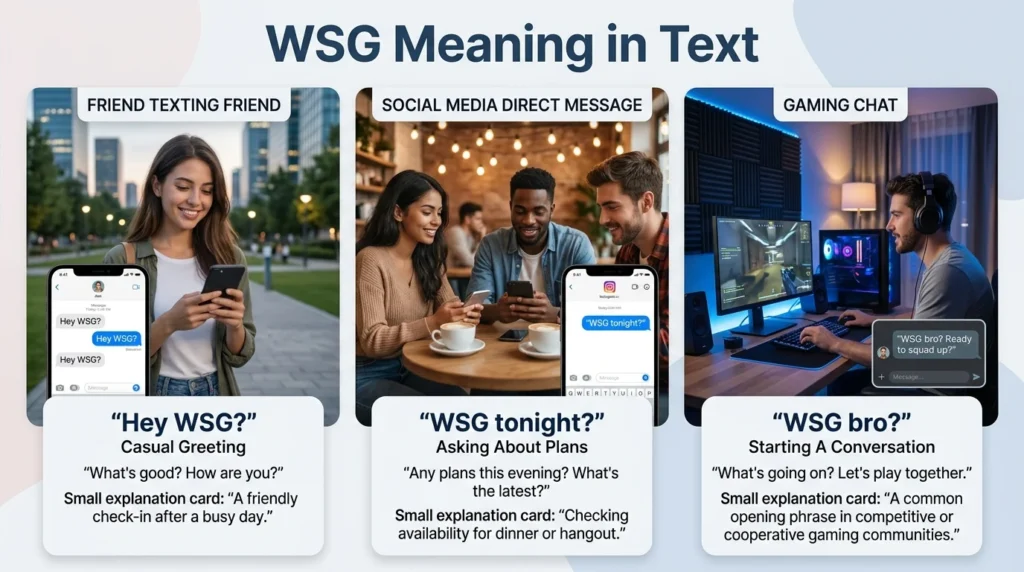
Friend: “WSG?”
This is usually a simple invitation to start a conversation.
You could reply:
“Not much. Just relaxing. You?”
The person asking WSG may not be looking for a detailed answer. Often, it is simply a casual greeting.
Common WSG Meanings
| Meaning | Context | Example |
|---|---|---|
| What’s good? | Casual texting | “WSG?” |
| What’s good? | Social media | “WSG bro?” |
| What’s good? | Group chats | “WSG everyone?” |
| Other abbreviation | Specialized contexts | Depends on the subject |
In ordinary online conversations, “What’s good?” is the meaning most people are likely to understand.
WSG Meaning in Text Messages
WSG works much like other casual greetings. The sender may use it at the beginning of a conversation or after not talking to someone for a while.
For example:
“WSG?”
can mean:
“What’s up?”
or:
“How are things?”
Another person might send:
“WSG with you?”
This can mean:
“What’s going on with you?”
The abbreviation is short, quick, and informal. It does not usually carry a deep hidden meaning.
WSG as a Greeting
A person may send only:
“WSG?”
The message can simply be an opening. They may be checking whether you are available to chat.
WSG as a Conversation Starter
Someone may use WSG to begin a longer conversation.
“WSG? You doing anything tonight?”
Here, the sender is asking how things are going and then asking about the person’s plans.
WSG After a Long Time
If you have not talked to someone recently, they might write:
“WSG man? It’s been a while.”
This sounds like a friendly attempt to reconnect.
Where Did WSG Come From?
WSG is a shortened form of “What’s good?”, an informal English expression that has been used as a greeting in casual speech.
The exact point when WSG became popular as a texting abbreviation is difficult to identify. Like many internet abbreviations, its growth is connected to the broader shift toward shorter digital communication.
Texting and social media made short greetings especially convenient. Instead of writing a full phrase, users could type three letters and start a conversation quickly.
Online communities also helped spread WSG. It can appear in text messages, social media comments, direct messages, gaming chats, and other informal spaces.
The abbreviation is best understood as a modern written shorthand for an existing casual expression rather than as a completely new word.
Different Meanings and Contexts of WSG
WSG generally keeps the same meaning across casual online platforms, but the exact intention can change slightly depending on the situation.
Text Messages
In a private text, WSG usually means:
“What’s good?”
It can function as a simple greeting.
Example:
“WSG? How have you been?”
Someone may reply to a story with:
“WSG?”
This can be a casual way to start a direct conversation.
Snapchat
Because Snapchat conversations are often informal, WSG can fit naturally into a quick message.
“WSG tonight?”
This could mean:
“What are you doing tonight?”
TikTok
A user may see WSG in comments or direct messages. The meaning is generally still connected to “What’s good?”
WhatsApp and iMessage
Friends may use WSG in private conversations as a quick alternative to “What’s up?”
Gaming Chats
WSG can be used to greet another player.
“WSG bro?”
The sender is usually asking how the other person is doing or what they are up to.
Professional Communication
WSG is generally too casual for formal workplace communication. A coworker might understand it, but “How are you doing?” or “How is everything going?” is usually clearer and more professional.
WSG Meaning From a Guy
If a guy sends you WSG, the most straightforward interpretation is that he is casually asking “What’s good?”
For example:
“WSG?”
He may simply want to start talking.
If the message comes from a friend, it may have no special meaning beyond a greeting.
If it comes from someone you are dating or someone you do not know very well, the broader conversation can provide more context. For example:
“WSG? You free tonight?”
This suggests he may want to know whether you are available to talk or meet.
Still, WSG by itself does not prove romantic interest. The rest of the conversation matters more than the abbreviation.
WSG Meaning From a Girl
When a girl sends WSG, it usually has the same basic meaning: “What’s good?”
She may simply be checking in or opening a conversation.
For example:
“WSG? Haven’t heard from you all day.”
This sounds like a casual check-in.
Another example:
“WSG tonight?”
This could mean she wants to know what your plans are.
The abbreviation alone does not establish whether the message is friendly, romantic, or simply casual. Look at the previous conversation and how the person normally communicates.
Tone and Emotional Meaning of WSG
WSG is generally relaxed and friendly, but its tone can shift based on context.
A Friendly Tone
“WSG bro?”
This usually sounds casual and familiar.
A Curious Tone
“WSG? What are you doing today?”
Here, the sender is genuinely asking about your plans.
A Playful Tone
“WSG 👀”
The eyes emoji can make the message feel more playful or curious.
A Reconnecting Tone
“WSG? It’s been forever.”
This suggests that the sender wants to reconnect.
A Short or Neutral Tone
“wsg”
A lowercase message may simply reflect the sender’s normal texting style. Lowercase writing does not automatically mean the person is cold or uninterested.
Punctuation and Emojis
Compare:
“WSG?”
“WSG 😂”
“WSG 👀”
The words remain the same, but the added punctuation or emoji can change how the message feels.
That is why it is better to read WSG as part of the entire conversation rather than assigning a fixed emotional meaning to the three letters.
Real Life Examples of WSG in Text
Example 1: Casual Greeting
Person A: “WSG?”
Person B: “Not much. Just watching TV. You?”
Here, WSG simply means “What’s good?” or “What’s up?”
Example 2: Asking About Plans
Person A: “WSG tonight?”
Person B: “Nothing planned yet.”
In this context, the sender is asking what the other person is doing that evening.
Example 3: Reconnecting With a Friend
Person A: “WSG bro? Been a minute.”
Person B: “I know! I’ve been busy with work.”
WSG is being used as a friendly way to restart communication.
Example 4: Social Media Message
Person A: “WSG? I saw your new post.”
Person B: “Haha, thanks. How are you?”
The abbreviation opens a casual conversation.
Example 5: Gaming
Person A: “WSG? You getting on tonight?”
Person B: “Yeah, I’ll be on around eight.”
Here, WSG works as a casual greeting before the sender asks about gaming plans.
Example 6: Checking In
Person A: “WSG? Everything good?”
Person B: “Yeah, just having a rough day.”
In this example, WSG is followed by a more direct question.
Example 7: Casual Conversation
Person A: “WSG with you?”
Person B: “Just finished dinner.”
The sender is asking what the other person is doing.
Practical Usage of WSG
Using WSG is simple. It usually works at the beginning of a casual conversation.
Common examples include:
- “WSG?”
- “WSG bro?”
- “WSG with you?”
- “WSG tonight?”
- “Hey, WSG?”
- “WSG man?”
- “WSG everyone?”
You can use it when:
- Starting a conversation with a friend
- Checking in with someone
- Reconnecting with an old friend
- Messaging someone through social media
- Talking in a gaming community
- Asking about someone’s plans
A person who receives WSG does not need to give a complicated answer. Natural replies include:
“Not much. You?”
“I’m good. What about you?”
“Just chilling.”
“Nothing much, what’s up?”
“Doing good. How are you?”
How to Reply to WSG
The easiest way to respond to WSG is to answer what you are doing or how things are going, then ask the same question back.
Simple Replies
“Not much, you?”
“I’m good. WSG with you?”
“Just relaxing.”
“Nothing much. How about you?”
If You Are Busy
“Just working right now. What’s up?”
If You Want to Continue the Conversation
“I’m good. I just got back from the gym. What are you up to?”
If You Think They Want to Make Plans
“Not much tonight. Why?”
That last reply is useful when you think the sender may have a plan or question in mind.
Is WSG Formal or Informal?
WSG is informal internet slang.
It is most appropriate when the conversation is casual and the people involved are comfortable with abbreviations.
Good Places to Use WSG
- Text messages with friends
- Group chats
- Social media messages
- Gaming chats
- Casual online communities
- Informal conversations
Places to Avoid WSG
- Job applications
- Formal emails
- Academic papers
- Business reports
- Resumes
- Customer service communication
- Official letters
Instead of:
“WSG? How is the project going?”
a professional message would be:
“Hi, how is the project going?”
The full version is clearer and more appropriate for a workplace setting.
Common Mistakes People Make With WSG
Mistake 1: Assuming WSG Is a Formal Greeting
WSG is casual slang. It is not the best choice for formal or professional communication.
Mistake 2: Thinking WSG Always Means “What’s Up?”
“What’s good?” is the common expansion, but the practical meaning is often similar to “What’s up?” Context can affect the exact interpretation.
Mistake 3: Assuming WSG Has Romantic Meaning
A person sending WSG may simply be starting a conversation. The abbreviation alone does not establish romantic interest.
Mistake 4: Giving an Overly Detailed Answer
If someone sends:
“WSG?”
you usually do not need to write a long explanation of your day. A short response such as “Not much, you?” is natural.
Mistake 5: Assuming Lowercase WSG Has a Negative Tone
People often type slang in lowercase because that is how they normally text. “wsg” and “WSG” usually have the same basic meaning.
Mistake 6: Confusing WSG With Other Abbreviations
Some people may mistake WSG for a technical abbreviation or a different internet expression. The conversation usually makes the intended meaning clear.
Related Words and Expressions
WSG is closely related to several casual greetings.
What’s Up?
“What’s up?” is one of the closest equivalents to WSG. It can mean “How are you?” or “What are you doing?”
What’s Good?
“What’s good?” is the phrase represented by WSG. It is slightly more slang-oriented than standard greetings.
WYD
WYD means “What are you doing?” It focuses more directly on a person’s current activity.
HBU
HBU means “How about you?” It is often used after someone answers a question.
HY
HY can have different meanings in texting, including “Hell Yeah” in many casual conversations. Its meaning is different from WSG.
WYA
WYA usually means “Where you at?” It asks about someone’s location rather than how things are going.
WSG vs Similar Texting Greetings
WSG is often confused with other short greetings because several abbreviations can appear in the same type of conversation.
| Term | Meaning | Main Purpose | Example |
|---|---|---|---|
| WSG | What’s good? | General greeting | “WSG?” |
| WYD | What are you doing? | Asking about activity | “WYD tonight?” |
| WYA | Where you at? | Asking about location | “WYA?” |
| HBU | How about you? | Returning a question | “I’m good. HBU?” |
| SUP | What’s up? | Casual greeting | “Sup?” |
| HY | Hell Yeah or another context-dependent meaning | Depends on context | “HY, let’s go!” |
The main difference is the question being asked. WSG is broad and can mean “What’s going on?” or “How are things?” WYD focuses on activity, while WYA focuses on location.
Social Media Usage of WSG
WSG appears in many casual online spaces because it is short and easy to type.
A person may respond to a story with:
“WSG?”
This can be a simple conversation opener.
Snapchat
A quick message might say:
“WSG tonight?”
The sender may be asking about plans.
TikTok
WSG can appear in comments or direct messages when someone wants to interact casually.
Discord
Gaming communities may use WSG when greeting friends or asking whether someone is online.
WhatsApp and iMessage
Friends commonly use short greetings such as WSG when starting a private conversation.
The meaning generally remains the same across platforms. The platform does not usually change what WSG stands for.
Professional Usage of WSG
WSG is usually not appropriate in professional communication.
For example, sending your manager:
“WSG?”
could sound overly casual.
A better option would be:
“Hi, how are you doing?”
or:
“Hi, how is everything going?”
In a workplace chat with close coworkers, casual language may be acceptable depending on the company culture. Still, a standard greeting is safer when you are communicating with clients, managers, customers, or people you do not know well.
Regional and Generational Usage
WSG is mainly an informal internet expression, so familiarity can vary between age groups and online communities.
People who frequently use texting, social media, gaming chats, and other digital platforms may recognize WSG immediately. Someone who rarely uses internet slang may not know what it means.
The expression is also not restricted to one English-speaking region. Online slang can spread across American, Canadian, British, Australian, and other English-speaking communities.
Still, usage is not universal. Some people prefer “What’s up?” while others may use “What’s good?” or another local greeting.
The safest approach is to match the communication style of the person you are talking to.
Is WSG the Same as “What’s Up?”
WSG and “What’s up?” often serve a similar purpose, but they are not literally the same phrase.
WSG stands for “What’s good?”
“What’s up?” is a different expression.
In casual conversation, however, both can function as greetings. Someone who sends WSG may simply want to know how you are doing or what you are up to.
For example:
“WSG?”
and:
“What’s up?”
can both receive the reply:
“Not much. You?”
That practical similarity is why people sometimes treat them as interchangeable in casual texting.
Does WSG Mean Someone Wants to Talk?
Usually, sending WSG opens the door to a conversation. The person may want to check in, ask what you are doing, or simply say hello.
However, the abbreviation alone does not tell you exactly why they messaged.
For example:
“WSG?”
could mean:
- “How are you?”
- “What are you doing?”
- “Are you free?”
- “What’s going on?”
- “Want to talk?”
The next message usually makes the purpose clearer.
Practice Questions
Test your understanding with these five questions.
Question 1
What does WSG usually stand for in texting?
Question 2
What is the practical meaning of “WSG?” in a casual conversation?
Question 3
Is WSG appropriate for a formal business email?
Question 4
Which abbreviation is more directly focused on someone’s current activity: WSG or WYD?
Question 5
Does receiving WSG automatically mean someone has romantic interest?
Answers
1. WSG usually stands for “What’s good?”
2. It is a casual greeting that can mean “What’s up?”, “How are you?”, or “What are you doing?”
3. Generally, no. WSG is informal internet slang and a standard greeting is more appropriate for professional communication.
4. WYD is more directly focused on someone’s current activity because it means “What are you doing?”
5. No. WSG is usually just a casual conversation starter. The broader conversation is needed to understand someone’s intentions.
FAQs
1. What does WSG mean in text messages?
WSG usually means “What’s good?” It is a casual greeting similar to “What’s up?” and is commonly used to start a conversation.
2. What should I reply when someone says WSG?
You can reply with something simple such as “Not much, you?”, “I’m good, how about you?”, or “Just chilling.”
3. Does WSG mean “What’s up”?
Not literally. WSG stands for “What’s good?” However, both expressions can serve a similar purpose as casual greetings.
4. Is WSG a slang word?
Yes. WSG is informal internet and texting slang. It is common in casual conversations but is generally not suitable for formal writing.
5. Does WSG mean someone likes you?
Not by itself. WSG is normally a casual greeting. If someone has romantic interest, other parts of the conversation may provide more context, but the abbreviation alone cannot establish their intentions.
Conclusion
The most common wsg meaning in text is “What’s good?” It is a casual greeting that can function much like “What’s up?” or “How are you?” People commonly use WSG when starting conversations with friends, checking in with someone, asking about plans, or reconnecting after some time.
WSG is informal and works best in texts, social media messages, gaming chats, and other relaxed settings. It should generally be replaced with a standard greeting in professional communication. Most importantly, the abbreviation itself does not reveal a person’s feelings or intentions, so the surrounding conversation should always be considered.
See Also More :
- GTS Meaning in Text: The Correct Meaning, Usage, and Examples Explained
- TS Meaning in Text: The Correct Meaning, Usage and Examples Explained