
Quick Answer
Blond and blonde are both correct spellings. Both describe light or golden-colored hair, but their use can depend on grammar, context, and regional style.
If you are writing about hair color, you may stop and wonder: should it be blond or blonde? The answer is not as simple as calling one right and the other wrong. Both forms are established English words.
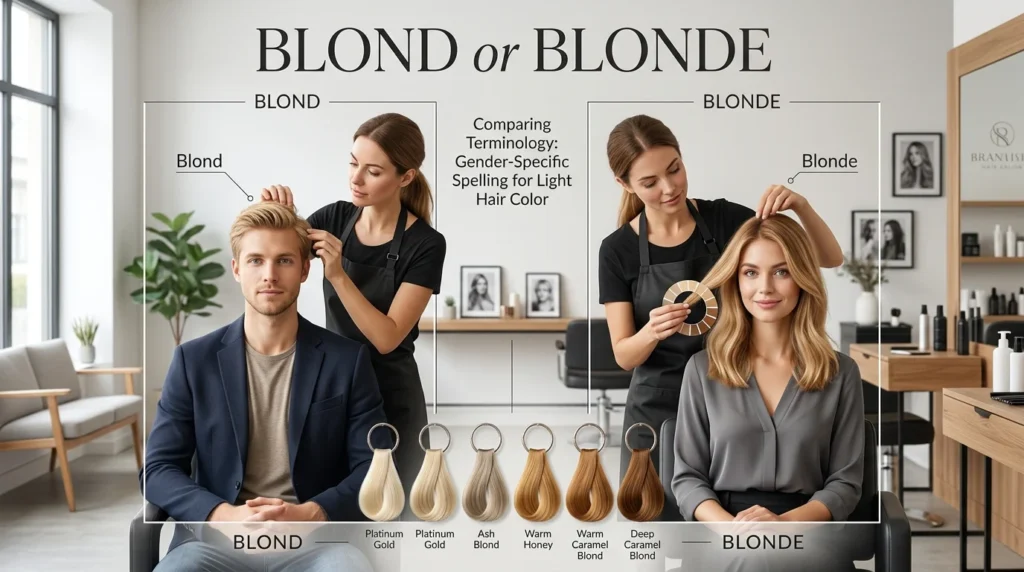
Traditionally, blond was used for a male person and blonde for a female person. That distinction is still seen in some forms of English. However, modern usage is more flexible, especially in American English, where blond is often used as a general adjective for people of any gender.
For example, you may see both blond hair and blonde hair. You may also see a blond man and a blonde woman. Understanding the context makes the choice much easier.
What Does Blond Mean?
Blond describes a light hair color, usually ranging from pale yellow to golden or light brown.
It can work as an adjective:
- He has blond hair.
- The boy has short blond curls.
- She dyed her hair blond.
- The character has naturally blond hair.
Blond can also be used as a noun for a person with light-colored hair.
For example:
The actor is a tall blond.
In modern usage, especially in American English, blond can work as a general form without making a male or female distinction.
The word can also describe light-colored materials.
For example:
The room has blond wood floors.
Here, blonde would not normally be used.
What Does Blonde Mean?
Blonde also describes light-colored hair.
It is especially familiar when talking about a woman or girl.
Examples include:
- She has blonde hair.
- The girl has long blonde curls.
- Her blonde hair looked bright in the sunlight.
- The actress is blonde.
Blonde can also be used as a noun:
She is a blonde.
This noun use traditionally refers to a woman with light-colored hair.
However, some modern style guides prefer blond as a general noun and adjective because it avoids making a gender distinction based only on hair color.
Blond or Blonde: What Is the Difference?
The two words mainly differ in spelling and traditional usage.
| Word | Common Use | Example |
|---|---|---|
| Blond | Light hair color and general adjective | He has blond hair. |
| Blonde | Traditionally associated with women and girls | She has blonde hair. |
The old rule is easy to remember:
Blond = male
Blonde = female
However, this rule is not absolute in modern English.
Today, blond is often used as a general adjective for anyone, while blonde remains common when referring to a woman or girl.
Is Blond or Blonde Correct?
Both are correct.
That is the first thing to remember.
If you write:
He has blond hair.
the spelling is correct.
If you write:
She has blonde hair.
the spelling is also correct.
You can even see:
She has blond hair.
This is also acceptable, particularly in American English.
The choice depends on the style and context rather than a simple right-or-wrong rule.
Blond Hair or Blonde Hair?
This is one of the most common questions.
Both blond hair and blonde hair appear in English.
For example:
He has blond hair.
This is completely natural.
You can also write:
She has blonde hair.
This is also completely natural.
In modern American usage, blond hair is often preferred as a general color description regardless of the person’s gender. At the same time, blonde hair remains very common, especially when describing a woman.
So you should not treat blonde hair as an error.
Blond for Men
Traditional usage commonly uses blond when describing a man or boy.
Examples:
- He is blond.
- The blond man was waiting outside.
- My brother has blond hair.
- The blond boy stood near the door.
Here, the spelling without the final e fits the traditional distinction.
However, this does not mean that modern English must always use blond for men. The main point is that blond is the traditional masculine form.
Blonde for Women
Traditional usage commonly uses blonde when describing a woman or girl.
Examples:
- She is blonde.
- The blonde woman was talking to her friend.
- Her daughter has blonde hair.
- The blonde girl wore a blue dress.
This form remains common today.
Still, modern English also uses blond as a gender-neutral adjective, so you may see:
She has blond hair.
There is nothing inherently wrong with that sentence.
Blond or Blonde in American English
American English often makes the distinction less strict.
Blond is widely used as an adjective for both .
For example:
He has blond hair.
She has blond hair.
This makes blond a useful general spelling when you are simply describing hair color.
The spelling blonde is still common, especially as a noun referring to a woman. However, some writers avoid that noun because it can place attention on a woman’s appearance rather than the person herself.
For neutral writing, blond hair or a person with blond hair can often be a cleaner choice.
Blond or Blonde in British English
Traditional British usage keeps the gender distinction more clearly.
You may see:
He is blond.
and:
She is blonde.
You may also see:
He has blond hair.
and:
She has blonde hair.
This convention comes from the older masculine and feminine forms of the word.
However, real English usage can vary. Writers and publications do not always follow the traditional distinction in exactly the same way.
Why Are There Two Spellings?
The history of blond and blonde helps explain the difference.
The words entered English through French. French traditionally uses different forms for masculine and feminine words. The masculine form is associated with blond, while the feminine form is associated with blonde.
English kept both spellings.
Over time, however, English became less dependent on grammatical gender. As a result, the old distinction became less strict in many situations.
That is why modern English can contain all of these forms:
- blond man
- blonde woman
- blond hair
- blonde hair
- blond person
The variation is a result of language history and changing usage.
Blond as a Noun
Blond can be used as a noun to refer to a person with light-colored hair.
For example:
The blond walked into the room.
Traditionally, this noun was more closely associated with a man or boy.
However, modern usage can use blond more broadly.
Another option is to avoid the noun entirely and write:
The person with blond hair walked into the room.
This can sound more neutral and specific.
Blonde as a Noun
Blonde can also be a noun.
For example:
She is a blonde.
Traditionally, this means a woman with light-colored hair.
You may also see:
A blonde woman entered the room.
However, the noun blonde can sometimes be viewed as reducing a woman to her appearance. For that reason, neutral alternatives can be better in some contexts.
Instead of:
A blonde entered the room.
you could write:
A woman with blond hair entered the room.
The second version focuses on the person rather than making hair color the main label.
Blond as a Color
Blond can describe more than human hair.
For example:
- blond wood
- blond furniture
- blond leather
- blond highlights
Here, blond refers to a light or pale color.
Examples:
The table is made from blond wood.
The room has blond wooden cabinets.
You would not normally write blonde wood simply because the material has a light color.
This is one situation where blond is clearly the useful form.
Blonde Hair Color
Blonde hair can appear in many shades.
People may describe it as:
- light blonde
- dark blonde
- golden blonde
- ash blonde
- dirty blonde
- platinum blonde
- strawberry blonde
These phrases describe different shades or tones.
For example:
She changed her hair to a warm golden blonde.
Or:
His natural hair is a dark blond shade.
The exact spelling can vary depending on the writer’s preferred style.
Blond vs Blonde in Hair Descriptions
When describing hair, context usually makes the meaning clear.
For example:
She has blond hair.
The reader immediately understands the color.
You can also write:
She has blonde hair.
The reader understands the same basic color.
Therefore, you do not need to worry that one spelling will completely change the meaning.
The larger question is whether you want to follow a traditional gender distinction or use blond as a more general adjective.
Common Mistakes With Blond and Blonde
One common mistake is saying that blonde is always wrong.
That is not true.
Another mistake is saying that blond is only used for men.
That reflects traditional usage, but modern English is more flexible.
A third mistake is assuming that blonde hair is grammatically incorrect.
It is not.
A fourth mistake is using blonde for things such as wood or furniture.
For example:
The house has blonde wood floors.
Many writers would use:
The house has blond wood floors.
The word blond works naturally as a color description for light-colored wood.
Blond or Blonde for Hair Dye
Both forms can appear when discussing hair color and hair dye.
For example:
She dyed her hair blond.
You may also see:
She dyed her hair blonde.
Both constructions can be understood.
When describing a specific color shade, blonde is especially common in beauty and hair-care language.
Examples include:
- blonde highlights
- blonde hair dye
- platinum blonde
- dark blonde
- golden blonde
At the same time, blond remains a standard spelling.
Blond or Blonde in Professional Writing
In professional writing, consistency matters.
If you choose blond as your general adjective, continue using it throughout the article or document.
For example:
The model has blond hair.
Her blond hair was styled in loose waves.
Avoid changing randomly to:
Her blonde hair was styled in loose waves.
unless there is a clear reason for the change.
The same principle applies to blonde.
Good writing does not require everyone to use exactly the same regional convention. It requires the chosen convention to be used clearly and consistently.
Blond or Blonde in Everyday Conversation
In everyday speech, the difference is much less noticeable because the two words are pronounced the same.
For example, when someone says:
She has blond hair.
you cannot hear whether the speaker would write blond or blonde.
The distinction mainly appears in writing.
That is why this question is usually a spelling and usage issue rather than a pronunciation problem.
How to Pronounce Blond and Blonde
Blond and blonde are normally pronounced the same way.
The final e in blonde does not create a separate pronunciation.
Both sound roughly like:
blond
This makes the difference easy to miss in conversation.
You may know exactly what someone means when they speak, but the spelling can still make you pause when you write the word.
Easy Way to Remember Blond and Blonde
A simple traditional memory trick is:
Blond = man or boy
Blonde = woman or girl
The extra e can remind you of the traditional feminine form.
However, remember that modern English does not always follow this rule.
If you simply mean the hair color, blond is a useful general form, especially in American English.
So a safer modern rule is:
Blond is a general adjective for light hair.
Blonde is especially common when referring to a woman or girl or when used as a noun.
Examples of Blond
Here are some natural examples:
- He has blond hair.
- The boy has short blond curls.
- She has naturally blond hair.
- The actor is blond.
- They have a blond wooden table.
- The character has dark blond hair.
- His blond hair turned lighter during the summer.
- The room has blond wood floors.
These examples show that blond can describe people, hair, and other light-colored objects.
Examples of Blonde
Here are some natural examples:
- She has blonde hair.
- The actress is blonde.
- The girl has long blonde curls.
- She chose a warm blonde shade.
- Her blonde highlights look natural.
- The stylist recommended a darker blonde.
- She dyed her hair platinum blonde.
- The blonde woman was standing near the window.
These examples show why blonde remains a common form in English.
Practice Questions
Choose blond or blonde for each sentence.
Question One
He has naturally ______ hair.
Answer: Blond or blonde can work, depending on the writer’s style.
Question Two
She has long ______ hair.
Answer: Blonde is very common here, although blond is also acceptable in modern usage.
Question Three
The man is ______.
Answer: Blond is the traditional form.
Question Four
The woman is ______.
Answer: Blonde is the traditional form, although blond is also used as a general adjective.
Question Five
The house has ______ wood floors.
Answer: Blond is the natural choice for describing the light color of wood.
Quick Comparison of Blond and Blonde
| Feature | Blond | Blonde |
|---|---|---|
| Basic meaning | Light-colored hair | Light-colored hair |
| Traditional male use | Yes | Less common |
| Traditional female use | Less common | Yes |
| General adjective | Very common | Also used |
| Noun use | Person with light hair | Traditionally a woman with light hair |
| Light-colored wood | Yes | No, generally |
| Pronunciation | Same | Same |
The biggest difference is not the basic meaning. It is how the spelling is used in different contexts and styles.
Which One Should You Use?
If you want a simple modern choice for describing hair color, blond is often the safest general adjective.
For example:
She has blond hair.
This avoids making the spelling depend on gender.
If you are following a traditional style, you can use:
He has blond hair.
and:
She has blonde hair.
If you are writing about a woman and using the noun form, blonde is traditionally common:
She is a blonde.
However, a more neutral sentence would be:
She has blond hair.
The best choice depends on your context and the style you want to follow.
Final Tips
Keep these points in mind:
- Blond and blonde are both correct.
- Both words describe light or golden-colored hair.
- Traditional usage uses blond for males and blonde for females.
- Modern English is more flexible than this old rule.
- Blond is widely used as a general adjective.
- Blonde remains common when describing women and girls.
- Blonde can also work as a noun for a woman with light-colored hair.
- Blond can describe light-colored wood and other materials.
- The two words are normally pronounced the same.
- Do not treat blonde hair as a spelling mistake.
- Choose a style and keep your writing consistent.
FAQs
Is blond or blonde correct?
Both blond and blonde are correct. Traditional usage often uses blond for men and blonde for women, but modern English frequently uses blond as a general adjective.
Should I write blond hair or blonde hair?
Both forms are used. Blond hair is a standard general description and is especially common in modern American usage. Blonde hair is also widely used, particularly when describing a woman or girl.
Is blonde only for women?
Not necessarily. Traditionally, blonde was the feminine form, but modern English does not always maintain that distinction. Blond is often used as a gender-neutral adjective.
Is a blond man correct?
Yes. A blond man is completely correct and follows the traditional masculine form.
Is a blonde woman correct?
Yes. A blonde woman is also correct and follows the traditional feminine form. However, a woman with blond hair is a more neutral alternative when hair color is not important to the sentence.
Conclusion
Blond or blonde is not a simple case of one spelling being right and the other being wrong. Both forms are established English words with the same basic connection to light-colored hair.
The traditional distinction is easy: blond for a man or boy and blonde for a woman or girl. Modern usage, however, is less strict. In particular, blond is widely used as a general adjective for people of any gender.
When describing hair, you may see both blond hair and blonde hair. When describing light-colored wood or another material, blond is the natural choice.
If you want the simplest modern approach, use blond as a general adjective and use blonde when it fits your chosen style or context. Most importantly, understand that neither spelling is automatically wrong.