

Quick Answer
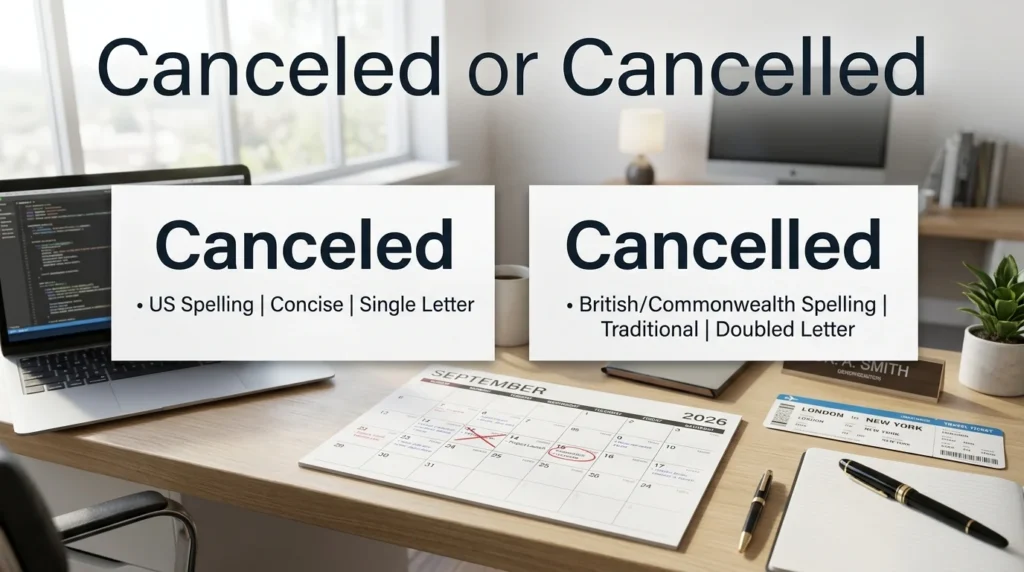
Canceled and cancelled are both correct spellings of the past tense of cancel. Canceled is more common in American English, while cancelled is more common in British English.
If you have ever typed canceled and wondered whether it needs another l, you are not alone. The same confusion happens with cancelled, especially when different forms of English use different spelling patterns.
The good news is that both spellings are correct. They have the same meaning and come from the same verb, cancel. The difference is mainly based on spelling conventions.
You can use either form when talking about a canceled or cancelled flight, meeting, appointment, event, order, trip, or plan. What matters most is choosing the spelling that fits the style of English you are using.
Once you understand why one version has one l and the other has two, the choice becomes much easier.
What Does Canceled Mean?
Canceled is the past tense and past participle of cancel.
It means that something planned, arranged, or scheduled was stopped before it happened.
For example:
- The meeting was canceled.
- She canceled her appointment.
- The airline canceled the flight.
- We canceled our trip.
- He canceled his order.
The spelling canceled uses one l before the ending.
It is especially common in American English.
What Does Cancelled Mean?
Cancelled has the same meaning as canceled.
The difference is simply the spelling.
It is the form commonly used in British English.
Examples:
- The meeting was cancelled.
- She cancelled her appointment.
- The airline cancelled the flight.
- We cancelled our trip.
- He cancelled his order.
So, if you see cancelled, do not assume it is a spelling mistake. It is a standard form of the word.
Canceled or Cancelled: What Is the Difference?
The main difference is regional spelling.
| Spelling | Common Use | Example |
|---|---|---|
| Canceled | American English | The flight was canceled. |
| Cancelled | British English | The flight was cancelled. |
Both forms mean that something was stopped or called off.
For example, these sentences have the same meaning:
The concert was canceled.
The concert was cancelled.
The spelling changes, but the action does not.
Is Canceled or Cancelled Correct?
Both are correct.
This is the most important rule to remember.
You do not need to decide that one spelling is right and the other is wrong. Instead, think about the spelling system you are following.
If you use American English, canceled is generally the better choice.
If you use British English, cancelled is generally the better choice.
The same idea applies to related forms such as canceling and cancelling.
When Should You Use Canceled?
Use canceled when following American spelling conventions.
Here are some natural examples:
- The school canceled the event.
- I canceled my reservation.
- She canceled the appointment.
- They canceled the game.
- We canceled our plans.
- The company canceled the order.
- The airline canceled our flight.
The one l form is common in everyday writing, business communication, notices, emails, and online content.
When Should You Use Cancelled?
Use cancelled when following British spelling conventions.
For example:
- The school cancelled the event.
- I cancelled my reservation.
- She cancelled the appointment.
- They cancelled the game.
- We cancelled our plans.
- The company cancelled the order.
- The airline cancelled our flight.
The meaning remains exactly the same.
Only the spelling is different.
Canceled or Cancelled for Flights
Flights are often canceled or cancelled because of weather, technical problems, scheduling changes, or other issues.
For example:
My flight was canceled this morning.
Or:
My flight was cancelled this morning.
You can also say:
The airline canceled several flights.
Or:
The airline cancelled several flights.
Both versions are grammatically correct.
The choice depends on the spelling style of the writer.
Canceled or Cancelled for Appointments
The word is also common when discussing appointments.
Examples include:
- I canceled my appointment.
- She canceled her interview.
- He canceled his dentist appointment.
- The office canceled the meeting.
With the British spelling:
- I cancelled my appointment.
- She cancelled her interview.
- He cancelled his dentist appointment.
- The office cancelled the meeting.
These sentences all describe an appointment or meeting that will no longer happen.
Canceled or Cancelled for Events
You can cancel many different types of events.
For example:
- The concert was canceled.
- The festival was canceled.
- The game was canceled.
- The party was canceled.
- The conference was canceled.
The British versions use cancelled:
- The concert was cancelled.
- The festival was cancelled.
- The game was cancelled.
- The party was cancelled.
- The conference was cancelled.
The meaning does not change.
Canceled or Cancelled for Orders
Businesses and customers often use cancel when talking about purchases.
Examples:
- I canceled my order.
- The customer canceled the purchase.
- She canceled the order before it shipped.
- The company canceled the order.
British spelling:
- I cancelled my order.
- The customer cancelled the purchase.
- She cancelled the order before it shipped.
- The company cancelled the order.
Both forms are correct.
Canceled or Cancelled for Plans
People often cancel plans when their schedule changes.
For example:
- I canceled my plans for tonight.
- She canceled dinner with her friends.
- We canceled our weekend trip.
- They canceled the party.
- He canceled his visit.
You can write the same sentences with cancelled if you are using British spelling.
This is one reason the word appears so often in everyday English.
Canceling or Cancelling
The spelling difference does not stop with canceled and cancelled.
The present participle also has two common forms:
canceling
and
cancelling
For example:
She is canceling the meeting.
Or:
She is cancelling the meeting.
Both are correct.
The one l form is commonly used with American spelling, while the two l form is commonly used with British spelling.
A simple pattern is:
American style
- canceled
- canceling
British style
- cancelled
- cancelling
What About Cancellation?
The noun form is cancellation.
For example:
- I received a cancellation notice.
- There is a cancellation fee.
- The cancellation was unexpected.
- We received an email about the cancellation.
Notice that cancellation normally contains two l’s.
This can surprise people because they may expect the noun to follow the same one l pattern as canceled.
It is better to remember cancellation as its own common spelling.
Canceled or Cancelled in Business Writing
Both spellings can be used in professional writing.
For example:
Your appointment has been canceled.
Or:
Your appointment has been cancelled.
Neither version is less professional.
The important thing is consistency.
If a business uses one spelling style throughout its communication, it should normally keep that style across its emails, notices, website content, and other written materials.
Changing between canceled and cancelled without a reason can make a document look inconsistent.
Canceled or Cancelled in Everyday Conversation
In speech, you cannot hear the spelling difference.
When someone says canceled or cancelled, the pronunciation is essentially the same.
The difference becomes visible when the word is written.
That means this issue mainly matters in emails, messages, schoolwork, articles, documents, websites, and other forms of written English.
Common Mistakes
One common mistake is believing that cancelled is always incorrect.
That is not true.
Another mistake is assuming that canceled must be wrong because the writer learned British spelling.
It is not wrong.
A third mistake is mixing both spellings in the same piece of writing.
For example:
The meeting was canceled, but the event was cancelled.
If both words are being used under the same spelling system, this can look inconsistent.
A better approach is to choose one style and use it throughout the document.
Canceled vs Cancelled and Other Words
The same regional spelling idea appears in several other English words.
For example, some words can take different forms depending on the variety of English being used.
This does not mean that English has one correct spelling and one incorrect spelling in every case. English developed across different regions, so spelling conventions can vary.
With cancel, the difference is especially easy to see:
canceled
versus
cancelled
Both remain understandable and correct.
How to Remember Canceled and Cancelled
Use a simple visual trick.
Canceled has one l.
Cancelled has two l’s.
Then connect the forms with their common spelling styles:
Canceled = American English
Cancelled = British English
For the present participle:
Canceling = American English
Cancelling = British English
You do not need a complicated grammar rule. Remembering this small pattern is usually enough.
Examples With Canceled
Here are some additional examples:
- The flight was canceled yesterday.
- I canceled the reservation.
- She canceled the meeting.
- We canceled our vacation.
- The company canceled the event.
- He canceled his subscription.
- They canceled the order.
- The school canceled classes.
- The game was canceled because of rain.
- She canceled her appointment.
Examples With Cancelled
Here are the same types of examples with the double l spelling:
- The flight was cancelled yesterday.
- I cancelled the reservation.
- She cancelled the meeting.
- We cancelled our vacation.
- The company cancelled the event.
- He cancelled his subscription.
- They cancelled the order.
- The school cancelled classes.
- The game was cancelled because of rain.
- She cancelled her appointment.
Notice that the meaning stays the same in every example.
Practice: Canceled or Cancelled?
Choose the form that fits the spelling style you are using.
1. The airline ______ our flight.
American: canceled
British: cancelled
2. She ______ her appointment yesterday.
American: canceled
British: cancelled
3. The concert was ______ because of heavy rain.
American: canceled
British: cancelled
4. He is ______ his subscription.
American: canceling
British: cancelling
5. We ______ the meeting at the last minute.
American: canceled
British: cancelled
The important lesson is that both regional forms can be correct.
Canceled or Cancelled: Which One Should You Use?
If you normally follow American spelling, choose canceled.
If you normally follow British spelling, choose cancelled.
For most writing, consistency is more important than trying to find one universal version.
For example, if your document uses American spellings elsewhere, canceled will usually fit naturally.
If your document follows British spelling, cancelled will usually look more natural.
A Simple Comparison
| Word | Meaning | Spelling |
|---|---|---|
| Canceled | Stopped or called off | One l |
| Cancelled | Stopped or called off | Two l’s |
| Canceling | Stopping or calling off | One l |
| Cancelling | Stopping or calling off | Two l’s |
| Cancellation | The act of canceling | Usually two l’s |
The core meaning remains the same.
Final Tips
Keep these points in mind:
- Canceled is correct.
- Cancelled is also correct.
- Both forms have the same meaning.
- Canceled is more common in American English.
- Cancelled is more common in British English.
- Canceling follows the one l pattern.
- Cancelling follows the two l pattern.
- Cancellation is normally spelled with two l’s.
- Do not treat cancelled as automatically incorrect.
- Do not treat canceled as automatically incorrect.
- Keep your spelling consistent within the same document.
FAQs
Is canceled or cancelled correct?
Both are correct. Canceled is more common in American English, while cancelled is more common in British English.
Is canceled the American spelling?
Yes. Canceled is the spelling commonly used in American English.
Is cancelled the British spelling?
Yes. Cancelled is the spelling commonly used in British English.
Is it canceling or cancelling?
Both forms are correct. Canceling is commonly used with American spelling, while cancelling is commonly used with British spelling.
Is cancellation spelled with one l or two l’s?
The usual spelling is cancellation, with two l’s.
Conclusion
Canceled and cancelled are both correct. They have the same meaning and are simply different regional spellings of the past tense and past participle of cancel.
Use canceled when following American spelling conventions and cancelled when following British spelling conventions. The same difference appears in canceling and cancelling.
The easiest way to remember the difference is simple: canceled has one l, while cancelled has two l’s. Once you know which spelling style you are using, choosing the right form becomes easy.