
Quick Answer:
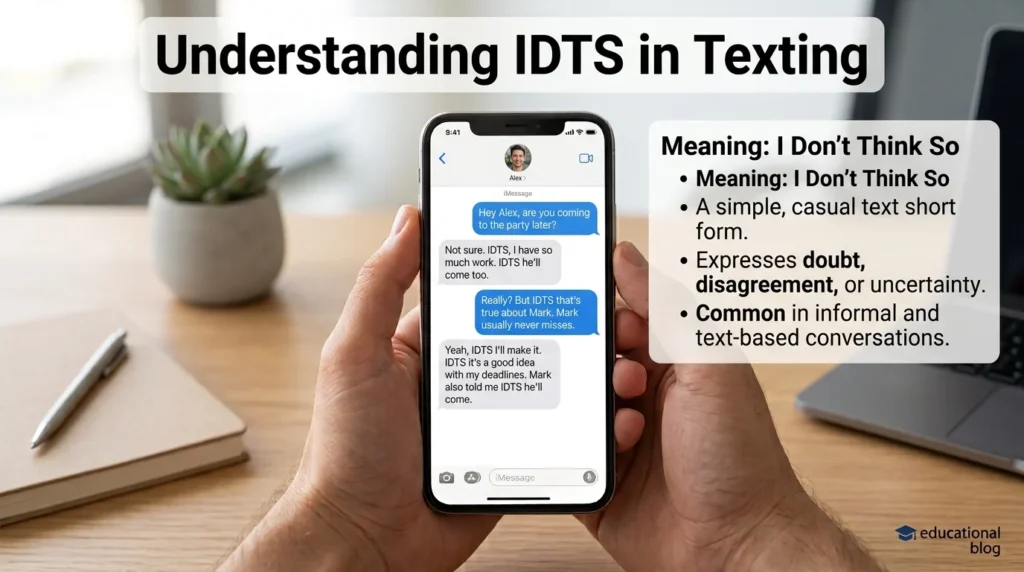
In texting, IDTS usually means “I Don’t Think So.” People use it to disagree, express doubt, or give a negative answer in a casual and less direct way.
If someone sends you IDTS in a text message, they are usually saying “I don’t think so.” It is a common informal abbreviation used when someone disagrees with an idea, doubts something will happen, or wants to give a negative response. For example, “IDTS he will come” means “I don’t think he will come.” The abbreviation is mainly used in casual conversations, social media messages, and texting. Understanding the context helps you recognize whether the sender is simply unsure or clearly disagreeing.
Key Facts About IDTS
| Term | Meaning | Common Use |
|---|---|---|
| IDTS | I Don’t Think So | Casual texting |
| Tone | Informal | Friends and online chats |
| Main purpose | Doubt or disagreement | Everyday conversations |
| Full phrase | I Don’t Think So | Negative or uncertain response |
What Does IDTS Mean in Text?
IDTS stands for “I Don’t Think So.” It is normally used when someone does not agree with a statement or does not believe something is true.
For example:
- “Do you think Jake will come? IDTS.”
- “IDTS that’s going to work.”
- “Will they finish today? IDTS.”
The abbreviation keeps the response short while still showing doubt or disagreement.
What Does IDTS Mean in a Conversation?
IDTS can have slightly different shades of meaning depending on the conversation. It may mean “probably not,” “I doubt it,” or simply “I don’t agree.”
For example:
“Do you think she’ll call tonight?”
“IDTS.”
Here, the sender believes the person probably will not call.
Another example:
“This movie is going to be amazing.”
“IDTS.”
In this case, IDTS shows disagreement with the opinion.
IDTS Tone and Meaning
IDTS usually sounds casual and relatively soft. It can be less direct than simply saying “No” or “That’s wrong.”
Compare:
“No, he won’t.”
This sounds direct.
“IDTS.”
This sounds more conversational and uncertain.
However, tone depends on the surrounding conversation. A very short “IDTS” can sometimes sound dismissive if there is no additional explanation.
IDTS vs IDK
These two abbreviations are easy to confuse, but they have different meanings.
| Abbreviation | Meaning | What It Shows |
|---|---|---|
| IDTS | I Don’t Think So | Doubt or disagreement |
| IDK | I Don’t Know | Lack of knowledge |
For example:
“Will Sarah come?”
“IDTS.” means the person thinks she probably will not.
“Will Sarah come?”
“IDK.” means the person does not know.
IDTS vs IMO
IMO means “In My Opinion.” It introduces a personal view, while IDTS normally responds negatively or expresses doubt.
For example:
- “IMO, this is the best option.”
- “IDTS, I think the other option is better.”
Both are informal, but they serve different purposes.
How to Use IDTS Naturally
IDTS works best in casual texts, DMs, group chats, and social media conversations.
Examples include:
“IDTS we have enough time.”
Meaning: I don’t think we have enough time.
“IDTS he knows about it.”
Meaning: I don’t think he knows about it.
“Are they coming tonight?”
“IDTS.”
These examples show how IDTS can express doubt without requiring a long response.
Is IDTS Formal?
IDTS is an informal texting abbreviation. It is appropriate for casual conversations but usually does not belong in academic writing, formal emails, business documents, or official communication.
In formal writing, write “I don’t think so” instead.
How to Reply to IDTS
Your response depends on the topic. You could ask for clarification, provide more information, or simply accept the person’s opinion.
For example:
“IDTS he’ll agree.”
You could reply, “Why not?”
Or:
“IDTS we’re ready.”
You could say, “We still have an hour to prepare.”
Common Examples of IDTS
- “IDTS that’s true.” — I don’t think that’s true.
- “IDTS she knows.” — I don’t think she knows.
- “IDTS we can finish today.” — I don’t think we can finish today.
- “Will it rain later?” “IDTS.” — I don’t think so.
- “IDTS that’s a good idea.” — I don’t think that’s a good idea.
FAQs
What does IDTS mean in texting?
IDTS usually means “I Don’t Think So.” It expresses doubt, disagreement, or a negative expectation.
What does IDTS mean from a girl or guy?
The meaning is generally the same regardless of who sends it. The context determines the intended tone.
Is IDTS rude?
Not usually. It is a casual way to express doubt or disagreement. However, a very short response can sometimes sound dismissive depending on the conversation.
What is the difference between IDTS and IDK?
IDTS means “I don’t think so,” while IDK means “I don’t know.” IDTS expresses doubt, whereas IDK shows that the person lacks information.
Can I use IDTS in formal writing?
It is better to avoid IDTS in formal writing. Use the complete phrase “I don’t think so” instead.
Conclusion
IDTS means “I Don’t Think So” in casual texting. People use it to express doubt, disagreement, or the belief that something probably will not happen.
The abbreviation is short, natural, and common in informal conversations. If you see IDTS in a message, read the surrounding words to understand exactly what the sender is doubting or disagreeing with.
See Also More :
- WYLL Meaning in Text: The Correct Meaning, Usage and Examples Explained
- MYF Meaning in Text: The Correct Meaning, Usage and Examples Explained
- YW Meaning in Text: The Correct Meaning, Usage and Examples Explained