
Many English learners become confused when comparing feel or fell because the words look almost identical. The only difference is one letter, yet their meanings are completely different. This small spelling difference can create major misunderstandings in writing and conversation.
The confusion often happens because both words are common in everyday English. People frequently talk about how they feel, and they also use fell when describing something that dropped or collapsed in the past. Since both words appear regularly in books, websites, schools, workplaces, and conversations, it is important to know when each one should be used.
Understanding feel or fell improves grammar, writing accuracy, reading comprehension, and communication skills. Whether you are a student, blogger, teacher, business professional, or English learner, knowing the difference helps you avoid mistakes and communicate more clearly.
This guide explains feel or fell in simple language. You will learn definitions, grammar rules, real world examples, common mistakes, comparison tables, exercises with answers, and frequently asked questions.
Quick Overview
Feel relates to emotions, sensations, opinions, or touching.
Fell is usually the past tense of fall.
Feel is commonly used in present tense situations.
Fell is commonly used when describing something that happened in the past.
Both words are correct but have different meanings.
Definition of Feel
Feel is a verb that refers to experiencing emotions, sensations, or physical contact.
Examples include:
- I feel happy today.
- She feels cold.
- They feel excited about the trip.
- Touch the fabric and feel its softness.
The word feel is used when discussing emotions, physical sensations, opinions, or perceptions.
Feel as an Emotion
Examples:
- I feel nervous before exams.
- He feels confident about the interview.
- We feel grateful for the opportunity.
Feel as Physical Sensation
Examples:
- I feel pain in my shoulder.
- She feels tired after work.
- They feel warm in the sunlight.
Definition of Fell
Fell is most commonly known as the past tense of fall.
Examples:
- The leaves fell from the tree.
- He fell off his bicycle.
- The book fell from the shelf.
- Rain fell throughout the night.
Fell describes something that already happened.
Fell as the Past Tense of Fall
Examples:
- The child fell while running.
- The glass fell and broke.
- Snow fell heavily last winter.
Fell as a Verb Meaning Cut Down
In some situations, fell means to cut down a tree.
Examples:
- Workers felled several trees.
- The storm felled large branches.
This meaning is less common but still correct.
Key Difference Between Feel or Fell
The biggest difference is meaning and grammar.
Feel refers to emotions, sensations, and perceptions.
Fell refers to something that dropped in the past or something that was cut down.
Quick Comparison Table
| Feature | Feel | Fell |
|---|---|---|
| Meaning | Sense or emotion | Past tense of fall |
| Grammar Type | Present tense verb | Past tense verb |
| Time Reference | Present or ongoing | Past |
| Common Usage | Emotions and sensations | Something dropped |
| Example | I feel happy | He fell down |
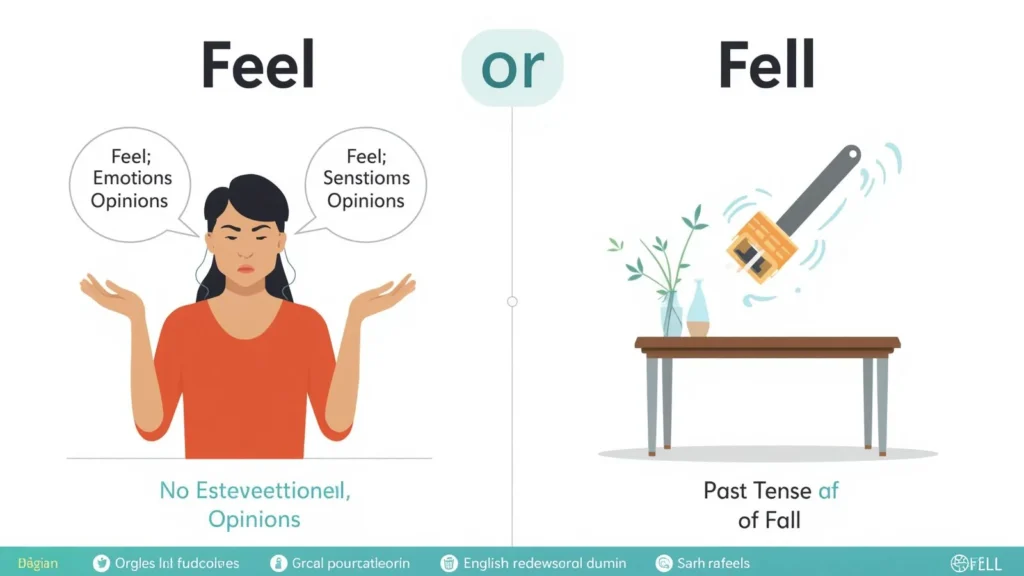
Visual Comparison of Feel or Fell


4
The comparison shows that feel relates to emotions and sensations, while fell refers to an action that happened in the past.
Understanding Feel in Everyday English
The word feel appears in everyday conversations more than most verbs.
People use it to discuss:
- Emotions
- Opinions
- Physical sensations
- Personal experiences
Examples:
- I feel great today.
- We feel optimistic about the future.
- She feels comfortable in her new home.
Because emotions are a major part of communication, feel is extremely common.
Understanding Fell in Everyday English
Fell is also common because things frequently fall.
Examples:
- The phone fell onto the floor.
- A tree fell during the storm.
- The temperature fell overnight.
- Prices fell last month.
Unlike feel, fell always points to a completed action in the past.
Grammar Rules for Feel
Feel has several forms.
Present Tense
- I feel
- You feel
- We feel
- They feel
Third Person Singular
- He feels
- She feels
- It feels
Continuous Form
- Feeling
Examples:
- I am feeling better.
- She is feeling confident.
Past Form
- Felt
Example:
- I felt happy yesterday.
Grammar Rules for Fell
Fell is already a past tense form.
Base Verb:
- Fall
Past Tense:
- Fell
Past Participle:
- Fallen
Examples:
- The leaves fell yesterday.
- The leaves have fallen.
Many learners confuse fell and fallen.
Remember:
- Fell is simple past tense.
- Fallen is the past participle.
Common Situations Where Feel Is Used
Talking About Emotions
- I feel excited.
- She feels worried.
Giving Opinions
- I feel this is a good idea.
- They feel the project will succeed.
Describing Physical Conditions
- I feel sick.
- He feels tired.
Describing Touch
- Feel the texture of this fabric.
- Feel the smooth surface.
Common Situations Where Fell Is Used
Accidents
- He fell from the ladder.
- She fell while skating.
Nature
- Leaves fell from the trees.
- Snow fell all night.
Business and Economics
- Sales fell last quarter.
- Prices fell significantly.
Sports
- The team fell behind early.
- Rankings fell after several losses.
Second Visual Comparison Section


4
These examples demonstrate how feel is connected to emotions and sensations, while fell is connected to past actions involving falling.
Why People Confuse Feel or Fell
Several reasons cause confusion.
Similar Spelling
Only one letter differs.
Similar Pronunciation
The words sound similar in fast speech.
Typing Mistakes
Writers often accidentally replace one with the other.
English Learning Challenges
Many learners struggle with irregular verbs.
Real World Examples
Example One
Correct:
- I feel confident about the presentation.
Incorrect:
- I fell confident about the presentation.
Example Two
Correct:
- He fell off the bicycle yesterday.
Incorrect:
- He feel off the bicycle yesterday.
Example Three
Correct:
- We feel excited about the vacation.
Incorrect:
- We fell excited about the vacation.
Example Four
Correct:
- The tree fell during the storm.
Incorrect:
- The tree feel during the storm.
Advantages of Understanding the Difference
Knowing the difference offers many benefits.
Better Writing
Sentences become more accurate.
Better Communication
Readers understand your meaning.
Improved Grammar
You avoid common mistakes.
Professional Credibility
Correct grammar creates a stronger impression.
Disadvantages of Mixing Up Feel and Fell
Using the wrong word can create confusion.
Misunderstood Messages
Readers may not understand your meaning.
Academic Mistakes
Students can lose marks.
Professional Errors
Business communication may appear careless.
Reduced Credibility
Grammar mistakes can affect trust.
Common Mistakes When Using Feel or Fell
Mistake One
Using fell for emotions.
Incorrect:
- I fell happy.
Correct:
- I feel happy.
Mistake Two
Using feel for past accidents.
Incorrect:
- He feel from the chair.
Correct:
- He fell from the chair.
Mistake Three
Confusing fell and felt.
Incorrect:
- I fell tired yesterday.
Correct:
- I felt tired yesterday.
Mistake Four
Confusing fell and fallen.
Incorrect:
- The leaves have fell.
Correct:
- The leaves have fallen.
Related Grammar Comparisons
Understanding feel or fell becomes easier when compared with similar words.
Feel vs Felt
Feel is present tense.
Felt is past tense.
Fall vs Fell
Fall is present tense.
Fell is past tense.
Fell vs Fallen
Fell is simple past tense.
Fallen is past participle.
Third Visual Comparison Section

Learning related verb forms helps improve grammar accuracy and confidence.
Beginner to Advanced Understanding
Beginner Level
Feel means experiencing emotions.
Fell means something dropped in the past.
Intermediate Level
Feel is present tense.
Fell is the past tense of fall.
Advanced Level
Feel has multiple grammatical functions involving emotions, sensations, opinions, and touch. Fell functions primarily as an irregular past tense verb and occasionally means cutting down trees.
Regional and Global Usage
Feel and fell are used throughout the English speaking world.
This includes:
- United States
- United Kingdom
- Canada
- Australia
- New Zealand
Their meanings remain the same across all major English dialects.
Practical Usage in Professional Writing
Professional writers frequently use feel and fell.
Examples:
- Customers feel satisfied with the service.
- Revenue fell during the economic downturn.
- Employees feel motivated.
- Demand fell unexpectedly.
Using the correct word improves clarity and professionalism.
Exercises With Answers
Question One
Which word refers to emotions?
Answer: Feel
Question Two
Which word is the past tense of fall?
Answer: Fell
Question Three
Complete the sentence.
I _____ excited about the event.
Answer: Feel
Question Four
Complete the sentence.
The book _____ from the table.
Answer: Fell
Question Five
Which sentence is correct?
I feel happy today.
Answer: Correct
Question Six
Which sentence is correct?
He fell off the ladder.
Answer: Correct
Question Seven
Can feel describe physical sensations?
Answer: Yes
Question Eight
Can fell describe a past event?
Answer: Yes
FAQs
Is feel or fell correct?
Both are correct, but they have different meanings.
What does feel mean?
Feel refers to emotions, sensations, opinions, or touching something.
What does fell mean?
Fell is usually the past tense of fall.
Can fell mean cutting down a tree?
Yes, that is another correct meaning.
Why do people confuse feel and fell?
Because the words look and sound similar.
What is the past tense of feel?
The past tense of feel is felt.
What is the past tense of fall?
The past tense of fall is fell.
Is I fell happy correct?
No. The correct sentence is I feel happy.
Is he feel down correct?
No. The correct sentence is he fell down.
How can I remember the difference?
Feel relates to emotions. Fell relates to falling in the past.
Conclusion
Understanding feel or fell is essential for clear and accurate English communication. Although the words differ by only one letter, their meanings are completely different. Feel relates to emotions, sensations, opinions, and physical touch, while fell usually serves as the past tense of fall or refers to cutting down a tree.
Many learners confuse these words because they look and sound similar. However, remembering their primary functions makes the distinction much easier. If you are discussing emotions or sensations, use feel. If you are describing something that dropped in the past, use fell.
Using the correct word improves grammar, strengthens writing, and enhances professional communication. Whether you are writing an essay, preparing business documents, publishing online content, or learning English, mastering the difference between feel and fell will help you communicate more effectively and confidently.