

Quick Answer
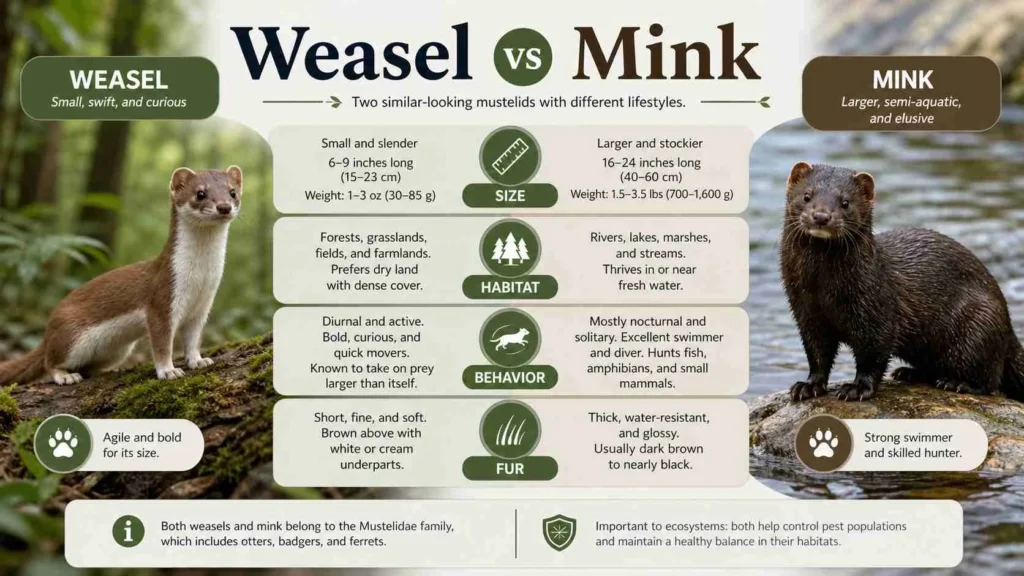
Weasel and mink are small carnivorous mammals from the same family, but they differ in size, habitat, and behavior. A weasel is usually smaller, slender, and more active on land, while a mink is larger, semi aquatic, and has thicker fur suited for water environments.
Many people confuse weasel vs mink because both animals look very similar. They have long bodies, short legs, and belong to the same animal family. At first glance, it can be hard to tell them apart.
However, these animals are quite different when you look closely. Weasels are smaller and more active hunters on land. Minks are larger and better swimmers. They live near water and have thick fur that keeps them warm in cold environments.
Understanding weasel vs mink is important for wildlife learning, animal identification, and general knowledge. It also helps students, nature lovers, and researchers understand animal behavior and habitat differences.
In this guide, you will learn everything about weasel vs mink in simple language. We will cover size, habitat, diet, behavior, real life examples, common mistakes, and much more.
Quick Overview
Weasel is smaller and lives mostly on land
Mink is larger and lives near water
Weasel has a thin body
Mink has thicker fur and body
Both are carnivores and skilled hunters
Key Difference Between Weasel vs Mink


The main difference is size and habitat.
Weasels are smaller and fast land hunters
Minks are larger and strong swimmers
Comparison Table
| Feature | Weasel | Mink |
|---|---|---|
| Size | Small | Medium |
| Body | Slim | Thicker |
| Habitat | Land | Near water |
| Fur | Thin | Dense |
| Behavior | Fast and active | Strong swimmer |
| Diet | Small animals | Fish and animals |
What Is a Weasel
A weasel is a small carnivorous mammal with a long, thin body. It is very fast and active. Weasels live in fields, forests, and farms.
They hunt small animals like mice, birds, and insects. Their slim body helps them enter small spaces and catch prey easily.
Weasels are known for their speed and hunting skills.
What Is a Mink
A mink is a medium sized mammal that belongs to the same family as the weasel. However, it is larger and has thicker fur.
Minks live near rivers, lakes, and wetlands. They are excellent swimmers and hunt fish, frogs, and small animals.
Their fur is very dense, which helps them survive in cold water.
Physical Differences Explained
Weasels are smaller and lighter. Their body is thin and long.
Minks are heavier and have a stronger build. Their fur is thicker and darker.
Weasels often have lighter fur in winter.
Minks usually have dark brown fur all year.
Habitat Differences


Weasels live mostly on land. They prefer forests, grasslands, and farms.
Minks live near water. They stay close to rivers, lakes, and wetlands.
Because of this, minks are better swimmers than weasels.
Diet and Hunting Behavior
Weasels hunt small animals like mice, birds, and insects. They move quickly and attack fast.
Minks eat fish, frogs, and small mammals. They can hunt both in water and on land.
Weasels depend on speed
Minks depend on strength and swimming ability
Behavioral Differences
Weasels are very active and energetic. They move quickly and rarely stay still.
Minks are more calm but strong. They spend time in water and are excellent swimmers.
Weasels are mostly land hunters
Minks are semi aquatic hunters
Fur and Appearance


Weasel fur is thinner and may change color in winter.
Mink fur is thick, soft, and water resistant. This makes it valuable and suitable for cold climates.
Real World Examples
1 Example One Farm Area
A farmer sees a small fast animal hunting mice. It is likely a weasel.
2 Example Two River Area
A person sees an animal swimming and catching fish. It is likely a mink.
3 Example Three Wildlife Observation
In forests, weasels move quickly on land. Near water, minks swim and hunt.
Advantages and Disadvantages
Weasel Advantages
Very fast
Excellent hunter
Can enter small spaces
Weasel Disadvantages
Smaller size
Less strength
Mink Advantages
Strong swimmer
Thick fur for cold weather
Can hunt in water and land
Mink Disadvantages
Needs water habitat
Slower than weasel on land
Common Mistakes
1 Mistake One Thinking They Are the Same
Correction They are different animals with different habitats
2 Mistake Two Confusing Size
Correction Minks are larger than weasels
3 Mistake Three Ignoring Habitat
Correction Weasels live on land, minks live near water
Related Comparisons
Weasel vs Ferret
Ferrets are domesticated, while weasels are wild
Mink vs Otter
Otters are larger and fully aquatic
Weasel Family Animals
Both belong to the same animal family
Beginner to Advanced Understanding
Beginner Level
Weasel is small
Mink is bigger
Intermediate Level
Weasel hunts on land
Mink hunts in water and land
Advanced Level
Habitat, body structure, and fur adaptation define their survival strategies
Regional and Global Usage
Weasels are found in many parts of the world including forests and farms.
Minks are common near water bodies in North America and Europe.
Both animals adapt well to different climates.
Exercises With Answers
One Question
Which animal is smaller
Answer Weasel
Two Question
Which animal swims better
Answer Mink
Three Question
Where does mink live
Answer Near water
Four Question
Which animal hunts mice
Answer Weasel
Five Question
Which has thicker fur
Answer Mink
FAQs
Are weasel and mink the same animal?
No, they are different but belong to the same family.
Which is bigger weasel or mink?
Mink is bigger than weasel.
Do both animals swim?
Mink is a strong swimmer, while weasel rarely swims.
Where do weasels live?
They live in forests, farms, and grasslands.
Where do minks live?
They live near rivers, lakes, and wetlands.
Which has better fur?
Mink has thicker and denser fur.
Are both carnivores?
Yes, both eat meat.
Which is faster?
Weasel is faster on land.
Conclusion
Understanding weasel vs mink helps you identify two similar but different animals. Weasels are small, fast, and land based hunters. Minks are larger, stronger, and live near water.
Both animals are skilled hunters and belong to the same family. However, their size, habitat, and behavior make them unique.
Knowing these differences improves wildlife knowledge and helps in accurate identification.