

Quick Answer
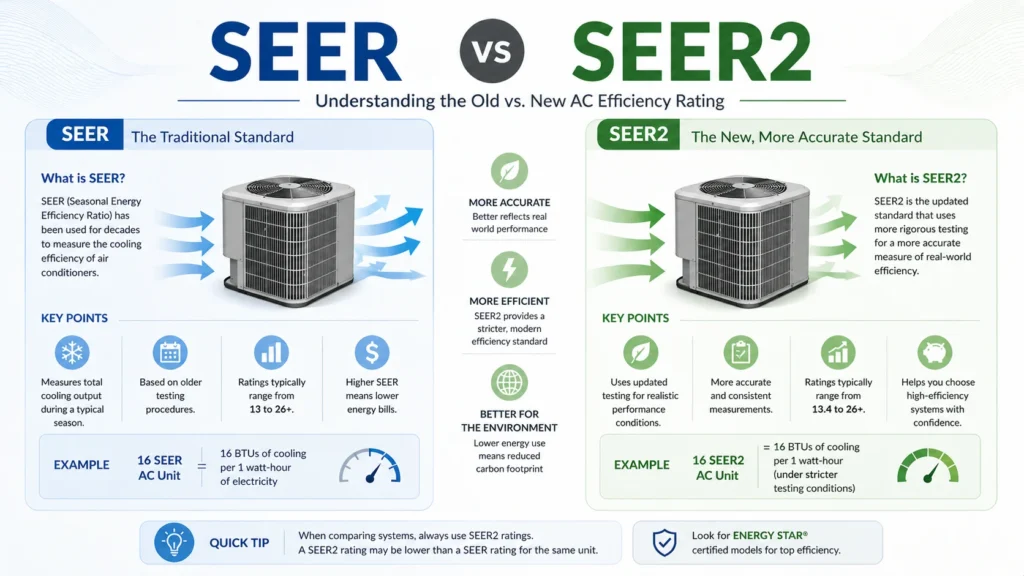
SEER and SEER2 measure how efficient an air conditioner or heat pump is. SEER is the older rating system, while SEER2 is the newer and more accurate standard introduced with updated testing conditions. A higher SEER or SEER2 number means better energy efficiency and lower electricity use.
Many people feel confused when they see SEER and SEER2 ratings on air conditioners. The numbers look similar, but they are not exactly the same. This confusion often leads to wrong buying decisions.
SEER stands for Seasonal Energy Efficiency Ratio. It has been used for many years to measure how efficiently an air conditioner cools your home. However, technology and testing methods improved over time. Because of this, SEER2 was introduced as a new standard.
SEER2 uses updated testing conditions that better reflect real life situations. Therefore, it gives a more accurate picture of how a system performs in your home.
Understanding SEER vs SEER2 helps homeowners choose the right HVAC system, save energy, and reduce electricity bills. This guide explains everything in simple language, from basics to advanced concepts.
Quick Overview
SEER is the old efficiency rating system
SEER2 is the updated and more accurate system
Both measure cooling efficiency
Higher numbers mean better performance
SEER2 reflects real world conditions better
Key Difference Between SEER vs SEER2


The main difference is how efficiency is tested.
SEER uses older lab conditions
SEER2 uses updated testing that simulates real airflow and pressure
Because of this, SEER2 ratings are usually slightly lower but more realistic.
What Is SEER
SEER stands for Seasonal Energy Efficiency Ratio. It measures how much cooling output an air conditioner provides compared to the energy it consumes over a season.
A higher SEER number means better efficiency.
For example
A unit with SEER 16 is more efficient than a unit with SEER 13
SEER has been used for decades and is still widely recognized.
What Is SEER2
SEER2 is the updated version of SEER. It uses new testing methods introduced in recent energy regulations.
The key difference is that SEER2 includes real world factors such as:
- External static pressure
- Airflow resistance
- Modern system design
Because of this, SEER2 gives a more accurate efficiency rating.
SEER vs SEER2 Rating Comparison Table
| Feature | SEER | SEER2 |
|---|---|---|
| Standard type | Old | New |
| Testing method | Lab conditions | Real world conditions |
| Accuracy | Moderate | High |
| Numbers | Slightly higher | Slightly lower |
| Usage | Older systems | New systems |
How Testing Conditions Differ


Testing conditions are the biggest difference.
SEER testing uses ideal conditions with minimal airflow resistance.
SEER2 testing adds real world pressure and airflow restrictions.
As a result, SEER2 reflects actual performance inside homes.
Why SEER2 Was Introduced
Energy standards change over time. Older SEER ratings did not fully represent real usage.
Therefore, regulators introduced SEER2 to:
- Improve accuracy
- Reflect modern HVAC systems
- Help consumers make better decisions
SEER2 aligns with updated energy efficiency rules.
Energy Efficiency and Savings
Higher SEER or SEER2 ratings mean lower electricity consumption.
For example
Upgrading from SEER 10 to SEER2 15 can significantly reduce energy bills.
Benefits include:
- Lower monthly costs
- Reduced energy waste
- Better environmental impact
Cost Differences
High efficiency systems cost more upfront.
Lower SEER Systems
- Lower price
- Higher electricity bills
Higher SEER2 Systems
- Higher initial cost
- Lower long term energy cost
Therefore, long term savings often justify higher efficiency units.
Real World Examples
1 Example One Home Upgrade
A homeowner replaces an old SEER 10 unit with SEER2 14. The energy bill drops significantly.
2 Example Two New Construction
Builders install SEER2 systems to meet new regulations.
3 Example Three Climate Impact
In hot regions, higher SEER2 systems provide better savings.
Advantages and Disadvantages
Advantages of SEER
- Simple and widely known
- Easy to compare older units
Disadvantages
- Less accurate
- Outdated testing
Advantages of SEER2
- More accurate
- Reflects real performance
- Supports energy savings
Disadvantages
- Slightly confusing for beginners
- Numbers appear lower
Common Mistakes
1 Mistake One Thinking SEER and SEER2 Are Equal
Correction SEER2 uses stricter testing
2 Mistake Two Assuming Lower SEER2 Means Worse
Correction It is more accurate, not worse
3 Mistake Three Ignoring Long Term Savings
Correction Higher efficiency saves money over time
Related Comparisons
SEER vs EER
EER measures efficiency at a fixed temperature
SEER vs HSPF
HSPF measures heating efficiency
HVAC Efficiency Ratings
All ratings help compare system performance
Beginner to Advanced Understanding
Beginner Level
SEER measures efficiency
SEER2 is a better version
Intermediate Level
SEER2 includes real airflow conditions
Advanced Level
Energy regulations and system design influence rating standards
Regional and Global Usage
SEER2 is now required in many regions, especially in newer HVAC regulations.
Different regions have minimum efficiency standards. Hot climates often require higher SEER2 ratings.
Installation and System Design Impact
Efficiency depends not only on rating but also installation.
Poor installation reduces efficiency even in high SEER2 systems.
Important factors include:
- Proper duct design
- Correct airflow
- Professional installation
Exercises With Answers
One Question
What does SEER measure
Answer Cooling efficiency
Two Question
Which is newer SEER or SEER2
Answer SEER2
Three Question
Which is more accurate
Answer SEER2
Four Question
Do higher ratings save energy
Answer Yes
Five Question
Does installation affect efficiency
Answer Yes
FAQs
What is the difference between SEER vs SEER2?
SEER is the older rating, while SEER2 uses updated testing for better accuracy.
Is SEER2 better than SEER?
Yes, SEER2 provides more realistic efficiency results.
Why are SEER2 numbers lower?
Because testing conditions are stricter and more realistic.
Should I buy a SEER2 system?
Yes, especially for long term savings and compliance with new standards.
Do SEER and SEER2 measure the same thing?
Yes, both measure cooling efficiency but in different ways.
Is higher SEER2 always better?
Yes, higher ratings mean better efficiency.
Does SEER2 reduce electricity bills?
Yes, it improves energy efficiency.
Can old systems be converted to SEER2?
No, SEER2 applies to new systems only.
Conclusion
Understanding SEER vs SEER2 is essential for making smart HVAC decisions. SEER is the traditional efficiency rating, while SEER2 is the updated version that reflects real world conditions.
Although SEER2 ratings may look lower, they are more accurate and reliable. Choosing a higher SEER2 system can reduce energy costs, improve comfort, and meet modern efficiency standards.
When selecting an air conditioning system, consider long term savings, proper installation, and climate needs. This ensures the best performance and value.