
Quick Answer
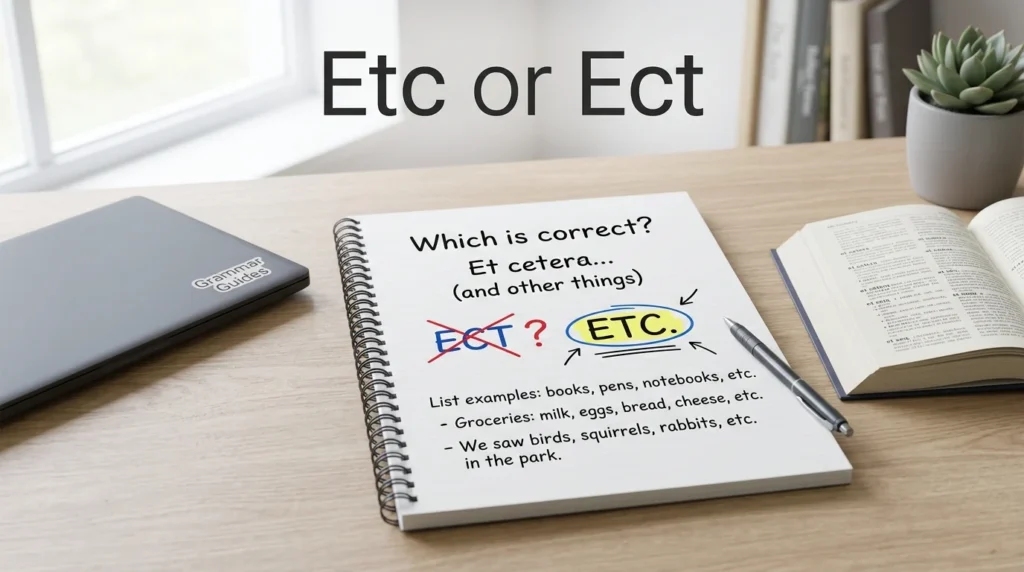
Etc. is the correct spelling and abbreviation of et cetera, meaning “and other similar things.” Ect is an incorrect spelling that usually happens when people write the letters in the wrong order.
Have you ever typed ect when you meant etc.? This is a very common mistake because the three letters are easy to mix up, especially when writing quickly.
The correct form is etc., with the letters e, t, c in that order. It comes from the Latin phrase et cetera, which means “and the rest” or “and other similar things.” Writers use it when they have already listed several examples and do not want to name every item.
For example, you might write, “Bring pens, pencils, notebooks, etc.” The word etc. tells the reader that other similar supplies are included too.
What Does Etc. Mean?
Etc. is an abbreviation of et cetera.
It is used after a list when you want to show that the list continues with other similar items.
For example:
I bought apples, oranges, bananas, etc.
This means the person bought apples, oranges, bananas, and other similar things.
Another example is:
The store sells shirts, jackets, shoes, etc.
The writer does not need to name every product. The abbreviation lets the reader know that other related products are also included.
What Does Ect Mean?
Ect is not the correct spelling of etc.
People usually write ect because they remember the sound or accidentally put the letters in the wrong order.
For example:
I bought books, pens, notebooks, ect.
This should be:
I bought books, pens, notebooks, etc.
The letters in the correct abbreviation are:
E T C
Not:
E C T
A simple way to remember it is to think of the beginning of et cetera:
ET + C
That gives you etc.
Etc or Ect: Which Is Correct?
The correct form is:
etc.
The incorrect form is:
ect
So if you are choosing between etc and ect, choose etc.
Examples:
We need paper, folders, pens, etc.
Correct.
We need paper, folders, pens, ect.
Incorrect.
The period after etc. is also commonly used because it is an abbreviation.
What Does Et Cetera Mean?
Et cetera is a Latin expression that means and other things of the same kind.
You do not usually need to write the complete phrase in everyday writing. The shortened form etc. is much more common.
For example:
We packed clothes, shoes, towels, etc.
The complete idea is:
We packed clothes, shoes, towels, and other similar things.
The phrase does not mean “anything at all.” It normally suggests that the omitted items belong to the same general group as the items already mentioned.
How to Remember Etc.
A simple memory trick can help.
Think:
ETC = Et Cetera
The first three letters of the phrase give you the correct order.
ET comes first.
C comes next.
So:
ET + C = ETC
This makes it easier to avoid writing ect.
Another useful trick is to say the phrase slowly in your head:
et cetera
The first part begins with et, which helps you remember that the t comes before the c.
Examples of Etc. in Sentences
Here are some natural examples:
- We bought milk, eggs, bread, etc.
- She likes hiking, camping, swimming, etc.
- The box contained books, papers, folders, etc.
- You can use a phone, tablet, laptop, etc.
- The restaurant serves burgers, sandwiches, salads, etc.
- He studies math, science, history, etc.
- Bring your ID, tickets, passport, etc.
- The store sells furniture, lamps, rugs, etc.
In each sentence, etc. indicates that the list contains other related items that the writer has not named.
Etc. in Everyday Writing
You can use etc. when a list is clear from context.
For example:
I need to buy groceries such as milk, bread, cheese, etc.
The reader understands that other grocery items may also be needed.
Another example:
We talked about school, homework, exams, etc.
The abbreviation keeps the sentence short instead of forcing the writer to list every possible topic.
Etc. in Formal Writing
Etc. is a standard abbreviation, but it should still be used carefully in formal writing.
If the exact items matter, it is often better to list them clearly.
For example, instead of:
Submit your passport, identification, forms, etc.
you may need to name every required document if the reader needs complete instructions.
However, etc. can be useful when the omitted items are obvious and the full list is not important.
The main question is simple:
Does the reader need to know every item?
If yes, give the full list.
If no, etc. may be enough.
When Should You Use Etc.?
Use etc. when:
- You have already given several examples.
- The missing items are similar to the examples.
- The reader can understand the general category.
- Listing every item would be unnecessary.
For example:
Bring pencils, pens, erasers, rulers, etc.
The reader understands that other similar school supplies may also be included.
When Should You Avoid Etc.?
There are situations where etc. is not the best choice.
Avoid it when the reader needs an exact list.
For example:
Submit your passport, visa, birth certificate, etc.
If an application requires specific documents, saying etc. may leave the reader unsure about what else is required.
A complete list would be clearer.
You should also avoid using etc. when the omitted items are not obvious.
For example:
I like apples, football, blue, etc.
This list does not establish one clear category, so etc. becomes vague.
Etc. After a List
The most common position for etc. is at the end of a list.
For example:
She bought notebooks, pens, folders, etc.
It usually follows the final listed item.
Another example:
The class covers grammar, vocabulary, pronunciation, etc.
This is one of the easiest ways to use the abbreviation correctly.
Can You Write Etc Without a Period?
You may sometimes see etc without a period, especially in informal digital writing.
However, etc. is the standard traditional form of the abbreviation.
For polished writing, using the period is a safe choice:
books, papers, folders, etc.
The period shows that etc. is an abbreviation.
Etc. at the End of a Sentence
When etc. comes at the end of a sentence, you do not normally need to add another period.
For example:
We packed clothes, shoes, toiletries, etc.
The period already included in etc. also serves as the sentence-ending period.
You would not normally write:
We packed clothes, shoes, toiletries, etc..
That gives you two periods and is unnecessary.
Etc. and Commas
A common pattern is to place a comma before etc. when it comes at the end of a list.
For example:
We bought apples, oranges, bananas, etc.
The comma separates the final listed item from the abbreviation.
However, punctuation can depend on the structure of the sentence.
The important point is not to add punctuation randomly. Look at how the list is structured and keep the sentence easy to read.
Etc. vs And So On
Etc. and and so on often have a similar meaning.
Compare:
We talked about sports, movies, music, etc.
and:
We talked about sports, movies, music, and so on.
Both suggest that the list continues.
However, etc. is shorter and often works well in written lists.
And so on can sound more conversational.
Etc. vs For Example
These two expressions are not the same.
For example introduces one or more specific examples.
Etc. suggests that other similar examples continue beyond the ones already mentioned.
Compare:
You can bring fruits, for example, apples or oranges.
This gives specific examples.
Now compare:
You can bring apples, oranges, bananas, etc.
Here, the writer indicates that other similar fruits may also be included.
Etc. vs Such As
Such as introduces examples.
For example:
I enjoy outdoor activities such as hiking and cycling.
This tells the reader that hiking and cycling are examples of outdoor activities.
You can also write:
I enjoy hiking, cycling, swimming, etc.
The first sentence gives examples after a category.
The second uses etc. to show that the list continues.
Common Mistakes With Etc.
Writing Ect
This is the biggest mistake.
Incorrect:
books, pens, paper, ect.
Correct:
books, pens, paper, etc.
Forgetting the Letter T
Some writers remember e and c but forget that t comes between them.
Remember:
ETC
not:
ECT
Using Etc. With an Unclear List
For example:
I like pizza, blue, running, etc.
The items do not form a clear category, so the abbreviation feels vague.
Using Etc. When the List Must Be Complete
If someone needs every item, etc. can create confusion.
Give the complete list instead.
Is Etc. a Word or an Abbreviation?
Etc. is an abbreviation of the Latin phrase et cetera.
Although people commonly use it as part of normal English sentences, its origin is Latin.
You do not need to use the full Latin expression every time.
In ordinary writing, etc. is the familiar form.
Is Etc. Formal or Informal?
Etc. can be used in both everyday and formal writing.
For example:
The course covers grammar, writing, vocabulary, etc.
This can work in an academic or professional context.
However, formal documents sometimes benefit from more precise wording. If the reader needs exact information, a complete list is usually better.
So the issue is not that etc. is automatically informal. The real issue is whether it gives the reader enough information.
How Many Items Should Come Before Etc.?
There is no universal rule that says you must list exactly three or four items before using etc.
The list should simply give enough information for the reader to understand the category.
For example:
Bring pens, pencils, notebooks, etc.
This is clear because the items belong to a recognizable category.
In another sentence, two examples may be enough:
The store sells laptops and tablets, etc.
Although grammatically possible, the sentence may feel vague because the category is not fully clear. In many cases, saying other electronic devices would be more precise.
Good writing is not only about grammar. It is also about giving the reader enough information.
Can You Use Etc. in a Text Message?
Yes.
For example:
I need to buy snacks, drinks, plates, etc.
People commonly understand the abbreviation.
However, if you are texting someone about an important task, be careful with vague lists. If the person needs to know exactly what to bring, write the full list.
Etc. in Academic Writing
Academic writing often requires precision.
You can use etc. when the missing examples are obvious and not central to the point.
For example:
Many forms of media, including television, radio, newspapers, etc., influence public discussion.
However, if the complete list is important to your argument, naming the items directly can make the writing stronger.
Instead of relying on etc., explain the category or provide the full list when needed.
Etc. in Business Writing
Business writing sometimes uses etc. in emails, notes, and general communication.
For example:
Please bring the contract, invoice, receipts, etc.
This can be fine when everyone understands which documents are being discussed.
But if the message is giving official instructions, clarity should come first.
For example:
Please bring the signed contract, original invoice, two receipts, and photo identification.
A complete list removes doubt.
Practice: Etc or Ect?
Choose the correct form.
1. I bought apples, oranges, bananas, _____.
Answer: etc.
2. She packed clothes, shoes, towels, _____.
Answer: etc.
3. We studied grammar, vocabulary, pronunciation, _____.
Answer: etc.
4. He likes basketball, football, baseball, _____.
Answer: etc.
5. Please bring pens, pencils, notebooks, _____.
Answer: etc.
The spelling is always etc., not ect.
Fix These Sentences
Here are some sentences with the common mistake.
Incorrect
I bought bread, milk, eggs, ect.
Correct
I bought bread, milk, eggs, etc.
Incorrect
Bring your laptop, charger, headphones, ect.
Correct
Bring your laptop, charger, headphones, etc.
Incorrect
She enjoys reading, painting, cooking, ect.
Correct
She enjoys reading, painting, cooking, etc.
The fix is simple every time: change ect to etc.
Quick Comparison
| Form | Correct? | Meaning |
|---|---|---|
| etc. | Yes | And other similar things |
| et cetera | Yes | Full form of etc. |
| ect | No | Common misspelling |
| and so on | Yes | Similar idea to etc. |
The main spelling rule is easy:
ETC is correct.
ECT is incorrect.
Final Tips
Remember these points:
- Etc. is correct.
- Ect is incorrect.
- Etc. is short for et cetera.
- It means “and other similar things.”
- Use it after a list when the remaining items are understood.
- Do not use it when the reader needs a complete list.
- Etc. and and so on can have similar meanings.
- Do not confuse etc. with for example.
- Remember the letter order: E, T, C.
- When etc. ends a sentence, you normally do not add another period.
FAQs
Is etc or ect correct?
Etc. is correct. Ect is a common misspelling caused by putting the letters in the wrong order.
What does etc. mean in English?
Etc. means et cetera, which is used to show that a list continues with other similar things or items.
Why do people spell etc. as ect?
People often write ect because the letters are easy to rearrange when writing quickly. Remembering ETC as the beginning of et cetera can help prevent the mistake.
Should I write etc or etc.?
For standard polished writing, etc. with the period is the usual form because it is an abbreviation.
Can I use etc. in formal writing?
Yes. Etc. can appear in formal writing, but it should be used carefully. If the reader needs an exact list, giving all the important items is clearer than ending the list with etc.
Conclusion
The correct form is etc., not ect. The abbreviation comes from the Latin expression et cetera and is used when a list continues with other similar items.
For example, you can write, “Bring pens, pencils, notebooks, etc.” The abbreviation saves space because you do not have to name every item in the group.
The easiest way to remember the spelling is E, T, C. If you ever find yourself writing ect, stop and switch the t and c back to their correct positions. Once you remember ETC, this common spelling mistake becomes easy to avoid.