
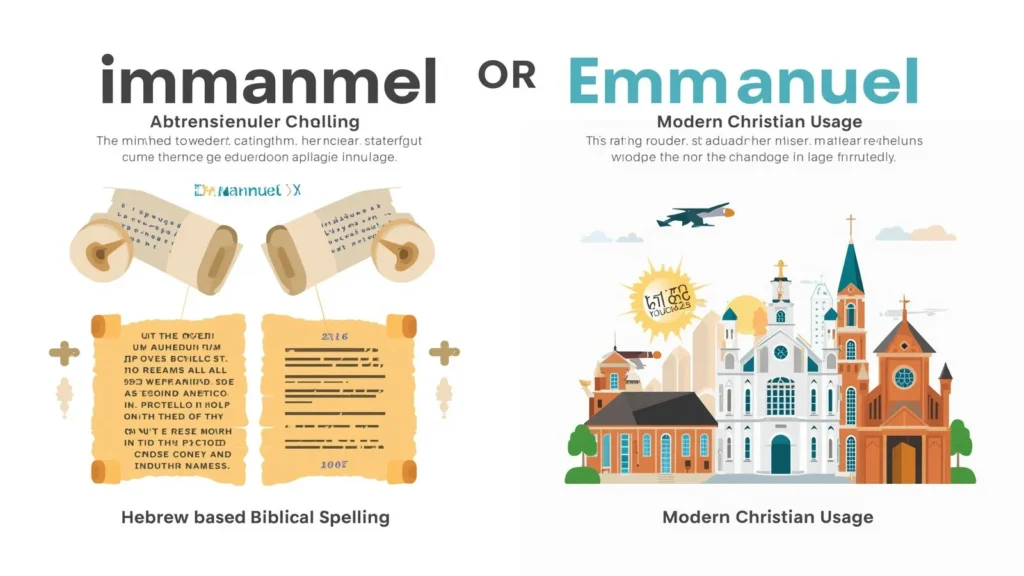

Many people search for Immanuel or Emmanuel because they notice both spellings being used in religious texts, church names, schools, books, and personal names. At first glance, the two words appear different. However, they share the same origin and meaning.
The confusion often comes from translations. Some Bible versions use Immanuel, while many modern organizations and individuals prefer Emmanuel. Since both spellings are widely used, people naturally wonder which one is correct.
Understanding Immanuel or Emmanuel is important for students, writers, Bible readers, researchers, and anyone interested in language history. The distinction is not about right versus wrong. Instead, it is about translation traditions, historical development, and modern preferences.
This guide explains the meaning, biblical background, historical development, pronunciation, real world usage, common mistakes, examples, and practical differences between Immanuel and Emmanuel in simple language.
Quick Overview
Immanuel and Emmanuel have the same meaning.
Both names mean God is with us.
Immanuel is often found in Bible translations.
Emmanuel is commonly used in modern names and institutions.
Both spellings are considered correct.
Definition of Immanuel
Immanuel is a biblical name derived from Hebrew.
The name combines words that mean:
- God
- With
- Us
Together, the meaning becomes:
God is with us.
The spelling Immanuel appears in several English Bible translations, especially in passages connected to prophecy.
Many theologians and Bible scholars prefer this spelling when discussing biblical texts.
Definition of Emmanuel
Emmanuel is another accepted spelling of the same name.
The meaning remains exactly the same:
God is with us.
Over time, Emmanuel became popular through Greek, Latin, French, and other language traditions.
Today, Emmanuel is commonly used as:
- A personal name
- A church name
- A school name
- An organization name
It is the spelling many people encounter most often in everyday life.
Key Difference Between Immanuel or Emmanuel
The primary difference is spelling tradition rather than meaning.
Quick Comparison Table
| Feature | Immanuel | Emmanuel |
|---|---|---|
| Meaning | God is with us | God is with us |
| Biblical Origin | Hebrew based spelling | Greek and Latin influenced spelling |
| Bible Usage | Common in many translations | Sometimes used in modern translations |
| Modern Names | Less common | More common |
| Church Names | Common | Very common |
| Correctness | Correct | Correct |
Neither spelling changes the meaning.
Visual Comparison of Immanuel or Emmanuel


Both spellings point to the same historical and religious meaning. The difference mainly reflects translation and language traditions.
Biblical Origin of Immanuel
The name Immanuel originates from ancient Hebrew.
It appears in the Old Testament as part of a prophecy.
The name symbolizes God’s presence with His people.
Biblical scholars often emphasize that the original Hebrew form is closer to Immanuel.
Because of this, many Bible translations preserve the spelling Immanuel when quoting prophetic passages.
Emmanuel in Christian Tradition
As Christianity spread through different cultures, the name passed through several languages.
These included:
- Greek
- Latin
- French
- English
During this process, Emmanuel became a common spelling.
Many churches adopted Emmanuel as their preferred version because it aligned with historical Christian traditions.
Today, countless churches around the world use Emmanuel in their names.
Historical Development of the Name
Language changes over time.
Names often develop multiple accepted spellings.
The journey of this name followed a similar path.
Hebrew Stage
Immanuel
Greek Influence
Modified pronunciation and spelling
Latin Influence
Further adaptation
Modern Usage
Emmanuel became increasingly common
Therefore, both spellings survived and continue to be used today.
Pronunciation Differences
Interestingly, pronunciation differences are usually very small.
Most English speakers pronounce both names almost identically.
Examples:
- Immanuel
- Emmanuel
In everyday conversation, many people cannot distinguish between them based solely on sound.
This contributes to the ongoing confusion.
Usage in Bible Translations
Different Bible translations use different approaches.
Some translations favor Immanuel because it reflects the Hebrew source more directly.
Others may use Emmanuel in notes, references, or modern adaptations.
Common Observation
Biblical discussions often use Immanuel.
Modern church branding often uses Emmanuel.
Real World Examples
Example One
A Bible study group discusses the prophecy of Immanuel.
Example Two
A church is named Emmanuel Community Church.
Example Three
A student named Emmanuel attends a Christian school.
Example Four
A theological article references Immanuel when discussing biblical texts.
All examples are correct within their contexts.
Second Visual Comparison Section


5
These examples show how both spellings appear in religious education, churches, and personal names.
Why Both Spellings Exist
Many English words and names have multiple accepted spellings because they pass through different languages.
Examples include:
- Color and colour
- Theater and theatre
- Isaiah and Esaias in historical texts
Similarly, Immanuel and Emmanuel developed through different translation pathways.
As a result, both spellings became accepted.
Common Uses of Immanuel
Immanuel often appears in:
- Biblical studies
- Theology books
- Religious education
- Scriptural discussions
- Bible commentaries
Scholars frequently choose this spelling when emphasizing the Hebrew origin.
Common Uses of Emmanuel
Emmanuel commonly appears in:
- Personal names
- Church names
- School names
- Organizations
- Modern Christian literature
This spelling dominates in many contemporary settings.
Advantages of Using Immanuel
Closer to Hebrew Origin
Many scholars prefer it for biblical accuracy.
Common in Theology
It is frequently used in religious studies.
Historical Significance
It reflects ancient scriptural traditions.
Advantages of Using Emmanuel
More Familiar
Many people recognize this spelling immediately.
Common in Modern Culture
It appears frequently in names and institutions.
Widely Accepted
It is popular across many countries.
Common Mistakes When Comparing Immanuel or Emmanuel
Mistake One
Thinking one spelling is completely wrong.
Correction:
Both spellings are correct.
Mistake Two
Assuming they have different meanings.
Correction:
Both mean God is with us.
Mistake Three
Believing Emmanuel is a modern invention.
Correction:
It has existed for centuries.
Mistake Four
Assuming Immanuel and Emmanuel refer to different people.
Correction:
They refer to the same biblical name.
Regional and Global Usage
Different regions show different preferences.
United States
Both spellings appear regularly.
United Kingdom
Both versions are recognized.
Europe
Emmanuel is often more common.
Religious Publications
Immanuel frequently appears in theological works.
Churches Worldwide
Emmanuel is often preferred in organization names.
Related Biblical Names and Concepts
Several names carry spiritual meanings similar to Immanuel and Emmanuel.
Examples include:
- Isaiah
- Gabriel
- Michael
- Daniel
- Nathaniel
Like Immanuel and Emmanuel, these names have deep historical and religious significance.
The Meaning Behind God Is With Us
The phrase God is with us carries powerful symbolic meaning.
For believers, it represents:
- Divine presence
- Guidance
- Protection
- Comfort
- Faith
This spiritual significance explains why the name remains popular after thousands of years.
Third Visual Comparison Section


6
The enduring popularity of both spellings comes from their deep religious and historical meaning.
Beginner to Advanced Understanding
Beginner Level
Immanuel and Emmanuel mean the same thing.
Intermediate Level
The difference comes from translation traditions.
Advanced Level
Immanuel reflects a Hebrew based spelling, while Emmanuel became popular through Greek, Latin, and later Christian traditions.
Both remain valid and widely accepted.
Academic and Religious Writing
Writers often choose the spelling based on audience.
Academic Theology
Immanuel is frequently preferred.
Church Publications
Emmanuel is often preferred.
General Writing
Either spelling may be acceptable depending on context.
Consistency is usually more important than the specific choice.
Exercises With Answers
Question One
Do Immanuel and Emmanuel have the same meaning?
Answer: Yes.
Question Two
What does the name mean?
Answer: God is with us.
Question Three
Which spelling is closer to Hebrew?
Answer: Immanuel.
Question Four
Which spelling is common in modern names?
Answer: Emmanuel.
Question Five
Are both spellings correct?
Answer: Yes.
Question Six
Do they refer to different people?
Answer: No.
Question Seven
Which spelling appears often in biblical studies?
Answer: Immanuel.
Question Eight
Which spelling is common in church names?
Answer: Emmanuel.
FAQs
Is Immanuel or Emmanuel correct?
Both spellings are correct.
What does Immanuel mean?
It means God is with us.
What does Emmanuel mean?
It also means God is with us.
Is there a difference between Immanuel and Emmanuel?
The difference is mainly translation and spelling tradition.
Which spelling is biblical?
Immanuel is commonly used in biblical translations.
Why do churches often use Emmanuel?
Because it became popular through Christian traditions and modern usage.
Are Immanuel and Emmanuel the same person?
Yes, they refer to the same name and meaning.
Which spelling should writers use?
Use the spelling most appropriate for your audience and remain consistent.
Is Emmanuel more common today?
Yes, it is often more common in names and organizations.
Do scholars prefer Immanuel?
Many biblical scholars do because it reflects the Hebrew source more closely.
Conclusion
Understanding Immanuel or Emmanuel becomes easy once you know their history. Both spellings are correct, both share the same meaning, and both refer to the powerful idea of God is with us. The primary difference comes from translation traditions rather than meaning or accuracy.
Immanuel is often associated with Hebrew based biblical texts and theological discussions. Emmanuel is commonly seen in personal names, churches, schools, and modern Christian organizations. Neither spelling is wrong, and both have been used for centuries.