

Quick Answer
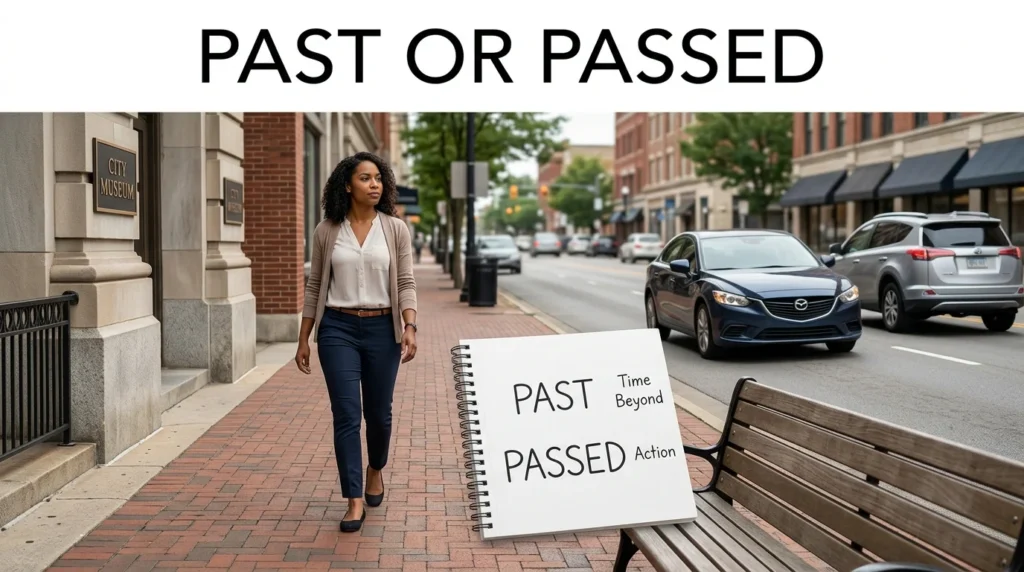
Past and passed are both correct words, but they have different meanings and grammatical jobs. Past usually refers to an earlier time, while passed is the past form of the verb pass.
Past or passed is a common English confusion because the two words sound very similar in everyday speech. Their spellings are different, and their meanings are different too.
Past can refer to an earlier time, a period that has already happened, or movement beyond a particular point. Passed, on the other hand, is usually a verb form. It can mean moved beyond something, completed a test, handed something to another person, or went by.
For example, you can say, “She walked past the store,” but you would say, “She passed the store.” The difference may look small, but choosing the wrong word can change the grammar of the sentence.
What Does Past Mean?
Past is a versatile word. It can work as a noun, adjective, preposition, or adverb.
Its basic idea is something connected with a time that has already happened or something located beyond a particular point.
Examples:
- We talked about the past.
- I learned from my past mistakes.
- She walked past the house.
- The train went past the station.
- It is half past five.
In each sentence, past has a different grammatical role, but the general idea remains connected to time, an earlier period, or movement beyond something.
What Does Passed Mean?
Passed is the past tense and past participle of the verb pass.
It describes an action that happened in the past.
Examples:
- She passed the exam.
- He passed the ball.
- The car passed our house.
- Time passed quickly.
- We passed several buildings on the way.
The word can describe movement, success, transfer, time, or many other actions.
A useful way to remember it is:
Passed = an action happened
Past = a time, position, or point beyond something
Past vs Passed: The Main Difference
The easiest way to understand the difference is to look at their roles.
| Word | Main Use | Example |
|---|---|---|
| Past | Earlier time or beyond a point | We talked about the past. |
| Passed | Past form of pass | She passed the test. |
Consider these two sentences:
He walked past the school.
Here, past tells us where he moved.
Now look at:
He passed the school.
Here, passed is the action. It tells us that he went beyond the school.
Both sentences can describe a similar event, but the grammar is different.
Past as a Noun
Past can be a noun when it refers to an earlier period of time.
Examples:
- We cannot change the past.
- She does not like talking about her past.
- His past is very different from his present.
- The past can teach us useful lessons.
- They wanted to learn more about the company’s past.
In these sentences, past refers to time that has already happened.
A common expression is:
Learn from the past.
Another is:
Leave the past behind.
Past as an Adjective
Past can describe something connected with an earlier time.
Examples:
- My past experiences helped me.
- The past year was difficult.
- Several past presidents attended the event.
- We discussed past mistakes.
- Her past work influenced her career.
Here, past describes a noun.
For example:
past experiences
past mistakes
past events
past years
Past as a Preposition
Past can also show movement beyond a person, place, object, or point.
Examples:
- Walk past the bank.
- Drive past the school.
- The runner moved past the finish line.
- We went past the old building.
- She looked past me.
In these sentences, past means beyond or farther than something.
This is one of the most important uses to understand when comparing past or passed.
Past as an Adverb
Past can also function as an adverb.
For example:
The car drove past.
This means the car moved beyond the speaker or another reference point.
Another example is:
The years went past quickly.
Here, past describes the movement of time.
Passed as a Verb
Passed is the past form of pass.
It is a verb, so it describes an action.
Examples:
- She passed the exam.
- He passed the ball.
- They passed the house.
- The car passed us.
- The teacher passed the papers around.
- Time passed quickly.
Whenever you are describing an action performed by a subject, passed may be the word you need.
Passed Meaning Succeeded
One very common use of passed is to say that someone successfully completed a test or examination.
Examples:
- I passed my driving test.
- She passed the final exam.
- He passed the math test.
- They passed the certification exam.
Here, passed means successfully met the required standard.
Do not write:
I past my exam.
That spelling is incorrect.
The correct sentence is:
I passed my exam.
Passed Meaning Moved Beyond Something
Passed can also describe physical movement.
Examples:
- The car passed the truck.
- We passed the school on our way home.
- She passed me in the hallway.
- The runner passed the other athlete.
- The bus passed our stop.
Here, passed describes the action of moving beyond someone or something.
Past or Passed in Time Expressions
The two words can appear in sentences about time, but they do different jobs.
For example:
It is five minutes past six.
Here, past means after six o’clock.
You would not write:
It is five minutes passed six.
That changes the grammar and does not express the standard time phrase.
Now consider:
Five minutes passed before she arrived.
Here, passed is a verb. It means five minutes went by.
This is a very useful contrast:
Five minutes past six.
Five minutes passed.
The first describes time on a clock. The second describes time moving by.
Past or Passed With Walk
The words are often confused when describing someone walking.
Correct examples include:
She walked past the store.
and:
She passed the store.
Both can be grammatically correct, but the structure is different.
In the first sentence, walked is the main verb and past shows movement beyond the store.
In the second sentence, passed is the main verb.
Another example:
He walked past me.
You could also say:
He passed me.
The first focuses on walking beyond you. The second uses pass as the main action.
Past or Passed With Drive
The same difference appears with driving.
We drove past the restaurant.
Here, past follows the verb drove.
You could also say:
We passed the restaurant.
Here, passed is the verb.
Both sentences can describe the same general movement.
The grammar simply changes.
Past or Passed With Time
This is another area where people often make mistakes.
Correct:
Time passed quickly.
Here, passed is the verb.
Correct:
We talked about the past.
Here, past is a noun.
Correct:
The past few years have been challenging.
Here, past describes a period of earlier time.
Correct:
It is ten minutes past noon.
Here, past describes the time on a clock.
These examples show why you should look at the whole sentence instead of choosing the word based only on sound.
Past or Passed an Exam
When talking about successfully completing an exam, use passed.
Correct:
She passed the exam.
Incorrect:
She past the exam.
The reason is simple: passed comes from the verb pass.
You can also use:
- passed the test
- passed the course
- passed the driving test
- passed the final exam
- passed the certification test
For example:
He studied every night and passed the exam.
Past or Passed Away
The phrase passed away is a polite expression meaning that someone died.
For example:
Her grandfather passed away last year.
Here, passed is the verb.
Do not write:
Her grandfather past away last year.
The correct form is:
Her grandfather passed away last year.
This is one of the most important fixed expressions involving passed.
Past or Passed in Everyday Conversation
Both words appear frequently in normal conversation.
You might say:
I saw him in the past.
Or:
I passed him on the way home.
You might also say:
We drove past your house.
Or:
We passed your house.
The meaning and structure depend on what you want to express.
When in doubt, ask yourself whether you are describing a time or position or an action.
Past or Passed in Professional Writing
Both words are common in business and professional writing.
Examples with past:
- The company has faced challenges in the past.
- Please review your past records.
- We analyzed past sales data.
- The past quarter showed strong growth.
Examples with passed:
- The proposal passed the review stage.
- The candidate passed the required test.
- The document was passed to the legal team.
- Several weeks passed before the project began.
The context usually makes the correct choice clear.
Common Mistakes With Past and Passed
One of the most common mistakes is writing past when you need the verb passed.
Incorrect:
She past the test.
Correct:
She passed the test.
Another common mistake happens with movement.
Incorrect:
We walked passed the store.
Correct:
We walked past the store.
The difference is important because walked is already the verb. You need past to describe movement beyond the store.
Another mistake is:
Time past quickly.
Correct:
Time passed quickly.
Here, passed is the verb describing what time did.
How to Remember Past vs Passed
A simple memory trick can make this much easier.
Think of passed as an action.
It comes from the verb pass:
pass → passed
Examples:
- pass a test → passed a test
- pass a car → passed a car
- pass the ball → passed the ball
Think of past as a point, place, or time.
Examples:
- the past
- past mistakes
- walk past the store
- past noon
- past the house
So remember:
Passed = action
Past = time or beyond
Past and Passed in Similar Sentences
Compare these examples carefully.
Example 1
We walked past the library.
Past shows where we walked.
Example 2
We passed the library.
Passed is the main verb.
Example 3
The past was different.
Past refers to an earlier time.
Example 4
The years passed quickly.
Passed means went by.
Example 5
It is past midnight.
Past refers to time after midnight.
Example 6
Midnight passed before we noticed.
Passed is the verb.
These pairs make the difference easier to see.
Common Phrases With Past
Here are some useful expressions containing past:
In the Past
I worked there in the past.
This means at an earlier time.
Past Experience
Her past experience helped her get the job.
This means experience from an earlier period.
Past Few Days
I have been busy for the past few days.
This refers to the days immediately before now.
Half Past
It is half past three.
This means thirty minutes after three.
Past Midnight
We stayed awake past midnight.
This means later than midnight.
Walk Past
I walked past the store.
This means I moved beyond the store.
Common Phrases With Passed
Here are some useful expressions with passed:
Passed the Test
She passed the test.
She successfully completed it.
Passed Away
His uncle passed away last year.
This is a polite expression for death.
Passed By
The bus passed by without stopping.
This means it went by.
Passed the Ball
The player passed the ball to his teammate.
The ball was transferred to another player.
Time Passed
Time passed quickly.
A period of time went by.
Past or Passed in Text Messages
The same grammar rules apply in texting and casual messages.
Someone might write:
I walked past your house.
Or:
I passed your house.
If someone writes:
I past your house.
They have used the wrong word.
Likewise:
I passed my test!
is correct.
The informal nature of texting does not change the meanings of the two words.
Past or Passed in School Writing
Students often encounter this pair in essays and assignments.
Consider:
In the past, people communicated differently.
Here, past is correct because the sentence refers to an earlier period.
Now consider:
She passed the final exam.
Here, passed is correct because it describes an action.
Another example:
The car passed the school.
Again, passed is the verb.
Understanding the role of each word will help you avoid spelling mistakes in school writing.
Past or Passed: Practice Questions
Choose past or passed in each sentence.
1. She ______ the driving test on her first attempt.
Answer: passed
2. We walked ______ the old house.
Answer: past
3. The train ______ the station without stopping.
Answer: passed
4. He often thinks about his ______.
Answer: past
5. Two hours ______ before they arrived.
Answer: passed
6. It is half ______ seven.
Answer: past
7. I drove ______ the grocery store.
Answer: past
8. She ______ the message to her manager.
Answer: passed
9. The ______ few weeks have been busy.
Answer: past
10. Time ______ quickly during the vacation.
Answer: passed
A Simple Test for Choosing the Right Word
When you are unsure, try this quick method.
First, ask:
Is the sentence talking about an earlier time or something beyond a point?
If yes, past may be correct.
Examples:
the past
past noon
walk past the store
past experience
Next, ask:
Is the sentence describing something that someone did?
If yes, passed may be correct.
Examples:
passed the exam
passed the house
passed the ball
time passed
This simple check solves many past or passed mistakes.
Past or Passed: Quick Comparison
| Situation | Correct Word | Example |
|---|---|---|
| Earlier time | Past | We talked about the past. |
| Beyond a point | Past | Walk past the door. |
| Time on a clock | Past | It is ten past five. |
| Earlier experiences | Past | Her past experience helped. |
| Successful test | Passed | He passed the test. |
| Movement | Passed | The car passed us. |
| Time going by | Passed | Three hours passed. |
| Giving something to someone | Passed | She passed me the paper. |
Final Tips
Remember these simple rules:
- Past can refer to an earlier time.
- Past can describe something beyond a point.
- Passed is a form of the verb pass.
- Use passed for actions such as passing a test or passing a person.
- Use past in expressions such as the past, past noon, and walk past.
- Time passed is correct.
- Half past five is correct.
- Passed the test is correct.
- Walked past the store is correct.
- When unsure, check whether the word is describing a time or an action.
FAQs
What is the main difference between past and passed?
Past usually refers to an earlier time or something beyond a point. Passed is a form of the verb pass and describes an action.
Is it passed or past the house?
Both can be correct, depending on the sentence. You can say “We walked past the house” because walked is the verb. You can also say “We passed the house” because passed is the main verb.
Is it past the test or passed the test?
The correct phrase is passed the test when you mean that someone successfully completed it.
Is it past away or passed away?
The correct expression is passed away. It is a polite way to say that someone died.
Is it time past or time passed?
Both can be correct, but they have different uses. Time passed means that time went by. Past is used in expressions such as half past five or the past.
Conclusion
Past and passed sound very similar, but they do different jobs in a sentence. Past is connected with earlier time, a previous period, or movement beyond a point. Passed is the past form of pass and normally describes an action.
A useful way to remember the difference is to connect passed with an action. You passed a test, passed a car, or passed the ball. Connect past with time or position. You can talk about the past, walk past a store, or arrive past noon.
Once you focus on the role of the word rather than just its sound, choosing between past or passed becomes much easier.