

Quick Answer
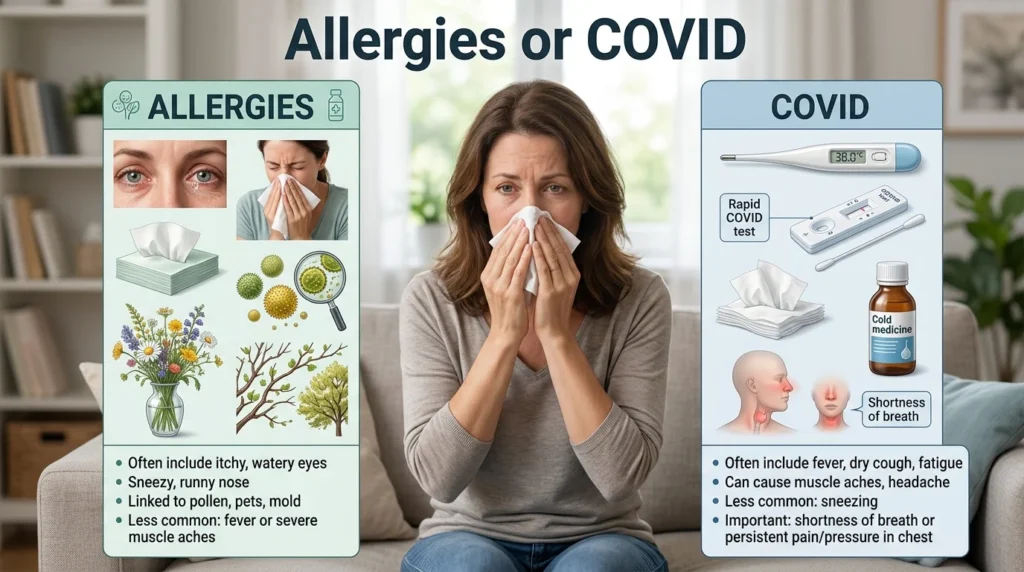
Allergies and COVID can cause some of the same symptoms, but they are different conditions. Itchy eyes and repeated sneezing often point more toward allergies, while fever, body aches, unusual tiredness, or other infection symptoms can occur with COVID. Symptoms alone cannot always tell you which one you have.
A stuffy nose, cough, headache, sore throat, and tiredness can make it hard to know whether you are dealing with allergies or COVID. The confusion is understandable because several symptoms can overlap.
The biggest difference is the cause. Allergies happen when the immune system reacts to substances such as pollen, dust, or pet dander. COVID is an infectious illness caused by the SARS-CoV-2 virus.
Some clues can help you understand the difference. Itchy or watery eyes and frequent sneezing are more typical of allergies. Fever, chills, body aches, and some digestive symptoms are more suggestive of an infection such as COVID. Still, no single symptom can confirm the cause.
What Are Allergies?
Allergies happen when the immune system reacts to something that is usually harmless to many other people.
Common triggers include:
- Pollen
- Dust mites
- Pet dander
- Mold
- Certain foods
- Some medicines
- Insect stings
Seasonal allergies often affect the nose and eyes. They can cause sneezing, congestion, a runny nose, itchy eyes, watery eyes, and other uncomfortable symptoms.
For some people, allergy symptoms return around the same time each year. Others may have symptoms whenever they encounter a particular trigger.
What Is COVID?
COVID is an infectious disease caused by the SARS-CoV-2 virus.
It can affect the respiratory system and may cause symptoms that range from mild to serious. Some people have very few symptoms, while others can become quite sick.
Possible COVID symptoms include:
- Fever
- Cough
- Sore throat
- Runny or stuffy nose
- Headache
- Fatigue
- Muscle or body aches
- Shortness of breath
- Nausea
- Vomiting
- Diarrhea
- Changes in taste or smell
Symptoms can vary from person to person. That is one reason why looking at one symptom alone is not enough to identify COVID.
Allergies or COVID: What Is the Difference?
The biggest difference is the underlying cause.
Allergies are an immune response to an allergen.
COVID is caused by a viral infection.
That difference also affects how the conditions behave.
Allergy symptoms often appear after exposure to a known trigger. For example, someone may begin sneezing after spending time around pollen.
COVID symptoms can develop after infection with SARS-CoV-2 and may include symptoms that are not typical of ordinary seasonal allergies.
A person can also have allergies and COVID at the same time. Therefore, having a history of allergies does not automatically mean that new symptoms are caused by allergies.
Allergy Symptoms That Often Stand Out
Certain symptoms are especially common with allergies.
These include:
- Itchy eyes
- Watery eyes
- Frequent sneezing
- Itchy nose
- Runny nose
- Nasal congestion
- Postnasal drainage
- Symptoms that return after exposure to a known allergen
For example, imagine that you start sneezing every time you spend time outdoors during a high-pollen period. Your eyes also become itchy and watery, but you do not develop a fever.
That pattern can fit seasonal allergies.
Still, it is not enough to diagnose the condition by yourself.
COVID Symptoms That May Stand Out
COVID can cause several symptoms that are less typical of seasonal allergies.
These may include:
- Fever
- Chills
- Muscle aches
- Significant fatigue
- Nausea
- Vomiting
- Diarrhea
- Cough
- Shortness of breath
A change or loss of taste or smell can also happen with COVID, although this symptom is less common than it was earlier in the pandemic.
The presence or absence of one symptom does not prove that you have or do not have COVID.
Can Allergies Cause a Fever?
A typical seasonal allergy does not usually cause a fever.
That makes fever a useful clue when comparing allergies with an infection. However, the absence of fever does not automatically mean that you have allergies.
Some people with COVID do not develop a fever.
For that reason, fever can provide a clue, but it cannot provide a diagnosis by itself.
Do Allergies Cause Sneezing?
Yes.
Sneezing is one of the classic symptoms associated with seasonal allergies.
A person with allergies may experience repeated sneezing along with an itchy or runny nose and watery eyes.
COVID can also cause sneezing, so sneezing alone does not rule out an infection.
The overall pattern matters more than one symptom.
Do Allergies Cause Itchy Eyes?
Yes.
Itchy or watery eyes are strongly associated with allergies.
For example:
My eyes are itchy and watery every time I spend time outside.
That pattern can fit seasonal allergies, especially when it happens around a known trigger.
COVID can sometimes cause eye-related symptoms too, so itchy eyes are not an absolute test for allergies.
Allergies or COVID With a Runny Nose
A runny or stuffy nose can happen with both conditions.
That makes this symptom less useful on its own.
With allergies, a runny nose may appear along with:
- Sneezing
- Itchy eyes
- Watery eyes
- Nasal itching
- Exposure to pollen or another allergen
With COVID, a runny or stuffy nose can occur along with symptoms such as:
- Sore throat
- Cough
- Headache
- Fatigue
- Fever
- Body aches
Because both conditions can affect the nose, you should consider the full symptom pattern rather than focusing only on congestion.
Allergies or COVID With a Cough
A cough can occur with both allergies and COVID.
Allergies may cause coughing because of irritation, mucus drainage, or airway sensitivity.
COVID can also cause coughing as part of the respiratory infection.
So, the question is not simply:
Do I have a cough?
A better question is:
What other symptoms do I have along with the cough?
A cough combined with itchy eyes and repeated sneezing may fit allergies more closely. A cough combined with fever, body aches, or marked fatigue may raise more concern for an infection.
Even then, symptoms cannot confirm the cause.
Allergies or COVID With Fatigue
Fatigue can occur with both allergies and COVID.
Someone with allergies may feel tired because symptoms interfere with sleep or make daily activities uncomfortable.
COVID can also cause fatigue, sometimes along with several other infection-related symptoms.
Because fatigue has many possible causes, it is not a reliable way to distinguish these two conditions by itself.
Allergies or COVID With a Sore Throat
A sore throat can also occur with both conditions.
Allergies may irritate the throat because of nasal drainage or ongoing irritation.
COVID can cause a sore throat as part of the infection.
If a sore throat appears together with fever, cough, body aches, or unusual fatigue, an infection becomes more important to consider.
However, the symptoms still overlap, so testing may be needed when COVID is a concern.
Allergies or COVID With Headache
Headaches can happen with both allergies and COVID.
Allergy-related congestion or sinus pressure may contribute to a headache.
COVID can also cause headaches as part of the illness.
Therefore, a headache alone cannot tell you which condition is responsible.
Look at the entire picture, including your other symptoms, recent exposure, and whether you have a known allergy trigger.
Can You Have Allergies and COVID at the Same Time?
Yes.
Having allergies does not protect someone from getting COVID.
A person can have an allergic reaction and a viral infection at the same time. This can make symptoms even harder to interpret because the two conditions may overlap.
For example, someone might have their usual seasonal allergies and then develop a fever and body aches.
In that situation, it would be unwise to assume that every symptom comes from allergies. Testing and medical advice may be appropriate depending on the situation.
Allergies or COVID Based on Timing
Timing can sometimes provide a useful clue.
Allergy symptoms may appear after exposure to a known trigger. Someone who reacts to pollen may notice symptoms during certain seasons or after spending time outdoors.
COVID follows an infection pattern rather than an allergen-exposure pattern.
For example, if several people in your household recently became sick and you then develop a cough and fatigue, an infectious illness deserves consideration.
Timing is helpful, but it cannot replace testing or medical evaluation.
How Testing Helps
Symptoms can overlap too much to reliably identify COVID in every case.
If you think you may have COVID, testing can help determine whether SARS-CoV-2 infection is present.
This is especially important when the result could affect treatment decisions, contact with other people, work, school, or care for someone who may be at higher risk.
A negative result does not always answer every medical question. If symptoms continue or become concerning, speak with a healthcare professional.
What Usually Helps With Allergies?
Managing allergies often starts with reducing exposure to the trigger.
For example, someone with pollen allergies may try to limit exposure during periods when pollen levels are high.
Depending on the person and symptoms, allergy treatment may include antihistamines, nasal sprays, or other medicines recommended by a healthcare professional.
The best option depends on the type and severity of the allergy.
If symptoms are frequent, severe, or affecting daily life, a healthcare professional can help identify the likely trigger and discuss treatment options.
What Should You Do If You Think You Have COVID?
If your symptoms make you suspect COVID, consider testing and follow current medical guidance.
It is also sensible to avoid exposing others when you are sick, particularly people who may be more vulnerable to severe illness.
If you have risk factors for severe COVID, contacting a healthcare professional early can be important because some treatments work best when started soon after symptoms begin.
Do not use antibiotics simply because you have symptoms that resemble a respiratory infection. Antibiotics do not treat viral infections such as COVID.
When Symptoms Need Urgent Attention
Some symptoms require prompt medical attention regardless of whether the original cause is allergies or COVID.
Seek emergency medical care for serious symptoms such as:
- Severe difficulty breathing
- Persistent chest pain or pressure
- New confusion
- Difficulty staying awake
- Other severe or rapidly worsening symptoms
Breathing problems can sometimes occur with COVID and can also occur when allergies trigger an asthma-related problem.
If you are unsure how serious your symptoms are, contacting a healthcare professional is the safest choice.
Common Mistakes When Comparing Allergies and COVID
One common mistake is assuming that a runny nose automatically means allergies.
It does not.
Another mistake is assuming that a cough automatically means COVID.
It does not.
A third mistake is using fever as the only test. Allergies usually do not cause fever, but not every person with COVID develops one.
People also sometimes assume that a familiar allergy pattern means every future episode must be allergies. That can be risky because a person can develop an infection while also having seasonal allergies.
The safest approach is to consider the full pattern and use testing when COVID is a possibility.
Simple Symptom Comparison
| Symptom | Allergies | COVID |
|---|---|---|
| Sneezing | Common | Can occur |
| Itchy eyes | Common | Less typical |
| Watery eyes | Common | Can occur |
| Runny nose | Common | Common |
| Stuffy nose | Common | Common |
| Cough | Can occur | Common |
| Sore throat | Can occur | Common |
| Headache | Can occur | Common |
| Fatigue | Can occur | Common |
| Fever | Unusual | Can occur |
| Body aches | Unusual | Can occur |
| Nausea | Unusual | Can occur |
| Diarrhea | Unusual | Can occur |
| Shortness of breath | Usually not typical, unless another breathing condition is involved | Can occur |
| Taste or smell changes | Can occur in some situations | Can occur |
This table is a general guide, not a diagnostic tool. Symptoms vary from person to person, and there can be overlap between the two conditions.
A Simple Way to Think About the Difference
Imagine two people.
The first person spends time outside during a high-pollen period. Soon afterward, they develop repeated sneezing, an itchy nose, and watery eyes. They do not have a fever or body aches.
That pattern may fit allergies.
The second person develops a cough, sore throat, headache, unusual fatigue, and fever.
That pattern may fit an infection such as COVID more closely.
However, neither example proves a diagnosis. The purpose of these patterns is only to show why some symptoms can point more strongly toward one condition than another.
Practice Questions
Question One
You have itchy, watery eyes and repeated sneezing after spending time around pollen. Which condition may fit this pattern better?
Answer: Allergies.
Itchy eyes and repeated sneezing are common allergy symptoms.
Question Two
You have a fever, body aches, cough, and significant fatigue. Should you automatically assume it is allergies?
Answer: No.
Those symptoms can occur with infections and deserve a different level of attention.
Question Three
Can a person have allergies and COVID at the same time?
Answer: Yes.
The two conditions can occur together.
Question Four
Does a runny nose prove that you have allergies?
Answer: No.
A runny or stuffy nose can occur with both allergies and COVID.
Question Five
Can symptoms alone always confirm COVID?
Answer: No.
Because COVID symptoms overlap with several other conditions, testing may be needed to confirm infection.
Allergies or COVID: What Should You Remember?
The easiest way to remember the difference is to focus on patterns rather than one symptom.
Allergies often feature:
- Sneezing
- Itchy eyes
- Watery eyes
- Runny nose
- Exposure to a known allergen
COVID can feature:
- Fever
- Cough
- Fatigue
- Headache
- Sore throat
- Body aches
- Digestive symptoms
- Shortness of breath
There is overlap, so these lists should not be treated as a diagnosis.
If COVID is possible, testing can provide more useful information than guessing from symptoms alone.
Final Tips
Keep these points in mind:
- Allergies are immune reactions to allergens.
- COVID is caused by the SARS-CoV-2 virus.
- Both can cause congestion and a runny nose.
- Both can cause coughing and fatigue.
- Itchy and watery eyes are more typical of allergies.
- Fever and body aches are more suggestive of an infection.
- Allergies usually do not cause fever.
- A person can have allergies and COVID at the same time.
- Symptoms alone cannot always identify COVID.
- Testing can help when COVID is suspected.
- Severe breathing problems require urgent medical attention.
FAQs
How can you tell if it is allergies or COVID?
Symptoms can provide clues, but they cannot always give a definite answer. Itchy eyes, watery eyes, and repeated sneezing are common with allergies. Fever, body aches, and some other infection symptoms can occur with COVID. Testing can help confirm COVID when it is suspected.
Can allergies cause a cough like COVID?
Yes. Allergies can cause coughing, especially when nasal drainage or airway irritation is involved. However, COVID can also cause a cough, so the cough itself cannot tell you which condition you have.
Are itchy eyes more likely to be allergies or COVID?
Itchy eyes are more commonly associated with allergies. COVID can sometimes cause eye symptoms, but itchy or watery eyes are a stronger clue toward allergies.
Can you have allergies and COVID at the same time?
Yes. Having seasonal allergies does not prevent you from getting COVID. The two conditions can occur together, which may make symptoms harder to interpret.
Do I need a COVID test if I think I only have allergies?
If your symptoms are unusual for your normal allergies or you have other signs that could fit COVID, testing can be useful. Since symptoms overlap, a test can provide information that symptoms alone cannot. If you are seriously ill or have risk factors for severe disease, contact a healthcare professional.
Conclusion
Allergies and COVID can look similar at first because both may cause symptoms such as congestion, runny nose, cough, headache, sore throat, and fatigue. However, they have very different causes. Allergies happen because the immune system reacts to an allergen, while COVID comes from an infection with SARS-CoV-2.
Itchy eyes, watery eyes, and repeated sneezing often fit allergies more closely. Fever, body aches, significant fatigue, and some digestive symptoms can point more toward COVID. Still, there is no single symptom that can reliably separate the two in every person. When COVID is a possibility, testing is a better way to check than relying on symptoms alone.