
Quick Answer
“Bot or not” means deciding something online is a real human or an automated program. A bot is software that performs tasks automatically, while “not” refers to real human behavior. The key difference lies in patterns, speed and authenticity of actions.
Every day, people interact online through social media, websites, and apps. However, not every account or message comes from a real person. Some are created and controlled by bots. This creates confusion and sometimes risk.
The question “bot or not” has become very important. It helps people decide they are talking to a real human or an automated system. Bots can be helpful, such as customer support chatbots. At the same time, they can also spread spam, fake news, or scams.
Because of this, understanding bot or not is useful for everyone. You use social media, run a business, or simply browse the internet, knowing the difference can protect you.
This guide explains bot or not in simple language. You will learn definitions, types of bots, detection methods, real world examples, mistakes, and practical tips.
Quick Overview
A bot is an automated program
A human shows natural behavior
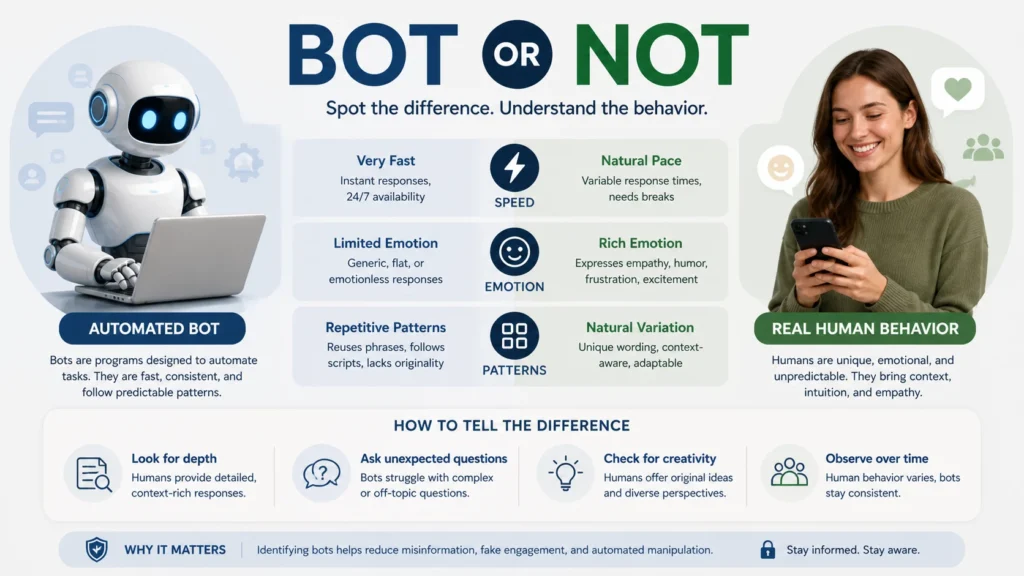
Bots work fast and repeat actions
Humans act with variation and emotion
Bots can be helpful or harmful
Key Difference Between Bot or Not


4
The main difference is behavior and control.
Bots follow programmed rules and patterns
Humans show natural and unpredictable behavior
What Is a Bot
A bot is a software program that performs tasks automatically. It can run without human control or with minimal input.
Common Types of Bots
- Chatbots for customer service
- Social media bots
- Search engine bots
- Spam bots
Bots are useful when they save time and effort. However, they can also be harmful when used for manipulation.
What Is Not a Bot
A real human user shows natural thinking and behavior. Humans respond with emotions, creativity, and variation.
Human Characteristics
- Slower response time
- Unique writing style
- Emotional expressions
- Irregular activity patterns
Types of Bots Explained
Helpful Bots
These bots assist users and improve services.
- Customer support chatbots
- Website assistants
- Search engine crawlers
Harmful Bots
These bots can cause problems.
- Spam bots
- Fake follower bots
- Scam bots
Understanding the type helps decide bot or not more clearly.
How Bots Work


Bots follow programmed instructions. They use algorithms to perform tasks quickly.
For example, a chatbot reads your message and selects a response from its system. It does not think like a human but follows patterns.
How Humans Behave Online
Humans act differently from bots.
They make mistakes
They show emotions
They change topics naturally
Because of this, human behavior is less predictable than it behavior.
Signs to Identify Bot or Not
Signs of a Bot
- Very fast replies
- Repetitive messages
- No personal detail
- Always active
And signs of a Human
- Delayed responses
- Unique replies
- Personal opinions
- Natural conversation flow
Comparison Table
| Feature | Bot | Human |
|---|---|---|
| Control | Automated | Manual |
| Speed | Very fast | Normal |
| Behavior | Repetitive | Natural |
| Emotion | None | Present |
| Activity | Constant | Variable |
Real World Examples
1 Example One Social Media
An account posts every minute with similar content. This is likely a bot.
2 Example Two Customer Support
A website chatbot answers simple questions quickly. This is a helpful bot.
3 Example Three Personal Chat
A friend replies with emotions and personal stories. This is a human.
Advantages and Disadvantages
Advantages of Bots
- Fast responses
- Saves time
- Works continuously
Disadvantages of Bots
- Lack of understanding
- Can spread spam
- May mislead users
Advantages of Humans
- Emotional intelligence
- Creativity
- Better decision making
Disadvantages of Humans
- Slower responses
- Limited availability
Common Mistakes
1 Mistake One Trusting Every Online Account
Not all accounts are human
2 Mistake Two Thinking Bots Are Always Bad
Some bots are helpful
3 Mistake Three Ignoring Patterns
Repeated actions often indicate bots
Bot Detection Tools and Methods


4
Modern systems use tools to detect bots.
- CAPTCHA tests
- Behavior analysis
- Machine learning systems
These tools help identify bot or not more accurately.
Regional and Global Usage
Bots are used worldwide in business, marketing, and technology.
Developed countries use advanced bots for automation
Developing regions use bots for customer service and communication
However, bot misuse is also a global issue.
Related Concepts
Bot vs AI
Bots can be simple or powered by AI
Spam vs Bot
Spam is unwanted content often sent by bots
Automation vs Human Work
Automation improves efficiency but lacks human touch
Beginner to Advanced Understanding
Beginner Level
Bot means automated
Human means real person
Intermediate Level
Bots follow patterns
Humans show variation
Advanced Level
AI powered bots can mimic human behavior, making detection more complex
Exercises With Answers
One Question
What is a bot
Answer An automated program
Two Question
Who shows emotions
Answer Human
Three Question
Which responds faster
Answer Bot
Four Question
Which is more natural
Answer Human
Five Question
What helps detect bots
Answer CAPTCHA and behavior analysis
FAQs
What does bot or not mean?
It means identifying an account is automated or human.
Can bots act like humans?
Yes, advanced bots can mimic human behavior.
Are all bots harmful?
No, many bots are useful.
How can I detect bot or not easily?
Look for speed, repetition, and lack of emotion.
What is a chatbot?
A chatbot is a bot designed to talk with users.
Why do bots exist?
To automate tasks and save time.
Are bots used on social media?
Yes, both for good and bad purposes.
Can bots be dangerous?
Yes, especially in scams or misinformation.
Conclusion
Understanding bot or not is essential in today’s digital world. Bots are automated programs that can perform tasks quickly and efficiently. Humans, on the other hand, show natural behavior, emotions, and creativity.
While bots can be helpful in customer service and automation, they can also be harmful if used for spam or scams. Therefore, recognizing the difference is important for online safety.
By observing behavior, response patterns, and communication style, you can identify bot or not more effectively. This knowledge helps you stay safe, make better decisions, and interact wisely online.