

Quick Answer
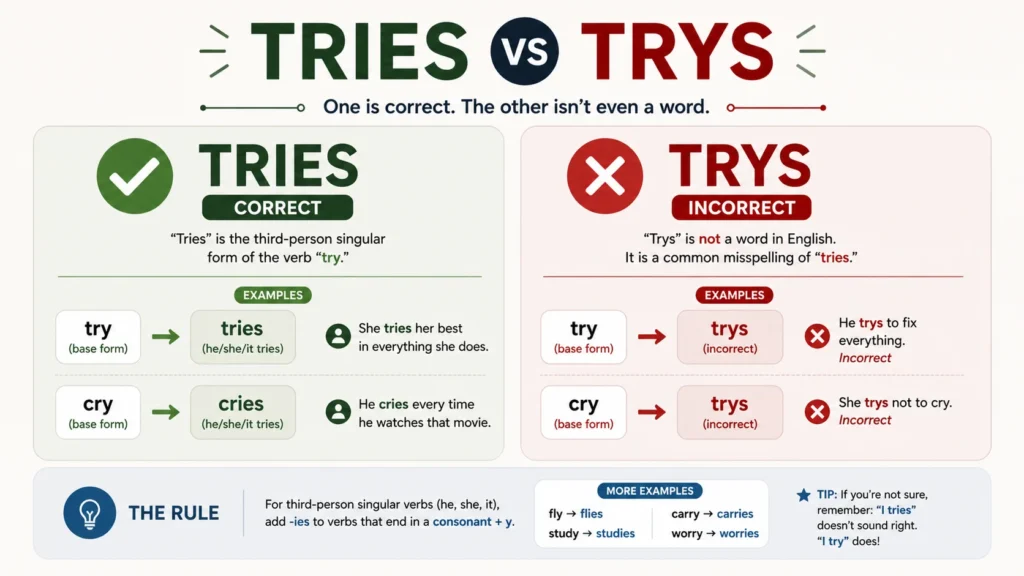
The correct spelling is tries, not trys. The verb try follows a common English rule where words ending in y change to ies when used with he, she, or it. Therefore, he tries, she tries, and it tries are correct, while trys is incorrect.
Many learners feel confused about tries or trys. The words look simple, but spelling rules make a big difference. You may see both forms online, especially in casual writing. However, only one of them is correct in standard English.
The verb try is very common. People use it every day in speaking and writing. Because of this, even small spelling mistakes can affect clarity and professionalism. Students, bloggers, and content writers often struggle with this rule.
The confusion comes from how English changes words when adding endings. Some words simply add s, while others change form. This can be tricky, especially for beginners.
Understanding tries or trys is important for correct grammar. It helps improve writing skills and avoids common mistakes. In this complete guide, you will learn spelling rules, grammar explanations, examples, real world usage, common mistakes, exercises, and much more in simple and clear language.
Quick Overview
Tries is the correct spelling
Trys is incorrect in standard English
Used with he she it
Follows y to ies rule
Key Difference Between Tries or Trys


4
The main difference is correctness.
Tries follows English grammar rules
Trys does not follow correct spelling rules
Therefore, tries is always correct in formal writing.
What Is Tries
Tries is the correct third person singular form of the verb try.
Example sentences
He tries his best
She tries to learn every day
It tries to move forward
In each example, tries is used with he, she, or it.
Why Trys Is Incorrect
Trys is not accepted in standard English grammar.
English spelling rules require changing y to ies when the word ends with a consonant plus y.
Since try ends with consonant plus y, it becomes tries.
Therefore, trys is incorrect and should not be used in formal writing.
Spelling Rule Explained
This rule applies to many English verbs.
If a verb ends in consonant plus y
Remove y
Add ies
Examples
Try becomes tries
Cry becomes cries
Fly becomes flies
If a verb ends in vowel plus y
Simply add s
Play becomes plays
Stay becomes stays
Visual Rule Explanation


4
This image helps you understand when to use ies instead of s.
Comparison Table
| Feature | Tries | Trys |
|---|---|---|
| Correct spelling | Yes | No |
| Grammar rule | Follows y to ies | Incorrect |
| Usage | Formal writing | Not accepted |
| Example | He tries | He trys |
Usage in Sentences
He tries to help others
She tries new ideas
It tries to function properly
Incorrect usage
He trys to help
She trys every day
Always use tries in writing.
Real World Examples
1 Example One Student Writing
A student writes, He tries his best in exams. This is correct.
2 Example Two Blog Writing
A blogger uses, She tries new recipes every week.
3 Example Three Common Mistake
Someone writes, He trys hard. This is incorrect.
Common Mistakes
1 Mistake One Using Trys
Correction Always use tries
2 Mistake Two Forgetting the Rule
Correction Remember consonant plus y becomes ies
3 Mistake Three Mixing Forms
Correction Use tries only with he she it
Related Comparisons
Try vs Tried
Tried is past tense
Try vs Trying
Trying is present continuous
Cry vs Cries
Same spelling rule applies
Beginner to Advanced Understanding
Beginner Level
Tries is correct
Trys is wrong
Intermediate Level
Use tries with he she it
Advanced Level
Understand spelling transformation rules in English verbs
Grammar Rule in Detail
English grammar follows patterns. One common pattern is changing y to ies.
This happens when
The word ends with consonant plus y
The subject is third person singular
This rule improves pronunciation and readability.
Why This Rule Exists
English spelling evolved to maintain sound clarity. The ies ending makes pronunciation smoother compared to ys.
For example
Tries sounds natural
Trys sounds awkward
Practice Section


4
Use these visuals to practice and improve understanding.
Exercises With Answers
One Question
He ___ to win
Answer tries
Two Question
She ___ every day
Answer tries
Three Question
Is trys correct
Answer No
Four Question
Cry becomes what
Answer cries
Five Question
Play becomes what
Answer plays
Regional and Global Usage
The rule applies in all English versions.
British English uses tries
American English uses tries
Trys is incorrect everywhere.
Advantages of Learning This Rule
Improves writing accuracy
Builds grammar confidence
Helps in exams and professional writing
FAQs
Is tries or trys correct?
Tries is correct, trys is incorrect.
Why is trys wrong?
Because English changes y to ies in this case.
When do we use tries?
With he, she, or it in present tense.
Does this rule apply to all verbs?
Only to verbs ending in consonant plus y.
Is trys used in informal writing?
Sometimes, but it is still incorrect.
What is the past form of try?
Tried
What is the continuous form?
Trying
Do all y words change to ies?
No, only consonant plus y words do.
Conclusion
Understanding tries or trys is essential for correct English writing. The correct form is tries, which follows the standard rule of changing y to ies when used with he, she, or it. On the other hand, trys is incorrect and should be avoided in all types of writing.
This rule is simple once you understand it. It also applies to many other verbs like cry, fly, and carry. Learning these patterns helps improve grammar, spelling, and confidence.
You are a student, writer, or professional, using correct forms like tries makes your writing clear and accurate. Always remember the rule, practice regularly, and avoid common mistakes.