

Quick Answer:
In texting, JS most commonly means “just saying.” It is used to share a comment or opinion without making it sound too serious or forceful.
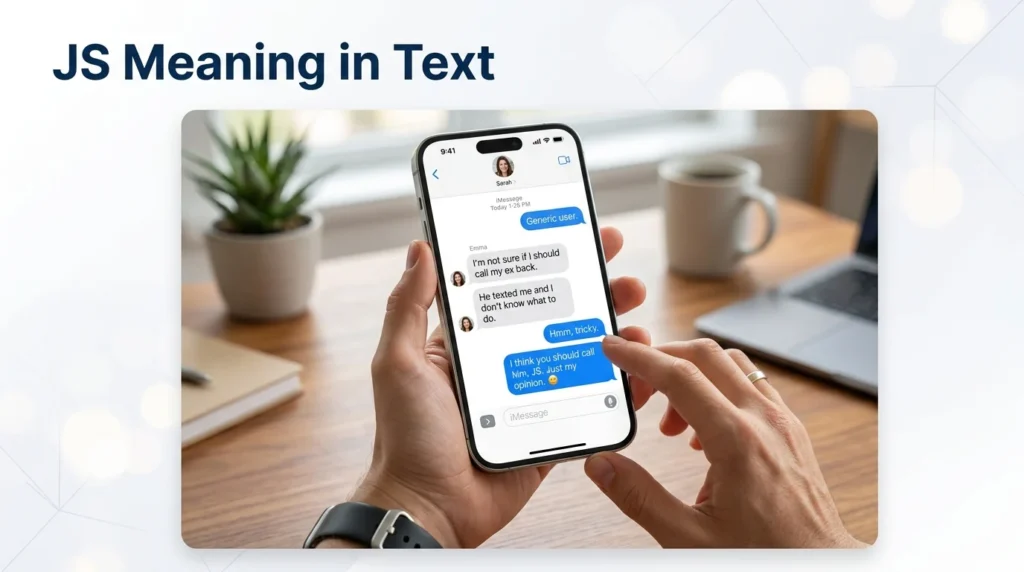
If you have seen JS in a text message, you may wonder what the abbreviation means. In casual texting, JS commonly stands for “just saying.” People use it after a comment, opinion, suggestion, or observation to make their message sound more casual. For example, “That movie was pretty long, JS” means “That movie was pretty long, just saying.” The exact meaning can depend on context, but “just saying” is the common meaning when JS appears in informal conversations.
Key Facts About JS
| Term | Meaning | Common Use |
|---|---|---|
| JS | Just Saying | Casual texting |
| Tone | Casual | Opinions and comments |
| Main purpose | Softens a statement | Informal conversations |
| Common setting | Text messages and chats | Friends and social conversations |
What Does JS Mean in Text?
JS usually means “just saying.” It is a short way to add a comment without sounding overly serious or demanding.
For example:
- “You could ask her, JS.”
- “That outfit looks better, JS.”
- “I think we should leave early, JS.”
The abbreviation can make the message feel more relaxed.
Why Do People Use JS?
People often use JS when they want to express a thought while making it clear that they are not trying to force the other person to agree.
For example:
“You might want to check the time, JS.”
This can sound softer than giving a direct command such as:
“Check the time.”
JS can therefore help keep a casual conversation from sounding too formal or forceful.
Examples of JS in Text Messages
Here are some natural examples:
“That place is expensive, JS.”
Meaning: That place is expensive, just saying.
“You should probably call him, JS.”
Meaning: You should probably call him, just saying.
“I think the blue one looks better, JS.”
Meaning: I think the blue one looks better, just saying.
“You were late again, JS.”
Meaning: You were late again, just saying.
What Tone Does JS Have?
The tone of JS depends on the message around it. It can sound friendly, casual, playful, or slightly blunt.
For example, “That was a good idea, JS” can sound harmless and friendly. On the other hand, “You could have told me earlier, JS” may sound like a mild criticism.
The abbreviation itself does not determine the emotion. The surrounding words and conversation matter.
JS vs TBH vs IMO
These abbreviations can appear in similar conversations, but their meanings are different.
| Abbreviation | Meaning | Main Purpose |
|---|---|---|
| JS | Just Saying | Adds a casual comment |
| TBH | To Be Honest | Introduces an honest opinion |
| IMO | In My Opinion | Clearly marks a personal opinion |
For example, “TBH, I don’t like it” directly introduces an honest opinion, while “I don’t like it, JS” adds a casual statement.
Is JS Formal or Informal?
JS is informal. It works best in text messages, social media chats, comments, and conversations with friends.
It is generally not suitable for formal emails, academic assignments, business documents, or professional reports. In formal writing, spelling out the full idea is clearer.
How to Reply to JS
There is no special response required when someone uses JS. Simply respond to the actual point they made.
For example:
“You should try the other restaurant, JS.”
You could reply:
- “Yeah, that’s a good point.”
- “I might try it.”
- “I’ll think about it.”
Common Mistake With JS
One common mistake is assuming that every use of JS has the same meaning. Abbreviations can have different meanings in different online communities.
However, when JS appears in ordinary casual texting after a statement or opinion, “just saying” is a strong contextual interpretation.
FAQs
What does JS mean in texting?
JS commonly means “just saying.” It is used to add a casual comment, suggestion, or opinion.
What does JS mean at the end of a text?
At the end of a text, JS usually means “just saying.” It can make the statement sound more casual.
Is JS rude in texting?
Not necessarily. JS can sound friendly or neutral, but it may sound slightly blunt when attached to criticism.
What is the difference between JS and IMO?
JS means “just saying,” while IMO means “in my opinion.” JS often softens or casually adds a statement, while IMO directly identifies something as a personal opinion.
Can I use JS in formal writing?
It is better to avoid JS in formal writing. The full phrase is clearer and more appropriate in professional or academic communication.
Conclusion
JS commonly means “just saying” in casual text messages. People use it to add an opinion, observation, or suggestion without making the message sound overly serious.
Its tone depends on the words around it. JS can sound friendly and casual, but it can also make criticism feel slightly blunt. Understanding the complete message is the best way to interpret its meaning.
See Also More :
- WYLL Meaning in Text: The Correct Meaning, Usage and Examples Explained
- MYF Meaning in Text: The Correct Meaning, Usage and Examples Explained
- YW Meaning in Text: The Correct Meaning, Usage and Examples Explained