
Quick Answe
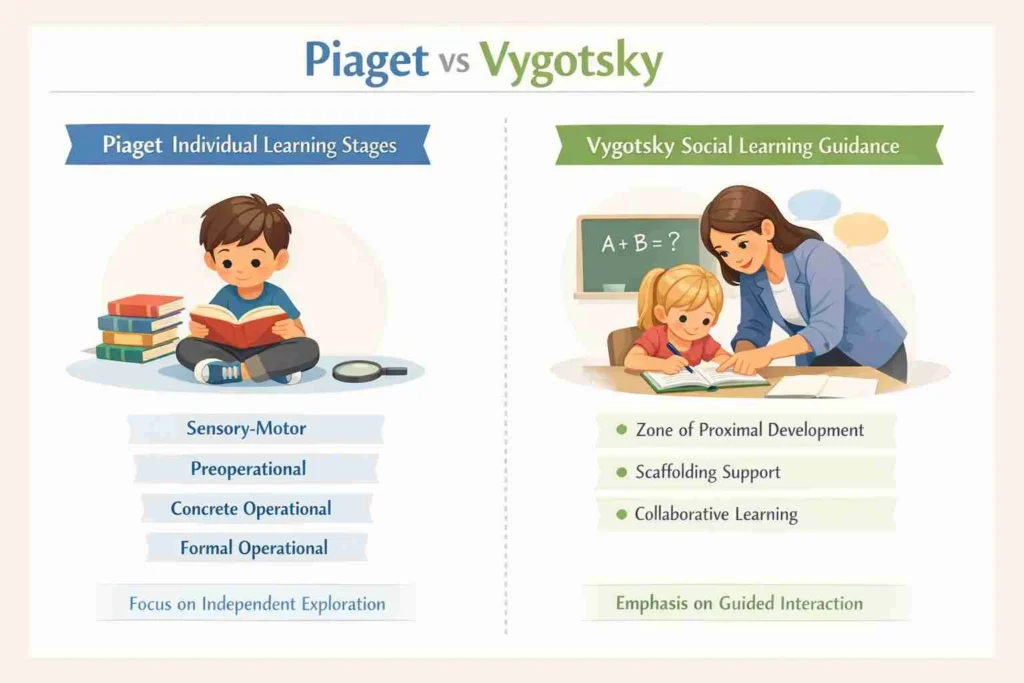
Piaget and Vygotsky are two famous psychologists who explained how children learn. Jean Piaget believed children learn through stages and independent discovery, while Lev Vygotsky believed learning happens through social interaction and guidance.
Many students, teachers, and parents compare Piaget vs Vygotsky to understand how children learn. Both psychologists studied child development, but they explained learning in different ways.
Piaget focused on how children think and grow through stages. He believed children learn by exploring the world on their own. In contrast, Vygotsky believed children learn best with help from others such as parents, teachers, or peers.
These ideas are very important in education. Teachers use them to design lessons, activities, and classroom strategies. Therefore, understanding Piaget vs Vygotsky helps improve teaching and learning.
In this guide, you will learn their theories, differences, examples, classroom use, advantages, mistakes, and much more in simple language.
Quick Overview
Piaget focused on individual learning and stages
Vygotsky focused on social learning and interaction
Piaget believed children discover knowledge
Vygotsky believed children learn through guidance
Both contributed to modern education
Key Difference Between Piaget vs Vygotsky


The main difference lies in how children learn.
Piaget believed learning happens through self discovery
Vygotsky believed learning happens through social interaction
Comparison Table
| Feature | Piaget | Vygotsky |
|---|---|---|
| Focus | Cognitive development | Social interaction |
| Learning style | Independent | Guided |
| Key idea | Stages of development | Zone of proximal development |
| Role of teacher | Observer | Guide |
| Language role | Secondary | Very important |
Who Was Jean Piaget
Jean Piaget was a Swiss psychologist who studied how children think and develop.
He introduced the idea that children go through stages of development. Each stage shows how thinking changes as a child grows.
Piaget Key Ideas
- Children learn by exploring
- Learning happens in stages
- Thinking develops over time
- Children construct knowledge
Who Was Lev Vygotsky
Lev Vygotsky was a Russian psychologist who focused on social learning.
He believed that children learn through interaction with others. Parents, teachers, and peers help children understand new ideas.
Vygotsky Key Ideas
- Learning is social
- Language is important
- Guidance improves learning
- Culture influences thinking
Piaget Theory Explained
Piaget divided learning into stages.
Sensorimotor Stage
Children learn through senses and movement
Preoperational Stage
Children begin to use language and imagination
Concrete Operational Stage
Children think logically about real objects
Formal Operational Stage
Children think abstractly and solve problems
Each stage builds on the previous one.
Vygotsky Theory Explained
Vygotsky introduced key concepts.
Zone of Proximal Development
This is the gap between what a child can do alone and what they can do with help.
Scaffolding
Teachers provide support to help children learn new skills. Over time, support is reduced.
Social Interaction
Learning happens through communication and collaboration.
Main Differences Explained
Piaget believed children learn alone
Vygotsky believed children learn with others
Piaget focused on stages
Vygotsky focused on continuous learning
And piaget saw teachers as observers
Vygotsky saw teachers as guides
Role of Teachers in Piaget vs Vygotsky
In Piaget theory
Teachers provide materials and let children explore
In Vygotsky theory
Teachers actively guide and support learning
Therefore, teaching styles differ based on theory.
Real World Examples
One Example : Classroom Learning
A teacher lets students explore objects freely. This follows Piaget theory
Two Example : Guided Learning
A teacher helps students solve problems step by step. This follows Vygotsky theory
Three Example : Group Work
Students work together to learn. This supports Vygotsky ideas
Advantages and Disadvantages
Piaget Advantages
Encourages independence
Builds critical thinking
Supports natural development
Piaget Disadvantages
May ignore social learning
Less guidance for learners
Vygotsky Advantages
Encourages collaboration
Supports guided learning
Improves communication
Vygotsky Disadvantages
Requires active teaching
May reduce independence
Common Mistakes
1 Mistake: Thinking Theories Are Opposite
Correction Both complement each other
2 Mistake: Ignoring Social Learning
Correction Interaction is important
3 Mistake: Ignoring Development Stages
Correction Growth happens step by step
Related Comparisons
Nature vs Nurture
Individual vs Social Learning
Cognitive vs Social Development
Beginner to Advanced Understanding
Beginner Level
Piaget focuses on individual learning
Vygotsky focuses on social learning
Intermediate Level
Piaget uses stages
Vygotsky uses interaction and guidance
Advanced Level
Both theories together create balanced education systems
Regional and Practical Usage
Piaget theory is used in self learning environments
Vygotsky theory is used in classrooms and group learning
Modern education combines both approaches
Exercises With Answers
1 Question
Who focused on stages
Answer Piaget
2 Question
Who focused on social learning
Answer Vygotsky
3 Question
What is ZPD
Answer Zone of proximal development
4 Question
Which theory supports independent learning
Answer Piaget
5 Question
Which theory uses scaffolding
Answer Vygotsky
FAQs
What is the main difference between Piaget vs Vygotsky?
Piaget focuses on stages and independent learning, while Vygotsky focuses on social learning.
Which theory is better?
Both are useful and often combined in education.
What is ZPD in Vygotsky theory?
It is the gap between what a child can do alone and with help.
Does Piaget ignore social learning?
He focused more on individual learning.
Why is Vygotsky important?
He explained the role of social interaction in learning.
Do teachers use both theories?
Yes, modern education combines both.
What is scaffolding?
It is support given to help learning.
Conclusion
Understanding Piaget vs Vygotsky helps improve education and learning. Piaget focused on stages and independent discovery, while Vygotsky focused on social interaction and guidance.
Both theories have strengths and limitations. Therefore, modern teaching combines both approaches to create balanced learning environments.
By understanding these theories, teachers and parents can support children more effectively and help them reach their full potential.